
The automotive world is a fascinating ecosystem where passion meets investment, nostalgia collides with practicality, and dreams are either fulfilled or shattered by market realities.
The car collecting, certain vehicles have achieved legendary status, commanding astronomical prices and inspiring fierce bidding wars at prestigious auctions. Meanwhile, others have become automotive pariahs, languishing in forgotten corners of used car lots, dismissed by collectors and enthusiasts alike.
Understanding what makes a car desirable to collectors involves examining a complex web of factors: rarity, historical significance, performance credentials, design excellence, cultural impact, and emotional resonance.
The most coveted collector cars often represent pivotal moments in automotive history, embody groundbreaking engineering achievements, or capture the zeitgeist of their era in ways that transcend mere transportation.
In this comprehensive guide, we’ll explore five cars that collectors absolutely adore and five that they wouldn’t touch with a ten-foot pole, examining the factors that have shaped these dramatically different destinies in the automotive collector’s world.
5 Cars That Collectors Love
These exceptionally desirable vehicles feature iconic styling and legendary engineering that maintain strong collector interest through decades of automotive evolution and changing tastes.
Their thoughtful design includes timeless proportions, premium materials, and distinctive character that resists the depreciation patterns typically created by mass production and mundane execution.
From naturally aspirated engines that deliver soul-stirring soundtracks to manual transmissions that connect drivers with the mechanical experience, these remarkable automobiles continue capturing enthusiast hearts without experiencing the obscurity or neglect that destroys lesser alternatives.
Strategic production limitations and unique features ensure sustained collector demand, while proven reliability and available parts support make ownership viable for serious enthusiasts rather than just museum pieces.
These cars represent the pinnacle of their respective eras, combining engineering innovation with aesthetic beauty in ways that create lasting automotive legends.
1. Porsche 911 Turbo (930)
The Porsche 911 Turbo, internally designated as the 930, stands as one of the most revered and feared sports cars in automotive history. Produced from 1975 to 1989, this machine earned the ominous nickname “Widowmaker” due to its propensity for sudden, dramatic oversteer that could catch even experienced drivers off guard.
Yet it’s precisely this dangerous reputation, combined with its extraordinary performance and distinctive aesthetic, that has made it one of the most sought-after collector cars of the modern era.
The 930 represented Porsche’s first serious attempt at turbocharging, employing a single KKK turbocharger that produced what was then considered massive power – initially 260 horsepower in European specification.
The car’s performance was nothing short of revolutionary for its time, capable of accelerating from 0 to 60 mph in under 5 seconds when most supercars struggled to break the 6-second barrier.
However, the early turbocharging technology created significant turbo lag, meaning that power delivery was often sudden and violent, transforming the car from manageable to terrifying in an instant.
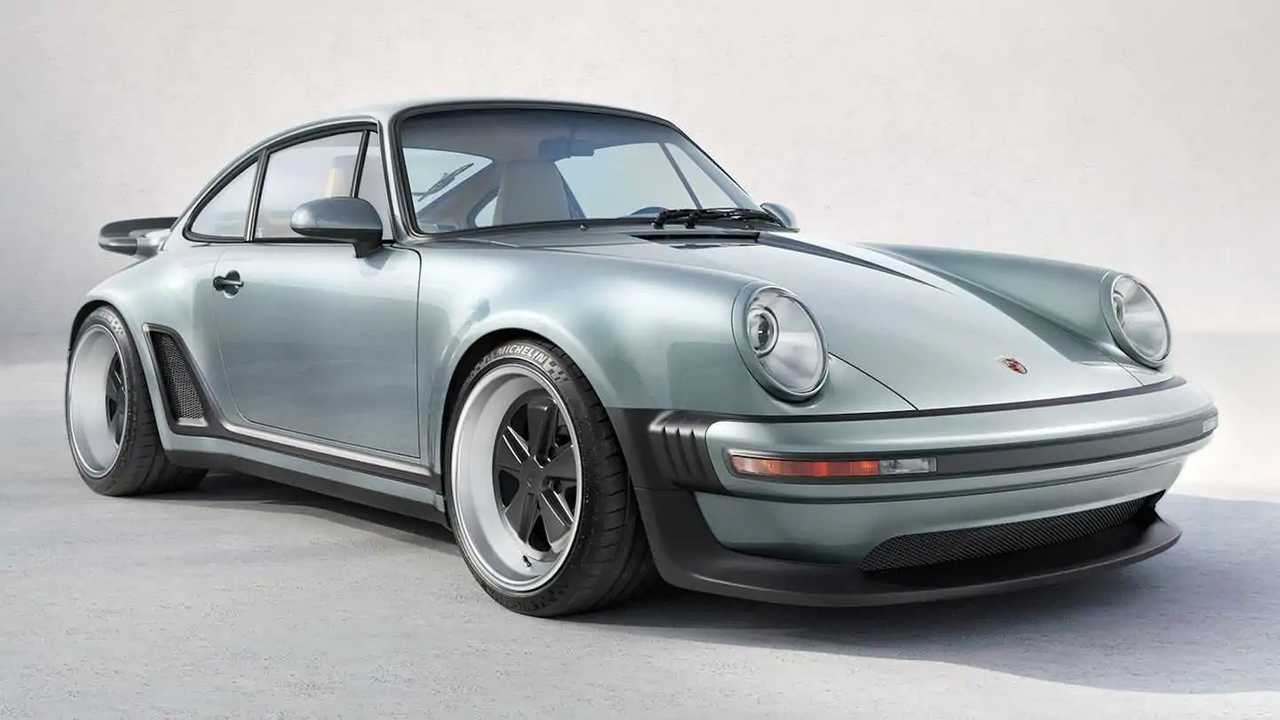
What makes the 930 particularly desirable to collectors is its role as a cultural icon of the 1980s excess era. The car’s distinctive “whale tail” spoiler and flared wheel arches gave it an unmistakably aggressive stance that perfectly captured the decade’s aesthetic.
It appeared in countless movies, adorned bedroom walls as posters, and became the ultimate status symbol for successful entrepreneurs and celebrities. The car represented raw, unfiltered performance at a time when most manufacturers were struggling with emissions regulations and fuel economy concerns.
The build quality and engineering excellence that went into the 930 also contribute to its collectibility. Unlike many supercars of its era, the 930 was designed for daily use, featuring Porsche’s legendary build quality and reliability.
The air-cooled flat-six engine, while demanding respect and proper maintenance, could deliver hundreds of thousands of miles of service when properly cared for. This combination of exotic performance and practical usability made it unique in the supercar world.
Today, pristine examples of the 930 command prices well into six figures, with particularly desirable models like the Sport Classic or Slant Nose variants reaching astronomical values.
The car’s appreciation has been driven not only by its performance credentials but also by the recognition that it represents the end of an era the last of the truly analog supercars before electronic intervention became commonplace.
Collectors value the 930’s honesty; it demands skill and respect from its driver, offering an unfiltered connection between man and machine that modern cars, for all their sophistication, cannot replicate.
2. Ferrari F40
The Ferrari F40 represents the pinnacle of automotive purity, a machine so focused on the singular goal of speed that it strips away every unnecessary element to achieve automotive perfection.
Introduced in 1987 as Ferrari’s 40th anniversary celebration, the F40 was intended to be the ultimate expression of what Ferrari could achieve when freed from the constraints of comfort, luxury, or compromise.
The result was a car that redefined what a supercar could be and established a template that manufacturers still chase today. At the heart of the F40’s appeal is its uncompromising approach to performance.
The car featured a twin-turbocharged V8 engine producing 471 horsepower, making it the first production car to exceed 200 mph. But raw power was only part of the equation.
Ferrari employed extensive use of carbon fiber, Kevlar, and aluminum to create a body that weighed just 2,425 pounds extraordinarily light by any standard, but particularly remarkable for a car of such capability. Every component was evaluated through the lens of performance, with creature comforts sacrificed in favor of speed and agility.
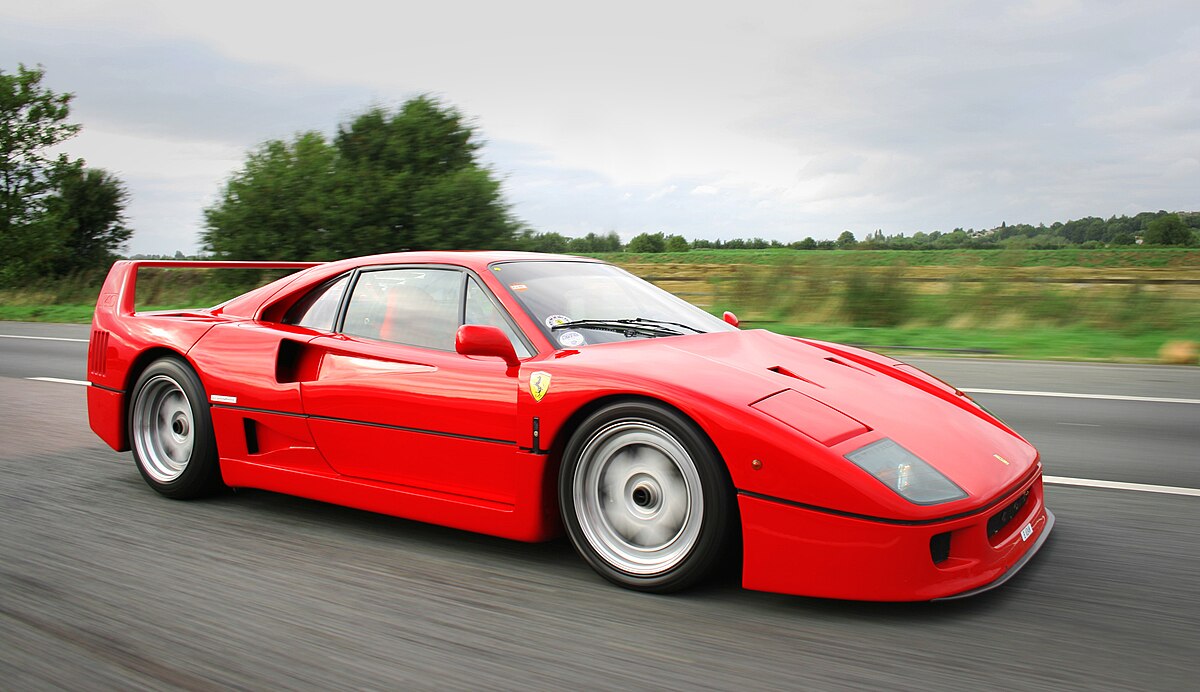
The F40’s design, penned by Pininfarina, achieved a perfect balance between form and function. Every curve, every vent, every surface served a purpose in managing airflow or reducing weight.
The massive rear wing wasn’t merely aesthetic it was a crucial component in maintaining stability at the car’s 201 mph top speed. The aggressive front splitter, side air intakes, and distinctive rear window louvers all contributed to the car’s ability to slice through the air with minimal resistance while maintaining downforce where needed.
What sets the F40 apart in the collector market is its position as the last Ferrari personally approved by Enzo Ferrari himself. The legendary founder died just months after the F40’s introduction, making this car his final statement about what a Ferrari should represent.
This historical significance cannot be overstated the F40 embodies the philosophy and vision of one of automotive history’s most important figures, making it not just a car but a piece of automotive history.
The F40’s collectibility has been further enhanced by its relatively limited production run of just 1,315 units. Unlike modern supercars that are produced in the thousands, the F40’s rarity ensures that supply will always be constrained while demand continues to grow.
The car’s reputation for reliability surprising in a machine of such extreme performance means that most examples remain in driving condition, allowing collectors to experience the car as it was intended rather than merely display it as static art. Current market values for the F40 have reached stratospheric levels, with pristine examples commanding well over $1.5 million.
The car’s appreciation has been driven by recognition that it represents a unique moment in automotive history the last of the analog supercars before electronic systems began to mediate the driving experience. For collectors, the F40 offers an unfiltered connection to automotive purity that simply cannot be replicated in the modern era.
3. Shelby Cobra 427
The Shelby Cobra 427 represents one of the most successful marriages in automotive history the combination of British engineering finesse with raw American muscle power.
Created through the vision of Carroll Shelby, this car took the lightweight, nimble AC Ace roadster and transformed it into a fire-breathing monster by installing Ford’s massive 427 cubic inch V8 engine.
The result was a machine that redefined performance expectations and created a legend that continues to collectors more than five decades after its introduction.
The Cobra’s origin story reads like automotive mythology. In 1961, Carroll Shelby, a former race driver turned entrepreneur, convinced AC Cars of Britain to provide him with Ace bodies without engines, while simultaneously persuading Ford to supply their small-block V8 engines.
The initial 289 Cobra was successful, but Shelby’s ambitions were far greater. When Ford developed their big-block 427 engine, Shelby saw an opportunity to create something truly extraordinary. The challenge was fitting this massive, powerful engine into the lightweight British chassis while maintaining the car’s essential character.
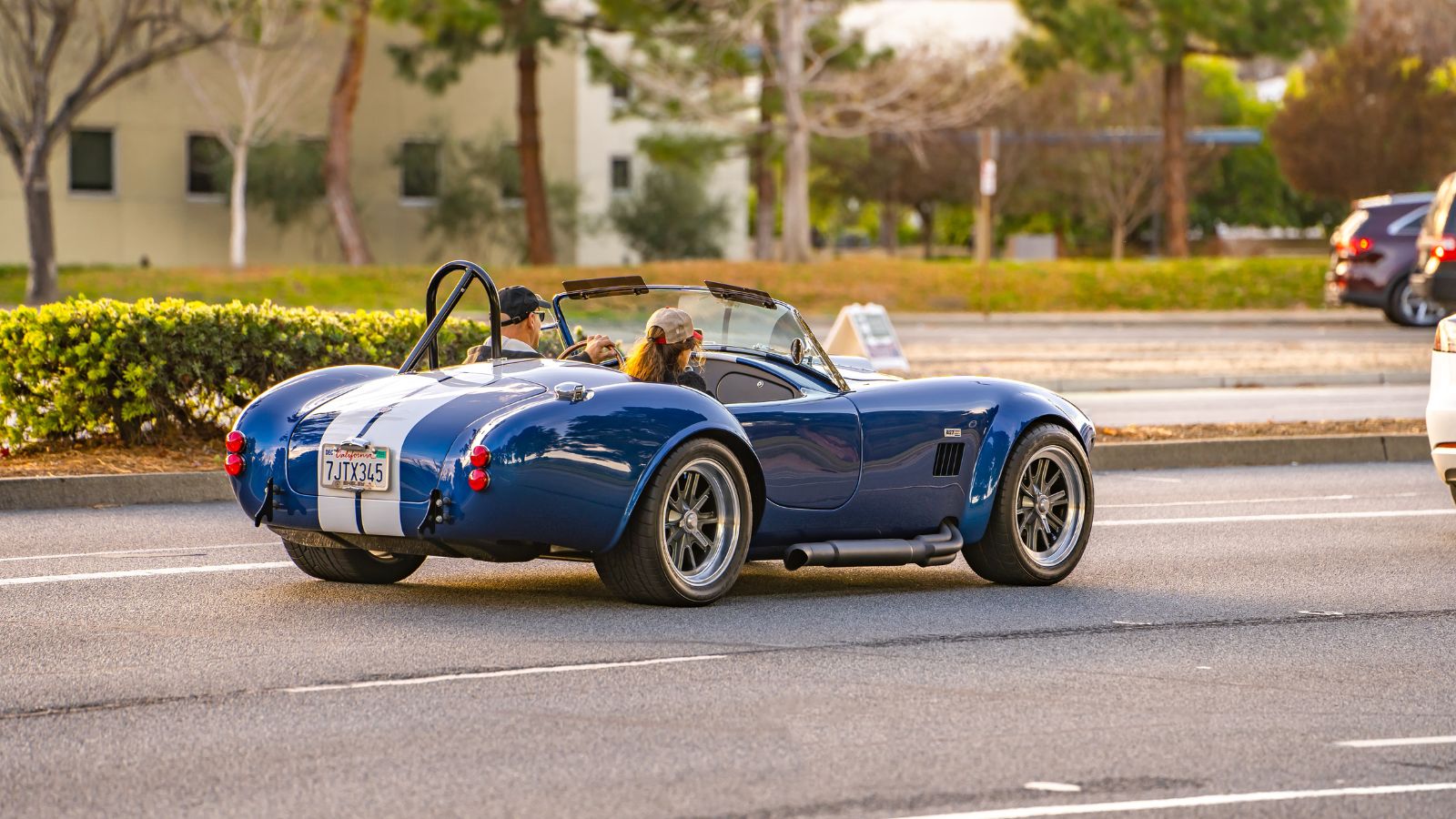
The engineering required to make this combination work was nothing short of remarkable. The original AC Ace chassis had to be extensively modified to accommodate the 427’s size and power output.
The frame was strengthened, the suspension was redesigned, and the body was widened to accommodate wider tires necessary to handle the increased power.
Despite these modifications, Shelby managed to keep the car’s weight under 2,500 pounds, creating a power-to-weight ratio that was simply staggering for its time.
Performance figures from the 427 Cobra were astronomical by any measure. The car could accelerate from 0 to 60 mph in under 4 seconds and reach a top speed exceeding 160 mph figures that were virtually unheard of in the 1960s.
More importantly, the Cobra could deliver this performance consistently, lap after lap, making it devastatingly effective in racing applications. The car dominated SCCA racing and competed successfully against Ferrari and Porsche in international competition, proving that American engineering could match the best from Europe.
Current market values for authentic 427 Cobras have reached extraordinary levels, with pristine examples commanding prices well over $2 million. The car’s appreciation reflects not only its rarity and performance but also its status as a cultural icon that represents a pivotal moment in American automotive history.
4. Lamborghini Miura
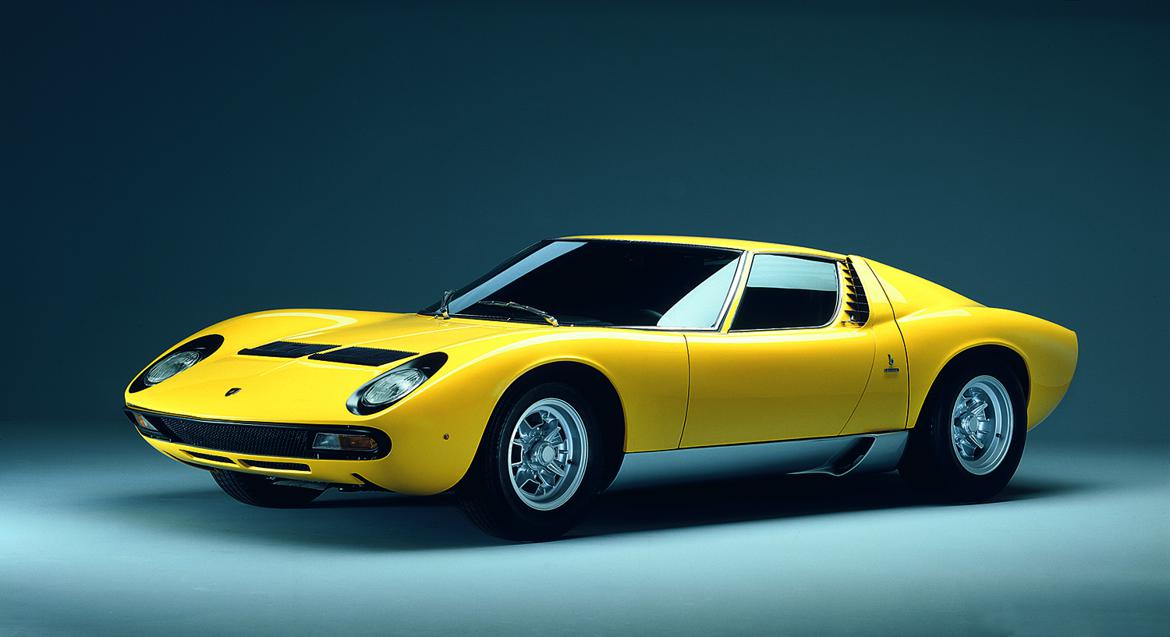
The Lamborghini Miura holds the distinction of being the world’s first true supercar, a machine that established the template that exotic car manufacturers continue to follow today.
Introduced in 1966, the Miura represented such a radical departure from conventional automotive thinking that it literally created an entirely new category of vehicle.
Its combination of mid-engine layout, stunning design, and extraordinary performance made it an instant icon that continues to be revered by collectors as one of the most significant cars ever produced.
The Miura’s development story is as remarkable as the car itself. The project began as an after-hours endeavor by three young Lamborghini engineers Gian Paolo Dallara, Paolo Stanzani, and Bob Wallace who believed that mounting the engine behind the driver would create superior handling dynamics.
They developed their concept in secret, knowing that Ferruccio Lamborghini preferred his cars to be luxurious grand tourers rather than extreme sports cars. When the chassis was finally revealed at the 1965 Turin Motor Show, the response was so positive that Lamborghini authorized full development.
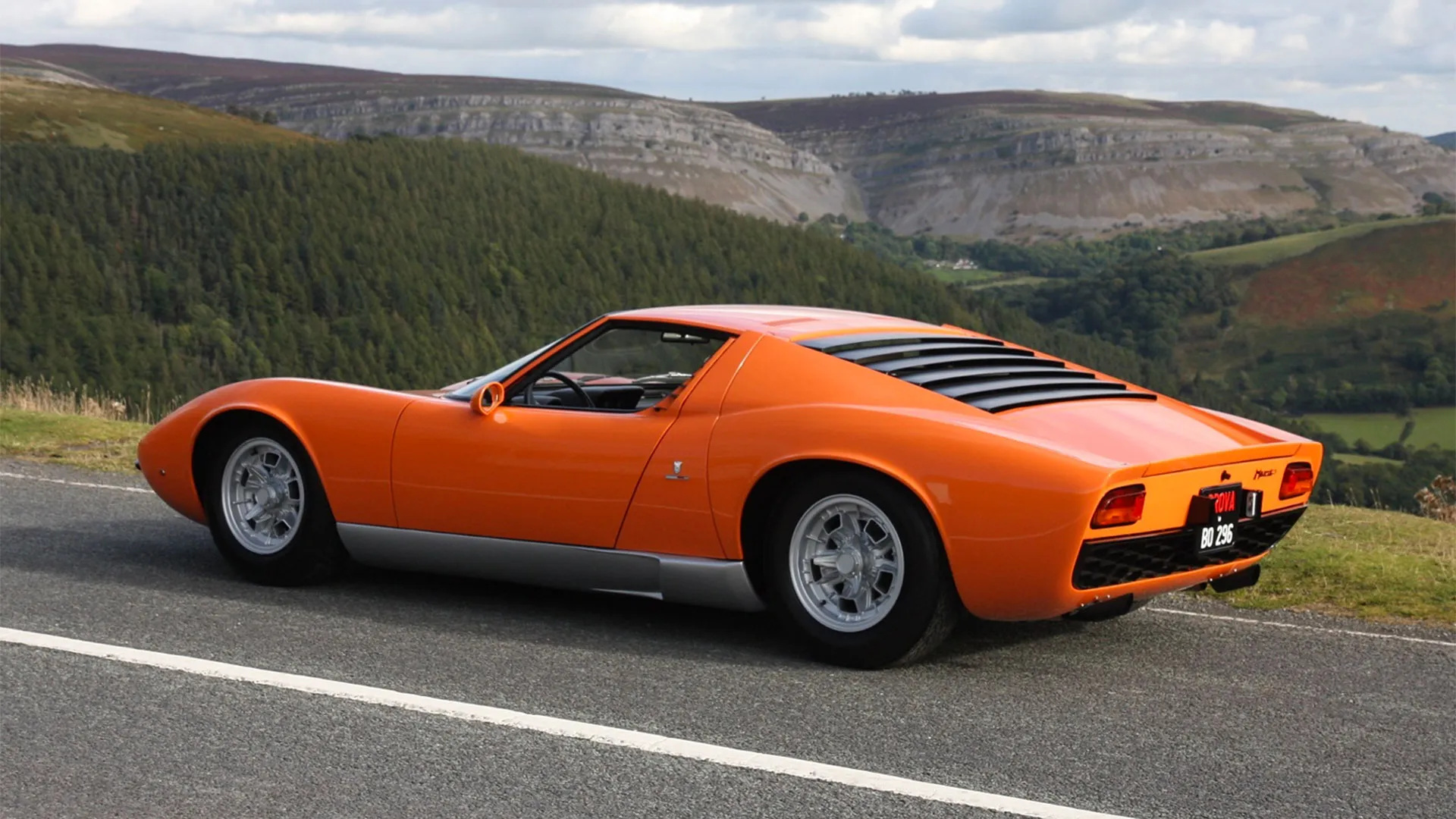
The technical innovations incorporated into the Miura were groundbreaking for their time. The mid-engine layout, now standard for supercars, was virtually unprecedented in a road car.
The engine and transmission were mounted transversely behind the cockpit, creating optimal weight distribution while keeping the car’s length manageable.
The sophisticated space frame construction provided exceptional rigidity while minimizing weight. Independent suspension at all four corners, with unequal-length control arms and coil springs, delivered handling characteristics that were revolutionary for the era.
Current market values for the Miura reflect its historical significance and continued desirability. Pristine examples command prices well into seven figures, with the most desirable SV models reaching astronomical values.
The car’s appreciation is driven by recognition that it represents a pivotal moment in automotive history the birth of the modern supercar concept that continues to drive exotic car development today.
Also Read: 12 Affordable Performance Cars With Long Lives
5. Mercedes-Benz 300SL Gullwing
The Mercedes-Benz 300SL Gullwing stands as perhaps the most universally acclaimed sports car of the 1950s, a machine that combined cutting-edge engineering, innovative design, and uncompromising performance in a package that was both technologically advanced and aesthetically timeless.
Introduced in 1954, the 300SL was the fastest production car of its era and established Mercedes-Benz as a serious competitor in the high-performance sports car market.
Its distinctive gullwing doors, space frame construction, and fuel-injected engine made it a technological tour de force that continues to influence automotive design and engineering today.
The 300SL’s development originated from Mercedes-Benz’s successful racing program in the early 1950s. The company’s W194 race car had achieved remarkable success in events like the Carrera Panamericana and Le Mans 24 Hours, demonstrating the effectiveness of the car’s innovative space frame chassis and fuel-injected engine.
When American importer Max Hoffman convinced Mercedes-Benz to produce a road-going version, the company committed to creating a car that would maintain the race car’s essential character while adding the refinement necessary for street use.
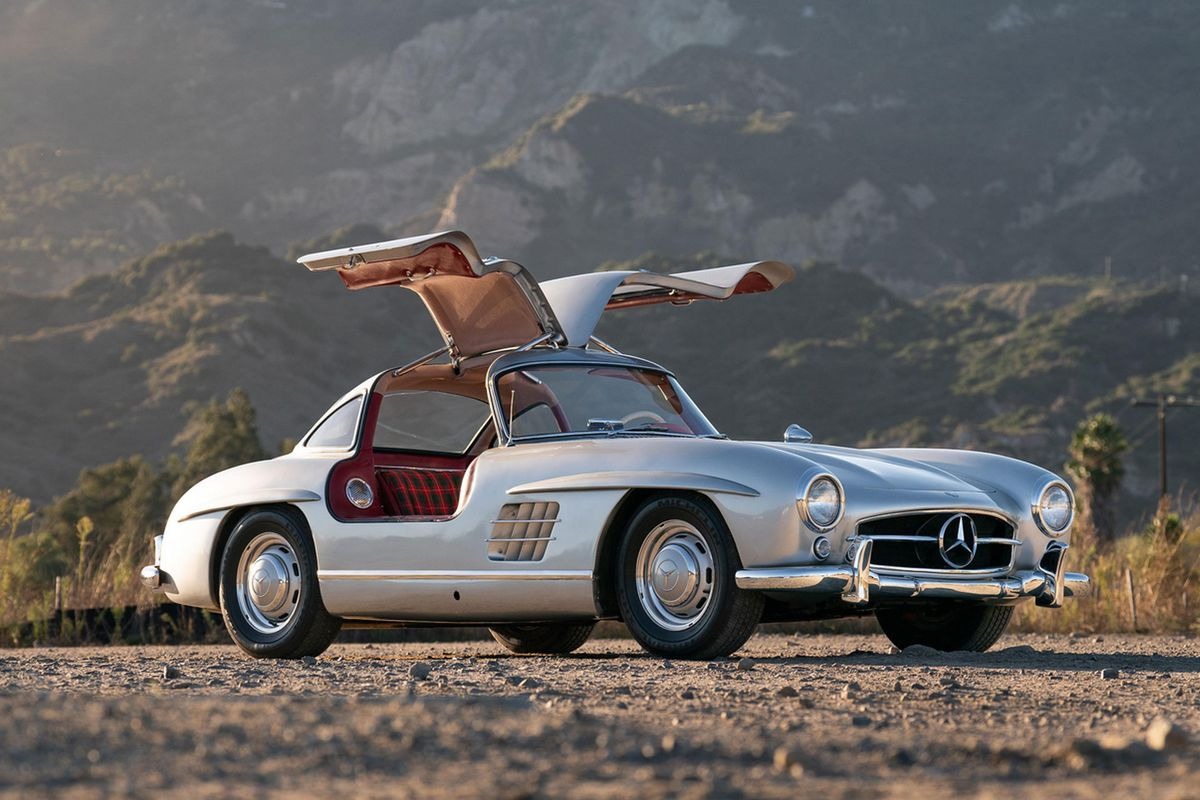
The engineering innovations incorporated into the 300SL were remarkable for any era, but were particularly impressive in the 1950s. The space frame chassis, constructed from small-diameter steel tubes, provided exceptional rigidity while minimizing weight.
However, the frame’s design created high door sills that made conventional doors impractical, leading to the adoption of the distinctive gullwing doors that gave the car its name. These doors, hinged at the roof line, not only solved a practical problem but also created one of the most iconic design elements in automotive history.
The 300SL’s engine was equally revolutionary. The 3.0-liter inline-six featured direct fuel injection – a technology that was virtually unknown in production cars at the time.
This system, adapted from aircraft engines, allowed the engine to produce 215 horsepower, making the 300SL significantly more powerful than any of its contemporaries.
The combination of advanced engine technology and lightweight construction gave the car a top speed of 161 mph, making it the fastest production car upon its introduction. Current market values for the 300SL Gullwing reflect its status as one of the most important cars ever produced.
Pristine examples regularly command prices exceeding $1.5 million, with particularly desirable models reaching even higher values. The car’s appreciation is driven by universal recognition of its historical significance, technological innovation, and timeless design excellence.
5 Cars That Nobody Wants
These catastrophically undesirable vehicles suffer from fundamental design failures and reliability nightmares that create perfect conditions for complete market rejection and accelerated depreciation.
Their uninspiring construction shows in bland styling that offends no one while exciting nobody, cheap interior materials that age poorly, and problematic mechanical systems that guarantee expensive ownership experiences.
Poor execution in critical areas destroys any collector potential these vehicles might have possessed, while widespread reliability issues create negative associations that persist decades after production ends.
These cars represent the unfortunate intersection of corporate cost-cutting and design-by-committee approaches that strip away everything that makes automobiles desirable, creating transportation appliances that fail even at basic mobility while destroying their manufacturers’ reputations and leaving owners with depreciating assets that nobody wants to buy, inherit, or even accept as gifts.
1. Pontiac Aztek
The Pontiac Aztek stands as perhaps the most universally reviled vehicle in automotive history, a machine so thoroughly despised that it has become synonymous with automotive failure.
Introduced in 2001 as Pontiac’s attempt to capture the growing crossover SUV market, the Aztek’s bizarre styling, questionable build quality, and general lack of coherent design philosophy made it an immediate laughingstock that effectively damaged the Pontiac brand beyond repair.
Even today, more than a decade after production ended, the Aztek remains automotive kryptonite in the collector car world. The Aztek’s problems began with its design philosophy, or rather, the apparent lack thereof.
General Motors attempted to create a vehicle that could serve multiple purposes family hauler, outdoor adventure vehicle, and urban cruiser but the resulting compromise satisfied none of these roles effectively.
The exterior styling appeared to be the work of multiple design teams who never communicated with each other, resulting in a collection of contradictory design elements that created visual chaos rather than coherent aesthetics.
The front end borrowed styling cues from Pontiac’s performance cars, while the rear section resembled a minivan, and the proportions suggested a vehicle that had been stretched and compressed in random directions.

The technical execution of the Aztek was equally problematic. Built on GM’s U-platform, which was shared with the Buick Rendezvous, the Aztek suffered from the typical GM cost-cutting measures of the early 2000s.
Interior materials felt cheap and flimsy, panel gaps were inconsistent, and build quality was poor even by the relaxed standards of American automotive manufacturing at the time.
The driving experience was similarly disappointing, with a poorly tuned suspension that delivered neither comfort nor handling, and a powertrain that felt underpowered despite adequate horsepower figures on paper.
Current market values for the Aztek reflect its complete lack of desirability. Even low-mileage examples struggle to command prices significantly above scrap value, and most examples are purchased purely as inexpensive transportation rather than for any intrinsic automotive merit.
The car’s depreciation curve has been relentless, and there are no signs that collector interest will ever develop. For automotive collectors, the Aztek serves as a perfect example of why some cars should be forgotten rather than preserved.
2. Chrysler PT Cruiser
The Chrysler PT Cruiser represents one of the most spectacular automotive failures of the early 2000s, a vehicle that initially generated enormous consumer interest through its distinctive retro styling but quickly revealed itself to be a poorly executed attempt to capitalize on nostalgia without delivering any of the substance that made classic cars actually desirable.
Introduced in 2000 as Chrysler’s attempt to inject personality into their lineup, the PT Cruiser’s combination of questionable build quality, poor driving dynamics, and styling that aged poorly has made it a pariah in the collector car world.
The PT Cruiser’s fundamental problem was that it prioritized style over substance to such an extreme degree that the resulting vehicle failed to excel in any meaningful way.
The retro-inspired design, which borrowed heavily from 1930s and 1940s automotive styling cues, initially attracted attention in showrooms but revealed its limitations as soon as customers began actually using the vehicles.
The tall, narrow stance that created the car’s distinctive silhouette also resulted in poor aerodynamics, awkward proportions, and a driving position that felt more like operating a delivery van than a personal automobile.
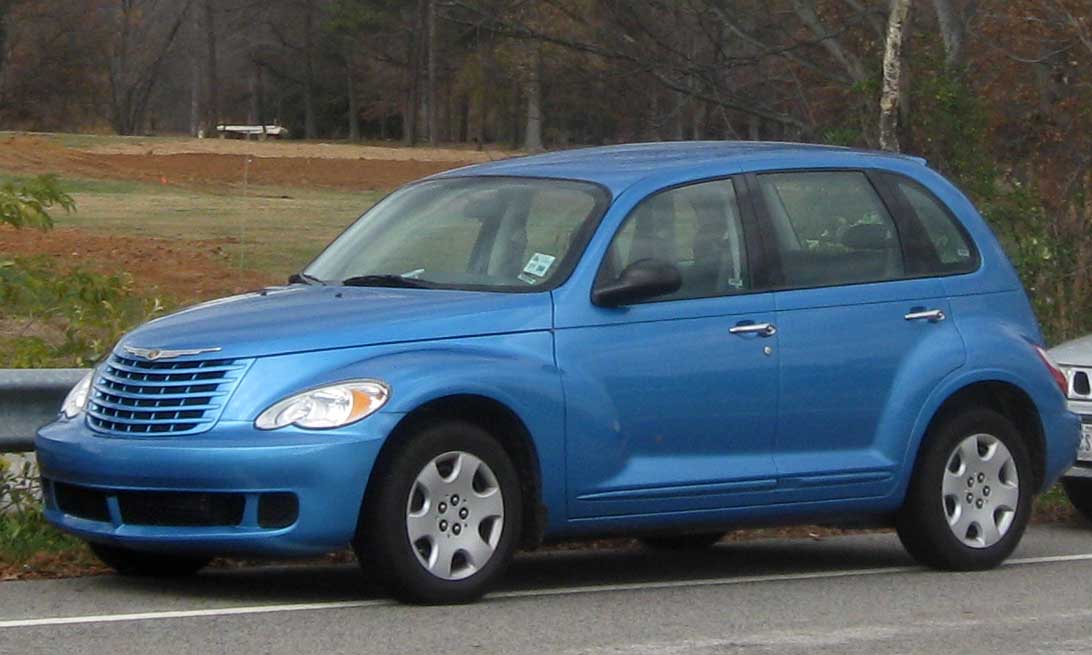
The technical execution of the PT Cruiser was equally problematic. Built on Chrysler’s PL platform, which was shared with the Dodge Neon, the PT Cruiser inherited many of that car’s mechanical shortcomings while adding additional complexity and weight.
The base 2.4-liter four-cylinder engine was adequate for the lighter Neon but felt severely underpowered in the heavier PT Cruiser. The optional turbo engine provided better performance but introduced reliability concerns that were never adequately addressed.
The suspension tuning prioritized comfort over handling, resulting in a driving experience that was neither engaging nor particularly comfortable. Current market values for the PT Cruiser reflect its complete lack of desirability among collectors and enthusiasts.
Even pristine examples command prices well below their original MSRP, and most examples sell for a fraction of their original cost. The car’s depreciation has been so severe that it serves as a textbook example of why distinctive styling alone cannot create lasting automotive value without the substance to support it.
3. Cadillac Cimarron
The Cadillac Cimarron stands as perhaps the most damaging single model in Cadillac’s history, a vehicle so fundamentally misguided that it nearly destroyed the brand’s luxury credibility and serves as the definitive example of how badge engineering can go catastrophically wrong.
Introduced in 1982 as Cadillac’s attempt to compete with imported luxury compact cars, the Cimarron was nothing more than a thinly disguised Chevrolet Cavalier with a Cadillac grille and interior trim, creating a product so transparently cynical that it alienated existing customers while failing to attract new ones.
The Cimarron’s fundamental problem was that it violated everything that the Cadillac brand represented. For decades, Cadillac had built its reputation on large, powerful, luxuriously appointed vehicles that represented the pinnacle of American automotive achievement.
The brand’s slogan, “Standard of the World,” reflected genuine engineering excellence and uncompromising quality. The Cimarron represented the complete opposite of these values it was small, underpowered, poorly finished, and obviously based on one of GM’s cheapest and most basic vehicles.
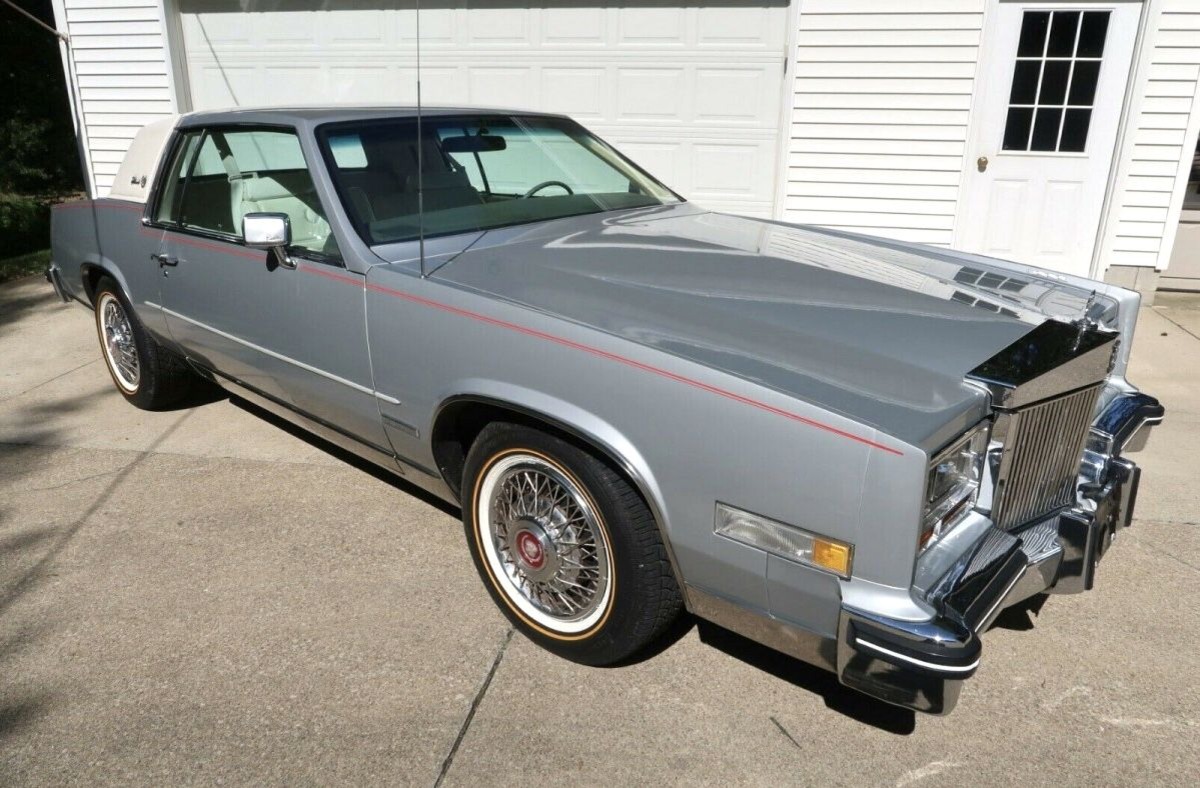
The technical shortcomings of the Cimarron were immediately apparent to anyone who examined the vehicle closely. The base engine was a 1.8-liter four-cylinder that produced just 88 horsepower, making it woefully inadequate for a vehicle wearing Cadillac badges.
The suspension was tuned for economy rather than the smooth, comfortable ride that Cadillac customers expected. Interior materials, while slightly upgraded from the Cavalier, still felt cheap and inappropriate for a luxury vehicle.
Most damaging of all, the Cimarron’s refinement was indistinguishable from its Chevrolet counterpart, making the substantial price premium impossible to justify.
Current market values for the Cimarron reflect its complete lack of desirability among collectors. Even low-mileage examples in excellent condition struggle to command prices significantly above basic transportation levels.
The car serves as a perfect example of how rarity alone cannot create collector value there must be some underlying merit, whether performance, historical significance, or cultural importance, to justify preservation and collection.
4. Chevrolet SSR
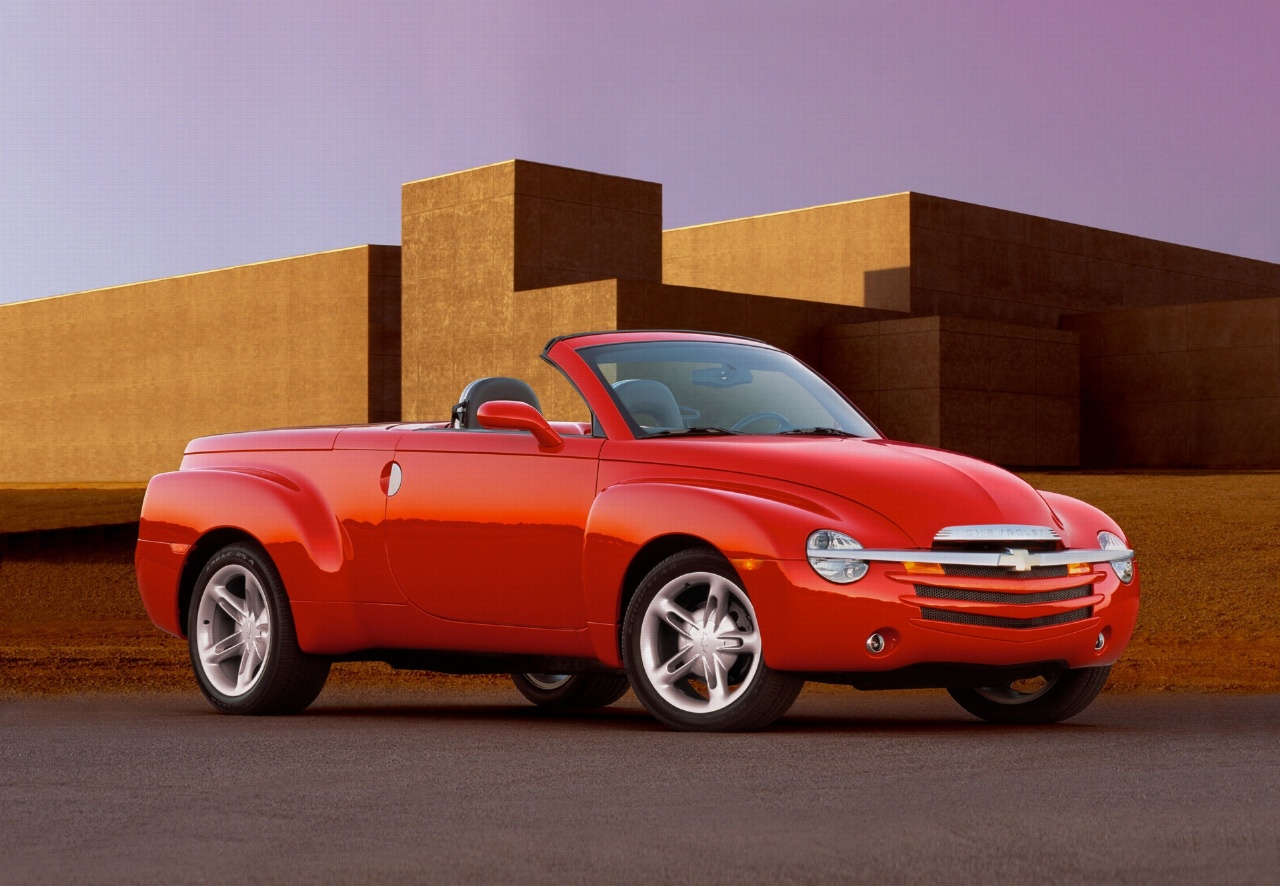
The Chevrolet SSR (Super Sport Roadster) represents one of General Motors’ most puzzling product decisions of the early 2000s, a vehicle that combined the practicality of a pickup truck with the impracticality of a convertible sports car while delivering neither the utility of the former nor the performance of the latter.
Introduced in 2003 as a retro-styled convertible pickup based on 1940s design themes, the SSR was intended to capture the excitement of GM’s concept car while providing real-world functionality. Instead, it created a vehicle that satisfied no particular need and appealed to virtually no one.
The SSR’s fundamental problem was its confused identity. GM marketed the vehicle as a pickup truck, but its tiny bed made it virtually useless for any serious hauling duties.
The company also promoted it as a performance vehicle, but its substantial weight and initially underpowered engine made it slower than far less expensive alternatives.
The convertible top was supposed to add excitement, but the complex retractable hardtop mechanism was heavy, unreliable, and compromised both cargo capacity and structural rigidity. The result was a vehicle that excelled at nothing while being expensive to purchase and maintain.
The technical execution of the SSR revealed the limitations of trying to combine incompatible vehicle types. Built on GM’s GMT360 truck platform, the SSR inherited the heavy, truck-based construction that made it unsuitable for sports car duty.
The initial 5.3-liter V8 engine produced only 300 horsepower, which was barely adequate to move the vehicle’s 4,700-pound curb weight with any enthusiasm.
The suspension, while upgraded from standard truck specification, still felt ponderous and unrefined compared to dedicated sports cars or even performance sedans.
The SSR’s styling, while initially striking, quickly revealed its limitations. The retro design themes, borrowed from 1940s Chevrolet trucks and customized hot rods, looked impressive in concept car form but appeared overstyled and cartoonish in production.
The proportions were awkward too large to be a sports car, too small to be a practical truck and the design details that worked on the concept car looked forced and artificial on the production vehicle.
The interior, while upgraded with premium materials, still felt more like a truck than the luxury sports car that the price suggested. Current market values for the SSR reflect its status as an automotive oddity rather than a collectible.
While some enthusiasts appreciate the vehicle’s uniqueness, the broader collector market has shown no interest in preserving or celebrating the SSR. The vehicle serves as a reminder that successful collector cars must excel in some meaningful way whether through performance, beauty, historical significance, or cultural impact rather than simply being different.
5. Hummer H2
The Hummer H2 represents everything that was wrong with American automotive culture in the early 2000s, a vehicle so excessive, wasteful, and impractical that it became a symbol of conspicuous consumption rather than genuine capability.
Introduced in 2002 as General Motors’ attempt to capitalize on the Hummer brand’s military heritage, the H2 was marketed as a civilian version of the legendary military vehicle but delivered none of the original’s genuine capability while amplifying all of its worst characteristics for suburban use.
The H2’s fundamental problem was that it prioritized appearance over substance to an extreme degree. While the original Hummer H1 was a genuine military vehicle adapted for civilian use complete with legitimate off-road capability and uncompromising construction the H2 was essentially a Chevrolet Tahoe dressed up in military-inspired styling cues. The result was a vehicle that looked imposing but possessed none of the authentic capability that the Hummer name suggested.
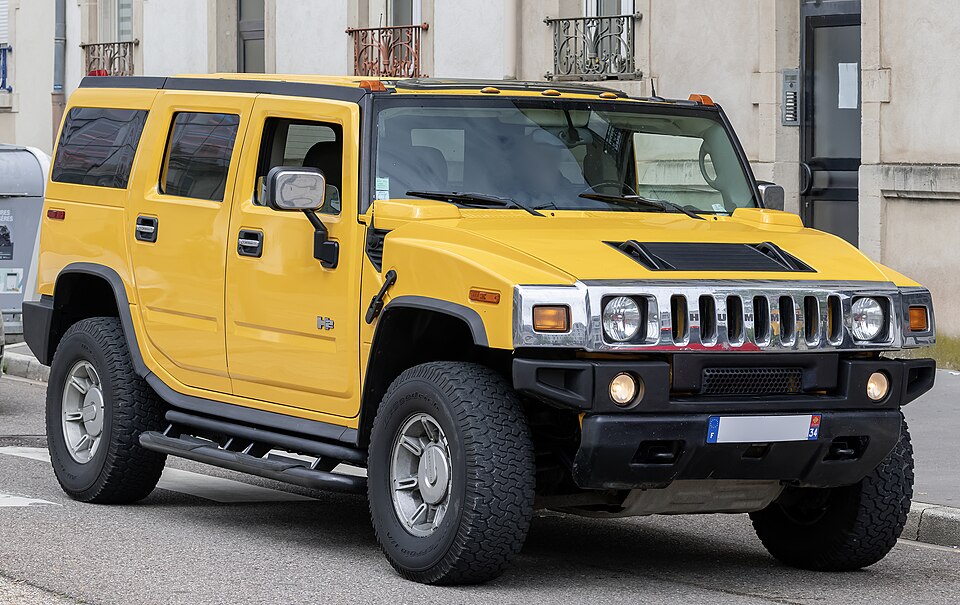
Built on GM’s GMT800 truck platform, the H2 shared its basic architecture with mainstream SUVs like the Chevrolet Suburban and GMC Yukon. While this platform was adequate for normal SUV duties, it was completely inappropriate for the serious off-road work that Hummer buyers expected.
The H2’s approach and departure angles were poor, its ground clearance was limited, and its electronic systems were not designed for the harsh conditions that genuine off-road vehicles must endure. Despite its massive size and aggressive appearance, the H2 was actually less capable off-road than many smaller, more focused vehicles.
The H2’s on-road performance was equally disappointing. The vehicle’s massive size and weight over 6,400 pounds made it cumbersome to drive and park in urban environments.
The 6.0-liter V8 engine, while producing adequate power, struggled to move the H2’s bulk with any enthusiasm, resulting in acceleration that was disappointing for such an expensive vehicle.
Fuel economy was abysmal even by SUV standards, with EPA ratings of 10 mpg city and 13 mpg highway that made the vehicle expensive to operate and environmentally irresponsible.
Current market values for the H2 reflect its complete lack of collector appeal. The vehicle serves as a perfect example of how cultural significance can be entirely negative, creating a reputation that makes preservation and collection impossible.
For automotive historians, the H2 represents a fascinating case study in how marketing can create initial demand for a fundamentally flawed product, but it offers no redeeming qualities that would make it worth preserving for future generations.
