
For decades, sedans have been the gold standard for handling dynamics, cornering precision, and driver engagement. Their lower center of gravity, balanced weight distribution, and car-like chassis have made them the preferred choice for enthusiasts who value responsive steering and nimble maneuverability.
Sport Utility Vehicles, on the other hand, were traditionally built for hauling families, towing trailers, and conquering rough terrain not carving canyon roads or attacking autocross courses.
However, the automotive world has undergone a dramatic transformation in recent years. As consumer preferences have shifted overwhelmingly toward SUVs and crossovers, manufacturers have invested billions into making these tall-riding vehicles drive more like sports sedans than ever before.
Advanced suspension technologies, sophisticated all-wheel-drive systems, active aerodynamics, and lightweight construction have helped bridge the gap between practicality and performance.
Today’s performance SUVs incorporate adaptive dampers that can firm up in milliseconds, torque-vectoring systems that actively distribute power to individual wheels for sharper cornering, and even anti-roll systems that virtually eliminate body lean.
Whether you’re looking for a practical family hauler that won’t bore you to tears on your daily commute, or you need the cargo space and weather capability of an SUV but refuse to compromise on driving dynamics, these twelve vehicles prove that you can have your cake and eat it too.
They demonstrate that the traditional handling advantage of sedans is no longer absolute, and in some cases, these SUVs might actually be more rewarding to drive than their four-door counterparts. Let’s explore the SUVs that are rewriting the rules of what high-riding vehicles can do when the road gets twisty.
1. Porsche Cayenne Turbo GT
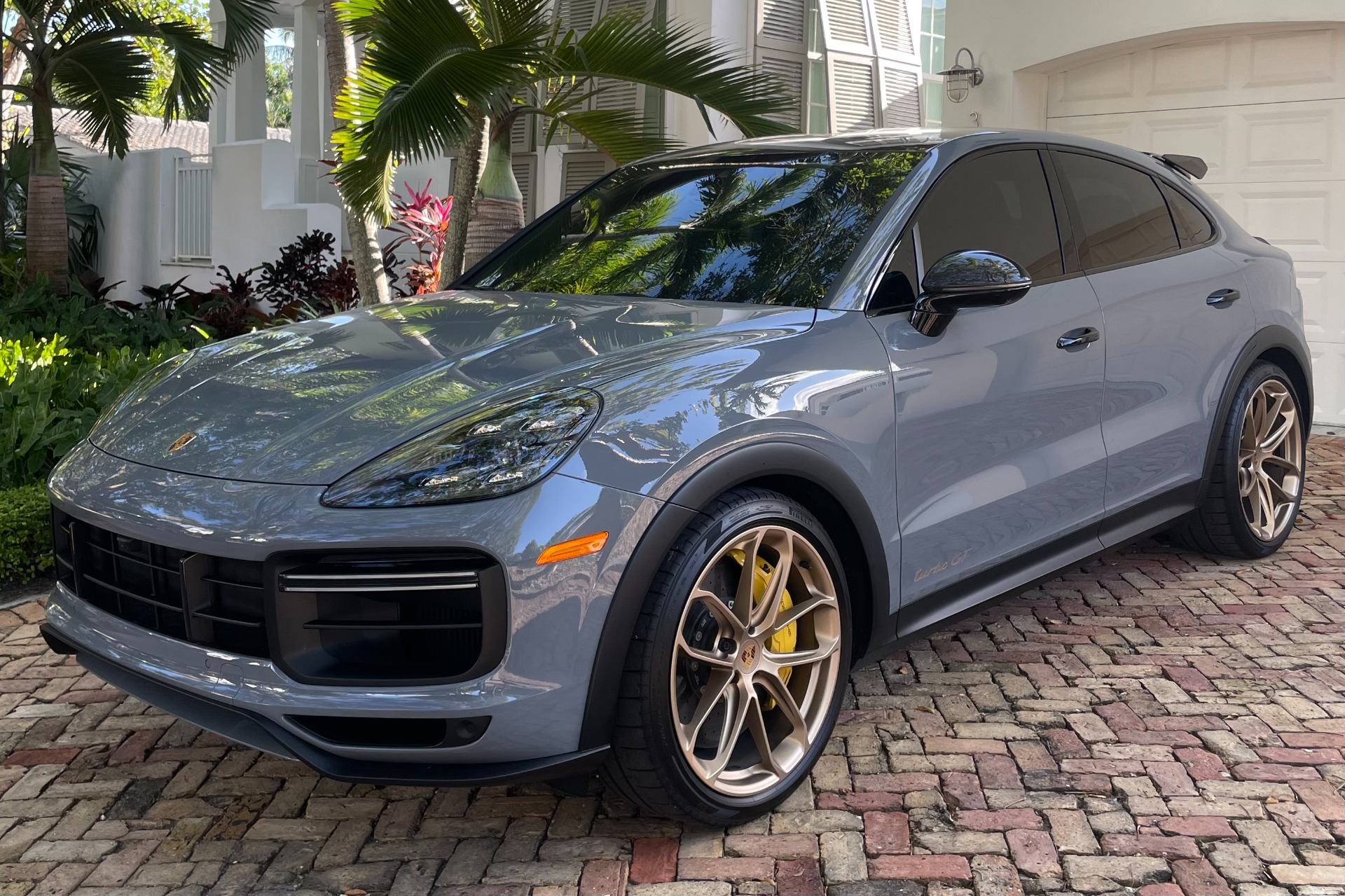
The Porsche Cayenne Turbo GT stands as the most track-focused SUV ever to wear the iconic German crest, and it handles with a level of precision that embarrasses many dedicated sports sedans.
This is no ordinary luxury SUV with a sporty badge it’s a genuine performance machine that happens to have five doors and cargo space.
Porsche engineers took the already impressive Cayenne Turbo Coupe and subjected it to the same rigorous development process they use for their legendary 911 sports cars, including extensive testing at the notorious Nürburgring Nordschleife.
Under the hood sits a 4.0-liter twin-turbocharged V8 producing a staggering 631 horsepower and 626 lb-ft of torque, propelling this two-ton SUV from 0-60 mph in just 3.1 seconds.
But raw power alone doesn’t make for exceptional handling. The Turbo GT receives exclusive chassis modifications including a 17mm lower ride height compared to the standard Cayenne Turbo, substantially stiffer springs, and specially calibrated adaptive dampers.
The rear axle features active anti-roll bars that can essentially eliminate body roll in corners, while the standard rear-wheel steering system (with up to 3 degrees of steering angle) makes the 196-inch-long SUV feel remarkably compact and agile.
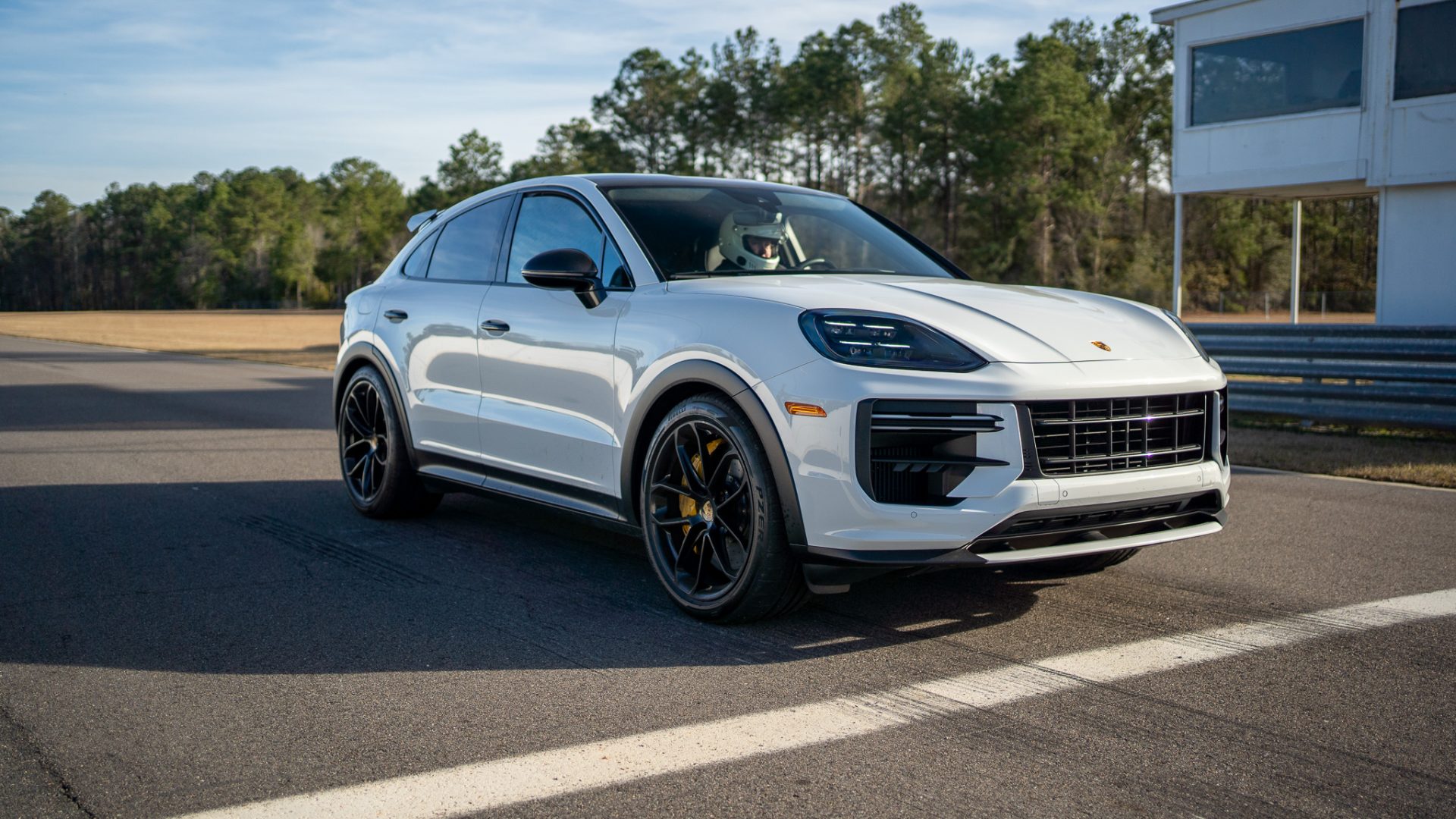
The tire setup is equally impressive, with staggered 22-inch wheels wrapped in Pirelli P Zero Corsa performance rubber measuring 285mm wide up front and a massive 315mm at the rear.
Behind those wheels sit carbon-ceramic brakes with 10-piston front calipers clamping down on 440mm rotors, providing fade-free stopping power even during repeated hard laps.
The Turbo GT also features active aerodynamics, including a large fixed rear wing and an adaptive front spoiler that adjusts based on speed and driving mode to maximize downforce or efficiency.
The driving experience is nothing short of remarkable. Turn into a corner, and the Cayenne Turbo GT responds with immediacy that seems to defy physics, the nose tucking in eagerly as the rear-wheel steering helps rotate the chassis.
Push harder, and the SUV maintains incredible composure, tracking through corners with minimal body roll and tremendous grip. The steering, while not quite as communicative as a dedicated sports car, still provides adequate feedback and weights up naturally as cornering loads increase.
Despite weighing over 4,900 pounds, the Turbo GT changes direction with an agility that would shame many sport sedans, proving that with enough engineering prowess and no regard for cost, an SUV can truly handle like a much smaller, lighter vehicle.
2. BMW X5 M Competition
BMW’s M Division has spent decades perfecting the art of making large, practical vehicles drive like precision instruments, and the X5 M Competition represents the culmination of that expertise applied to a midsize luxury SUV.
This is a vehicle that can comfortably transport seven passengers in three-row configuration, yet attack a racetrack with the ferocity of a dedicated performance car.
The X5 M Competition proves that Munich’s engineers understand that “M” should represent exceptional driving dynamics regardless of body style.
The heart of this beast is a 4.4-liter twin-turbocharged V8 producing 617 horsepower and 553 lb-ft of torque, managed by an eight-speed automatic transmission that delivers lightning-quick shifts.
But the engine is just the beginning of the performance equation. BMW’s M xDrive all-wheel-drive system is specifically tuned to provide a rear-biased power delivery that gives the X5 M Competition a distinctly sporting character.
In the most aggressive driving modes, the system can operate in essentially rear-wheel-drive mode, sending all available power to the rear axle until slip is detected, at which point it seamlessly redistributes torque to maintain traction and stability.
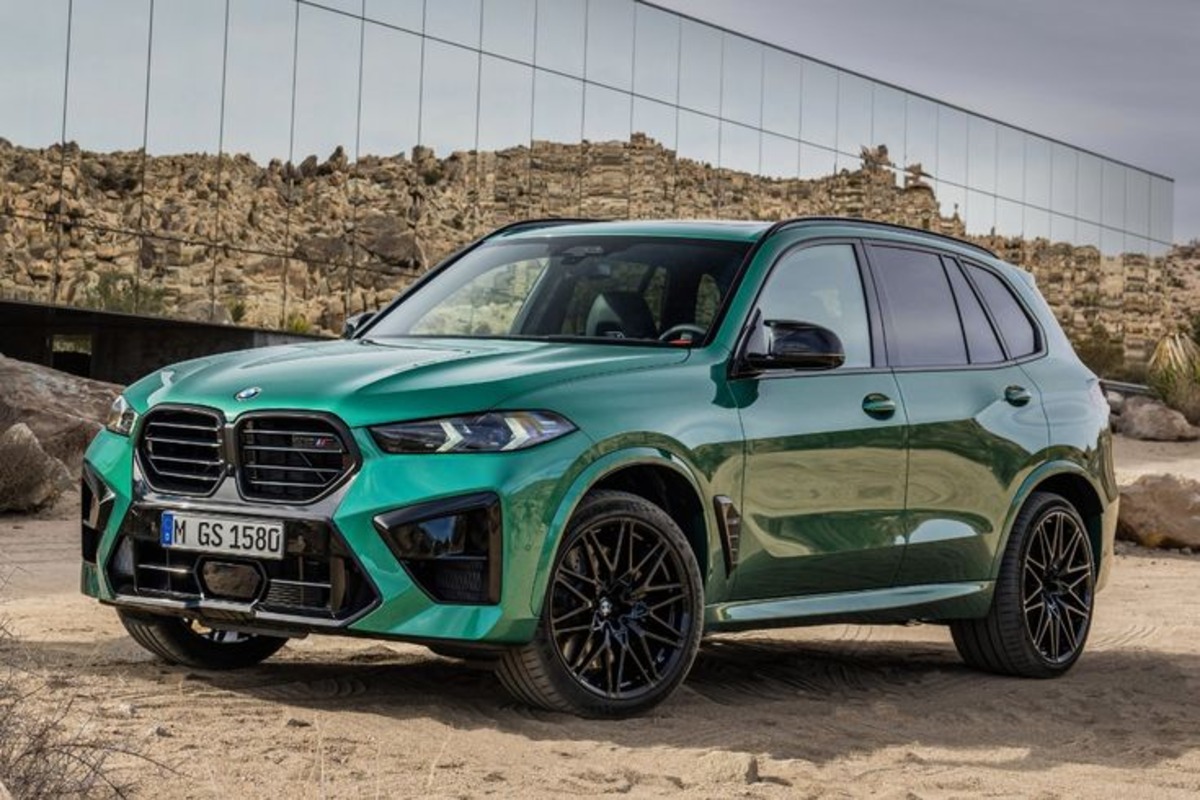
The suspension setup is a masterclass in balancing comfort with performance capability. Adaptive M dampers provide continuously variable damping control, while the Active M Differential at the rear axle actively distributes power between the rear wheels to enhance cornering precision and traction out of corners.
The steering system incorporates variable ratio and adjustable assistance, becoming more direct and weighted in Sport and Sport Plus modes.
High-performance M compound brakes with six-piston front calipers and internally vented discs provide exceptional stopping power and heat resistance during spirited driving.
On a twisty road, the X5 M Competition delivers an engaging and rewarding driving experience. The steering, while not the most communicative, is precise and well-weighted, allowing you to place the SUV exactly where you intend.
Turn-in is sharp, with minimal understeer thanks to the torque-vectoring rear differential and rear-biased all-wheel-drive system. Body control is excellent even during rapid direction changes, and there’s tremendous grip from the staggered performance tires.
Perhaps most impressively, the X5 M Competition maintains this sporting character while still riding comfortably enough for daily use, proving that the SUV versus sedan handling debate is no longer as clear-cut as it once was.
3. Alfa Romeo Stelvio Quadrifoglio
When Alfa Romeo decided to build an SUV, enthusiasts were understandably skeptical. Could the brand that built the iconic Giulia Quadrifoglio sport sedan translate that magic into a taller, heavier crossover? The answer, remarkably, is a resounding yes.
The Stelvio Quadrifoglio handles with such precision, balance, and engagement that it not only rivals sport sedans it actually drives better than many of them, delivering the kind of emotional driving experience that has become increasingly rare in the modern automotive world.
At the core of the Stelvio Quadrifoglio’s exceptional handling is its Ferrari-derived 2.9-liter twin-turbocharged V6 engine producing 505 horsepower and 443 lb-ft of torque.
This all-aluminum powerplant sits entirely behind the front axle line, contributing to the SUV’s near-perfect 50/50 weight distribution.
Power reaches all four wheels through an eight-speed automatic transmission and Alfa’s Q4 all-wheel-drive system, which is intentionally rear-biased, sending 100% of power to the rear wheels under normal driving and only engaging the front axle when additional traction is needed.
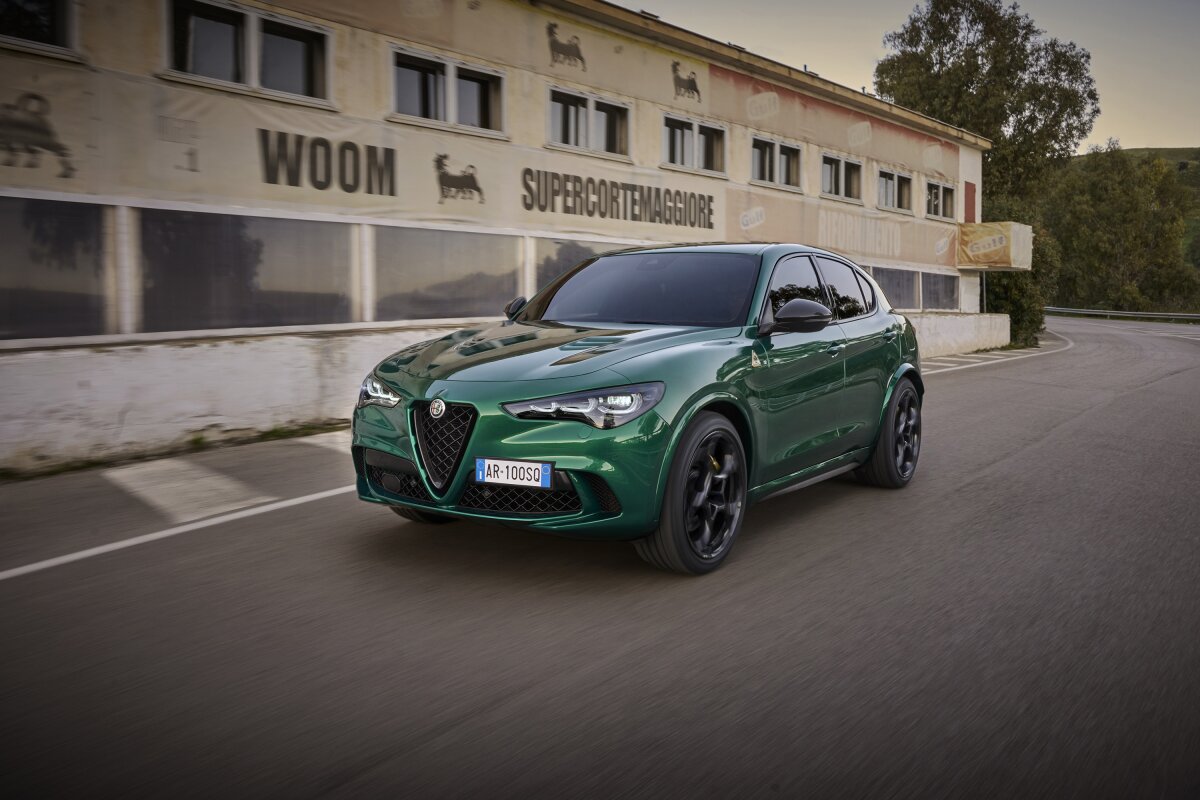
This configuration gives the Stelvio Quadrifoglio a distinctly rear-drive character that’s rare among performance SUVs. The driving experience borders on the transcendent for an SUV.
Point the Stelvio Quadrifoglio at a series of corners, and it responds with an enthusiasm that’s genuinely shocking for a vehicle with this much ground clearance and cargo capacity.
The front end turns in with precision and eagerness, the rear-biased all-wheel-drive system allows for a hint of oversteer rotation when pushed, and the body remains remarkably flat and composed throughout.
The balance is exquisite, the feedback through the controls is satisfying, and there’s a sense of mechanical harmony that’s distinctly Alfa Romeo.
While competitors may be faster in straight-line acceleration or offer more technology, few deliver the same emotional connection and pure driving pleasure. The Stelvio Quadrifoglio proves that exceptional handling isn’t just about physics and engineering it’s also about passion and soul.
4. Lamborghini Urus
The Lamborghini Urus represents the Italian supercar manufacturer’s bold entry into the SUV market, and it handles with a level of aggression and precision that would make many sport sedans feel pedestrian by comparison.
This is not a case of badge engineering or a cynical attempt to capitalize on SUV market trends the Urus is a thoroughly developed performance machine that happens to offer the practicality and commanding driving position of a tall-riding vehicle.
Lamborghini engineers approached the project with the same obsessive attention to detail they apply to the Huracán and Aventador supercars.
The powertrain is suitably dramatic: a 4.0-liter twin-turbocharged V8 producing 641 horsepower and 627 lb-ft of torque, shared with other Volkswagen Group products but uniquely tuned by Lamborghini.
Power reaches all four wheels through an eight-speed automatic transmission and Lamborghini’s active torque-vectoring all-wheel-drive system, which can continuously vary power distribution between the front and rear axles and between individual wheels to optimize traction and handling.
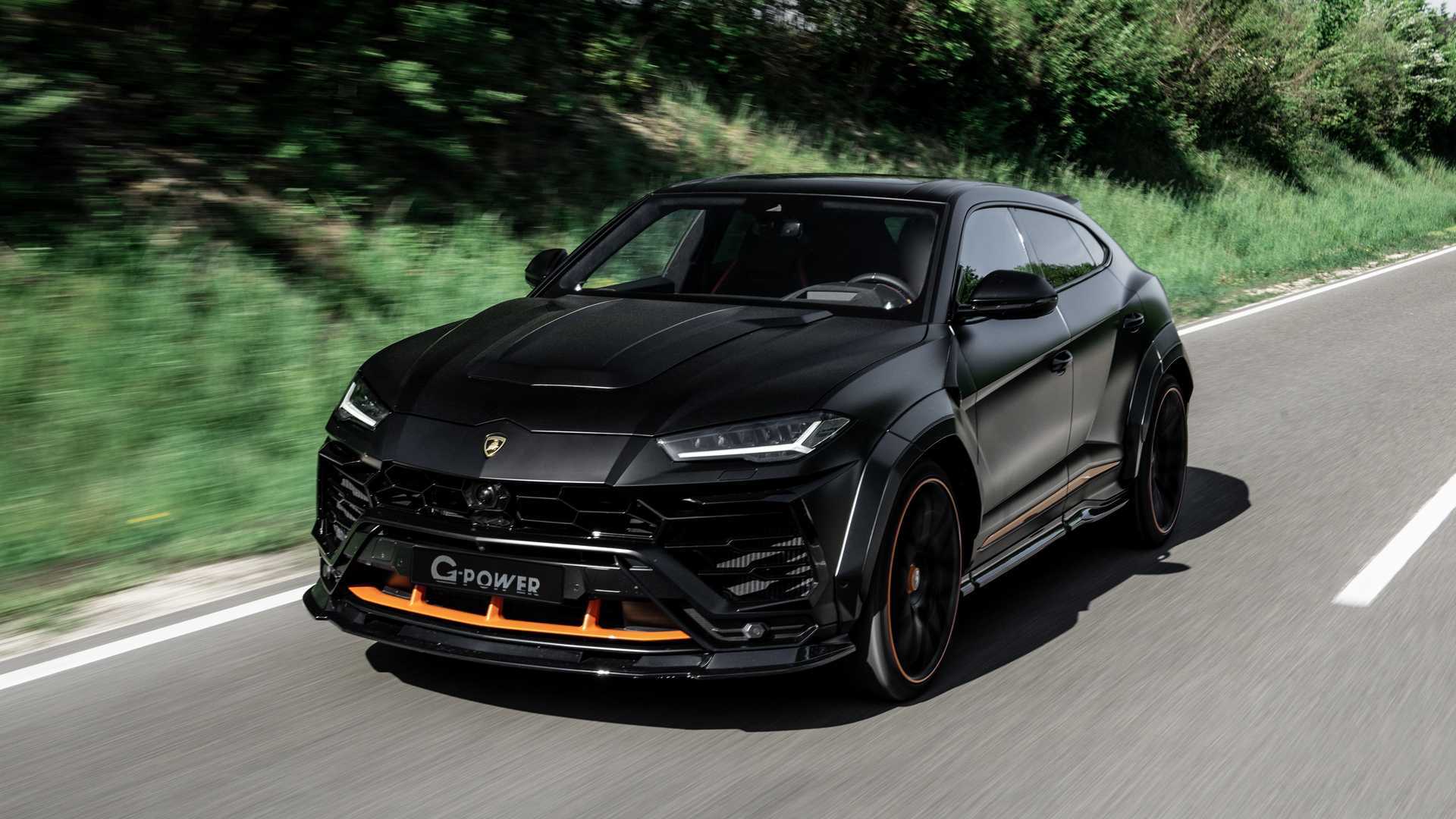
The default power split favors the rear axle, maintaining Lamborghini’s rear-drive heritage, but can send up to 70% of torque forward when conditions demand.
The performance numbers are genuinely supercar-level: 0-60 mph in 3.1 seconds and a top speed of 190 mph, making the Urus one of the fastest SUVs ever produced.
But more impressive than straight-line speed is how composed and balanced the Urus feels when driven aggressively through corners.
There’s tremendous grip from the standard 22-inch wheels wrapped in performance rubber, and the torque-vectoring system actively helps rotate the chassis for sharper, more precise cornering. The carbon-ceramic brakes provide fade-free stopping power lap after lap.
Despite weighing approximately 4,800 pounds, the Urus changes direction with an agility that legitimately rivals sport sedans, while offering the raised seating position, cargo capacity, and snow-capable all-wheel-drive system that sedans simply cannot match. It’s a genuine daily-drivable supercar that proves SUVs need not sacrifice handling excellence.
Also Read: 12 SUVs That Keep Owners Happy Past 300k
5. Mercedes-AMG GLC 63 S
Mercedes-AMG has a well-deserved reputation for transforming ordinary luxury vehicles into fire-breathing performance machines, and the GLC 63 S represents one of their most impressive achievements in making an SUV handle like a proper sports sedan.
This compact luxury SUV receives the full AMG treatment, with virtually every component touched, tuned, or replaced entirely to deliver a driving experience that prioritizes precision and engagement above all else.
The result is a vehicle that offers sedan-destroying handling wrapped in a practical, daily-usable SUV package. The beating heart of the GLC 63 S is AMG’s hand-built 4.0-liter twin-turbocharged V8 producing 503 horsepower and 516 lb-ft of torque an astonishing amount of power for a vehicle of this size.
The engine features turbochargers positioned inside the V of the cylinder banks for optimal throttle response, and it’s mated to AMG’s Speedshift MCT 9-speed automatic transmission that delivers remarkably quick shifts.
AMG’s 4MATIC+ all-wheel-drive system is specifically tuned for performance, with a rear-biased torque split that can send up to 100% of power to the rear axle when traction allows, providing a distinctly rear-drive feel that’s crucial for engaging handling dynamics.
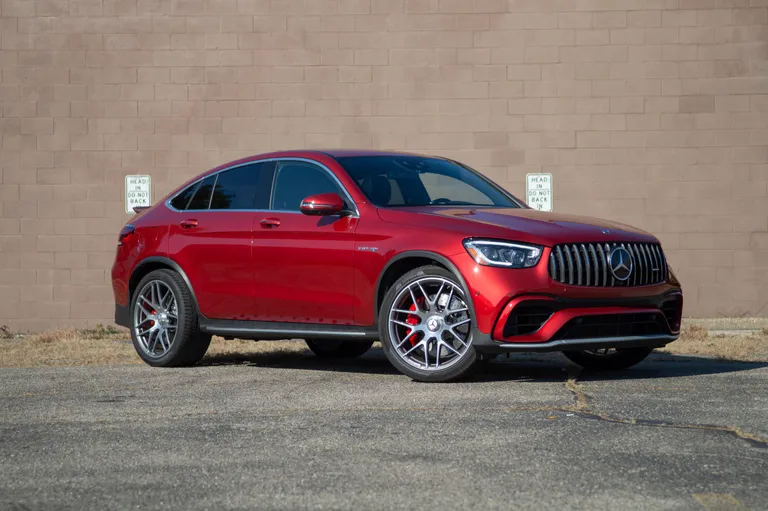
The suspension system is a technological tour de force. AMG Ride Control adaptive dampers provide continuously adjustable damping at each wheel, monitoring body movements and adjusting firmness up to 1,000 times per second.
The electronic limited-slip rear differential works in harmony with the all-wheel-drive system to enhance traction and cornering precision.
High-performance braking is provided by massive six-piston front calipers with 360mm internally ventilated and perforated discs, while the standard performance tires provide exceptional grip in both dry and wet conditions.
The steering system features variable ratio and electrically assisted operation that becomes more direct and weighted in Sport and Sport+ modes.
The driving experience is visceral and engaging in ways few SUVs can match. The engine provides explosive acceleration with virtually no turbo lag, the transmission responds to paddle inputs with race-car immediacy, and the exhaust produces an intoxicating soundtrack of pops, crackles, and thunderous roars.
More importantly, the chassis rewards skilled driving with precise, predictable responses. Turn-in is sharp and immediate, mid-corner balance is excellent, and corner-exit traction is phenomenal thanks to the electronic limited-slip differential actively managing rear-wheel torque distribution.
The GLC 63 S legitimately handles better than many sport sedans, proving that AMG’s performance magic isn’t diminished by increased ride height and cargo capacity. It’s a vehicle that makes every drive feel like an event.
6. Audi RS Q8
Audi’s flagship performance SUV, the RS Q8, represents the culmination of decades of all-wheel-drive expertise and quattro rally heritage applied to a large luxury crossover coupe.
This is not simply a powerful SUV with sporty pretensions it’s a comprehensively engineered performance machine that handles with a level of precision and composure that challenges the handling supremacy of traditional sport sedans.
Audi engineers leveraged every available technology to ensure the RS Q8 drives far smaller and more agile than its substantial dimensions might suggest.
Under the hood sits a 4.0-liter twin-turbocharged V8 producing 591 horsepower and 590 lb-ft of torque, managed by an eight-speed automatic transmission that delivers seamlessly quick shifts.
The engine features mild-hybrid technology with a 48-volt electrical system and belt-alternator-starter that can provide electric boost during acceleration and enable coasting with the engine off for improved efficiency.
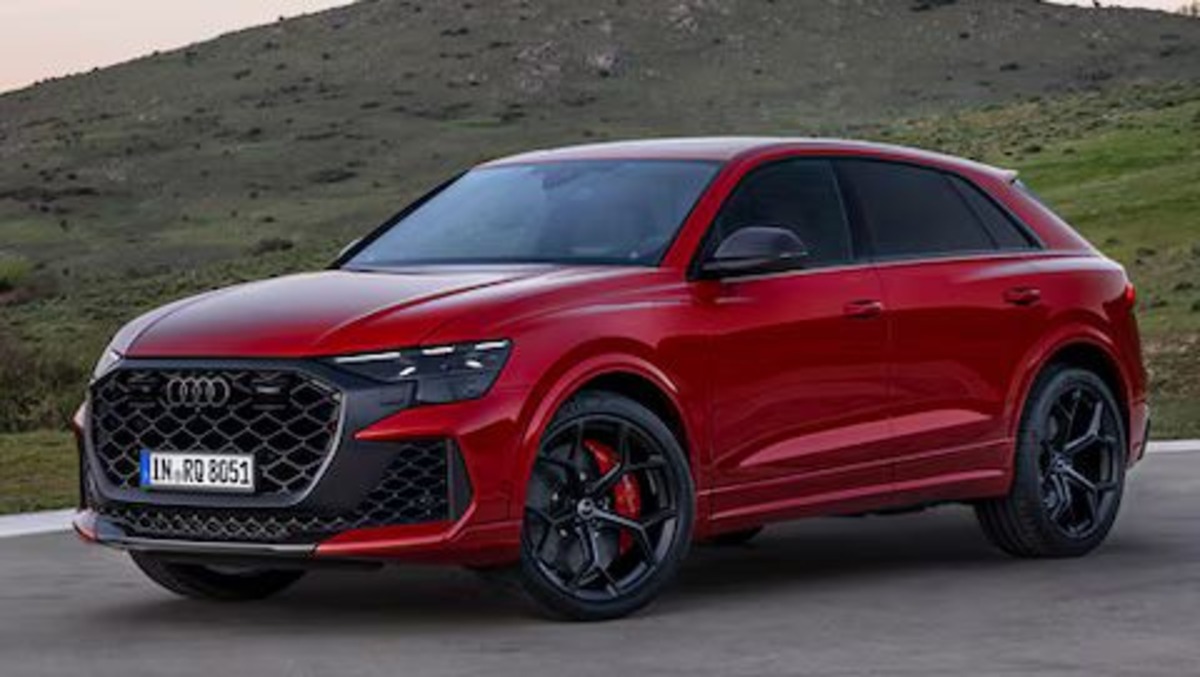
But efficiency takes a back seat to performance in this application the RS Q8 rockets from 0-60 mph in just 3.7 seconds and reaches an electronically limited top speed of 155 mph (or 190 mph with the optional dynamic package).
The chassis technology is where the RS Q8 truly distinguishes itself. Audi’s sport adaptive air suspension provides three chamber technology that can vary spring rates and ride height based on driving conditions and selected drive mode.
The system can lower the RS Q8 by up to 3.5 inches at high speeds for improved aerodynamics and stability. More impressive is the standard electromechanical active roll stabilization system, which actively counteracts body roll during cornering by applying torque to the anti-roll bars.
This system virtually eliminates the body lean typically associated with SUVs, keeping the RS Q8 remarkably flat even during aggressive cornering maneuvers.
What’s perhaps most impressive is how the RS Q8 accomplishes all this while maintaining genuine SUV practicality. The interior is spacious and luxurious, there’s ample cargo capacity, and the ride quality in Comfort mode is genuinely pleasant for daily driving.
Yet when the road turns interesting, the RS Q8 transforms into something genuinely special a vehicle that handles with the precision and engagement of a sport sedan while offering the commanding visibility, weather capability, and cargo flexibility that sedans simply cannot provide.
7. Range Rover Sport SVR
When most people think of Range Rover, handling precision isn’t typically the first attribute that comes to mind. These are vehicles built for conquering challenging off-road terrain and providing limousine-like luxury for their occupants.
However, the Range Rover Sport SVR, developed by Jaguar Land Rover’s Special Vehicle Operations division, completely rewrites expectations for what a British luxury SUV can accomplish when the road turns twisty.
This is a vehicle that genuinely handles better than many dedicated sport sedans, while still maintaining the off-road capability and luxurious refinement that defines the Range Rover brand.
The engine is suitably dramatic: a supercharged 5.0-liter V8 producing 575 horsepower and 502 lb-ft of torque, providing explosive acceleration and a thunderous exhaust note.
Power reaches all four wheels through an eight-speed automatic transmission and Land Rover’s sophisticated Intelligent Driveline Dynamics system, which can distribute torque between the front and rear axles and between individual wheels to optimize traction and handling. The default torque split is rear-biased, but the system can shift power forward instantaneously when needed for maximum traction.
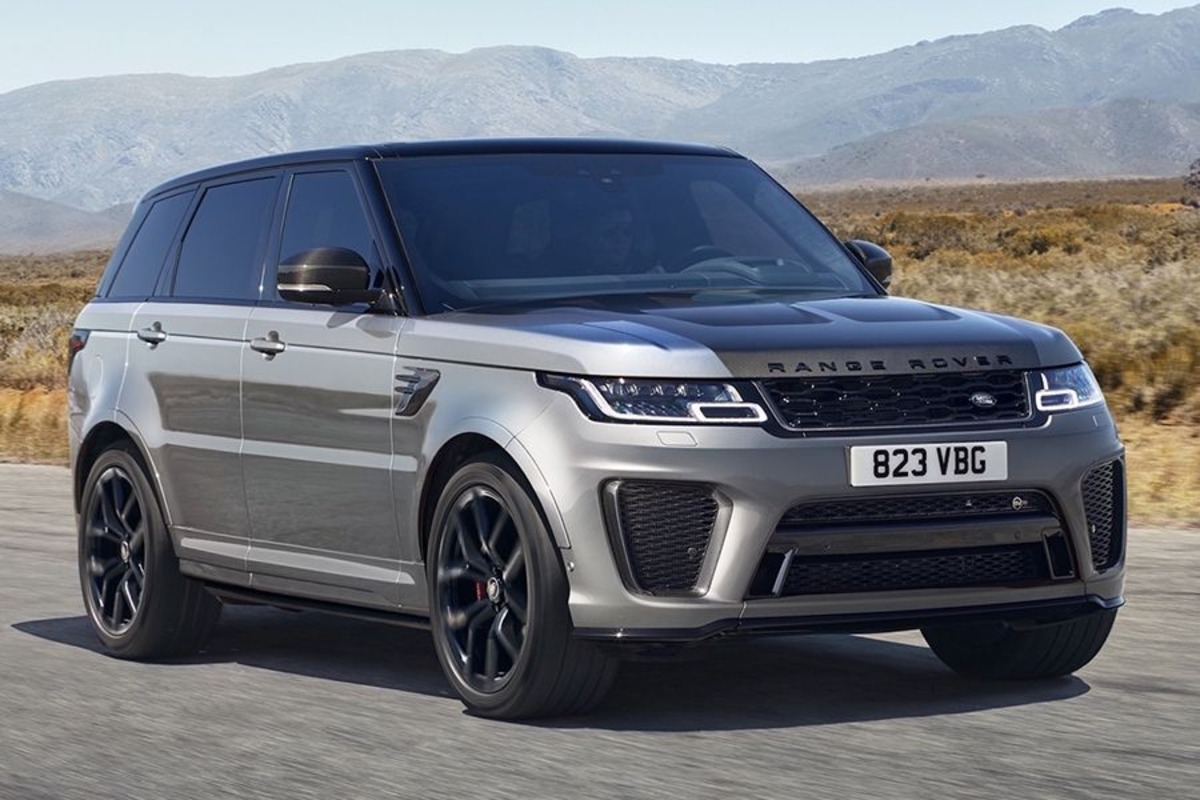
The suspension system is remarkably sophisticated for an SUV. Electronic air suspension provides continuously variable damping control and can adjust ride height based on speed, terrain, and selected driving mode.
At highway speeds, the Sport SVR automatically lowers for improved aerodynamics and stability, while dynamic mode further lowers the suspension and firms up the dampers for maximum handling performance.
The SVR also features active electronic rear differential and dynamic stability control with multiple settings from fully intrusive to nearly off, allowing enthusiastic drivers to explore the limits of the chassis while maintaining a safety net.
Perhaps most remarkably, the Range Rover Sport SVR accomplishes all this performance while maintaining genuine off-road capability.
Terrain Response 2 system provides multiple off-road driving modes, and the air suspension can raise the vehicle significantly for improved ground clearance.
It’s genuinely capable of conquering challenging trails that would stop most sport sedans before they even left the pavement. This combination of on-road handling excellence and legitimate off-road ability is extraordinarily rare and makes the Sport SVR one of the most versatile performance vehicles available.
You can attack your favorite canyon road in the morning and tackle a challenging trail in the afternoon something no sedan, regardless of how well it handles, can claim.
8. Maserati Levante Trofeo
Maserati’s entry into the high-performance SUV segment, the Levante Trofeo, brings Italian flair and Ferrari-developed performance technology to the luxury crossover market.
This is an SUV that handles with the passion and precision you’d expect from Modena, Italy a city with deep motorsport heritage. The Trofeo isn’t simply about straight-line speed or luxury appointments; it’s about delivering an emotional, engaging driving experience that rivals and often exceeds what sport sedans offer, wrapped in a practical, raised package.
The powertrain is pure Ferrari magic: a 3.8-liter twin-turbocharged V8 developed by Ferrari engineers in Maranello, producing 580 horsepower and 538 lb-ft of torque.
This hand-assembled engine shares DNA with the powerplants found in Ferrari’s mid-engine sports cars, and it delivers power with the kind of explosive urgency and intoxicating soundtrack that makes every acceleration feel like an event.
The engine is mated to an eight-speed automatic transmission with paddle shifters that deliver quick, decisive shifts. Power reaches all four wheels through Maserati’s Q4 intelligent all-wheel-drive system, which is intentionally rear-biased to maintain the brand’s sporting character.
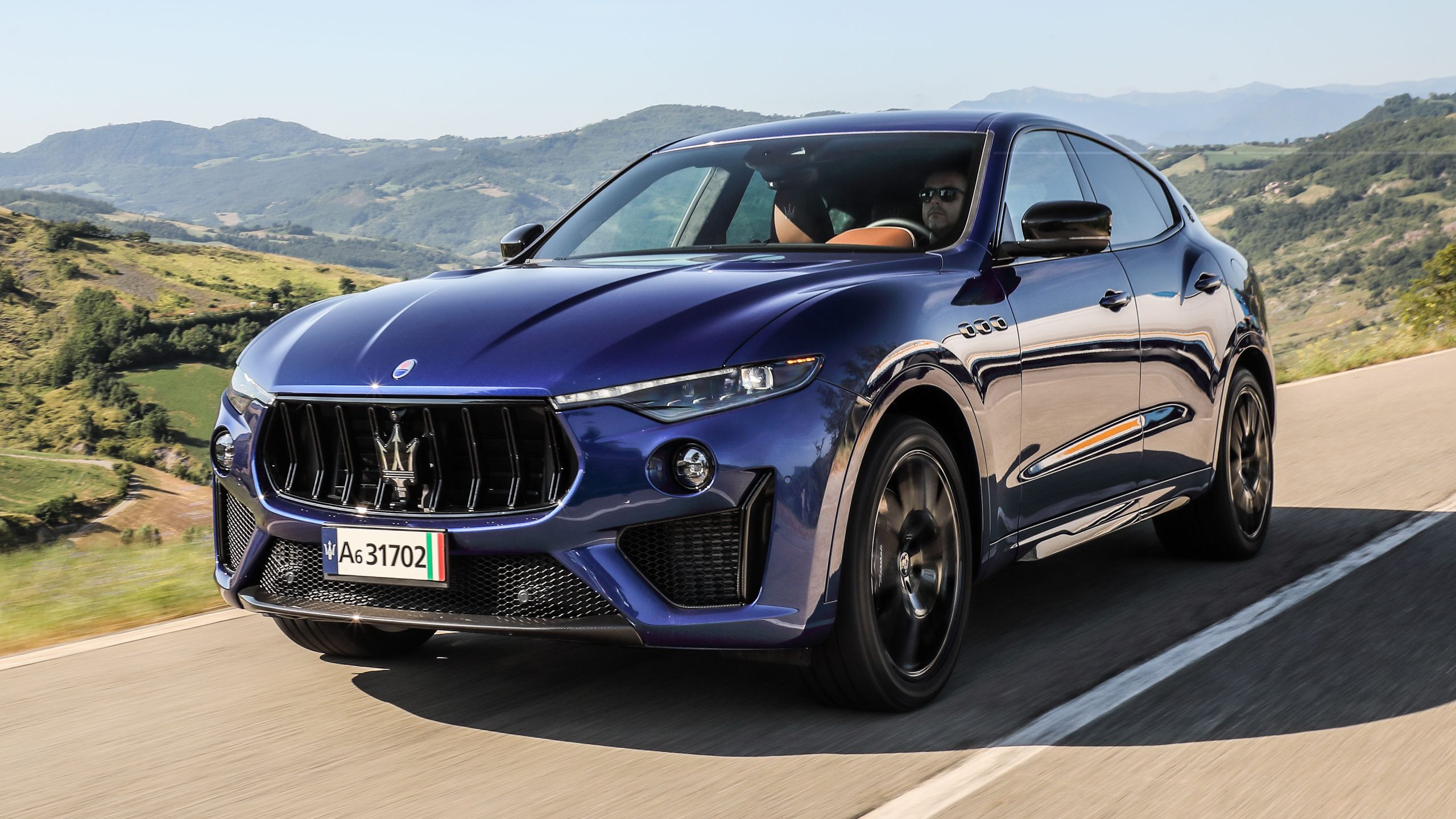
The chassis features Maserati’s Skyhook adaptive suspension system with continuously variable damping that monitors vehicle dynamics and adjusts firmness at each wheel up to 1,000 times per second.
The electronic limited-slip rear differential actively manages torque distribution between the rear wheels to enhance traction and cornering precision.
What sets the Levante Trofeo apart from German competitors is its focus on providing an emotional, engaging driving experience rather than clinical precision.
There’s a sense of mechanical connection and feedback through the controls that feels distinctly Italian less about perfection and more about passion.
The steering is particularly noteworthy. Maserati engineers tuned the variable-ratio electromechanical power steering to provide genuine feedback and natural weighting that builds progressively as cornering loads increase.
It’s not the absolute sharpest or most communicative steering available in an SUV, but it has character and personality that makes you want to seek out challenging roads.
The steering column is sourced from Ferrari and features a carbon fiber construction that reduces weight while maintaining rigidity. This attention to detail extends throughout the chassis, with aluminum suspension components helping keep unsprung weight in check.
What makes the Levante Trofeo particularly appealing is how it balances performance with practicality and luxury. The interior is beautifully appointed with premium materials and elegant Italian design.
There’s genuine SUV practicality with spacious seating and cargo capacity. Yet when the road opens up, the Levante Trofeo delivers an involving, rewarding driving experience that legitimately rivals sport sedans.
It may not be as clinically perfect as German alternatives, but for many enthusiasts, that imperfect passion is exactly what makes it special. It proves that exceptional handling isn’t just about engineering excellence it’s also about emotion and character.
9. Tesla Model X Plaid
The Tesla Model X Plaid represents a completely different approach to SUV handling excellence instead of relying on traditional mechanical solutions like adaptive dampers and active anti-roll bars, it leverages the unique advantages of electric propulsion and software-defined vehicle dynamics.
The result is an SUV that handles with a level of precision and agility that seems to defy physics, while offering family-friendly practicality, including available seven-passenger seating and distinctive falcon-wing rear doors. It proves that the future of vehicle dynamics isn’t just about incremental improvements to traditional technology.
The tri-motor electric powertrain produces a combined 1,020 horsepower, with one motor driving the front axle and two motors independently driving the rear wheels.
This configuration enables incredibly sophisticated torque vectoring capabilities the system can distribute power not just between front and rear axles, but also between individual rear wheels, adjusting torque delivery thousands of times per second for optimal traction and handling.
The instant torque delivery characteristic of electric motors means throttle response is immediate, with no turbo lag or transmission delays. The Model X Plaid rockets from 0-60 mph in an astonishing 2.5 seconds, making it one of the quickest SUVs ever produced.
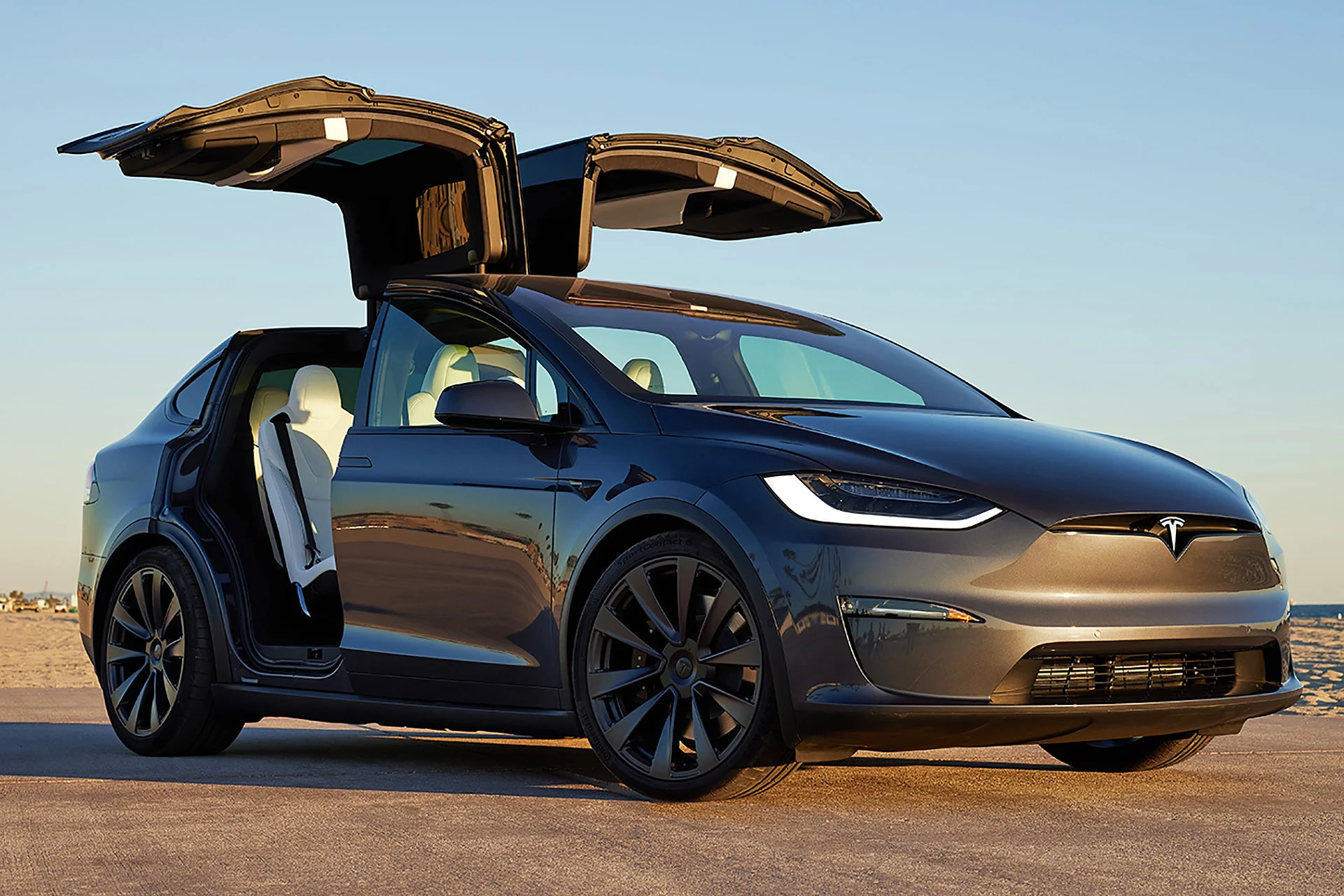
The handling advantage of the Model X Plaid begins with its battery pack, which forms a massive skateboard-like platform beneath the passenger compartment.
This configuration places the vehicle’s heaviest components as low as possible, resulting in an extraordinarily low center of gravity actually lower than many sport sedans despite the raised ride height.
This fundamental architecture advantage pays enormous dividends in cornering situations, as the Model X Plaid exhibits minimal body roll and tremendous stability even during aggressive maneuvers.
The battery pack essentially acts like permanent ballast optimally positioned for handling dynamics. Perhaps most impressively, the Model X Plaid accomplishes all this performance while offering genuine practicality.
The interior can accommodate up to seven passengers, there’s ample cargo space with the rear seats folded, and the Autopilot driver assistance features make long highway drives remarkably relaxing.
The electric powertrain means no visits to gas stations, and the extensive Supercharger network makes long-distance travel feasible. It’s a vehicle that can serve as a comfortable family hauler during the week and embarrass sports cars at track days on the weekend all while producing zero tailpipe emissions.
The Model X Plaid proves that electric propulsion and software-defined dynamics represent a legitimate path toward exceptional SUV handling, offering advantages that traditional mechanical systems cannot match.
10. Jaguar F-PACE SVR
Jaguar’s performance SUV, the F-PACE SVR, brings British sporting heritage and race-bred dynamics to the luxury crossover segment.
Developed by Jaguar’s Special Vehicle Operations division, this is an SUV that handles with the grace and precision that the Jaguar brand has been delivering in sports cars for decades.
The F-PACE SVR proves that the sporting DNA that makes cars like the F-TYPE such engaging drivers can be successfully translated into a practical, family-friendly SUV without sacrificing the driving engagement that enthusiasts demand.
Under the hood sits Jaguar’s supercharged 5.0-liter V8 producing 550 horsepower and 502 lb-ft of torque, providing explosive acceleration and a glorious mechanical soundtrack.
This is the same basic engine architecture that powers the F-TYPE SVR sports car, tuned specifically for the F-PACE application but retaining that distinctive supercharger whine and aggressive exhaust note.
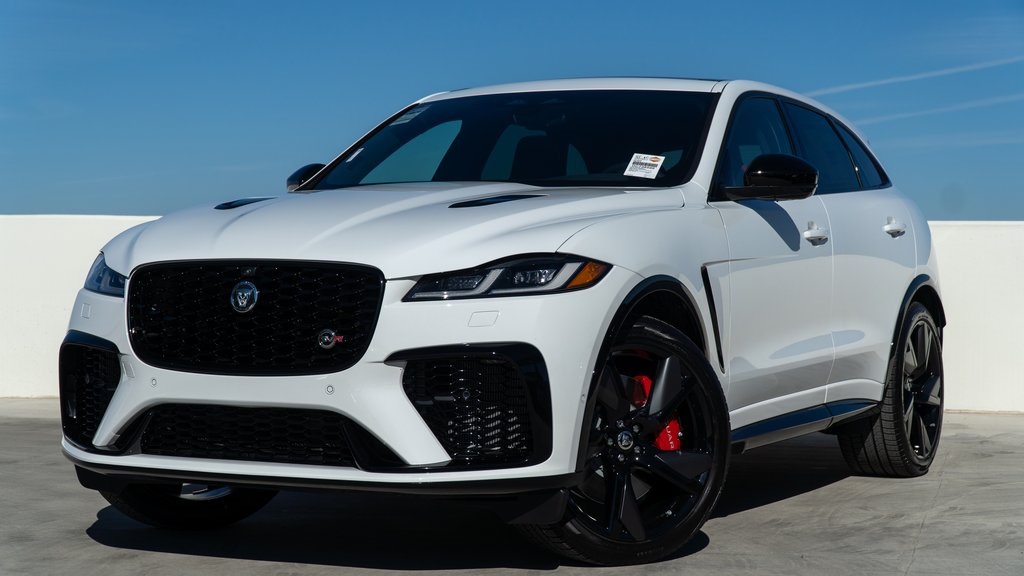
Power reaches all four wheels through an eight-speed automatic transmission with quickshift technology and intelligent all-wheel-drive system that can send up to 100% of torque to the rear axle when conditions allow, maintaining Jaguar’s rear-drive sporting character.
What makes the F-PACE SVR particularly appealing is how it balances performance with daily usability. The interior is beautifully appointed with premium materials and sophisticated British design.
There’s genuine SUV practicality with spacious seating for five adults and generous cargo capacity. The ride quality, while certainly firm, remains acceptable for daily commuting and long highway journeys.
Yet when the road turns interesting, the F-PACE SVR transforms into something genuinely special a vehicle that handles with grace, precision, and genuine feedback that’s increasingly rare in the SUV segment.
It may not be the absolute fastest or most technologically advanced performance SUV available, but for many enthusiasts, the F-PACE SVR’s combination of engaging dynamics, beautiful design, and British character makes it the most desirable choice.
11. Aston Martin DBX707
Aston Martin’s first SUV, the DBX707, represents British luxury and sporting excellence applied to the high-performance crossover segment.
This is not simply a prestige badge slapped onto a generic platform the DBX707 is a comprehensively engineered performance vehicle that handles with the precision and engagement that Aston Martin has been delivering in grand touring cars for over a century.
With 697 horsepower, carbon-ceramic brakes, and sophisticated chassis technology, the DBX707 proves that Aston Martin’s motorsport heritage and commitment to driver engagement translate successfully into SUV form.
The engine is a Mercedes-AMG-sourced 4.0-liter twin-turbocharged V8, but extensively modified by Aston Martin engineers to produce 697 horsepower and 663 lb-ft of torque making it the most powerful production SUV when it launched.
Peak torque arrives at just 2,750 rpm and remains available through 5,000 rpm, providing explosive acceleration across a wide powerband.
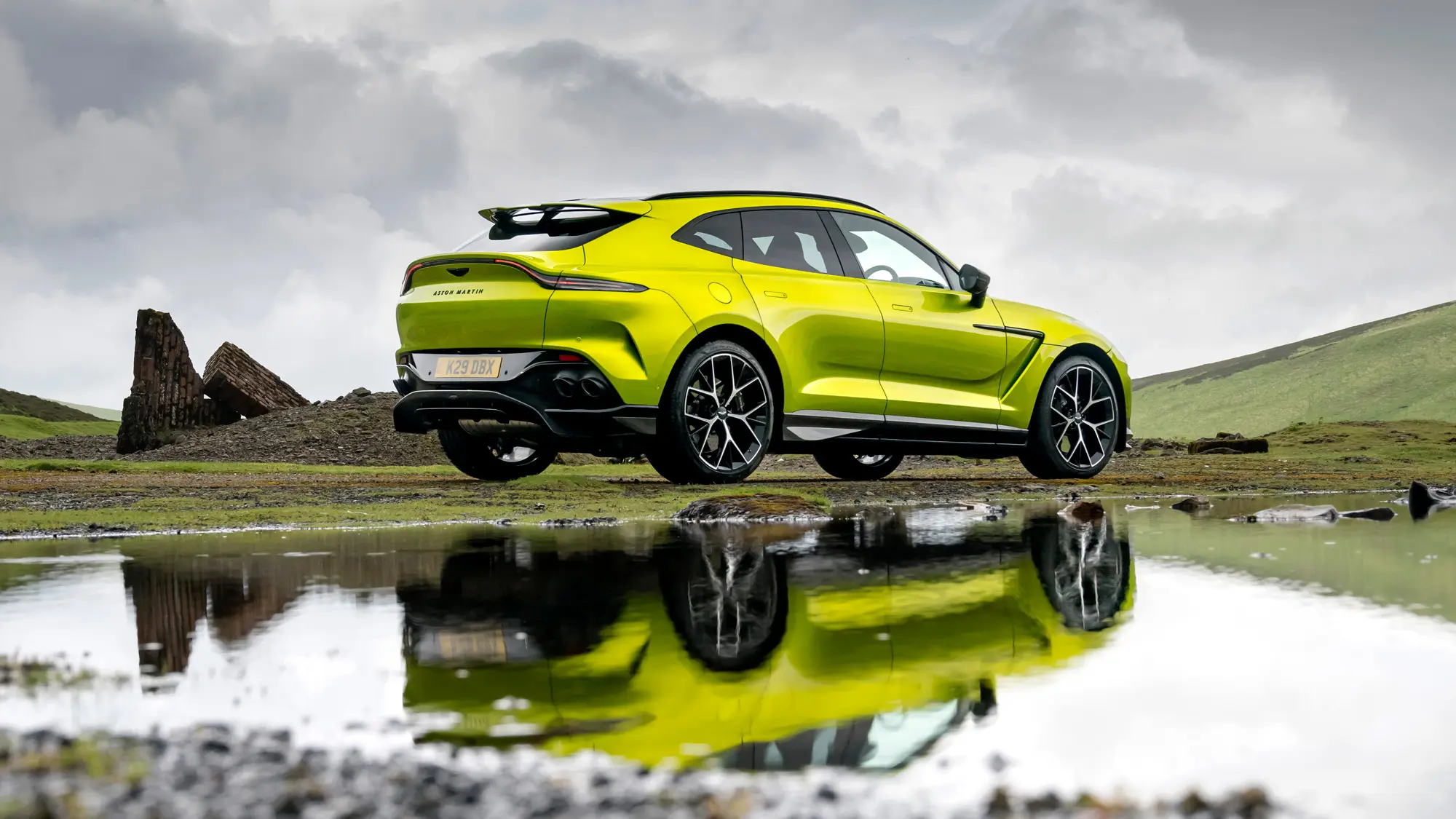
The V8 is mated to a nine-speed automatic transmission with wet-clutch technology borrowed from motorsport applications, providing faster shifts and better heat management than conventional torque-converter automatics.
Power reaches all four wheels through an electronically controlled center differential that can vary torque distribution from fully front-biased to fully rear-biased based on driving conditions and selected drive mode.
The DBX707 also maintains Aston Martin’s commitment to beautiful design and luxurious appointments. The interior is exquisitely crafted with premium materials throughout, the exterior design is elegant and distinctive, and there’s a sense of occasion and specialness that transcends mere performance statistics.
It’s a vehicle that can serve as a comfortable, refined daily driver during the week and a compelling canyon carver on weekends all while making an unmistakable statement about your automotive priorities.
The DBX707 proves that Aston Martin’s century-plus of sports car expertise translates successfully into SUV form, delivering handling excellence without sacrificing the luxury, craftsmanship, and emotional appeal that defines the brand.
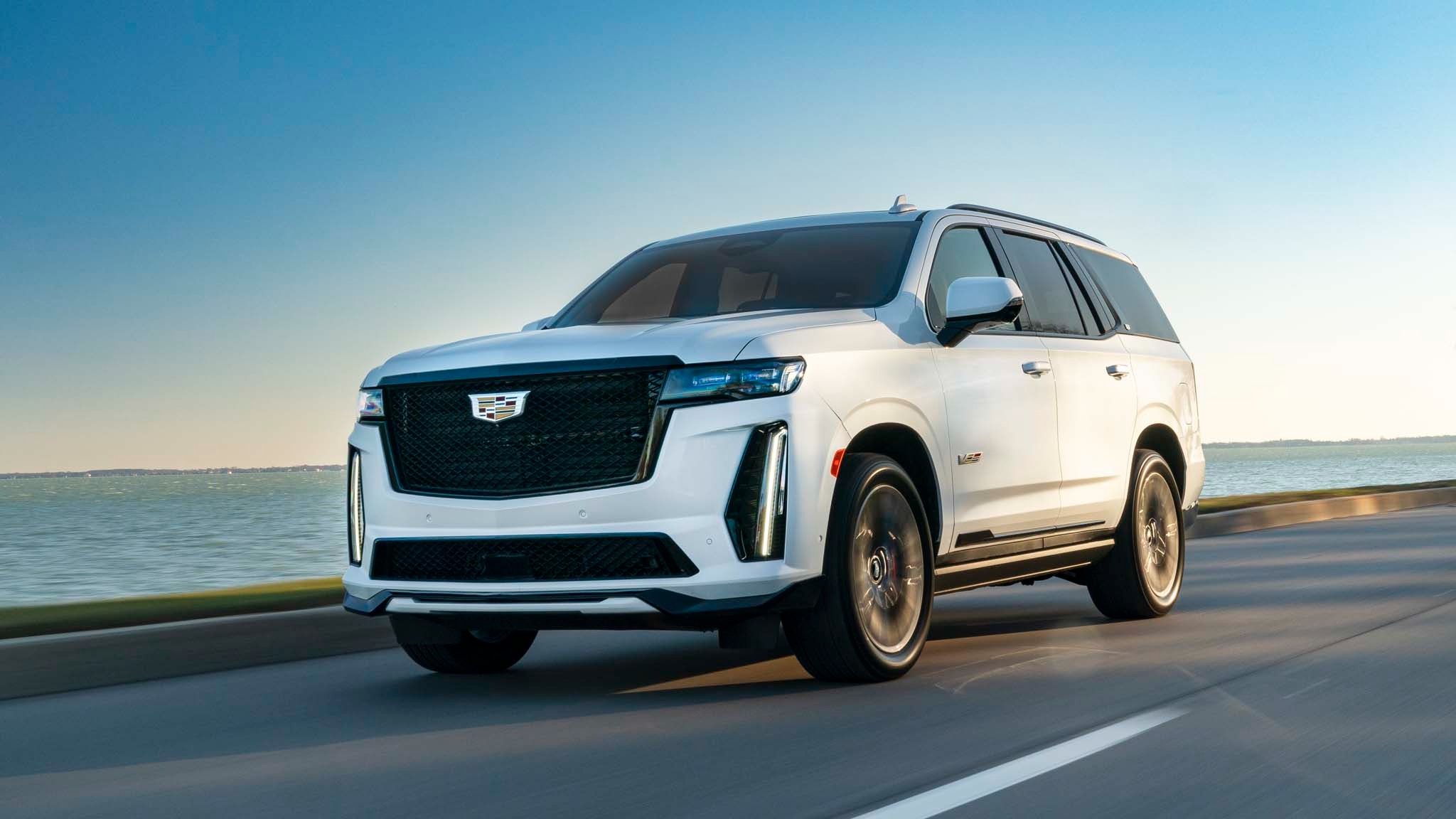
12. Cadillac Escalade-V
The Cadillac Escalade-V represents an unexpected entry in the high-performance SUV segment a massive, American luxury SUV that handles far better than its full-size dimensions would suggest.
While previous Escalades prioritized luxury, space, and presence over sporting dynamics, the Escalade-V proves that Cadillac can build a large SUV that not only provides explosive performance but also handles with precision and engagement that challenges many sport sedans.
This is particularly impressive given that the Escalade-V weighs over 6,200 pounds and measures over 211 inches long, making it one of the largest and heaviest vehicles on this list.
The powertrain is pure American muscle: a supercharged 6.2-liter V8 producing 682 horsepower and 653 lb-ft of torque. This is the same basic engine architecture found in the Cadillac CT5-V Blackwing super sedan, adapted for the Escalade application but retaining that explosive power delivery and addictive supercharger whine.
The V8 is mated to a 10-speed automatic transmission calibrated specifically for performance driving, with manual shift capability via steering wheel-mounted paddle shifters.
Power reaches all four wheels through an electronically controlled all-wheel-drive system with active transfer case and electronic limited-slip rear differential.
The Escalade-V proves that exceptional handling isn’t limited to compact, lightweight vehicles. With sophisticated suspension technology, powerful braking systems, and comprehensive chassis tuning, even a massive full-size SUV can deliver engaging, precise driving dynamics.
It represents perhaps the most dramatic example on this list of how modern technology and engineering have closed the gap between SUVs and sedans in handling capability.
While purists might argue that physics ultimately limits what’s possible with a 6,200-pound SUV, the Escalade-V comes remarkably close to making those concerns irrelevant, delivering a driving experience that’s genuinely engaging and rewarding despite or perhaps because of its improbable specifications.
