

The 1960s were a golden era for American muscle cars, a time when horsepower reigned supreme, and manufacturers waged an unrelenting arms race on the quarter mile. “10 Quarter-Mile Monster Muscle Cars That Ruled the ’60s” celebrates the cars that defined this period, blending raw performance, bold styling, and technical ingenuity.
From compact Barracudas with massive big-blocks to full-size Mopars and NASCAR-inspired Mustangs, each model showcased unique engineering solutions to extract maximum speed and torque. Cars like the Plymouth ’Cuda 440 and Dodge Charger Hemi were not just street machines; they were statements of intent, designed to dominate drag strips and command attention wherever they went.
These muscle cars balanced innovation, risk, and flair, often pushing the limits of design, weight distribution, and tire technology. By examining their performance, history, and cultural impact, this list highlights the legends that transformed American streets into arenas of speed and power, capturing the spirit of an era obsessed with straight-line domination.
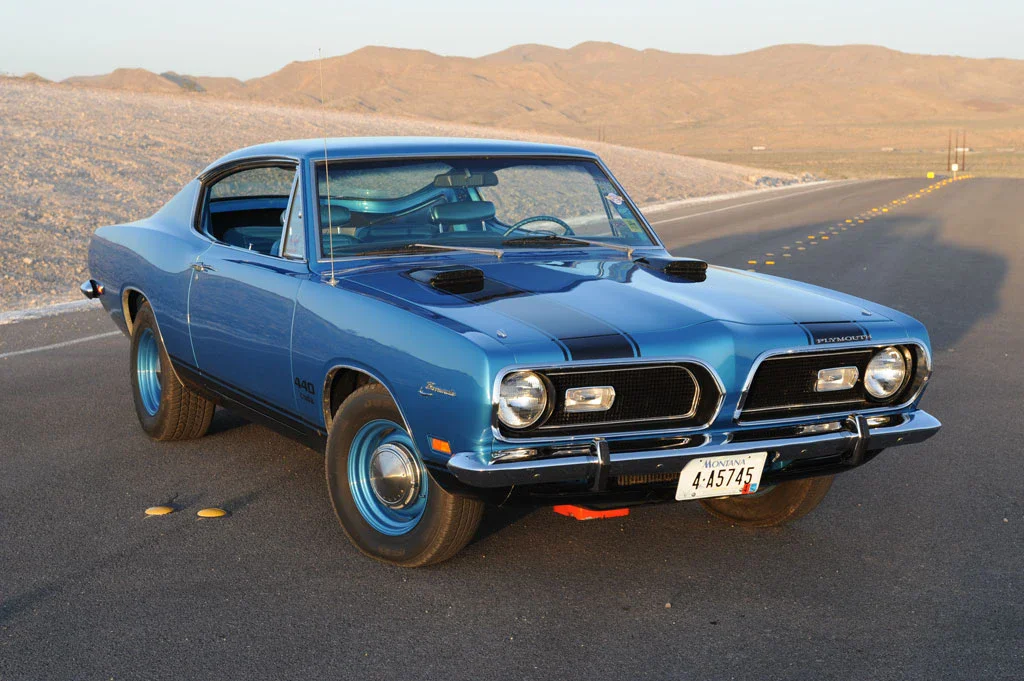
1. 1969 Plymouth ’Cuda 440: Big-Block Bravado at a Cost
The 1969 Plymouth ’Cuda 440 stands as one of the most extreme expressions of the late-1960s muscle car wars. While the Barracuda had existed since 1964, it was the second-generation A-Body cars that proved Plymouth’s drag-strip credibility.
Initially offered with capable 340- and 383-cubic-inch V8s, the ’Cuda still struggled to stand out against increasingly powerful rivals. Plymouth’s answer was radical: shoehorn a massive 440-cubic-inch RB big-block V8 into the compact Barracuda for 1969.
Rated at 375 horsepower and a formidable 480 lb-ft of torque, the Super Commando 440 gave the ’Cuda an undeniable straight-line presence.
An A13-optioned example tested by Hot Rod recorded a 13.89-second quarter mile at 103.21 mph with a three-speed Torqueflite automatic and aggressive 4.10 gearing. On paper, these numbers suggested dominance; in reality, the package was far more compromised.
The 440 ’Cuda was not factory-assembled in the traditional sense. All 400 examples were built as 383 cars and shipped to Hurst Performance in Michigan, where the big-block swap was completed. The result was an unbalanced machine.
Over 57 percent of the car’s weight sat on the front end, exacerbated by heavy, unassisted manual steering. Power steering, air conditioning, front disc brakes, and a four-speed manual were unavailable. Skinny E70-14 tires on narrow wheels struggled to manage the torque, while the modest rear end and sedan-spec automatic transmission dulled performance potential.
Despite its reputation, the 440 ’Cuda was only marginally quicker than the far better-balanced 340 ’Cuda, which had already proven itself as one of the best all-around pony cars of the era. Contemporary testers found the 440 version disappointing at the strip and deeply flawed on a road course, citing excessive understeer, weak braking, and slow steering.
Where the 440 ’Cuda did excel was effortless high-speed cruising, its torque making freeway passing trivial. Ultimately, it was a car built for bragging rights, impressive in concept, intimidating in appearance, but compromised in execution, and a clear illustration of how far the muscle car arms race had gone by 1969.
2. 1969 Chevrolet Nova SS: Compact Muscle with Big-Block Punch
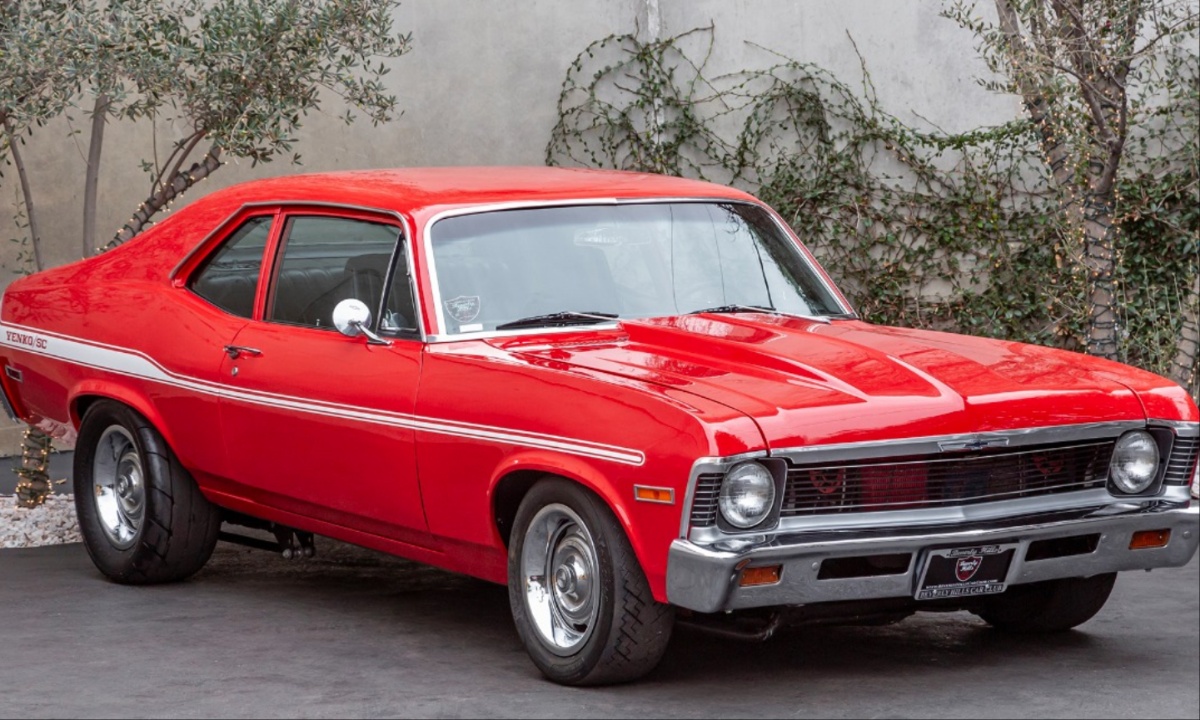
Often overshadowed by Chevrolet’s more famous muscle cars like the Chevelle and Camaro, the 1969 Chevrolet Nova SS remains one of the most underrated high-performance machines of the era. In SS form, the compact X-body could be ordered with the formidable 396-cubic-inch big-block V8.
When equipped with the L78 specification, it delivered a stout 375 horsepower and 415 lb-ft of torque. This potent combination gave the Nova serious straight-line credibility despite its smaller size and lower profile within Chevy’s lineup.
Fitted with 3.55 rear gears and a three-speed manual transmission, the Nova SS impressed testers at Hot Rod magazine. While average quarter-mile runs hovered in the low 14-second range, the quickest recorded pass came in at an impressive 13.87 seconds at 105.14 mph.
That performance placed the Nova SS firmly among the quickest street cars of 1969. Testers speculated that even better results might have been possible had Chevrolet approved the requested 4.10 gearing.
Beyond raw numbers, the Nova SS holds a special place in enthusiast lore, exemplified by stories like that of Norm Meads. As a 17-year-old high school student in Baltimore, Norm was deeply influenced by a Hot Rod road test of the L78 Nova.
With years of savings from paper routes and part-time work, and the support of his parents, he ordered a brand-new black-on-black SS396. Financing the car through GMAC, Norm balanced school, work, and weekend drag racing, quickly becoming the envy of his classmates.
Norm’s Nova was no garage queen. Equipped with factory performance options and later enhanced with period-correct modifications, it became a regular competitor at Capital Raceway, eventually running deep into the 12-second range. Life changes, including marriage and a police career, forced him to sell the car in the early 1970s, a decision that lingered for decades.
Years later, Norm set out to recapture that youthful dream. Though he never found his original car, he acquired a nearly identical 1969 Nova SS and restored it in the spirit of his original build. Today, it stands as a rolling reminder of the Nova SS’s appeal. It is compact, brutally quick, and capable of leaving an outsized impression that lasts a lifetime.
3. 1968 Mercury Cyclone GT: Cobra Jet Power Breaks the Mold
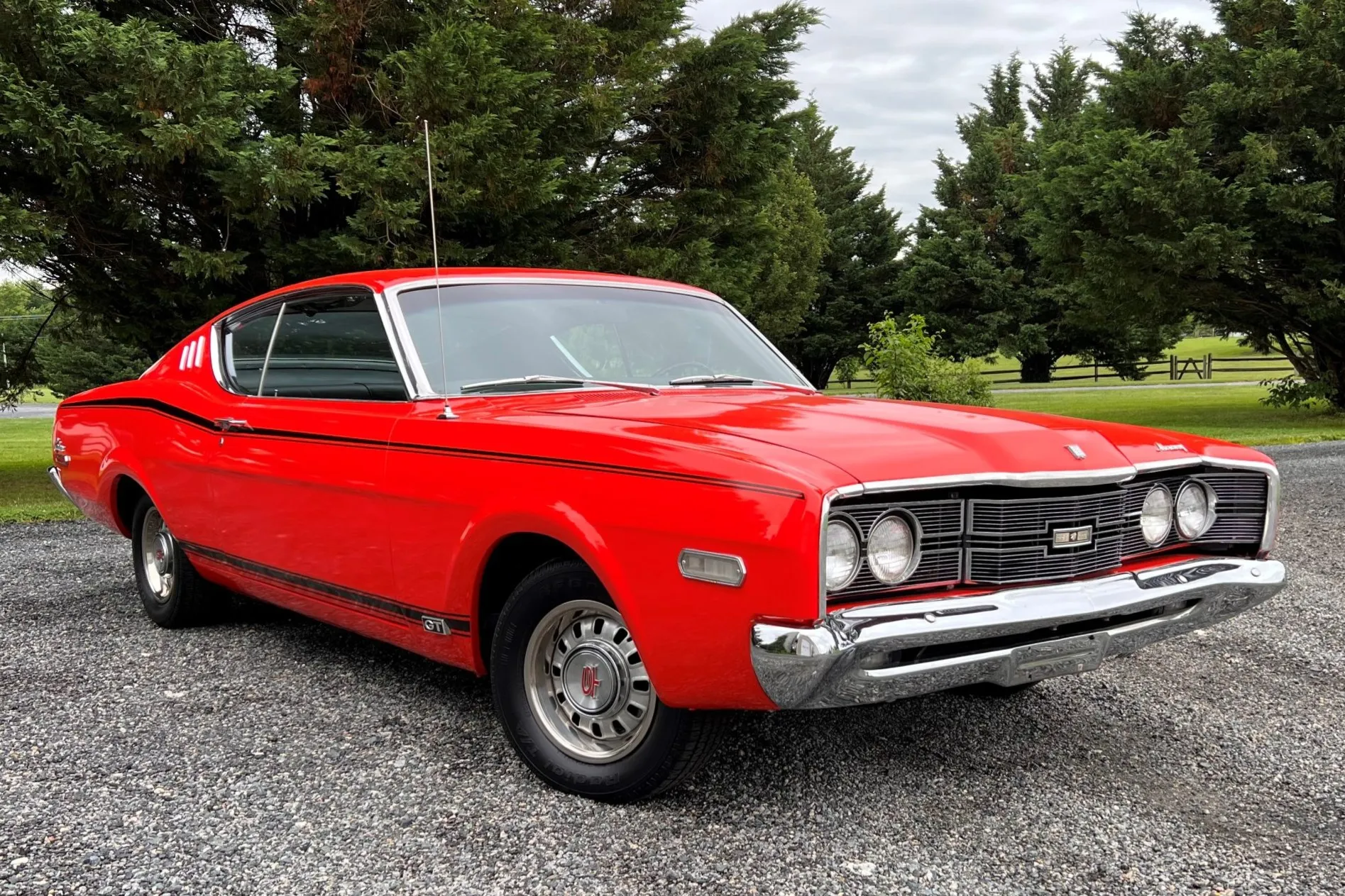
The 1968 Mercury Cyclone GT marked a turning point for Mercury’s performance image. Earlier Cyclones were essentially appearance and performance packages applied to the Fairlane-based Comet, but for 1968, the model emerged as a more distinct and serious muscle car.
Riding on the sleek new Torino fastback body, the Cyclone GT finally gave Mercury a street machine that matched its racing reputation.
Buyers could choose from several V8s, ranging from a modest 302 to various 390 options, but the standout was the 428-cubic-inch Cobra Jet. Officially rated at a conservative 335 horsepower and delivering 440 lb-ft of torque, the big-block was paired in test form with a three-speed automatic and aggressive 4.11 rear gears.
Despite tipping the scales at nearly 3,900 pounds, the Cyclone GT delivered impressive performance. Hot Rod recorded a best quarter-mile time of 13.86 seconds at 101.69 mph, along with a 0–60 mph sprint of 6.1 seconds.
Out of the box, the Cyclone ran mid-14s, but with minor tweaks such as removing the power steering belt and changing spark plugs, testers unlocked its full potential. Those numbers put it ahead of many contemporary intermediate muscle cars and helped reshape Mercury’s image, which had lagged behind rivals on the street despite strong results in professional racing.
Motor Trend’s Eric Dahlquist was especially enthusiastic, praising the Cobra Jet’s immense low-end torque and smooth power delivery. The engine did not need high rpm to perform, producing most of its thrust well below 5,500 rpm. Its conservative rating was influenced by rising insurance pressures, but that understated figure only helped its standing in stock-class drag racing.
The Cyclone GT also earned praise for its handling, with Dahlquist calling it one of the best-balanced Mercurys ever built. Nimble road manners and strong acceleration made it a well-rounded performer, though visibility from the fastback roof, dated interior trim, weak instrumentation, and heavy fuel consumption drew criticism.
With bold styling, serious performance, and Cobra Jet muscle under the hood, the 1968 Cyclone GT proved Mercury could build a true street contender. One hard pull through the gears was often all it took to make believers.
4. 1968 Chevrolet Camaro Z/28: Trans-Am Roots, Giant-Killer Performance
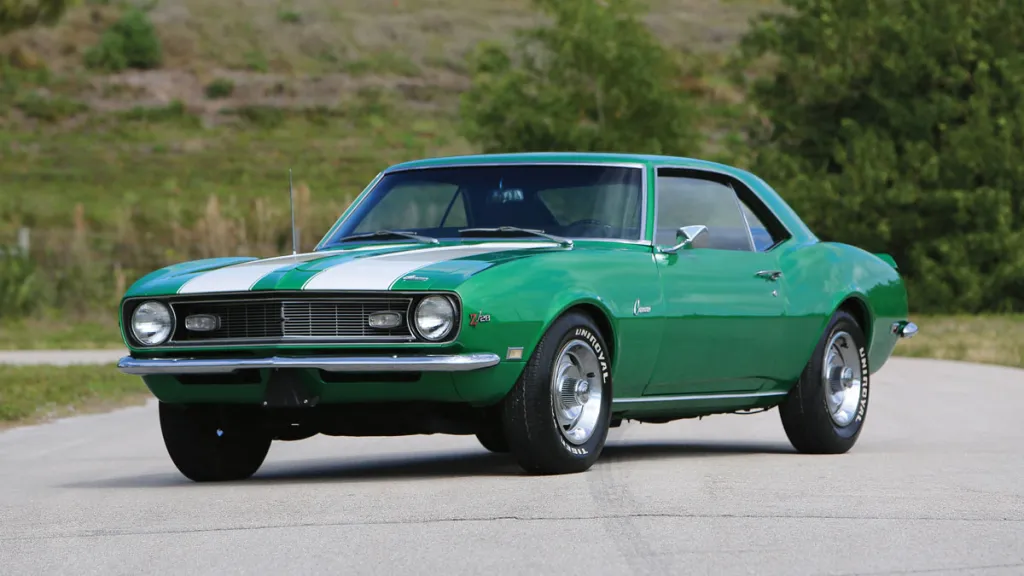
The 1968 Chevrolet Camaro Z/28 was never intended to win bench-racing contests on paper. Instead, it was engineered as a homologation special to qualify the Camaro for SCCA Trans-Am competition, and its real-world performance proved just how effective that focus could be.
When Car and Driver included the Camaro in a six-car muscle comparison alongside the Mustang and other notable contenders, the Z/28 finished ahead of its Ford rival despite giving up significant displacement and advertised horsepower.
At the heart of the Z/28 was a purpose-built 302-cubic-inch small-block V8. Officially rated at 290 horsepower and producing 333 lb-ft of torque, the engine was widely understood to deliver far more in reality, with estimates ranging from 360 to nearly 400 horsepower at high rpm.
Designed to thrive above 7,000 rpm, the 302 was paired with a close-ratio four-speed manual and aggressive 4.10 rear gears. The result was a startling performance for a small-block pony car. The Z/28 blasted through the quarter mile in 13.77 seconds at 107.39 mph and reached 60 mph in just 5.3 seconds.
Those numbers were not only quicker than contemporary Mustangs but also eclipsed far more exotic and powerful machinery, including the Ferrari 275 GTB/4 and even Chevrolet’s own 427-powered Corvette. The Z/28’s success underscored the advantage of high-revving power, low weight, and efficient gearing over brute displacement alone.
Beyond straight-line speed, the Camaro earned widespread praise for its handling. With track-focused suspension tuning, staggered rear shocks, and performance-oriented springs, the Z/28 delivered cornering ability that rivaled or exceeded contemporary Shelby Mustangs.
Disc brakes were standard, though some testers noted balance issues under heavy use. On the street, the aggressive camshaft and high compression made the car demanding in traffic, requiring premium fuel and a committed driver.
Stylistically, the 1968 model brought subtle refinements, including mandated side marker lights, revised lighting elements, and a more refined interior with anti-glare finishes. Today, the 1968 Camaro Z/28 stands as a landmark performance car, celebrated for its racing pedigree, giant-killing performance, and enduring collector appeal.
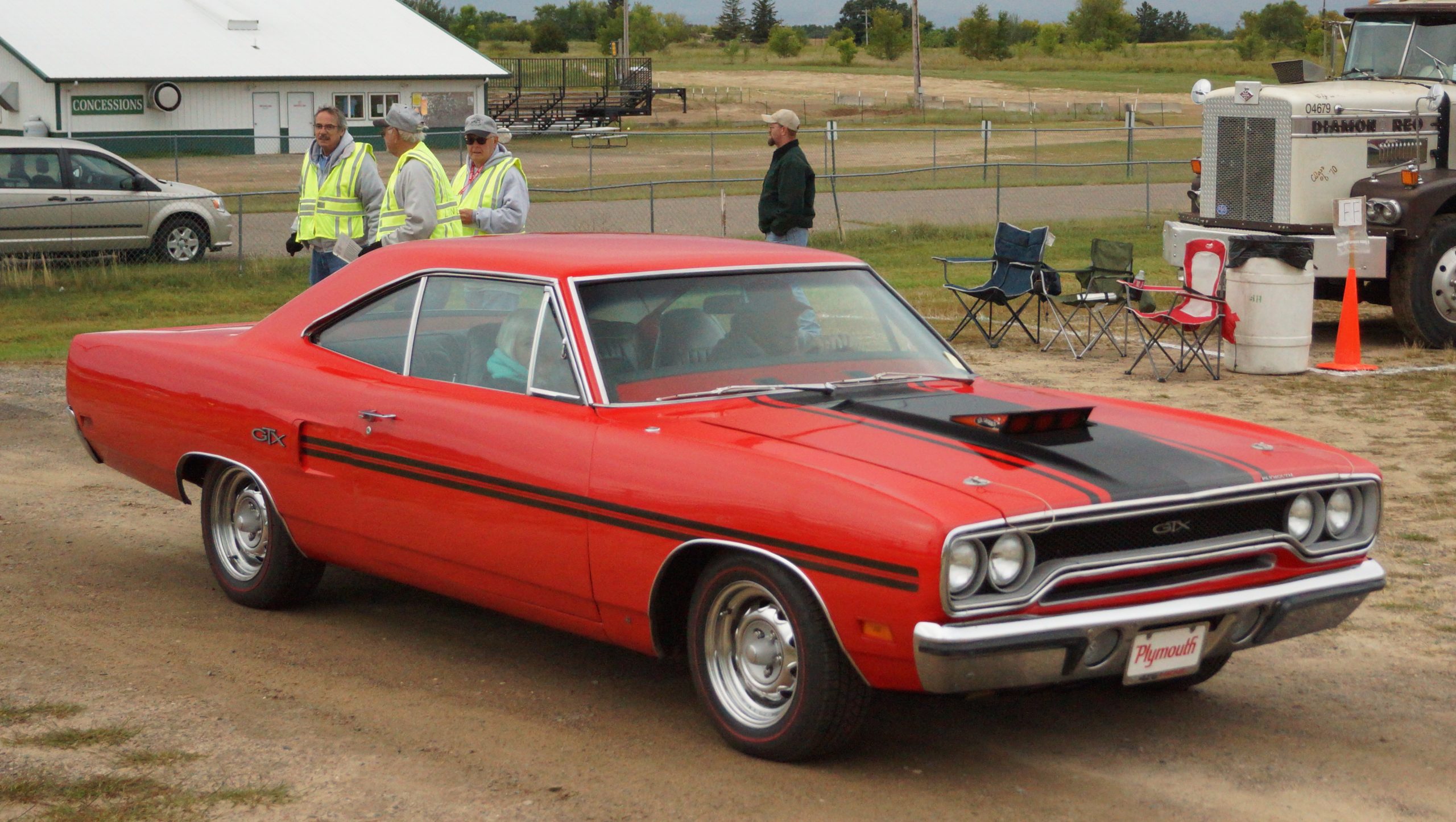
5. 1969 Plymouth GTX: Refined Muscle with Big-Block Authority
The 1969 Plymouth GTX occupied a unique place in the muscle car hierarchy. While the Road Runner earned fame as Plymouth’s stripped-down street brawler, the GTX was designed as a more upscale alternative that combined brute force with comfort and refinement.
Marketed as a “gentleman’s muscle car,” the GTX delivered serious performance without asking its driver to sacrifice interior quality or everyday usability.
Standard power came from Plymouth’s 440-cubic-inch Super Commando V8, rated at 375 horsepower and producing a massive 480 lb-ft of torque. Buyers seeking even more could step up to the optional 440 Six Pack, which added three two-barrel carburetors and extra power, or the legendary 426 Hemi.
Even in base 440 form, the GTX was a formidable performer. When Motor Trend tested a 1969 GTX equipped with a three-speed automatic transmission and aggressive 4.10 rear gearing, it recorded a quarter-mile time of 13.70 seconds at 102.8 mph.
Those numbers were slightly behind the lighter and more spartan Road Runner, but the context matters. The GTX carried additional weight from sound insulation, luxury trim, and standard equipment, making its performance all the more impressive. Acceleration from 0 to 60 mph took under six seconds, placing the GTX firmly among the elite muscle cars of its era.
Beyond straight-line speed, the GTX distinguished itself with a more refined driving experience. The interior featured bucket seats, a padded dashboard, full instrumentation, and higher-quality materials than Plymouth’s budget-oriented performance models.
The ride was more composed, with added sound deadening that made long-distance cruising far more pleasant, while still allowing the 440’s torque to dominate on demand.
Styling updates for 1969 included a revised grille and taillights that complemented the GTX’s muscular “Coke bottle” body lines. Subtle badging and restrained design cues reinforced its premium positioning.
Today, the 1969 Plymouth GTX is highly regarded by collectors for its blend of power, comfort, and relative rarity. It remains an ideal choice for enthusiasts who appreciate classic muscle car performance but prefer it delivered with polish and sophistication rather than bare-knuckle austerity.
Also Read: 5 Cars for Sioux Falls Practical Commuters vs 5 Cars That Break Often
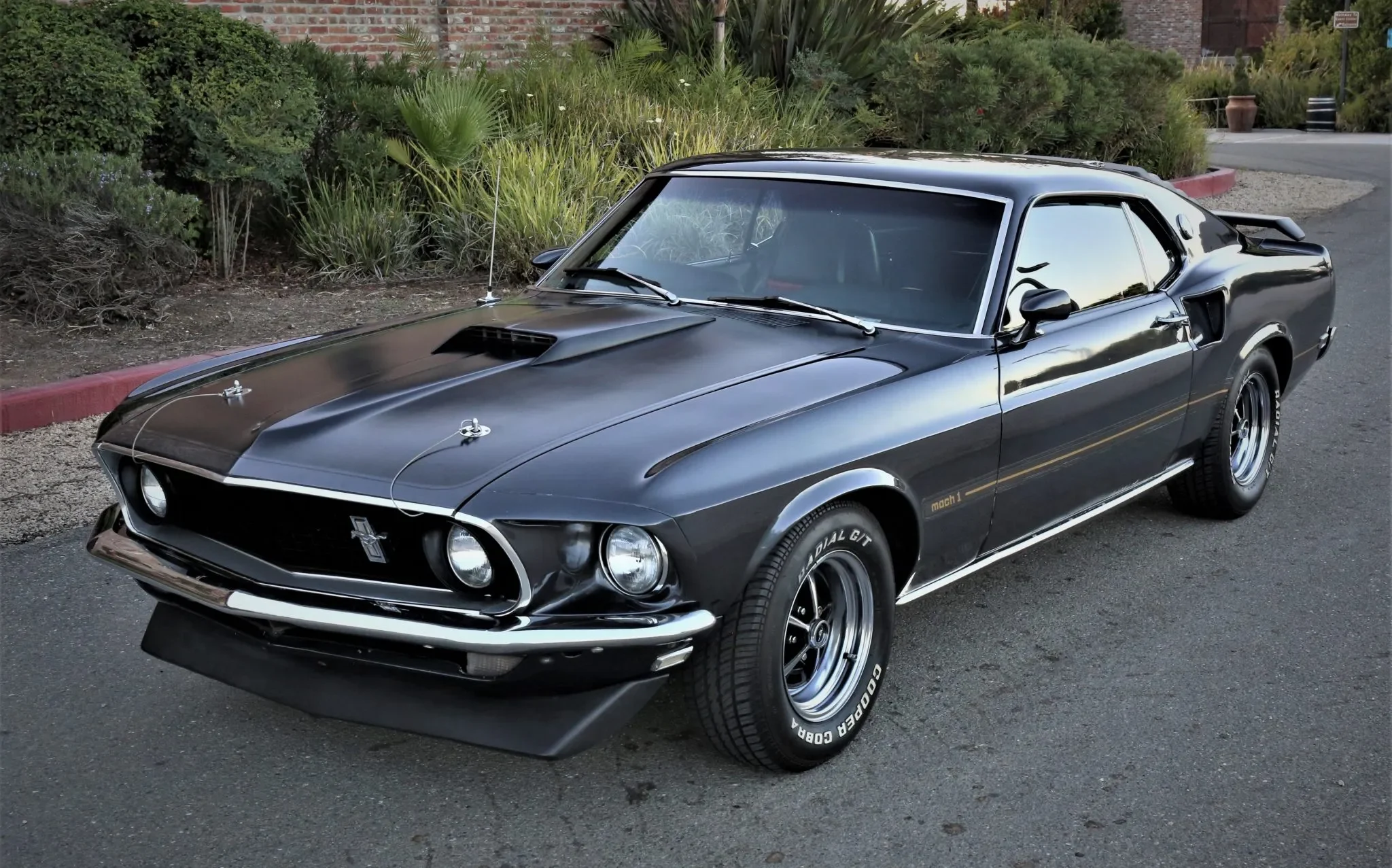
6. 1969 Ford Mustang Mach 1: Bold Style Meets Cobra Jet Muscle
The 1969 Ford Mustang Mach 1 debuted as Ford’s most aggressive-looking Mustang to date, blending dragstrip attitude with showroom flair. Introduced as a performance-oriented fastback, the Mach 1 featured a lowered roofline, raked windshield, hood pins, inset headlights, simulated side scoops, and a rear spoiler.
Visually, it projected serious intent, and buyers had a wide range of powertrain options to match the image.
Standard power came from a 351 cubic inch V8, but the real attraction was the optional 428 cubic inch Cobra Jet. Officially rated at a conservative 335 horsepower with 440 lb-ft of torque, the Cobra Jet was already legendary in drag racing circles.
In January 1969, Popular Hot Rodding tested a Mach 1 equipped with the 428 Cobra Jet, Ram Air induction, a three-speed automatic, and 3.50 rear gears. In pure stock condition, the car delivered a strong quarter-mile time of 13.69 seconds at 103.44 mph, firmly placing it among the quickest Mustangs of the era.
Straight-line performance was the Mach 1’s strongest suit. The Cobra Jet produced massive low-end torque, allowing effortless highway passing and explosive acceleration once traction was available. Its deep exhaust note and dual chrome-tipped pipes reinforced the car’s muscle car persona.
However, putting that power to the pavement proved challenging. The 1969 Mustang grew in size, with much of the added length placed ahead of the front wheels. As a result, weight distribution was heavily front-biased, limiting traction and dulling handling.
Contemporary road tests noted that despite its dramatic appearance and formidable engine, the Mach 1 struggled to fully exploit its performance potential. Wheelspin was a constant issue, even with F70 Goodyear Polyglas tyres, and handling suffered from the nose-heavy balance.
Most testers agreed the automatic transmission helped manage power delivery better than a manual, though wide, sticky tyres were considered essential for anyone serious about drag racing.
Still, the Mach 1 delivered exactly what many buyers wanted. It looked fast standing still, sounded intimidating at full throttle, and could run solid mid-13-second quarter miles straight off the showroom floor. While not the sharpest-handling Mustang, the 1969 Mach 1 with the 428 Cobra Jet remains an icon of late-1960s muscle, combining bold styling, big-block torque, and undeniable street presence.
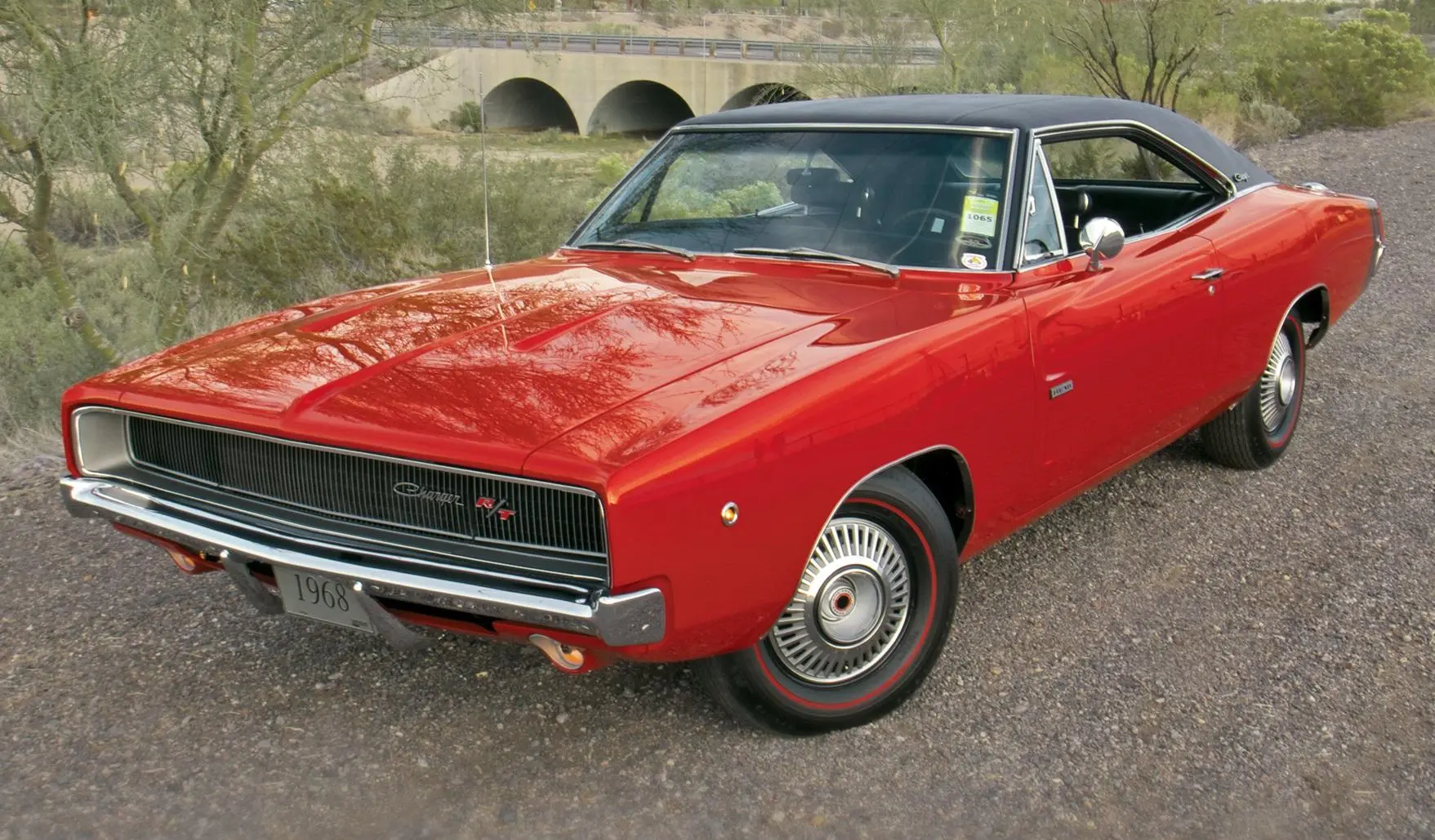
7. 1968 Dodge Charger Hemi: Full-Size Muscle with Legendary Power
The 1968 Dodge Charger Hemi represents one of the most formidable combinations of style, size, and performance to emerge from the golden age of muscle cars. As part of the first-generation Charger lineup, the 1968 model benefited from dramatic “Coke bottle” styling, hidden headlights, and a long, low profile that made it instantly recognisable.
Beyond its looks, the Charger Hemi delivered performance that justified its fearsome reputation and explains why it remains one of the most valuable classic Mopars today.
At the heart of the Charger Hemi was Chrysler’s legendary 426 cubic inch Hemi V8. Rated at 425 horsepower and producing a massive 490 lb-ft of torque, the engine was engineered for both street dominance and racing credibility.
Despite the Charger’s substantial dimensions, stretching more than 208 inches in length and weighing just over 4,000 pounds, the Hemi provided relentless acceleration. In testing conducted by Car and Driver, a 1968 Charger equipped with the Hemi, a three-speed automatic transmission, and relatively tall 3.23 rear gears recorded a quarter-mile time of 13.50 seconds at 105 mph.
Those results were impressive for a car of its size and configuration, especially considering the conservative gearing, which favoured highway cruising over all-out drag strip launches.
Acceleration from 0 to 60 mph took just 4.8 seconds, placing the Charger Hemi among the quickest street cars of its era. While its top speed of around 156 mph would later be eclipsed by modern performance cars, the Charger’s ability to surge forward from a stoplight made it a serious threat on the street.
The Charger Hemi was not merely about straight-line speed. Its long wheelbase contributed to a stable ride at high speeds, making it well-suited for highway runs and extended cruising. That said, its size and weight meant it was never intended to be a nimble corner carver. Instead, it excelled as a high-speed grand touring muscle machine with overwhelming power available at a moment’s notice.
Today, the 1968 Dodge Charger Hemi stands as a symbol of excess done right. It combined outrageous engine technology with dramatic styling and real-world performance, creating a muscle car that continues to command respect, admiration, and significant collector value more than five decades later.
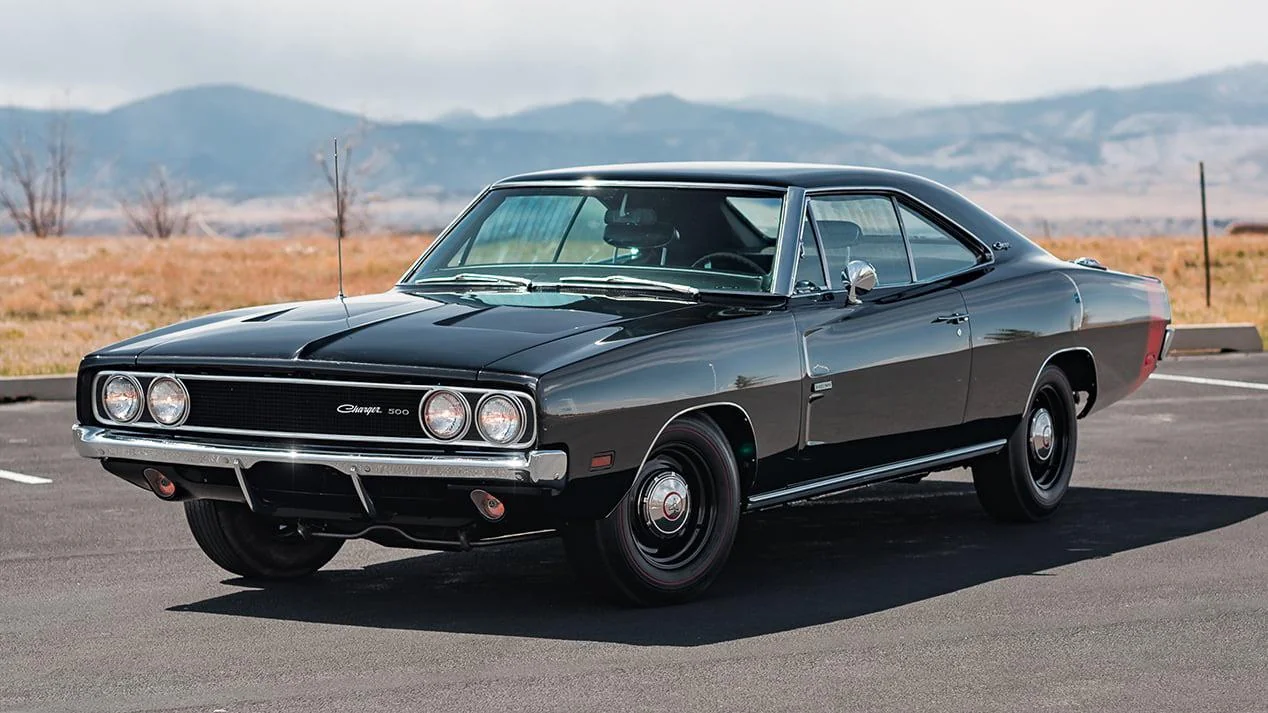
8. 1969 Dodge Charger 500: Aerodynamics Meet Hemi Power
The 1969 Dodge Charger 500 stands as one of the most significant yet understated muscle cars of the late 1960s. Born from NASCAR’s homologation rules and Dodge’s escalating rivalry with Ford, the Charger 500 represented a critical shift in performance thinking.
Raw horsepower was no longer enough. Reducing drag and improving high-speed stability had become essential, and the Charger 500 was Dodge’s first serious step in that direction.
Visually similar to the standard Charger, the 500 featured subtle but effective aerodynamic revisions. The deeply recessed grille of the regular Charger was replaced with a flush-mounted design borrowed from the Coronet, while the dramatic flying-buttress rear window was eliminated in favour of a laid-back, “plugged” backlight.
These changes reduced drag and rear lift, curing the high-speed instability that plagued earlier Chargers on NASCAR’s fastest tracks. Though restrained compared to the later Daytona, the Charger 500’s bodywork delivered meaningful gains where it mattered most.
Under the hood, buyers could choose several big-block engines, but the ultimate configuration paired the Charger 500 with Chrysler’s legendary 426 cubic inch Hemi V8. Rated at 425 horsepower and producing 490 lb-ft of torque, the Hemi transformed the already improved Charger into a genuine performance threat.
With 4.10 rear gearing, a Hemi-equipped Charger 500 tested by Hot Rod ran the quarter mile in 13.48 seconds at 109 mph, placing it among the quickest American production cars of the decade.
Contemporary road tests showed 0 to 60 mph times in the mid-five-second range and consistent mid-13-second quarter-mile capability. While straight-line acceleration was similar to that of a Hemi ’Cuda, the Charger 500’s aerodynamic advantage allowed it to excel at sustained high speeds, particularly on long straights and high-speed ovals.
This made it an ideal platform for NASCAR competition and a preview of Dodge’s more extreme aero experiments to come.
Production numbers were extremely limited, with fewer than 600 Charger 500s built and only a fraction equipped with the Hemi. That rarity, combined with its direct NASCAR lineage, has made the Charger 500 one of the most desirable Mopars in existence. Today, it represents a pivotal moment in muscle car history, when Detroit learned that airflow could be just as powerful as cubic inches.
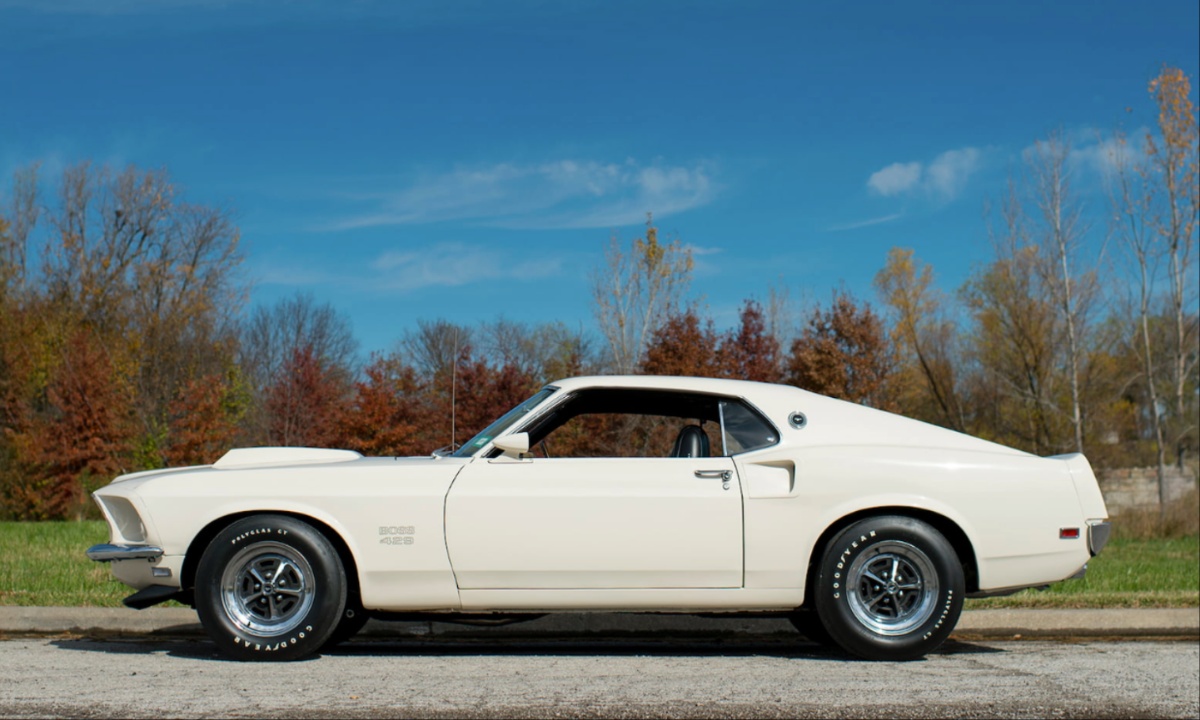
9. 1969 Mustang Boss 429: NASCAR Engineering Meets Street Muscle
The 1969 Mustang Boss 429 was Ford’s answer to NASCAR’s 426 Hemi and part of the Blue Oval’s Total Performance initiative. Designed as a homologation special, it featured a massive 429-cubic-inch V8 with aluminium heads on a cast-iron block, large ports, and staggered valves.
Officially rated at 375 horsepower and 450 lb-ft of torque, the engine’s true output likely exceeded 500 horsepower. Period tests recorded quarter-mile runs of 13.34 seconds at 107 mph, showcasing the Boss 429 as one of the era’s fastest production Mustangs.
Ford’s goal was to create a car capable of competing on the track while still retaining street usability. The Boss 429’s drivetrain included a 9-inch rear with Traction-Lok, 3.91 gearing, and a Ford Top Loader four-speed manual.
Its chassis could accommodate the massive engine, and stock F60/L60 Goodyear tires were standard. However, the car was not just about raw power; it incorporated design solutions inspired by NASCAR, such as the tall dual-point distributor, Holley 1,050-cfm Dominator carburettor, and a single-plane aluminium Spider Dominator intake manifold for high-RPM breathing.
Coolant was routed through the cylinder heads to manage the engine’s heat, reflecting race-derived engineering.
Rick Parker’s restored Boss 429 offers a period-correct homage to early 1970s NASCAR modifications. After acquiring a former drag-race Boss, Parker upgraded the rear gears to 4.30, installed larger rear tires, and fitted 1970-style dual mufflers to improve exhaust flow.
A Comp Cams high-lift cam enhanced performance while retaining street drivability. The exterior remained largely stock but received minor touches like a chrome-edged Grande grille replacing the blackout Boss grille, giving the car sharper styling while preserving its classic character.
This combination of factory and race-inspired upgrades produced a Mustang that was faster and more responsive than the original, yet still suitable for street driving. Parker’s Boss 429 demonstrates how the car could have been improved while honouring its historic engineering.
Beyond speed, the Mustang’s appeal lies in its direct NASCAR heritage, innovative engine design, and bold styling, making it both a collector’s gem and a representation of the apex of late-1960s American muscle engineering.
Rick’s build shows that the Boss 429 was not only a street car but a performance icon that captured the excitement and ingenuity of Ford’s Total Performance era.
10. 1969 Plymouth Road Runner: Affordable Power Meets Legendary Muscle
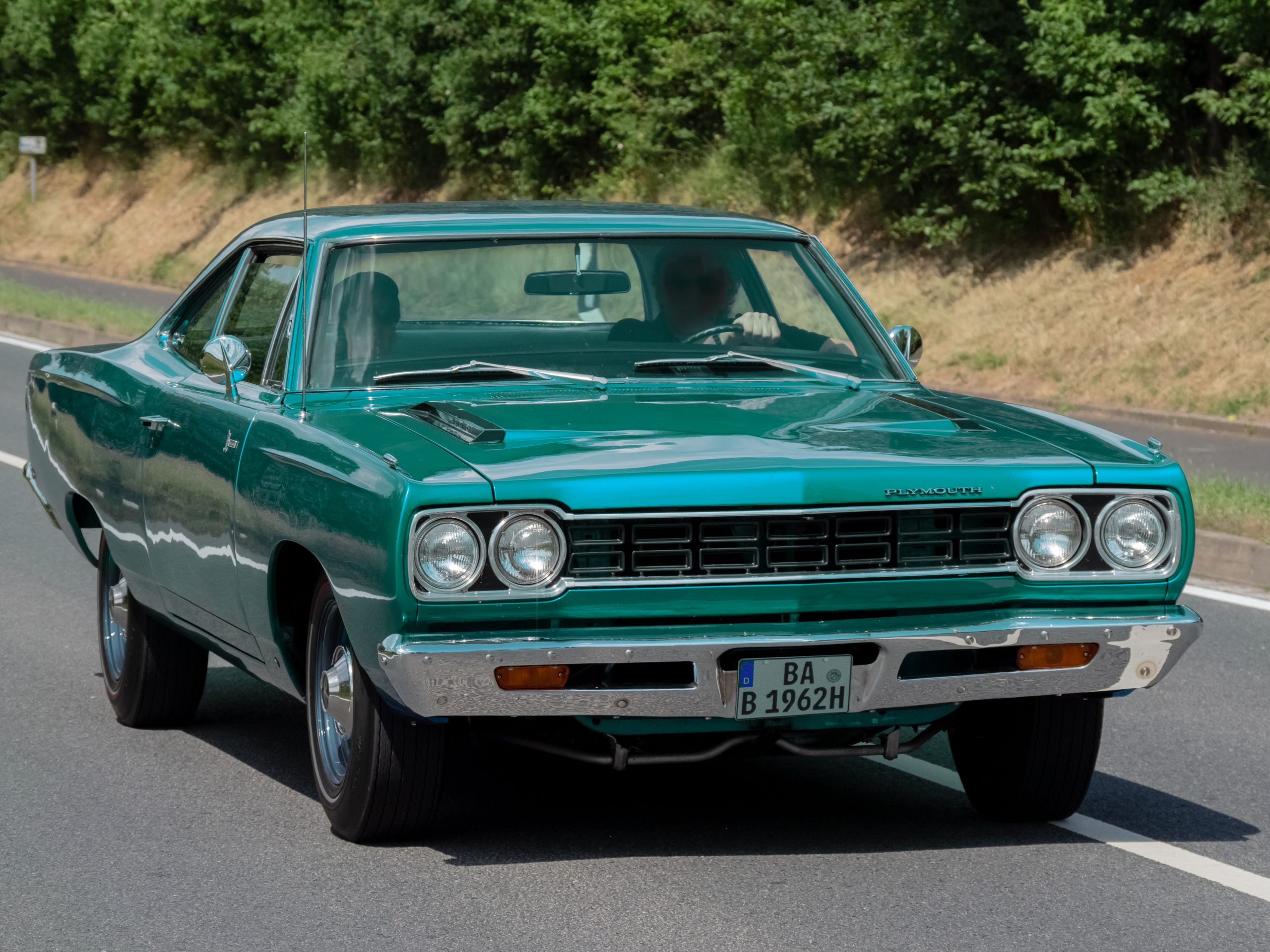
The 1969 Plymouth Road Runner stands out as one of the most iconic and practical muscle cars of its era, earning MotorTrend’s Car of the Year award for its blend of performance, affordability, and distinctive style. With its Road Runner graphics, beep-beep horn, and Coyote Duster air cleaner, the car remains a cultural and automotive icon.
While the base 383 engine was capable, it was the optional 426-cubic-inch Hemi V8 that truly unleashed the Road Runner’s potential, delivering 425 horsepower and 440 lb-ft of torque.
Paired with a TorqueFlite three-speed automatic and 4.10 gears, the Hemi-equipped Road Runner achieved a blistering quarter-mile of 13.32 seconds at 107.65 mph on F70-15 tires, demonstrating its serious performance credentials.
Ronnie Clark of Alamosa, Colorado, provides a unique example of the Road Runner’s history. After missing out on a Hemi Charger due to family decisions, Clark special-ordered a ’69 Road Runner in Bronze Fire Metallic with the Hemi, Super Trak Pak axle package, and front disc brakes.
Though intended for racing, the car became a family vehicle, demonstrating the Road Runner’s versatility. Clark and his wife relied on it for daily driving, including trips over mountain passes in blizzards, proving that muscle cars could be practical as well as fast.
Over the years, the Road Runner remained largely original. Aside from a fresh repaint after minor damage, the car retains its original engine, 4-speed manual transmission with Hurst shifter, Dana 60 rear with 4.10 gears and Sure-Grip differential, and black vinyl bucket-seat interior.
It has logged just 60,000 miles, maintaining a remarkable degree of authenticity with original Torq-Thrust wheels and tires.
The Clark family’s care and documentation highlight the Road Runner’s value as both a collector car and a personal classic. Every build sheet, registration, and purchase receipt from 1969 has been preserved, reflecting the sentimental and historical significance of the vehicle.
With its combination of straight-line speed, everyday usability, and historical relevance, the 1969 Plymouth Road Runner exemplifies the golden age of American muscle cars. It remains a symbol of accessible performance and a testament to the enduring appeal of Mopar engineering.
Ronnie Clark’s Road Runner shows that muscle cars can be both cherished family vehicles and high-performance legends, a rare balance few models achieve.
The decade of the 1960s produced some of the most memorable and extreme muscle cars in automotive history, and the ten machines featured here embody that legacy.
Each car, from the ferocious Plymouth Road Runner to Ford’s NASCAR-inspired Boss 429, illustrates the ingenuity and ambition that defined the muscle car wars. Beyond raw numbers, these vehicles captured the imagination of enthusiasts, blending performance, style, and personality in ways that went beyond mere horsepower.
They were engineered to thrill, whether through a perfectly timed quarter-mile or the commanding presence they brought to the street. Today, these cars remain coveted collector pieces, representing the pinnacle of a performance-driven era before safety and emissions regulations reshaped American automotive priorities.
The stories behind them, including the races, restorations, and personal connections, remind us that muscle cars of the ’60s were more than machines; they were cultural icons that embodied freedom, audacity, and the thrill of speed.
Also Read: 10 Cars That Look Stunning But Disappoint True Enthusiasts
