
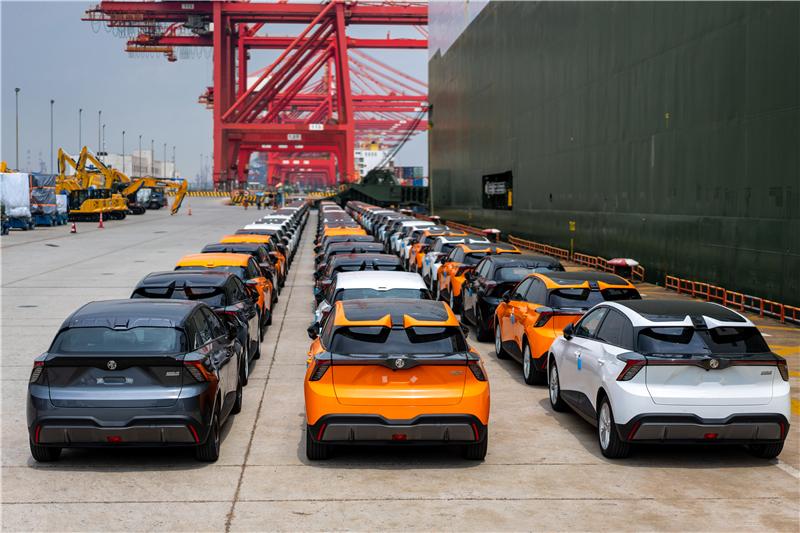
Chinese electric vehicle exports are accelerating at a pace that’s becoming impossible for Western automakers to ignore. Through November, global exports climbed 29 percent, with nearly 2 million Chinese EVs shipped across Asia, Europe, and key emerging markets. The momentum is building fast, and the latest numbers suggest there’s little the West can do to meaningfully stop it.
Not long ago, Chinese-built cars were widely dismissed as cheap knockoffs. Today, they represent one of the most serious competitive threats Western automakers have faced in decades. Fresh data from China’s General Administration of Customs shows electric vehicle exports spiked an eye-catching 87 percent in November, underscoring just how quickly the landscape is shifting.
That November surge marks a dramatic increase compared to last year, and Mexico stood out as the single biggest destination. Chinese EV exports to the country skyrocketed by 2,367 percent, reaching 19,344 units in just one month. While the data doesn’t specify which models drove the jump, the BYD Dolphin Mini has gained significant traction south of the U.S. border.
The compact EV stretches just 148.8 inches (3,780 mm) in length and uses a front-mounted electric motor producing 74 hp (55 kW / 75 PS) and 100 lb-ft (135 Nm) of torque. Buyers can choose between 30.1 kWh and 38.8 kWh battery packs, delivering a NEDC-rated range of up to 236 miles (380 km), making it an attractive, affordable urban option.
After Mexico, Indonesia and Thailand rounded out the top export markets in November. Indonesia imported 17,503 Chinese EVs, while Thailand followed closely with 13,517 units.

Europe continues to be a focal point of concern. Exports to the UK surged 113 percent in November, totaling 9,096 vehicles for the month. That brings year-to-date shipments to 121,555 units, representing a 24 percent increase compared to the same period last year.
Belgium tells a slightly different story. While it has absorbed a massive 195,309 Chinese EVs in the first 11 months of the year, that figure actually represents a 15 percent decline compared to 2024. Even so, the volume remains enormous and highlights how deeply Chinese manufacturers have penetrated the European market.
Asia remains the dominant destination for Chinese EV exports. In November alone, shipments to the region rose 71 percent to 110,061 units. Europe and Latin America, including the Caribbean, followed behind.
Through November, Asian markets have imported nearly 1 million Chinese EVs. Europe, however, stands out with 604,105 vehicles delivered so far this year. That total is 12 percent higher than in 2024 and clearly explains why European automakers, and policymakers, are increasingly alarmed.
Taken together, the numbers paint a clear picture: Chinese EV makers are scaling globally at speed, leveraging cost advantages, aggressive pricing, and fast product cycles. As exports continue to rise, the challenge for Western manufacturers isn’t just about tariffs or regulations, it’s about competing with an industry that has already gone fully global.
Also Read: Top 10 Used Jaguar Models That Won’t Ruin You With Repairs
