
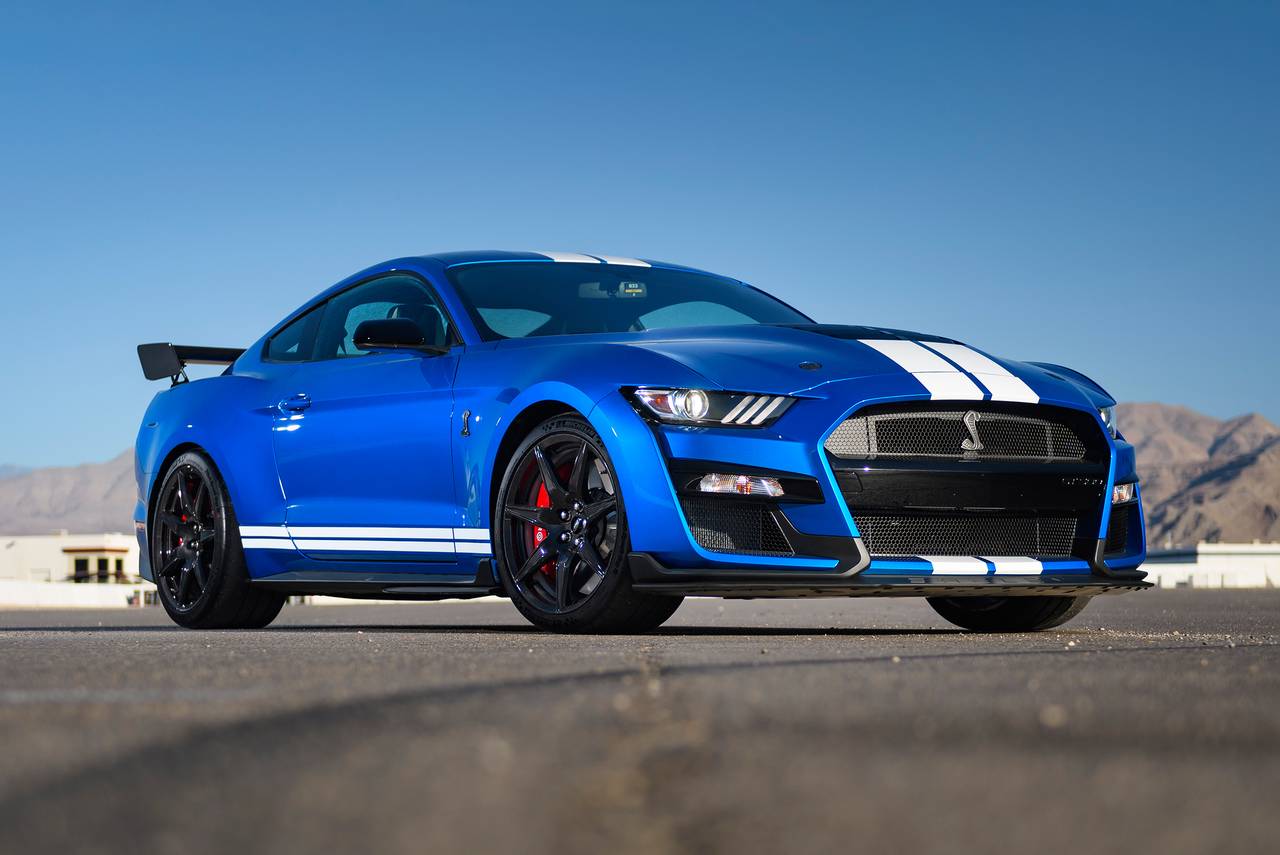
Muscle cars are a cornerstone of American automotive culture, and while they’re celebrated for aggressive styling, roaring V8 engines, and straight-line dominance, nothing captures their essence quite like a fast quarter-mile time.
The quarter-mile has long been the benchmark for performance enthusiasts, drag racers, and car reviewers alike. It’s where raw power, traction, and engineering finesse converge to produce an adrenaline-charged sprint from a standstill to 1,320 feet down the strip.
Over the decades, American muscle car manufacturers have continuously pushed the boundaries of what’s possible, building vehicles capable of mind-bending acceleration. Here’s a look at ten muscle cars with the quickest quarter-mile times, showcasing the pinnacle of straight-line performance in U.S. muscle cars.
1. Dodge Challenger SRT Demon (2018)
The Dodge Challenger SRT Demon is the undisputed king of the quarter-mile among modern muscle cars. With a supercharged 6.2-liter HEMI V8 producing 840 horsepower on race fuel and 770 horsepower on pump gas, it rockets from 0-60 mph in just 2.3 seconds.
Its drag-specific design, featuring transbrake, line-lock, and 315mm drag radial tires, allows it to complete the quarter-mile in a staggering 9.65 seconds at 140 mph, making it the fastest production muscle car in history. In the U.S., the Demon represents the ultimate combination of muscle car heritage and modern engineering bravado.
The Challenger SRT Demon sits on an entirely different level than the already ferocious Hellcat, delivering as much as 840 horsepower along with drag-racing hardware you won’t find on any other Dodge. And yes, it’s capable of pulling the front wheels off the ground.
Although this limited-run monster bowed out after the 2018 model year, it still stands as one of the wildest and most memorable vehicles ever to carry a Dodge badge.
Several of its engine and transmission upgrades have since trickled down to the Challenger SRT Hellcat Redeye, but that doesn’t diminish the Demon’s legacy.
Even today’s most extreme pony cars, including the 650-hp Chevrolet Camaro ZL1 and the new Ford Mustang Shelby GT500 with more than 700 horsepower, struggle to rival the Demon’s straight-line brutality.
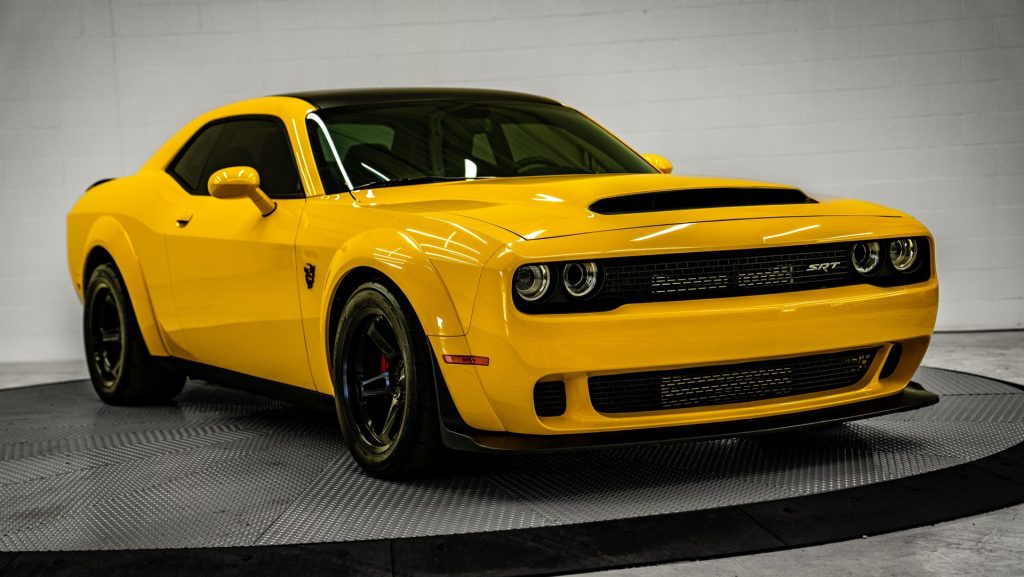
That package includes a specialized engine controller designed to unleash the motor’s full output. Combine that extra power with aggressive weight reduction, achieved by removing various interior components and employing multiple mass-saving strategies, and Dodge says the Demon can rip through the quarter-mile in just 9.65 seconds at 140 mph.
Although we never ran one through our own test track, we did put seat time in at the drag strip, where its neck-snapping launches left no doubt about its capabilities. Of course, that kind of performance isn’t simply the result of massive horsepower and torque.
The Demon comes loaded with purpose-built upgrades, many of which we’ve already broken down in detail. Among the standouts are adjustable dampers engineered to shift weight rearward during launches.
The standard eight-speed automatic transmission features a trans brake that delivers even harder starts, along with several other performance-focused tweaks. Ultra-sticky tires come standard beneath the car’s aggressively flared fenders, and the Demon Crate also includes a pair of ultra-narrow 4.5-inch front wheels, though you’ll need to supply the tires yourself.
While this drag-strip weapon was never designed for tight corners or winding back roads, it’s surprisingly civil when cruising to car shows or local meetups.
2. Dodge Charger SRT Hellcat Redeye (2019-Present)
The Charger SRT Hellcat Redeye takes the classic full-size American muscle car and infuses it with supercharged fury. Its 6.2-liter supercharged HEMI V8 produces 797 horsepower, enabling quarter-mile times in the 10.8-second range at over 130 mph.
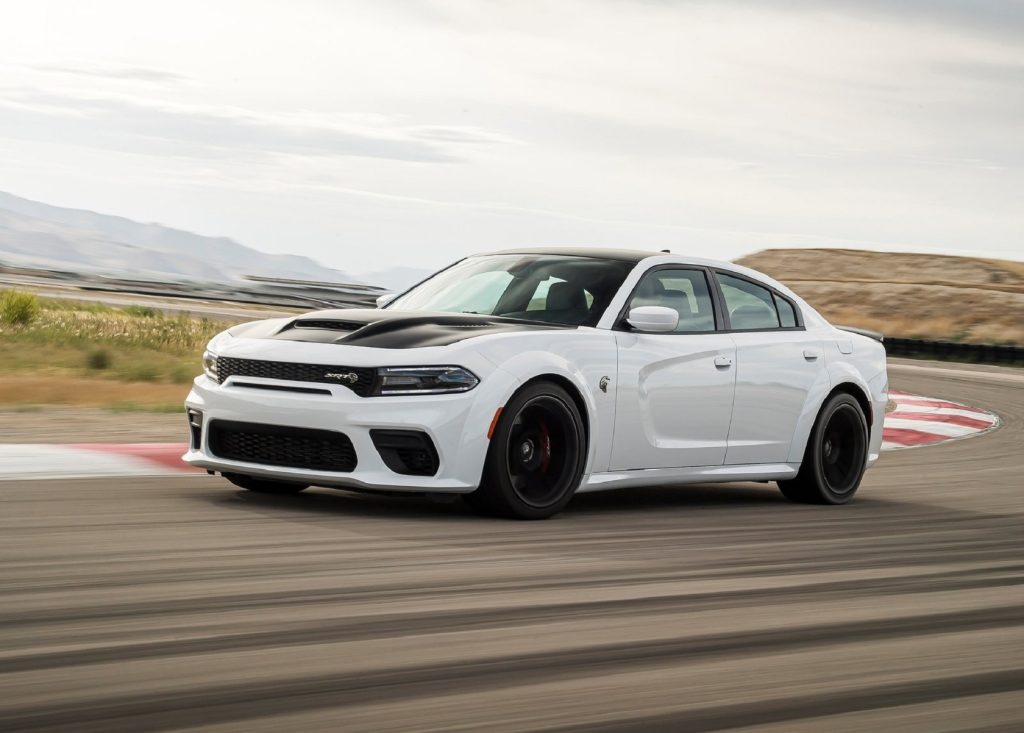
Despite its size, the Redeye proves that full-size sedans can dominate the drag strip, blending muscle car tradition with modern technological advancements. For U.S. enthusiasts, it’s a thrilling statement: four doors, immense power, and a quarter-mile that leaves competitors in the dust.
3. Chevrolet Camaro ZL1 1LE (2018-Present)
The Camaro ZL1 1LE isn’t just a corner-carving track machine, it’s also capable of seriously fast straight-line performance. Its 6.2-liter supercharged LT4 V8 delivers 650 horsepower, allowing it to complete the quarter-mile in about 11.2 seconds at roughly 127 mph.
Its combination of power, weight reduction, and drag-focused setup makes it one of the most versatile modern Camaros, appealing to American drivers who demand speed both on the strip and on twisty backroads.
The Camaro’s 650-hp supercharged 6.2-liter V-8 is impressively tractable and well-mannered, delivering strong power throughout the rev range. Whether it’s mated to the standard six-speed manual or the available 10-speed automatic, this supercharged small-block V-8 is a serious powerhouse, cranking out 650 pound-feet of torque.
Even in less extreme trims, the Camaro is a joy to drive, offering responsive, communicative steering, a well-balanced rear-wheel-drive chassis, and a surprisingly pliant ride.

The ZL1 amplifies all these strengths. Its adaptive dampers adjust stiffness depending on the selected drive mode, yet even the most aggressive settings don’t ruin the car’s otherwise firm but manageable ride.
For drivers seeking more, the 1LE Extreme Track Performance package, exclusive to the coupe, catapults the ZL1’s cornering capabilities into supercar-level territory.
The package combines wider, grippier tires, a manually adjustable front suspension, and unique spool-valve dampers to make racetrack laps both faster and more exhilarating. When it comes to stopping power, the ZL1 halts from 70 mph in just 143 feet, with a brake pedal that offers the precise firmness you’d expect from a serious performance machine.
Also Read: Top 10 Most Gorgeous Italian Sports Bikes Ever
4. Ford Mustang Shelby GT500 (2020-Present)
The latest Shelby GT500 pushes the boundaries of what a modern Mustang can achieve. Equipped with a 5.2-liter supercharged V8 producing 760 horsepower, it accelerates from 0-60 mph in 3.3 seconds and completes the quarter-mile in about 10.5 seconds.
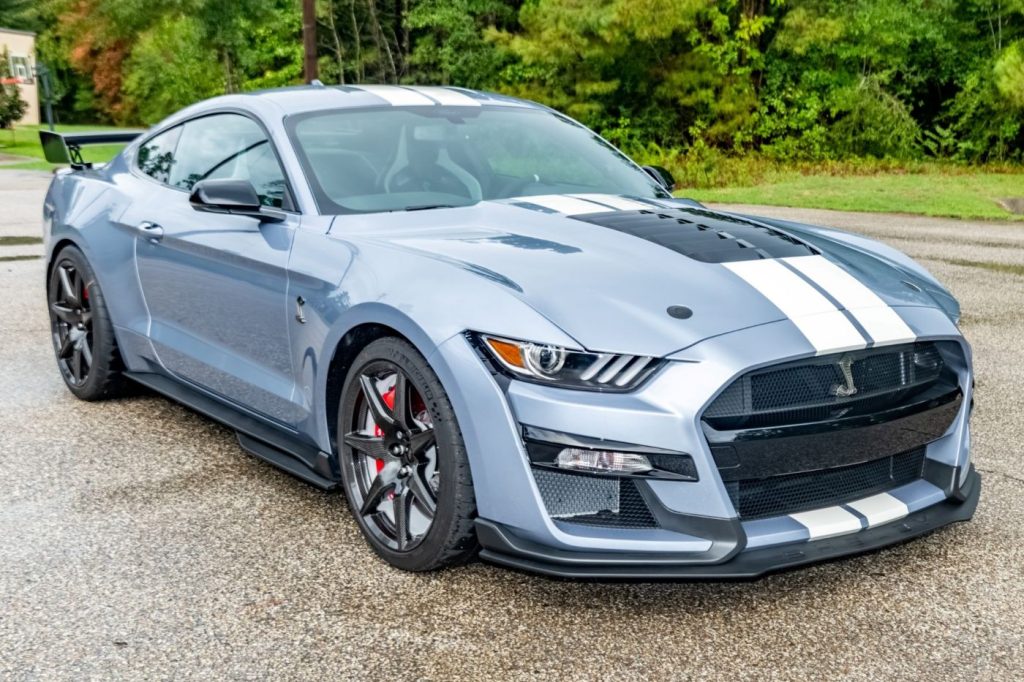
With modern launch control, magnetic ride suspension, and aerodynamic enhancements, the GT500 blends traditional Mustang styling with the capability to compete with the fastest production muscle cars ever built in the U.S.
5. Dodge Challenger R/T Scat Pack Widebody (2020-Present)
While not as extreme as the Hellcat or Demon, the R/T Scat Pack Widebody delivers impressive quarter-mile performance thanks to its naturally aspirated 6.4-liter HEMI V8 producing 485 horsepower.
With a 0-60 mph time around 4.3 seconds, it can complete the quarter-mile in roughly 12.8 seconds. Its widebody tires improve traction, making it a formidable competitor for enthusiasts who want fast quarter-mile times without moving into supercharged territory.
History suggests that the 2021 Dodge Challenger competes directly with the Chevrolet Camaro and Ford Mustang, but in reality, it has an entirely different character.
All three American muscle icons boast high-powered V-8 engines, yet their driving experiences are worlds apart. Where the Camaro and Mustang excel with razor-sharp handling, the Challenger leans into a more relaxed, cruiser-friendly personality, always ready to unleash a crescendoing V-8 exhaust note on demand.
For those chasing maximum firepower, the SRT Hellcat delivers up to 807 horsepower. Inside, the Challenger may not always offer the best visibility or the most refined design, but it makes up for it with more comfortable seats and greater passenger space than its rivals.
Its large trunk, segment-exclusive all-wheel-drive option, and a wide array of vibrant paint choices and retro-inspired appearance packages help the Challenger carve out its own niche against the Camaro and Mustang.
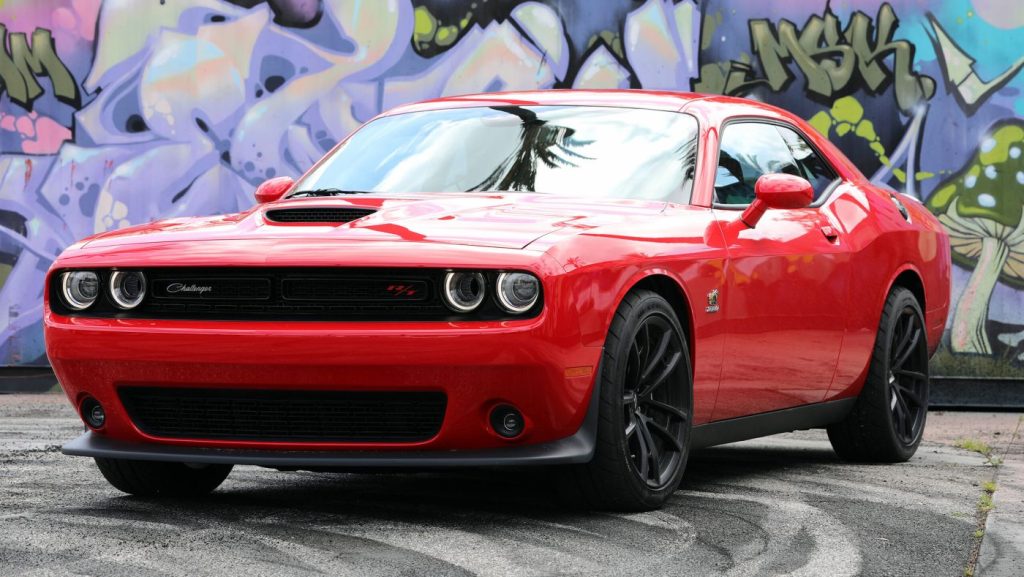
While we tend to prefer the V-8-powered Camaro and Mustang for their sharper handling, the Challenger offers a hefty dose of nostalgia and value. To maximize both, the R/T Scat Pack stands out as the best choice.
It comes standard with the 485-hp 6.4-liter Hemi V-8 and offers either a six-speed manual or eight-speed automatic. Surprisingly, we’d choose the $1,595 automatic, which feels far more responsive than the sometimes sluggish manual
The Challenger’s base 305-hp V-6 is unlikely to satisfy performance enthusiasts. Paired exclusively with the eight-speed automatic, it struggles to deliver the acceleration and excitement offered by rival cars.
Those seeking the ultimate Challenger experience will gravitate toward the 6.4-liter V-8, which produces 485 horsepower and 475 pound-feet of torque. We also sampled the T/A 392 with the automatic and were impressed by its cannon-like startup roar and commanding baritone exhaust note under throttle.
While we remain fans of a manual gearbox, the ZF automatic is highly responsive to throttle input, delivering quick, downshifted bursts of power. The Challenger charges through corners with the ferocity of a bull, snorting and swaying as if daring anyone to challenge it.
This is a muscle car in the truest sense: it thrives on the street and the drag strip, but tight two-lane roads and technical circuits are not its forte. Since the 2015 redesign, Challenger models we’ve driven offer a ride that’s comfortable, albeit slightly coarse.
Compared with the Camaro and Mustang, whose handling is sharper and stickier, the Challenger feels soft in tight turns, and its steering lacks feedback. That slower, more deliberate helm is actually well-suited to easygoing drives and manageable power-induced tail slides.
Also Read: 10 Best Pickup Truck V8 Engines in Automotive History
6. Chevrolet Camaro SS 1LE (2016-2021)
The Camaro SS 1LE, with its naturally aspirated 6.2-liter LT1 V8 producing 455 horsepower, excels both on the track and in straight-line performance.
It can cover the quarter-mile in about 12.3 seconds at speeds exceeding 115 mph. Lightweight suspension components, magnetic ride control, and aerodynamic upgrades help it maintain stability at high speeds, making it one of the fastest naturally aspirated Camaros in quarter-mile history.
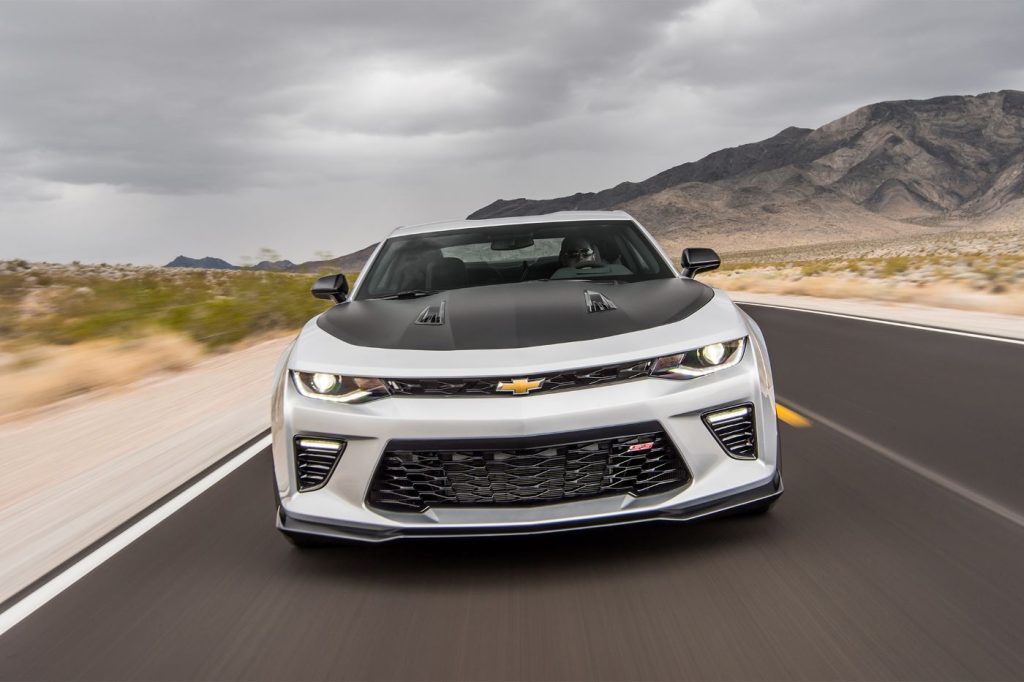
Longtime readers will remember that our 2016 Camaro SS, logged over roughly 15,000 miles, proved itself both a comfortable cruiser and a tire-shredding extrovert. The 2017 Camaro SS we tested here shares that DNA but adds the 1LE package, which sharpens the car’s performance and aesthetic appeal.
These wrap 20-inch Satin Graphite forged-aluminum wheels, 10 inches wide at the front and 11 inches at the rear, and measure 285/30ZR-20 up front and 305/30ZR-20 out back.
Cosmetic cues signal the car’s aggressive intent. A more pronounced front fascia and grille are paired with a larger splitter and a rear blade spoiler, with the aero elements finished in satin black to match the hood wrap.
Inside, a head-up display and Recaro front bucket seats greet the driver, while the flat-bottomed steering wheel and shift knob are wrapped in a soft synthetic-suede that feels excellent to the touch.
7. Ford Mustang GT (2018-Present)
The modern Mustang GT, equipped with a 5.0-liter Coyote V8 producing 460 horsepower, is a quarter-mile powerhouse in its own right.
With proper tires and launch technique, it can complete the quarter-mile in roughly 12.8 seconds at over 110 mph. The Mustang GT represents the ideal balance of performance, affordability, and accessibility for U.S. enthusiasts looking to dominate local drag strips without breaking the bank.
We’re thoroughly impressed with the EcoBoost Mustang’s available performance packages, which finally give the turbocharged powertrain some personality and allow it to stand toe-to-toe with the Camaro’s track-focused models.
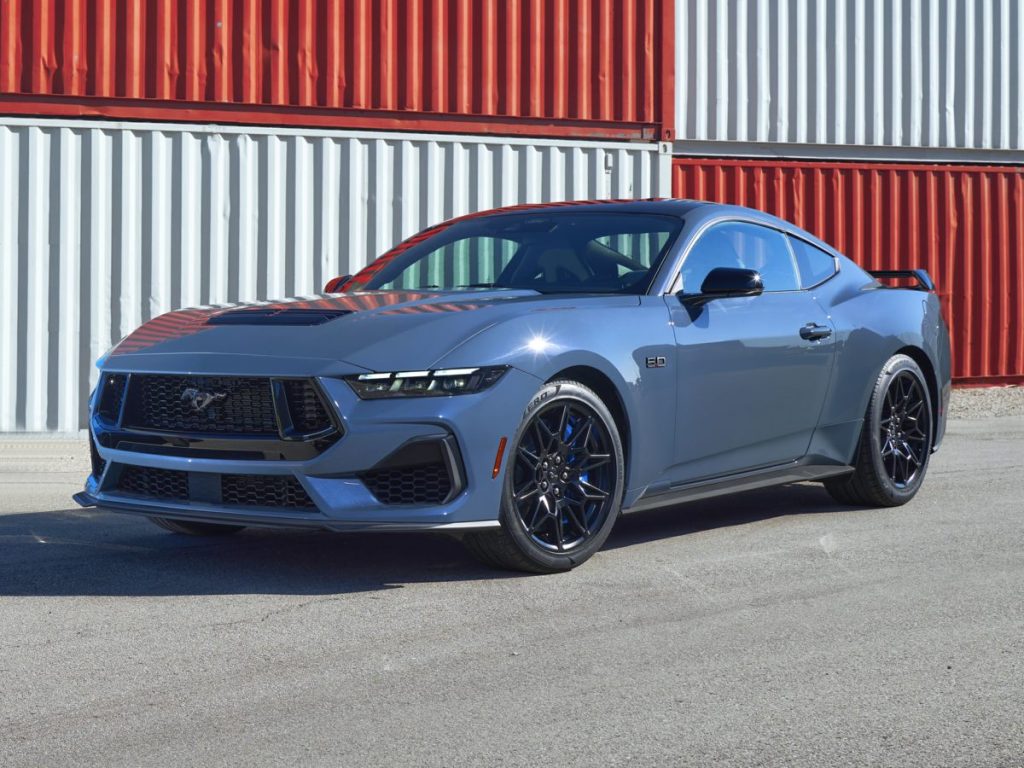
Still, our affection remains strongest for the V-8–powered Bullitt, which we enjoyed during our long-term testing. While it isn’t offered as a convertible and carries a higher price tag than the base GT, its unmistakable styling combined with impeccably balanced ride and handling make it the Mustang to own.
Every Bullitt comes standard with unique 19-inch wheels and exterior trim, a customizable digital gauge cluster, heated and ventilated front seats, a heated steering wheel, leather upholstery, and a fully loaded touchscreen infotainment system.
It also includes everything from the Level 1 Performance Pack, which is largely responsible for making the Bullitt such a joy to drive and live with on a daily basis. The only optional upgrade we’d consider adding is the MagneRide adaptive dampers.
8. Dodge Challenger SRT Hellcat (2015-Present)
The original Hellcat variant of the Challenger made waves upon its release with its 6.2-liter supercharged HEMI V8 producing 707 horsepower.
Quarter-mile times range from 11.0 to 11.2 seconds at speeds around 125 mph, making it one of the fastest muscle cars of its era. Its combination of modern muscle car styling, immense straight-line performance, and wide U.S. appeal cemented its legacy among collectors and drag racers alike.
Billowing burnouts and thunderous exhaust notes come standard on Dodge’s Challenger SRT lineup. The brand’s high-powered duo features adaptive suspension and hefty brakes; the SRT 392 boasts a 485-hp Hemi V-8, while the Hellcat unleashes a fearsome 707-hp from its supercharged V-8.
Both retro-inspired coupes send power to the rear wheels via a standard six-speed manual or an available eight-speed automatic.
While the stripped-down 840-hp Challenger SRT Demon rules the drag strip, the SRT 392 and Hellcat excel at dominating weekly cruise nights, offering a comfortable ride and a suite of attractive standard features.
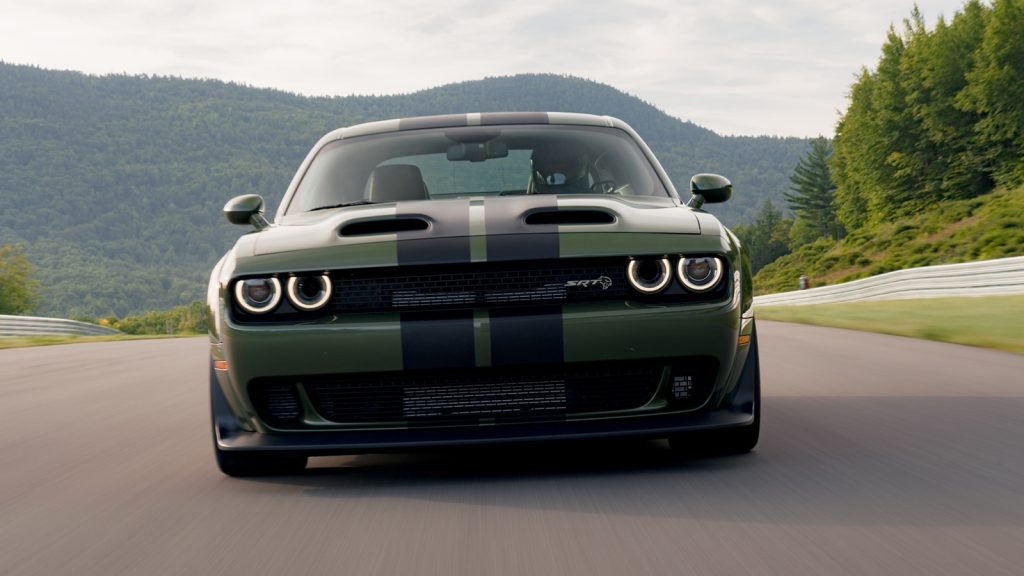
Both SRT Challengers are powered by robust V-8s, but Dodge’s SRT engineers pulled out all the stops for the 707-hp Hellcat. High horsepower is matched with impressive torque.
The 485-hp SRT 392 produces 475 lb-ft from its 6.4-liter V-8, while the Hellcat’s supercharged 6.2-liter cranks out 650 lb-ft. The standard six-speed manual offers plenty of engagement, though its clutch is stiff and throws are long. The eight-speed automatic delivers lightning-quick shifts while still making cruising effortless.
Neither SRT is a razor-sharp track car, but both are brutally fast. The Hellcat’s handling may feel sloppy compared with the track-ready Camaro ZL1 or Ford Shelby GT350, yet it never drives like a boat. On twisty two-lane roads, it still thrills, and the car’s immense speed between corners ensures the Brembo brakes get plenty of exercise.
9. Chevrolet Camaro ZL1 (2012-2015)
The fifth-generation Camaro ZL1, powered by a supercharged 6.2-liter LSA V8 producing 580 horsepower, could run the quarter-mile in approximately 11.6 seconds at 123 mph.
This model demonstrated that Camaros could compete with Dodge and Ford supercharged variants while delivering aggressive styling and track-capable performance. It remains a favorite for enthusiasts seeking a blend of classic muscle character and modern engineering.
The difference is noticeable the moment you turn the Camaro’s key. The big V-8 and supercharger take a few seconds to spool, but once the engine settles into a loping idle, the ZL1 proves far more tractable and user-friendly than the over-engineered Shelby GT500.
Its clutch and transmission are easier to finesse than those in any other Camaro, and the ride remains relatively comfortable unless you switch the adaptive dampers into Sport mode.
The biggest advantage shows in structural rigidity: while the stiffly sprung Ford flops and wanders over broken pavement, the ZL1 convertible remains surprisingly composed, barely shaking more than its coupe counterpart.
When you finally unleash the supercharger, the Camaro delivers a more exhilarating experience than the Mustang. Torque surges violently, the exhaust bellow roars, and acceleration pins you in your seat.
The Shelby GT500 is just as fast, of course, but it feels so wild and unruly that you constantly worry about ending up in the nearest obstacle. The Camaro ZL1 convertible, in contrast, manages high-speed composure remarkably well.
Few cars are as monstrously burly as the Camaro ZL1, yet it’s hard to fall in love with it. I felt similarly about the raucous Shelby GT500. Sometimes, I’d rather enjoy the lighter weight, naturally aspirated, slightly slower thrills of something like the Mustang Boss 302 or, as colleagues have noted, the Camaro SS with the 1LE package.
Even with 580 horsepower and a track-focused design, the ZL1 convertible still feels too big and heavy from behind the wheel to give the sense of a true sports car. That said, it doesn’t need to be one, the point is sheer brute force. Looking at the 305-section rear tires, you might expect wheelspin to be impossible.
In reality, this monster loves spinning the back tires, even in third gear, and the speedometer rockets toward triple digits with alarming ease. The only thing that slows you down is the convertible top, which takes roughly twenty seconds to stow or deploy, and feels like forever in the moment.
The ZL1’s “no-lift shift” feature is a blast, as flat-footed gear changes unleash ear-piercing supercharger screams and huge bursts of acceleration. Even while cruising, flooring it in sixth gear at 55 mph, less than 2,000 rpm, delivers surprising pep, proving this Camaro is always ready to roar.
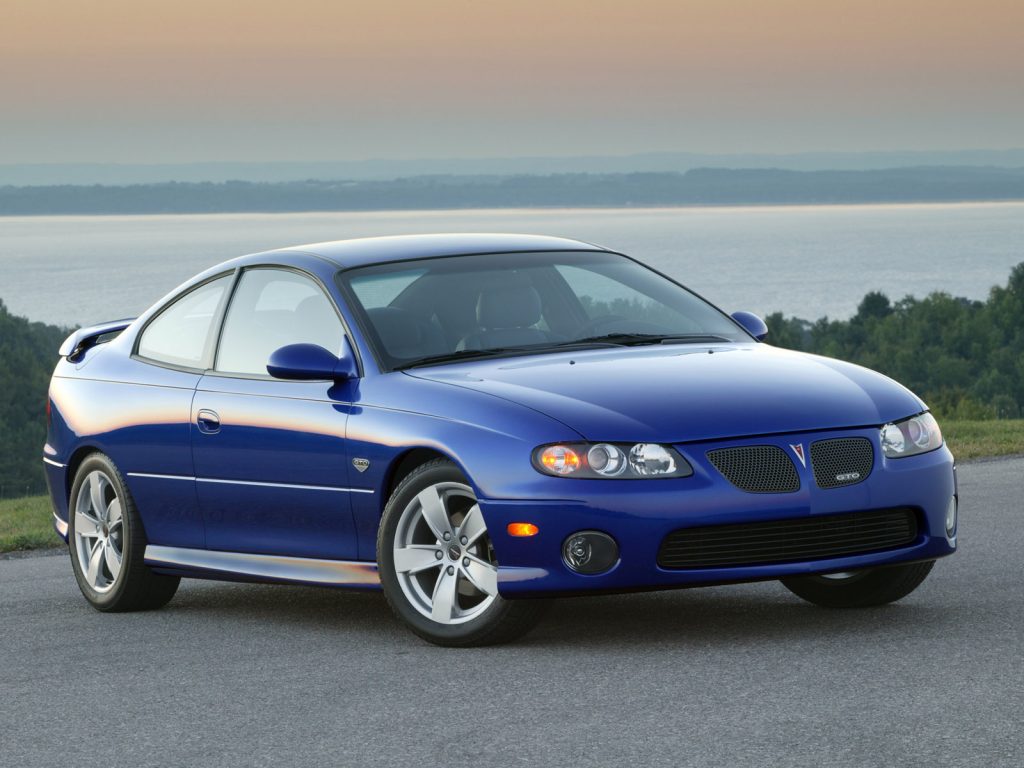
10. Pontiac GTO (2004-2006)
The last-generation Pontiac GTO, equipped with a 6.0-liter LS2 V8 producing 400 horsepower, could complete the quarter-mile in roughly 13.0 seconds at 110 mph.
While it doesn’t match the extreme speeds of the supercharged modern era, it represents an important milestone in U.S. muscle car history, proving that naturally aspirated V8s could still deliver impressive straight-line performance when combined with modern chassis technology.
The quarter-mile remains the ultimate benchmark for muscle car performance because it tests everything a car has to offer: engine power, torque delivery, weight distribution, and traction.
Unlike top speed alone, the quarter-mile showcases acceleration from a dead stop, making it a true measure of real-world performance for enthusiasts. For U.S. drivers, the quarter-mile also ties into decades of drag racing culture, from street races to sanctioned events, and underscores the competitive spirit embedded in American muscle cars.
The 2004 Pontiac GTO comes with its share of quirks and challenges that owners should be aware of. A frequently noted issue involves certain components’ build quality, particularly interior plastics and body panels, which some owners find flimsy and detract from the vehicle’s durability.
Paint blemishes and misaligned lights have also been reported, reflecting occasional inconsistencies in assembly. Electrical gremlins are not uncommon either, ranging from malfunctioning window defrosters to erratic electronic behavior, frustrating owners who expect reliable daily operation.
Transmission reliability is another area of concern for a subset of GTO owners. Manual gear selection, especially engaging reverse, has been a source of persistent trouble, sometimes requiring unexpected trips to the dealer.
Ride quality can feel harsh over rough surfaces, a byproduct of the sports-tuned suspension, which also tends to amplify cabin noise. The GTO’s weight contributes to noticeable body roll during spirited driving or tight cornering, which undermines the car’s agile aspirations.
While the engine delivers substantial power, the hefty curb weight somewhat blunts acceleration and nimbleness compared with lighter competitors.
Parts availability is another practical hurdle. Limited production and the GTO’s Australian engineering mean some components must be sourced internationally, increasing repair times and costs. Rear-wheel drive also limits all-weather confidence in colder climates, prompting many owners to store their GTOs during winter months to avoid traction issues.
From the fire-breathing Dodge Demon to the iconic Pontiac GTO, muscle cars have always been about straight-line dominance. The ten cars listed here represent the fastest quarter-mile performers in American muscle car history, each delivering a unique blend of power, engineering, and excitement.
Whether you crave the modern technology and supercharged fury of today’s Hellcats and Camaros or the raw naturally aspirated thrill of the GTO, these cars prove that American muscle isn’t just about style, it’s about exhilarating speed that makes every quarter-mile a heart-pounding experience.
