
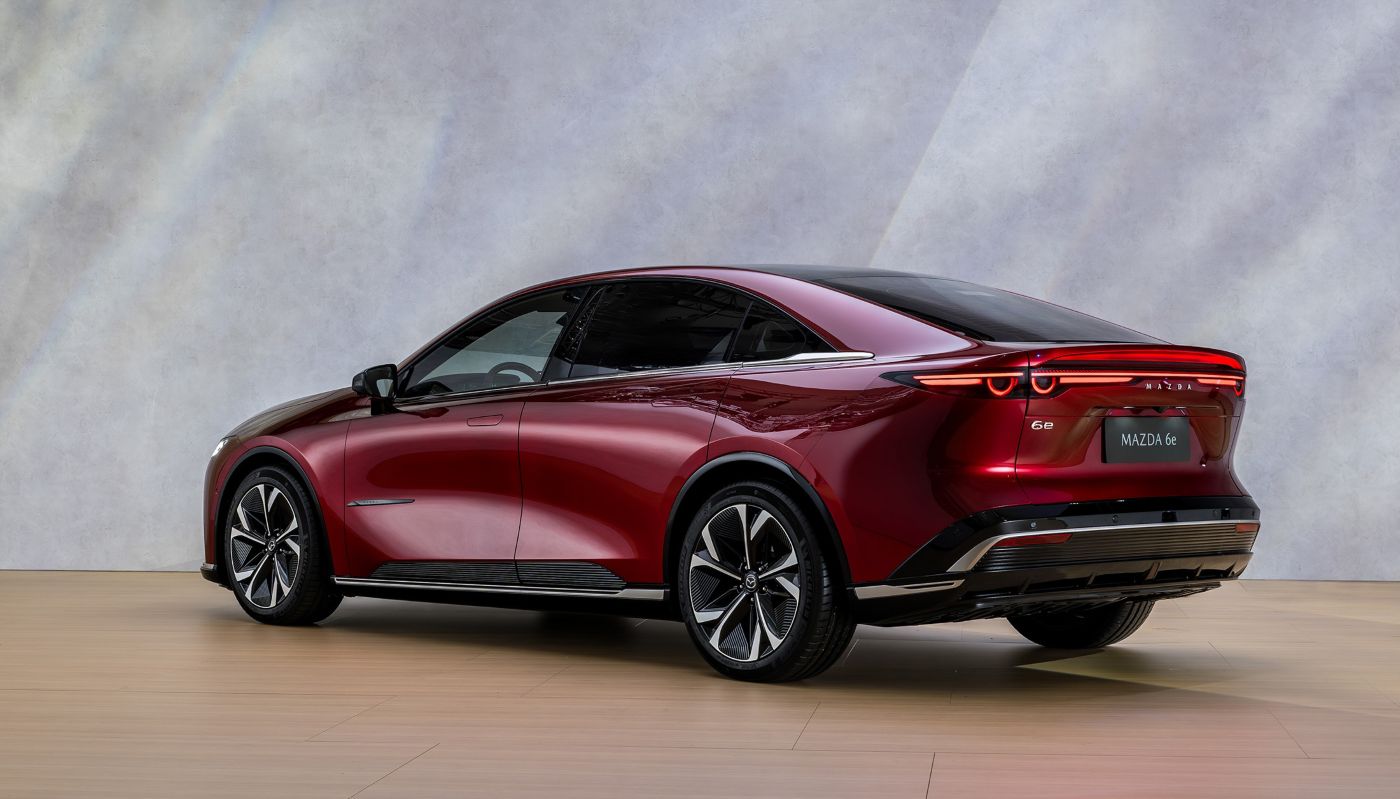
Mazda’s newest electric SUV blends familiar Japanese design cues with EV hardware developed in China, and it’s clearly aimed at shoppers who might otherwise consider something like a Tesla Model Y.
Introduced as the CX-6e, the model represents Mazda’s latest attempt to carve out a place in the increasingly crowded electric crossover market, pairing a striking tech-forward interior with restrained styling that doesn’t immediately advertise itself as an EV.
Roughly a year after Mazda revealed the Mazda6e in Europe, the brand has returned with a closely related concept wrapped in a far more popular body style. The original 6e, also sold as the EZ-6 in China, was essentially a reimagined Mazda6 sedan designed for the electric era.
It emphasized simplicity, featuring clean exterior lines, a minimalist aesthetic, and an interior dominated by large digital displays to signal Mazda’s commitment to electrification.
Building on that foundation, Mazda has now transformed the same platform into the CX-6e, a mid-size electric crossover designed to compete with established players such as the Tesla Model Y and the Audi Q6 e-tron.
Like the 6e, the CX-6e is produced in China through Mazda’s partnership with Changan before being adapted for the European market. Rather than serving as a replacement for an existing model, the CX-6e is intended to complement the Mazda6e, expanding Mazda’s growing EV lineup with a more mainstream and potentially higher-volume option.
Visually, the CX-6e stays true to Mazda’s current Kodo design language, simply scaled up into a taller, more substantial crossover form. Short overhangs, pronounced wheel arches, and slim lighting elements help keep the proportions balanced, preventing the vehicle from feeling overly bulky.
Higher trim levels add features such as digital side mirrors and subtle aerodynamic enhancements, though the overall design avoids the exaggerated styling cues often associated with electric vehicles.
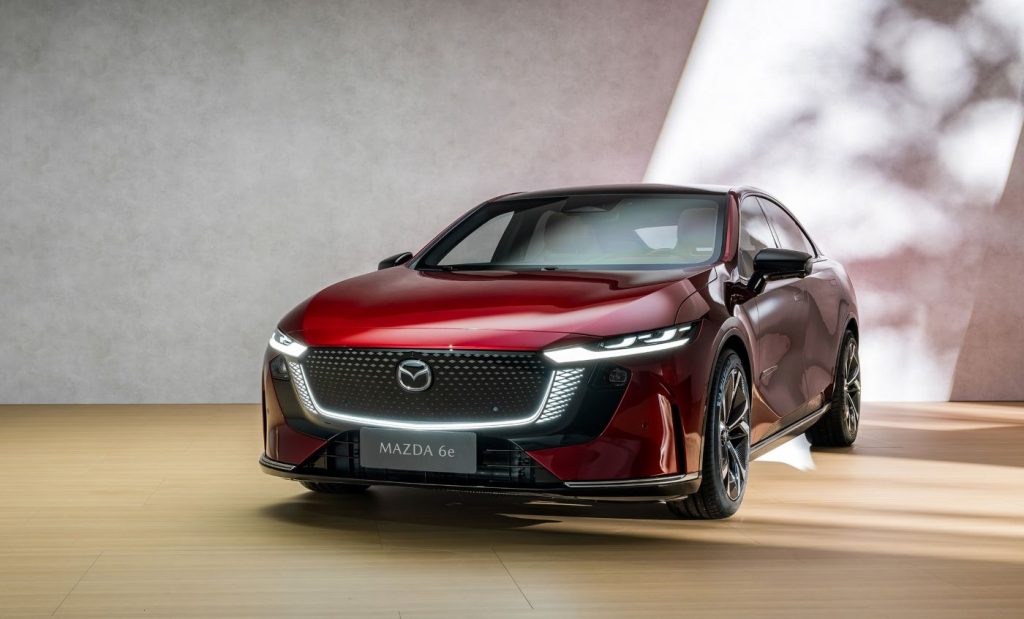
Inside, the CX-6e prioritizes openness and simplicity. The cabin layout feels uncluttered, with a strong emphasis on space and technology.
The centerpiece is a massive 26-inch ultra-wide touchscreen that spans much of the dashboard, supported by a head-up display and a minimal number of physical controls. Mazda positions this setup as both futuristic and user-friendly, aiming to reduce visual noise while still delivering a high-tech experience.
Material quality is said to be a step up, with vegan upholstery used throughout the cabin, complemented by ambient lighting and a panoramic glass roof that comes standard.
Technology integration is another focal point, highlighted by features such as the wing-mirror camera displays that are seamlessly incorporated into the dashboard design rather than appearing as tacked-on screens.
Beneath the CX-6e’s sleek exterior sits a 78 kWh lithium-iron phosphate battery paired with a rear-mounted electric motor producing 258 horsepower and 214 lb-ft of torque.
Performance is adequate rather than thrilling, with a 0–62 mph time of 7.9 seconds. Fast-charging capability peaks at 195 kW, allowing the battery to recharge from 10 to 80 percent in approximately 24 minutes when connected to a suitable high-speed charger.
Mazda quotes a maximum driving range of 484 kilometers, or roughly 300 miles, based on the WLTP testing cycle. While that figure appears respectable on paper, it falls short when compared to key rivals once testing standards are taken into account.
The Tesla Model Y Standard and Audi Q6 e-tron both achieve at least 321 miles on the more stringent EPA cycle. As a result, if the CX-6e were to reach the U.S. market, its real-world range would likely come in noticeably lower.
For now, the CX-6e is slated to launch in Europe in 2026, with a potential U.S. release still uncertain. Its Chinese production could complicate American market entry, particularly as regulatory pressures and shifting consumer demand continue to reshape the EV space.
While the CX-6e delivers impressive interior technology and familiar Mazda design appeal, its range may prove to be the key factor that determines how competitive it ultimately becomes.
Also Read: Top 10 Cars Cheap Enough to Own and Fast Enough to Scare You
