
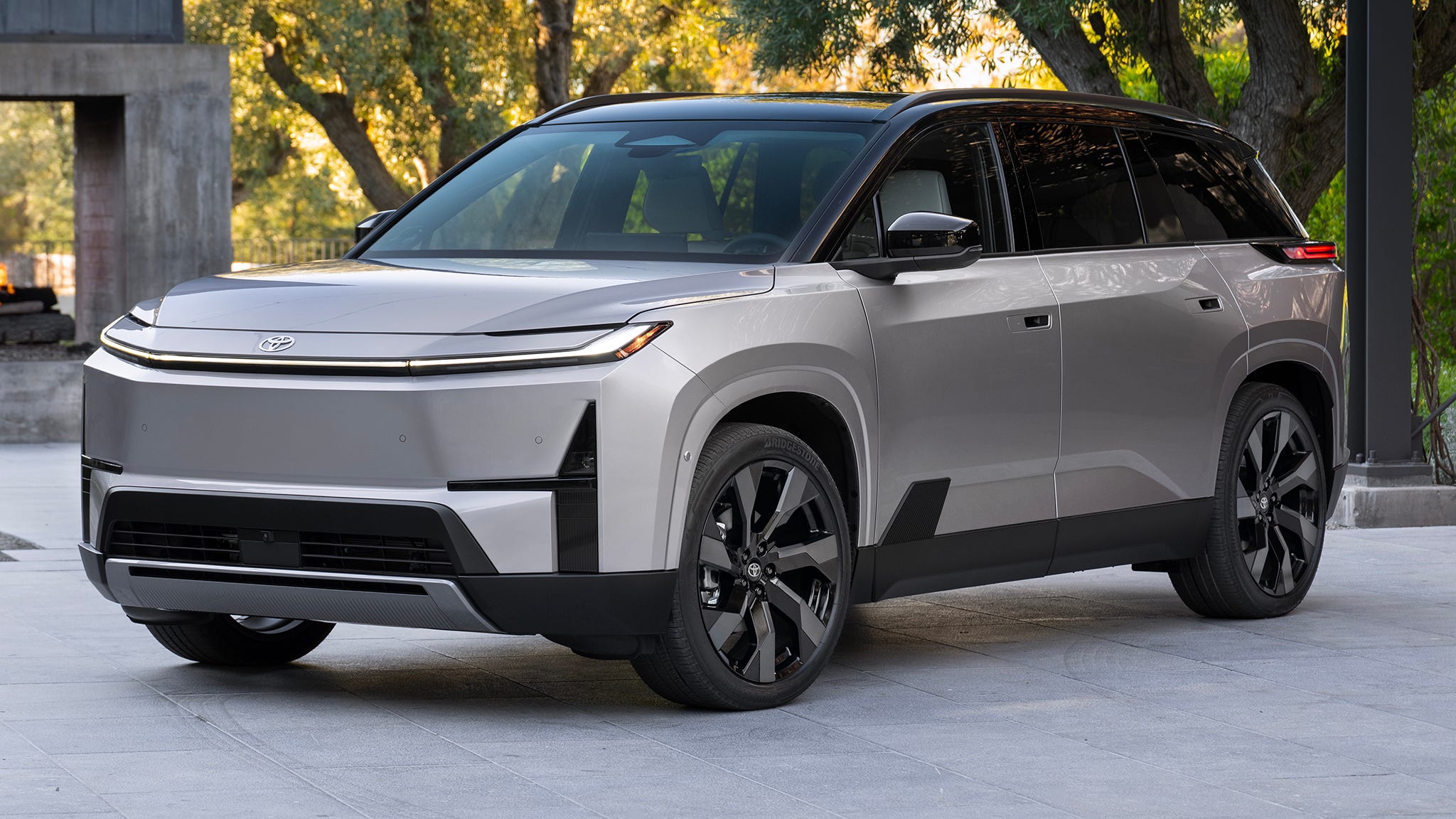
Several automakers have recently moderated their electric-vehicle strategies in the United States. Toyota, however, is expanding its efforts in a substantial way, both figuratively and literally. Introducing the 2027 Toyota Highlander, a fully electric three-row SUV.
Produced in the U.S. and equipped with batteries sourced domestically, this model underscores Toyota’s renewed commitment to EV development at a time when some competitors are shifting focus back toward hybrids.
Dimensionally, the electric Highlander closely mirrors its gasoline-powered sibling. Buyers will have a choice between two battery configurations, with the longest-range version offering an estimated 320 miles per charge.
That figure aligns with the dual-motor Hyundai Ioniq 9. However, Hyundai achieves that comparable range with a larger-capacity battery pack, despite also assembling its EV in the United States.
The Highlander EV will be offered in two trims: XLE and Limited. In entry-level XLE form, it features a 77-kilowatt-hour battery paired with a front-mounted electric motor producing 221 horsepower and 198 pound-feet of torque. This setup delivers an estimated 287 miles of range.
The same 77-kWh battery in XLE specification can also be configured with a dual-motor, all-wheel drive system generating 338 horsepower and 323 lb-ft of torque. In this configuration, estimated range decreases slightly to 270 miles on a full charge.
A larger 95.8-kWh battery will also be available, though only in combination with all-wheel drive XLE and Limited variants. Both achieve a maximum estimated range of 320 miles.
For context, the dual-motor Hyundai Ioniq 9 matches that figure but relies on a 110.3-kWh battery. Hyundai also offers the larger battery with a single rear-mounted motor, increasing its estimated range to 335 miles.
The electric Highlander is equipped from the factory with a Tesla-style NACS charging port. Toyota has not disclosed the maximum DC fast-charging rate, but it states that charging from 10% to 80% should require approximately 30 minutes under appropriate conditions.
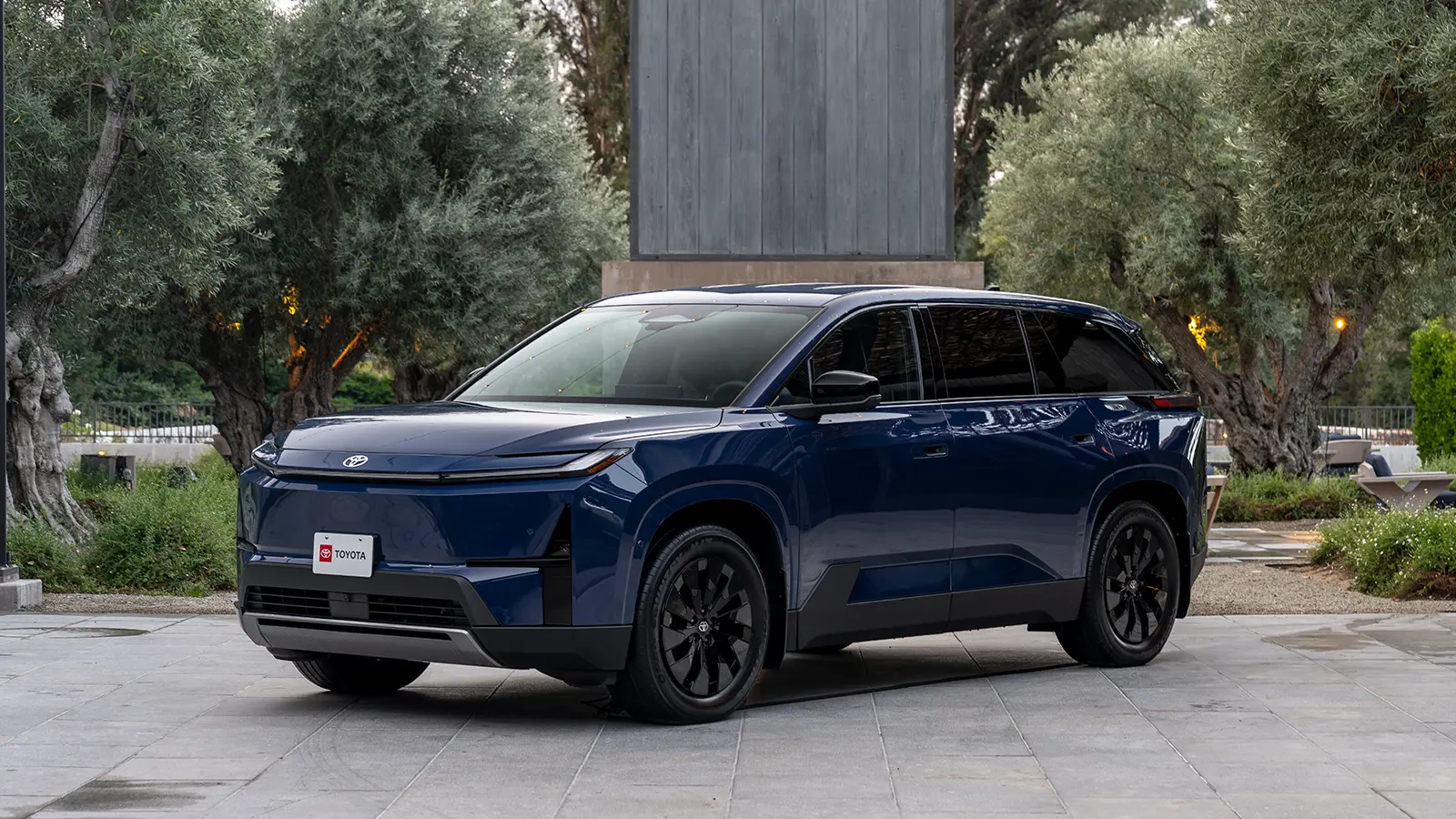
Battery preconditioning is standard and can be activated either manually or automatically when routing to a charging station via the built-in navigation system.
The vehicle also supports Plug & Charge functionality and includes vehicle-to-load (V2L) capability, allowing energy to be drawn from the high-voltage battery through an adapter.
In terms of size, the Highlander measures 198.8 inches in length, 78.3 inches in width, and 67.3 inches in height, with a wheelbase of 120.1 inches.
These dimensions place it very close to the Hyundai Ioniq 9, which stands three inches taller and rides on a wheelbase three inches longer.
Cargo capacity is rated at 15.9 cubic feet with the third row upright, expanding to 45.6 cubic feet when the rear seats are folded flat.
The SUV is built on a revised version of Toyota’s TNGA-K platform, which also underpins models such as the RAV4 crossover and Sienna minivan.
The electric Highlander comes standard with a six-seat layout, including captain’s chairs in the second row. On the XLE AWD variant, buyers can opt for a second-row bench, increasing seating capacity to seven.
Inside, the Highlander features a driver-centric cabin anchored by a 12.3-inch digital instrument cluster and a 14-inch central touchscreen running Toyota’s latest infotainment system.
Known as “Toyota Audio Multimedia,” the interface includes 5G connectivity via AT&T, an integrated voice assistant, and wireless Apple CarPlay and Android Auto compatibility. A built-in dashcam system, branded Drive Recorder, is also included.
The XLE trim provides front acoustic glass, 19-inch wheels, heated front seats and steering wheel, a 64-color ambient lighting system, a six-speaker audio setup, and the dual-screen configuration.
Stepping up to the Limited trim adds a head-up display, ventilated front seats, heated second-row seats, rear sunshades, a 360-degree camera system, and lane change assistance.
Optional equipment includes a fixed panoramic glass roof, an 11-speaker JBL premium sound system, two-tone exterior paint, and 22-inch wheels.
The introduction of the electric Highlander marks a significant milestone for Toyota’s U.S. manufacturing operations. It represents the brand’s first three-row EV for the American market and the first fully electric vehicle produced at one of its domestic plants.
Production of the 2027 Highlander is scheduled to begin later this year at Toyota’s Kentucky facility, with sales anticipated to start in late 2026.
Pricing details have not yet been released, but it is expected to align with competitors such as the Kia EV9 and Hyundai Ioniq 9, which currently range from approximately $55,000 to $80,000.
Also Read: 5 Vehicles With Reliable Software vs 5 With Glitches
