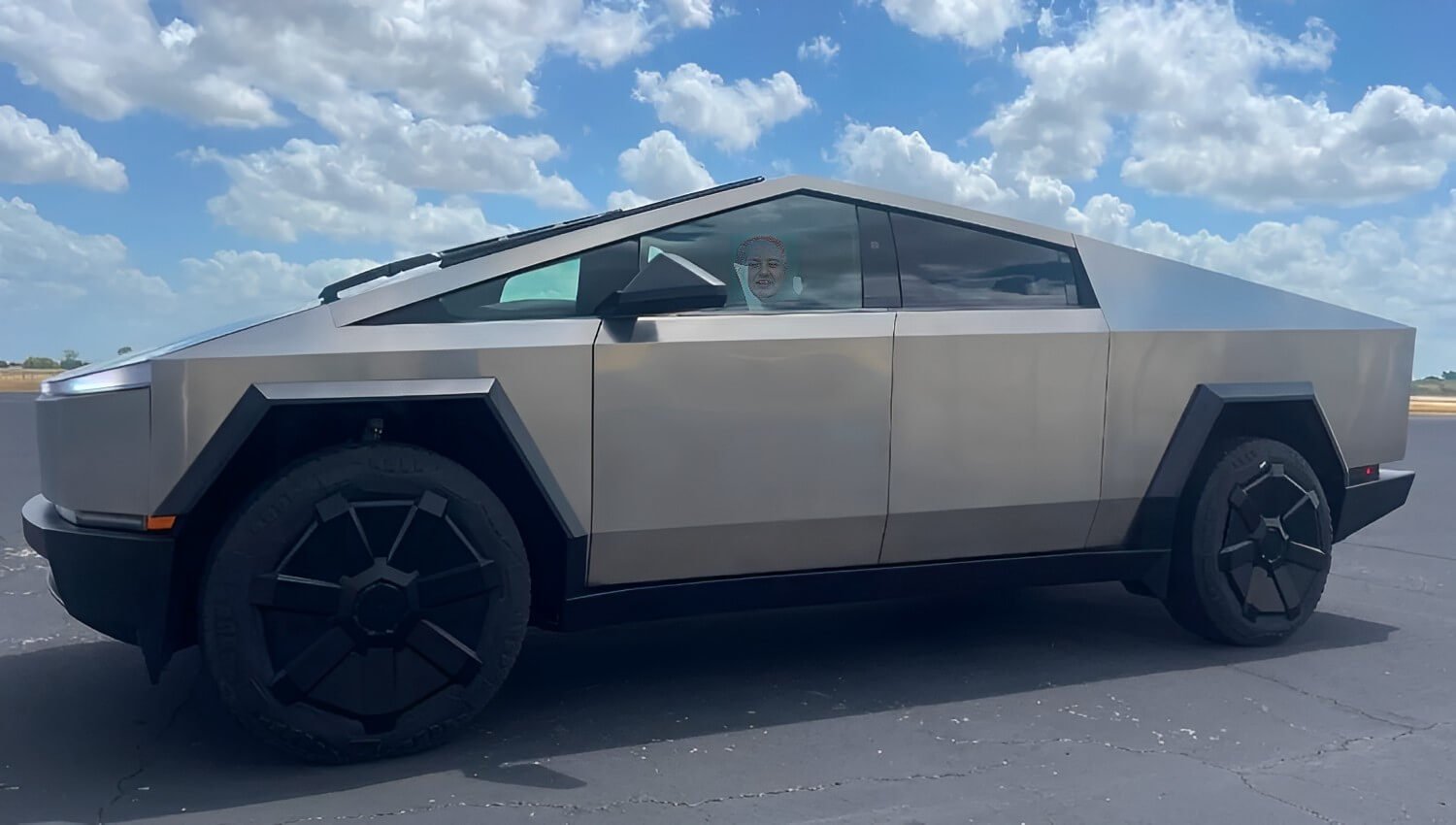
Tesla has initiated its first vehicle-to-grid (V2G) initiative in the United States, beginning in select regions of Texas.
Branded “Powershare Grid Support,” the program enables Tesla Cybertruck owners to export energy from the truck’s 123 kWh battery back to the grid during peak demand periods in exchange for utility bill credits.
For perspective, that battery capacity is roughly equivalent to nine Tesla Powerwalls.
The announcement, made by Tesla Energy, represents a meaningful development for a company that has long referenced bidirectional charging as a future capability but has repeatedly delayed broad deployment across its vehicle portfolio.
Participation is currently limited to Cybertruck owners served by CenterPoint Energy and Oncor, two major transmission and distribution utilities covering the Houston and Dallas metropolitan regions.
Eligible vehicles must be equipped with a Powershare Gateway and Tesla’s Universal Wall Connector, which together enable bidirectional energy flow between the vehicle and the grid.
After hardware installation, owners enroll via Tesla’s Electric Drive plan in the Tesla mobile app and opt into Powershare Grid Support.
When high-demand grid events occur, the system automatically discharges stored energy from the Cybertruck to the grid. Participants receive corresponding credits on their electricity bills.
Tesla indicates that grid events may be announced with minimal lead time, advising participants to keep their vehicles plugged in while at home.
Owners maintain control over discharge thresholds, allowing them to reserve sufficient battery capacity for driving or home use. This mirrors the operational logic of Tesla’s existing vehicle-to-home (V2H) Powershare functionality.
At present, the initiative operates on an invitation-only basis during an early adopter phase.
Tesla has stated that broader availability will follow after initial testing. The company also notes that participation through Tesla Electric will not affect the Cybertruck’s warranty during this early phase.
Texas is a deliberate starting point. The state’s grid, managed by ERCOT, operates largely in isolation from other U.S. grids and has experienced high-profile reliability challenges during extreme weather events.
Tesla has been developing its virtual power plant (VPP) presence in Texas since 2022, initially through a 200-Powerwall pilot and later securing approval from the Public Utility Commission of Texas in August 2023 for two VPP programs.
In 2024, Tesla reported paying Powerwall owners $9.9 million through its VPP initiatives. Integrating Cybertrucks into that distributed energy network materially increases potential capacity.
Each truck contributes 123 kWh, substantially exceeding the 13.5 kWh capacity of a single Powerwall.

Expansion to California is planned next, targeting territories served by PG&E, Southern California Edison, and San Diego Gas & Electric.
Tesla’s rollout occurs in a market where competitors have already established bidirectional capability.
Ford Motor Company introduced vehicle-to-home functionality with the Ford F-150 Lightning at launch in 2022 and is participating in a residential V2G pilot with Baltimore Gas and Electric.
General Motors has committed to equipping all new EVs with bidirectional capability by 2026, with Ultium-based vehicles already shipping with 19.2 kW hardware.
Hyundai Motor Group is conducting V2G pilots across Korea, Europe, and the United States using models such as the Ioniq 5, Ioniq 6, Kia EV6, and EV9.
Within Tesla’s own lineup, the Cybertruck remains the only vehicle with officially supported bidirectional charging.
Tesla indicated in late 2025 that the new Model Y Performance would include such capability, but widespread activation has not yet occurred.
Additionally, the anticipated Powershare integration with Powerwall, intended to enable seamless interaction between vehicle and home battery systems, has been delayed again and is now projected for mid-2026, despite earlier commitments targeting late 2024.
The timeline slippage has drawn scrutiny. In March 2023, Tesla’s then–VP of energy, Drew Baglino, suggested bidirectional charging could be available within two years.
Three years later, it is operational on a single vehicle in a limited geography, and certain previously outlined features remain pending.
Some Tesla owners have turned to third-party providers, such as Sigenergy, which offers universal bidirectional DC charging solutions compatible with Tesla vehicles.
From an energy systems perspective, enabling 123 kWh battery packs to support grid stability during peak events represents a significant distributed resource. ERCOT’s history of volatility underscores the value of flexible capacity.
However, the rollout remains narrow in scope. V2G is currently restricted to one vehicle, one state, and an invitation-only cohort. Meanwhile, competitors have normalized vehicle-to-home and grid integration across broader segments of their EV portfolios.
Tesla’s caution may reflect battery warranty risk management and long-term degradation considerations. Nonetheless, industry trends indicate that bidirectional capability is becoming a standard expectation.
If Tesla intends to position itself as both an automotive and energy infrastructure company, scaling V2G beyond the Cybertruck will be necessary to align with that ambition.