
The electric vehicle revolution has transformed the automotive world over the past decade, but while new EVs often command premium prices, the used market tells a remarkably different story.
As early electric vehicles age and newer models with improved range and technology flood the market, first-generation EVs have experienced dramatic depreciation, creating unprecedented opportunities for budget-conscious buyers looking to go electric.
What once seemed like an exclusive club reserved for early adopters with deep pockets has now become accessible to the average consumer. Cars that originally sold for $30,000, $40,000, or even more are now available for a fraction of their original price, sometimes dipping below $10,000.
This depreciation, while painful for original owners, represents a golden opportunity for second-hand buyers who can enjoy the benefits of electric driving lower fuel costs, reduced maintenance, instant torque, and whisper-quiet operation without the new-car premium.
The reasons for this steep depreciation are multifaceted. Concerns about battery degradation, the introduction of more competitive newer models with longer range, and the rapid pace of EV technology advancement have all contributed to falling used prices.
Additionally, federal tax credits available only on new EVs have historically made pre-owned models less attractive, further driving down their values.
However, many of these depreciated EVs still offer excellent value. Battery technology has proven more durable than initially feared, with most EVs retaining 80-90% of their original capacity even after years of use.
For buyers with modest daily driving needs the average American drives just 40 miles per day these affordable used EVs can serve as practical, economical transportation. Let’s explore eight electric vehicles that have become surprisingly affordable on the used market.
1. Nissan Leaf (2011-2017)
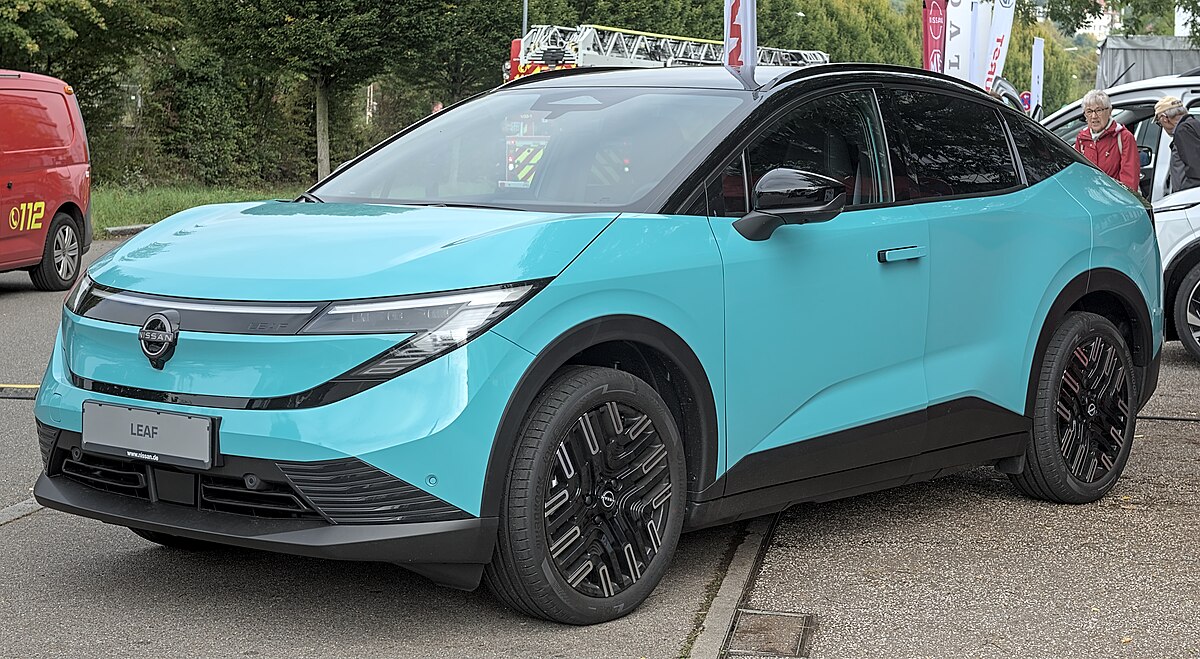
The Nissan Leaf holds the distinction of being the world’s first mass-market electric vehicle, launching in late 2010 as a 2011 model. As a pioneer in the EV space, the Leaf made electric driving accessible to mainstream consumers, and today, early models represent some of the most affordable electric vehicles on the used market, with first-generation examples regularly selling for under $8,000.
The original Leaf came with a 24 kWh battery pack offering an EPA-estimated range of 73-84 miles, depending on the model year. While this range seems limited by today’s standards, it’s important to remember that most daily commutes fall well within this capability.
Later first-generation models received a 30 kWh battery option starting in 2016, extending range to approximately 107 miles. The Leaf’s powertrain delivers 107-110 horsepower and provides the instant torque characteristic of electric motors, making city driving surprisingly sprightly.
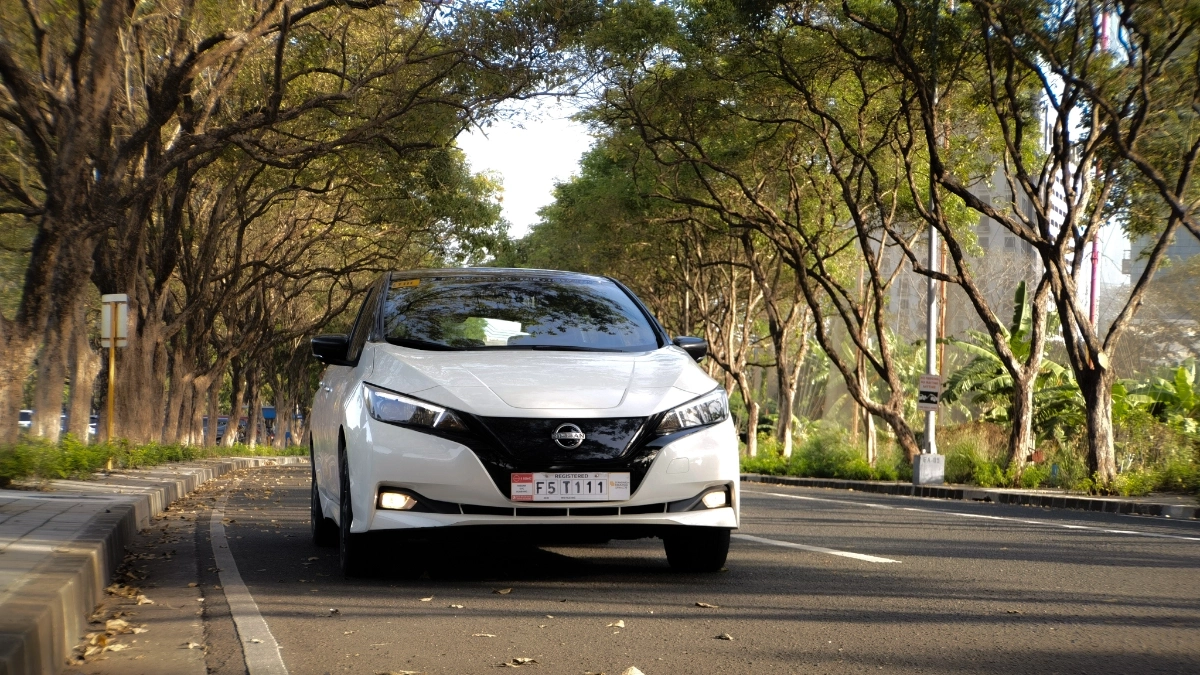
One of the Leaf’s most significant drawbacks is its passive battery cooling system, which relies on air rather than liquid cooling. This has led to accelerated battery degradation in hot climates, particularly in states like Arizona and Texas.
Prospective buyers should carefully check the battery’s state of health, which is displayed on the dashboard as capacity bars twelve bars indicate full health, while fewer bars signal degradation. Finding a Leaf with minimal bar loss, especially in moderate climates, can yield an excellent value.
The interior is practical if somewhat dated by modern standards, with seating for five and a reasonable 24 cubic feet of cargo space. Early models featured basic infotainment systems, though later versions included navigation and improved connectivity.
The Leaf’s charging capabilities are limited to CHAdeMO fast charging, a standard that’s becoming less common in the U.S., though Level 2 charging at home remains practical for most users.
Maintenance costs are remarkably low no oil changes, transmission fluid changes, or spark plug replacements to worry about. The Leaf’s simplicity and Nissan’s wide dealer network make service accessible and affordable.
For urban dwellers or those seeking a dedicated commuter vehicle, a used Leaf under $10,000 represents exceptional value. Just remember to have the battery checked, review the vehicle’s charging history, and consider your local climate before purchasing.
2. Chevrolet Spark EV (2014-2016)
The Chevrolet Spark EV remains one of the automotive industry’s best-kept secrets a peppy, fun-to-drive electric city car that’s now available for shockingly little money.
Produced for only three model years and sold exclusively in California and Oregon, the Spark EV never achieved widespread recognition, but those who find one on the used market often discover a delightful surprise.
Under the hood, the Spark EV packs an unexpected punch with a 130-horsepower electric motor producing an impressive 400 lb-ft of torque.
This gives the diminutive hatchback genuinely entertaining acceleration, capable of sprinting from 0-60 mph in less than eight seconds faster than many gas-powered sports cars of the era.
The instant torque delivery makes the Spark EV feel particularly lively in urban environments, darting through traffic with surprising agility. Many automotive journalists praised its fun-to-drive character, with some calling it one of the most engaging electric vehicles available at the time.
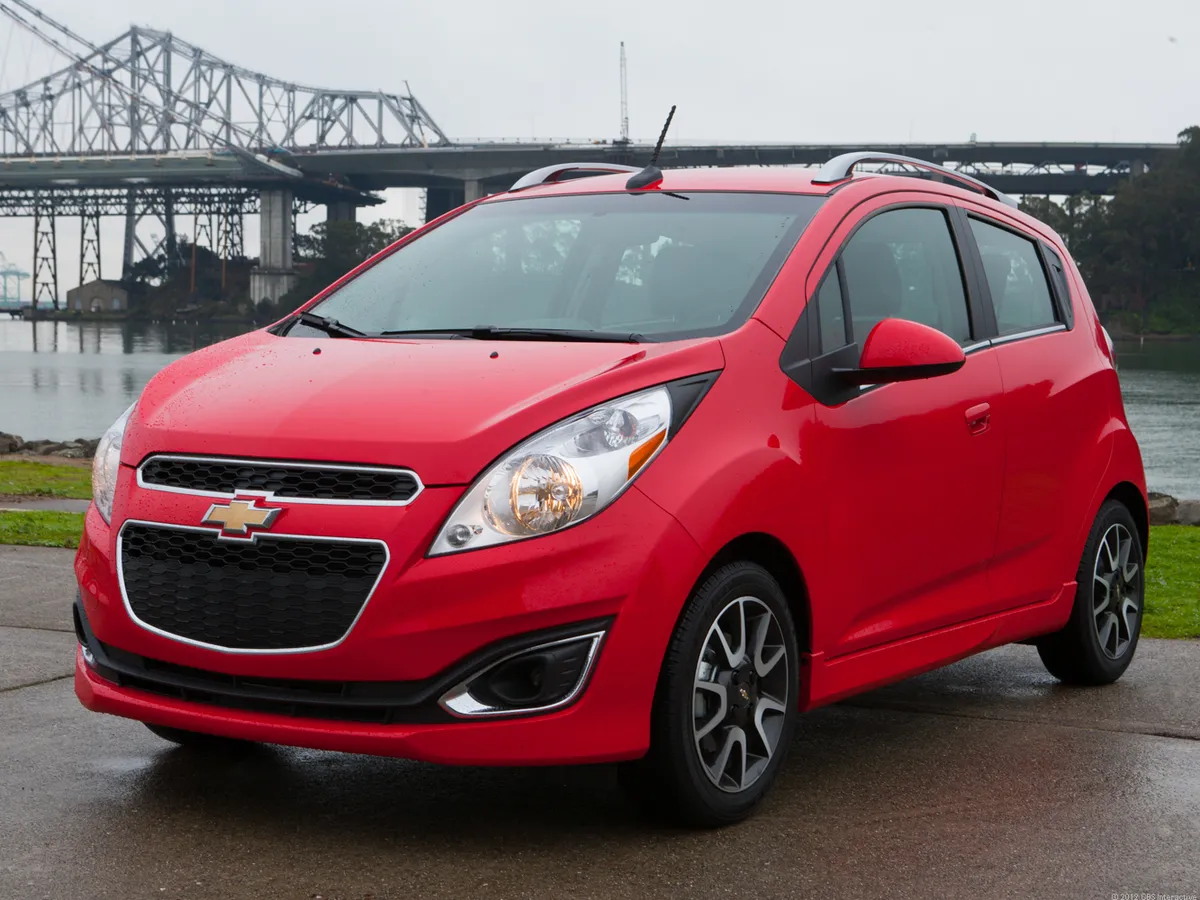
The 19 kWh battery pack provides an EPA-estimated range of 82 miles, which, while modest, proves adequate for city driving and short commutes.
The limited range hasn’t aged as poorly as you might think for second-car duties or urban use, 80 miles covers most daily needs. DC fast charging capability comes standard, allowing the battery to charge to 80% in approximately 20 minutes when using a compatible charger.
Inside, the Spark EV mirrors its gasoline counterpart with seating for four (though the rear seats are admittedly cramped) and 27.2 cubic feet of cargo space with the rear seats folded.
The interior materials are basic, reflecting the car’s economy origins, but the cabin is well-organized and functional. The 7-inch touchscreen infotainment system includes Chevrolet’s MyLink interface with Bluetooth, USB connectivity, and available navigation.
Because of its limited production and regional availability, finding a Spark EV requires patience they’re not as common as Leafs or other mass-market EVs.
However, this scarcity hasn’t translated to high prices. Most examples now sell for between $6,000 and $10,000, representing extraordinary value for an electric vehicle that’s genuinely enjoyable to drive.
The Spark EV’s main appeal lies in being an entertaining city runabout that costs almost nothing to operate. For buyers prioritizing driving enjoyment over maximum range or interior luxury, the Spark EV deserves serious consideration.
3. Ford Focus Electric(2012-2018)
Ford’s entry into the electric vehicle market, the Focus Electric, brought the familiar comfort and refinement of the popular Focus compact car to the EV segment.
While it never achieved the sales success of some competitors, the Focus Electric has depreciated significantly, making it an attractive option for used EV buyers seeking a conventional driving experience with zero emissions.
The first-generation Focus Electric (2012-2016) used a 23 kWh battery pack that delivered approximately 76 miles of range, which was respectable for its era but limited by today’s standards.
Ford updated the model for 2017, installing a larger 33.5 kWh battery that extended range to 115 miles, a meaningful improvement that makes the later models more practical for a wider range of driving scenarios.
The electric motor produces 143 horsepower and 184 lb-ft of torque, providing adequate acceleration and smooth, refined power delivery that feels natural to drivers transitioning from gasoline vehicles.
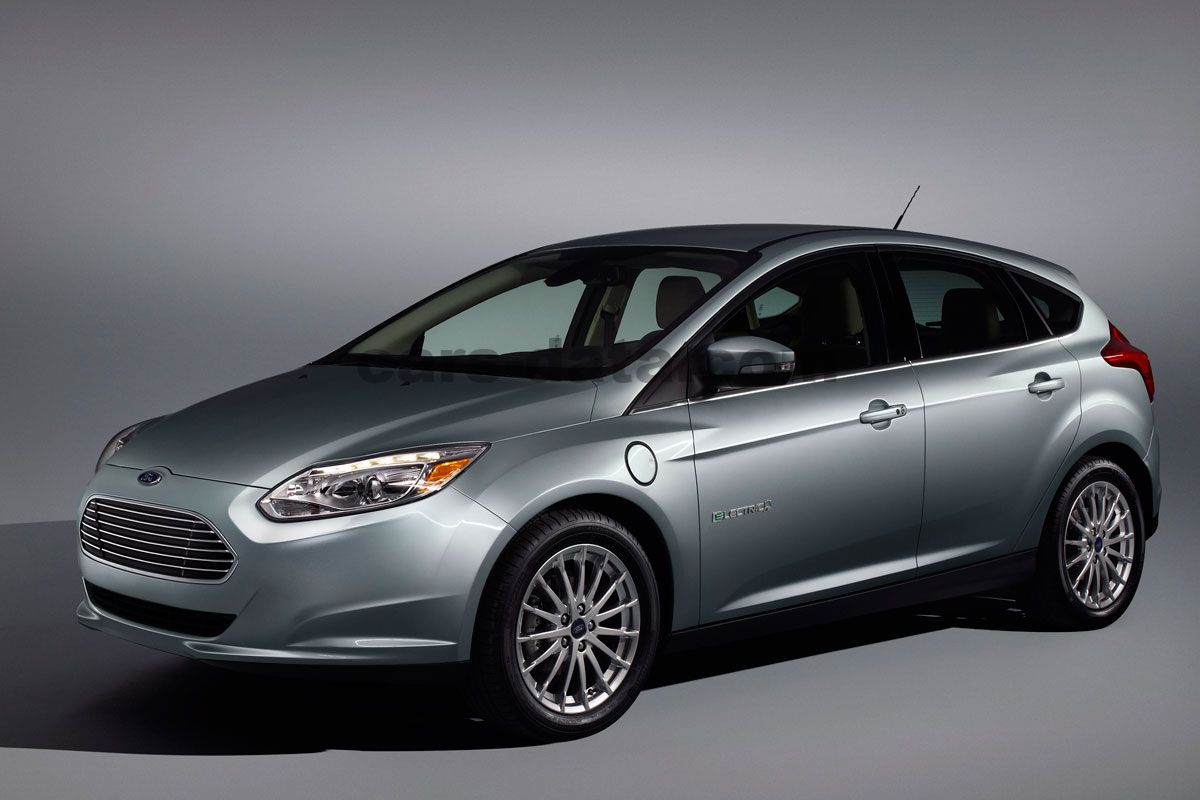
One of the Focus Electric’s strengths is its driving dynamics. Building on the well-regarded Focus platform, the electric version maintains good handling characteristics, a comfortable ride, and a quiet cabin made even more serene by the absence of engine noise.
The driving position is conventional and comfortable, with good visibility and controls that feel familiar to anyone who’s driven a modern Ford product. This normalcy, while perhaps not as exciting as some dedicated EV platforms, makes the Focus Electric easy to live with.
The interior is essentially identical to the gasoline Focus, with quality materials for the segment and seating for five. Cargo space measures 14.5 cubic feet with the seats up, reduced from the gas model due to battery placement but still adequate for daily use.
Ford’s SYNC infotainment system comes standard, featuring voice controls, smartphone integration, and on later models, an 8-inch touchscreen. MyFord Mobile functionality allows owners to monitor charging, pre-condition the cabin, and locate charging stations via smartphone app.
Charging is where earlier Focus Electrics show their age. The 2012-2016 models charge at a maximum rate of 3.3 kW on Level 2, meaning a full charge takes over seven hours painfully slow by modern standards. Ford improved this to 6.6 kW for 2017 and later models, cutting charging time in half. DC fast charging wasn’t initially available but became optional on later models, a worthwhile feature to seek out.
Used Focus Electrics typically range from $8,000 to $14,000, with earlier models at the lower end and late-model, low-mileage examples commanding premium prices.
The reliability has generally proven solid, with Ford’s widespread dealer network making service accessible. For buyers seeking a conventional, comfortable electric car without flashy styling or attention-grabbing features, the Focus Electric delivers competent, unpretentious transportation at a bargain price.
4. Fiat 500e (2013-2019)
The Fiat 500e represents one of the automotive world’s most interesting contradictions: a car that was reportedly produced at a loss, sold in limited markets, and yet became beloved by owners for its charming character and surprising driving dynamics.
Originally available only in California and Oregon due to compliance requirements, the 500e has depreciated dramatically, now offering Italian style and electric efficiency at basement prices.
Chrysler’s former CEO Sergio Marchionne famously pleaded with customers not to buy the 500e, claiming the company lost $14,000 on each unit sold. This unusual anti-marketing created a quirky reputation that’s followed the car ever since. Despite the corporate reluctance, Fiat engineers created a genuinely engaging electric vehicle.
The 111-horsepower electric motor provides spirited acceleration 0-60 mph in under nine seconds and the 500e’s low center of gravity (thanks to floor-mounted batteries) gives it nimble, go-kart-like handling that’s genuinely fun on twisty roads.
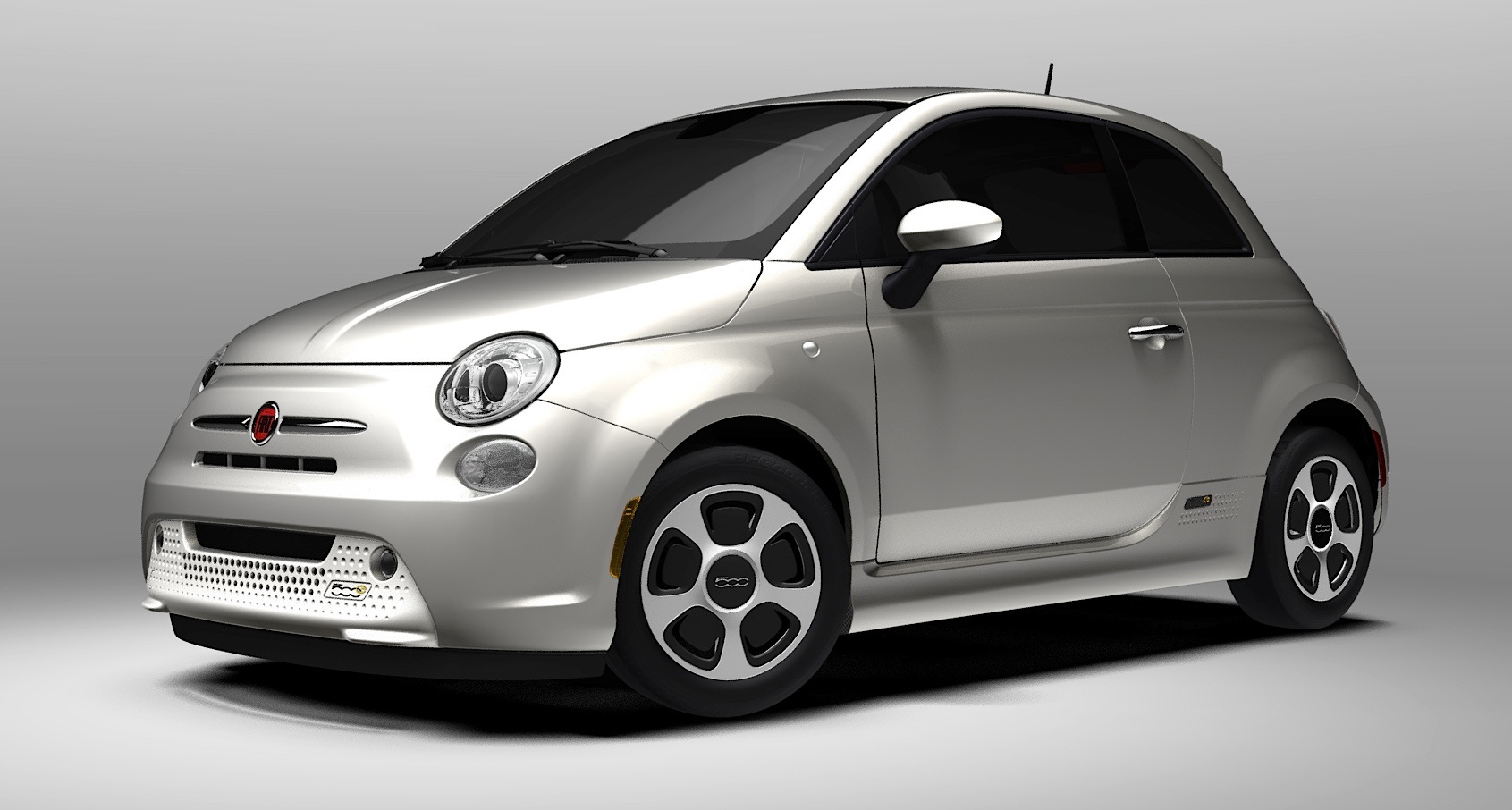
The 24 kWh battery pack delivers an EPA-rated 84 miles of range, adequate for city driving and short commutes. Like the standard Fiat 500, the 500e is unabashedly a city car, best suited to urban environments where its compact dimensions (just over 12 feet long) make parking effortless and its zippy acceleration feels perfectly matched to the environment.
Highway driving is possible but less comfortable, as the short wheelbase and light weight make it feel less planted at higher speeds. Inside, the 500e maintains the retro-chic aesthetic that made the standard 500 popular, with a stylish dashboard, circular design elements, and available color customization.
The cabin is cozy rather than spacious, with adequate front-seat room but cramped rear seats suitable primarily for children or emergency use. Cargo space is limited at 9.5 cubic feet, reflecting the car’s small footprint. The 7-inch touchscreen infotainment system includes navigation, smartphone integration, and the ability to pre-condition the cabin while plugged in.
Charging is straightforward, with Level 2 charging at 6.6 kW taking about four hours for a full charge. DC fast charging is not available, limiting road trip capability, though the car’s range and purpose make it clear that long-distance travel isn’t its intended use case. The 500e’s efficiency is excellent, rated at 112 MPGe combined, translating to very low operating costs.
Perhaps the most compelling aspect of the used Fiat 500e is its price. These cars regularly sell for $5,000-$9,000, depending on condition, mileage, and model year.
For that money, buyers get distinctive Italian styling, entertaining driving dynamics, and nearly free operation. The main considerations are the limited range, cramped interior, and the fact that Fiat has largely exited the U.S. market, potentially complicating service (though many owners report minimal maintenance needs). For urban dwellers seeking affordable, stylish electric transportation, the 500e is hard to beat.
Also Read: 10 Cars With Factory Exhaust Notes Worth Preserving
5. Volkswagen e-Golf (2015-2019)
Volkswagen’s e-Golf exemplifies the “electric car that doesn’t look like an electric car” philosophy. Based on the seventh-generation Golf, one of the world’s best-selling and most respected compact cars, the e-Golf delivers familiar Volkswagen refinement and build quality in an electric package.
As these vehicles age, they’ve become surprisingly affordable while maintaining the core competencies that made the Golf a global success.
The e-Golf debuted for the 2015 model year with a 24.2 kWh battery providing 83 miles of EPA-estimated range. Volkswagen upgraded the battery to 35.8 kWh for 2017, increasing range to 125 miles a meaningful improvement that makes later models significantly more practical.
The electric motor produces 115 horsepower (134 hp in 2017+), delivering smooth, linear acceleration that feels appropriately quick for the car’s character. The e-Golf prioritizes refinement over performance, with quiet operation, minimal NVH (noise, vibration, harshness), and a planted, confident feel that’s distinctly Volkswagen.
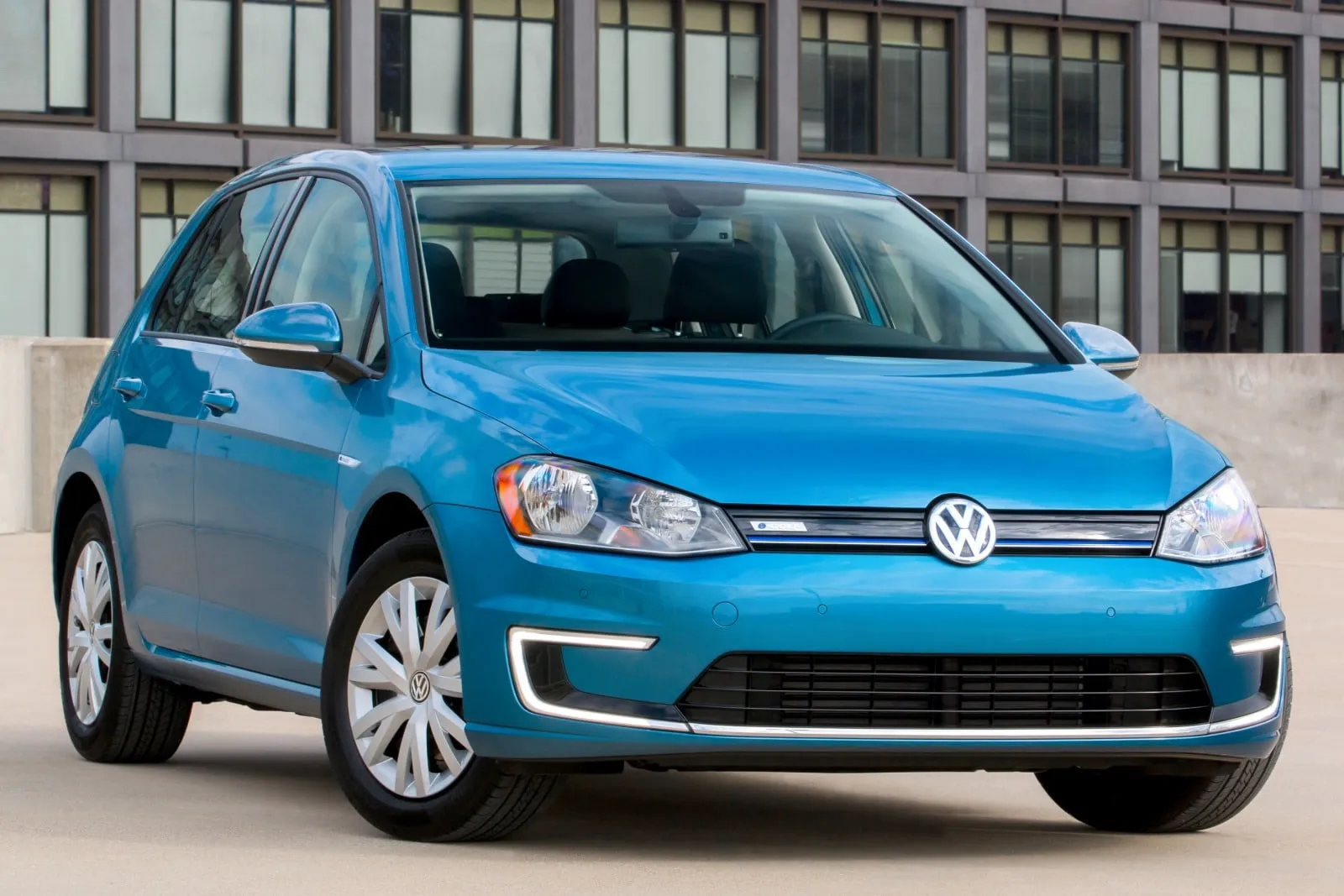
Driving dynamics are a highlight. The e-Golf retains the standard Golf’s excellent chassis tuning, offering precise steering, composed handling, and a comfortable ride that soaks up imperfections without feeling floaty.
The low-mounted battery pack improves the center of gravity, actually enhancing handling compared to the gasoline Golf. The driving experience feels mature and refined, appealing to drivers who appreciate quality engineering over flashy acceleration or attention-seeking styling.
Interior quality exceeds most competitors in this price range. Volkswagen’s fit and finish, logical control layout, and quality materials give the e-Golf a premium feel despite its mid-market positioning.
The cabin accommodates five adults reasonably well, with supportive seats and good visibility. Cargo space measures 16.9 cubic feet behind the rear seats, expandable to 52.7 cubic feet with seats folded genuinely practical for everyday use. The infotainment system varies by model year, with later versions featuring VW’s Car-Net connectivity, smartphone integration, and available navigation.
Charging capabilities improved over the model years. Early e-Golfs charge at 7.2 kW on Level 2, completing a full charge in about four hours. DC fast charging became available on SE and SEL Premium trims, adding valuable flexibility for longer trips or quick top-ups. The 2017+ models with larger batteries and faster charging are worth seeking out for their enhanced practicality.
Used e-Golfs typically range from $10,000 to $18,000, with earlier, lower-range models at the bottom of that spectrum and late-model examples with the larger battery commanding more.
The VW dealer network provides accessible service, and the e-Golf’s mechanical simplicity keeps maintenance costs low. The main appeal here is driving a fundamentally excellent car the Golf that happens to be electric.
For buyers who prioritize conventional driving goodness, build quality, and understated competence over maximum range or cutting-edge technology, the e-Golf is an outstanding choice in the used EV market.
6. BMW i3 (2014-2021)
BMW’s i3 stands apart from every other vehicle on this list and indeed, from nearly every car ever made. With its carbon fiber passenger cell, rear-mounted electric motor, suicide doors, and avant-garde styling, the i3 represents BMW’s radical reimagining of urban mobility.
Initially expensive as a new car, the i3 has depreciated sharply, now offering distinctive design, premium materials, and innovative engineering at surprisingly accessible prices.
The i3’s specifications evolved significantly over its production run. Early models (2014-2016) came with a 22 kWh battery providing approximately 81 miles of range, while 2017-2018 models received a 33 kWh pack for 114 miles. BMW introduced a 42.2 kWh battery for 2019-2021, extending range to 153 miles.
Additionally, BMW offered a range-extender (REx) option featuring a small gasoline engine that generates electricity when the battery depletes, adding approximately 75-80 miles of total range a feature worth considering for buyers concerned about range anxiety.
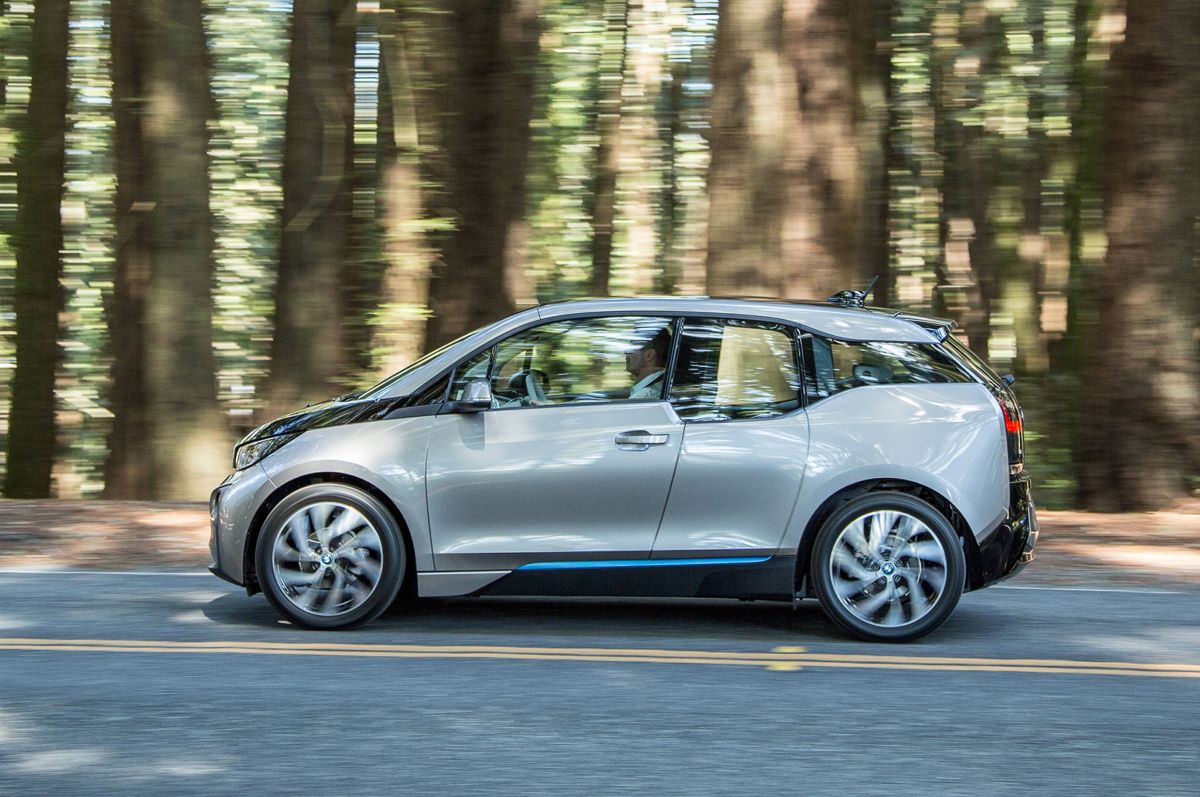
The driving experience is uniquely BMW. The i3 delivers 170 horsepower (181 hp in later models) and instant torque to the rear wheels, creating surprisingly spirited acceleration 0-60 mph in about 7 seconds.
The tall, narrow tires, short wheelbase, and rear-wheel drive create distinctive handling characteristics that feel nimble and direct, if unconventional. The one-pedal driving mode, which uses regenerative braking to slow the car dramatically when lifting off the accelerator, takes adjustment but becomes intuitive quickly.
Interior design is where the i3 truly shines. BMW used sustainable materials extensively: eucalyptus wood, recycled plastics, and naturally tanned leather create a cabin that feels both premium and environmentally conscious. The minimalist dashboard, floating infotainment screen, and abundant glass create an airy, futuristic atmosphere.
The rear-hinged back doors (which require opening the front doors first) and lack of a traditional B-pillar make entry and exit surprisingly easy despite the compact footprint. Rear seat space is adequate for adults on short trips, and the 15.1 cubic feet of cargo space is cleverly packaged.
The i3’s carbon fiber construction keeps weight remarkably low under 3,000 pounds, contributing to efficiency, handling, and acceleration. This exotic material in a mass-market electric car was unprecedented and remains unusual.
However, this also means collision repairs can be expensive, making a thorough pre-purchase inspection and comprehensive insurance important.
Used i3 prices vary widely based on battery size, range-extender inclusion, and condition. Early models without REx can be found for $10,000-$15,000, while later, larger-battery examples with REx run $18,000-$25,000.
The i3 appeals to buyers seeking something different a car with personality, innovative engineering, and genuine premium materials.
It’s not the most practical electric car, nor the longest-range or fastest-charging, but it’s arguably the most interesting. For those who value distinctive design and are comfortable with the i3’s quirks, it offers a unique entry point to electric BMW ownership.
7. Kia Soul EV (2015-2019)
The Kia Soul EV brings the practical, boxy design and surprising personality of the popular Soul to the electric vehicle market. While never a sales leader, the Soul EV has developed a dedicated following among owners who appreciate its functionality, reliability, and affordable operation.
As these vehicles enter the used market, they represent excellent value for buyers seeking practical electric transportation without sacrificing space or versatility.
The first-generation Soul EV utilized a 27 kWh battery pack providing approximately 93 miles of EPA-estimated range. Kia updated the model for 2018, installing a larger 30 kWh battery that extended range to 111 miles modest but serviceable for many buyers’ daily needs.
The electric motor produces 109 horsepower and 210 lb-ft of torque, providing adequate acceleration and the smooth, quiet power delivery inherent to electric vehicles. While not particularly sporty, the Soul EV handles competently and rides comfortably, making it pleasant for everyday driving.
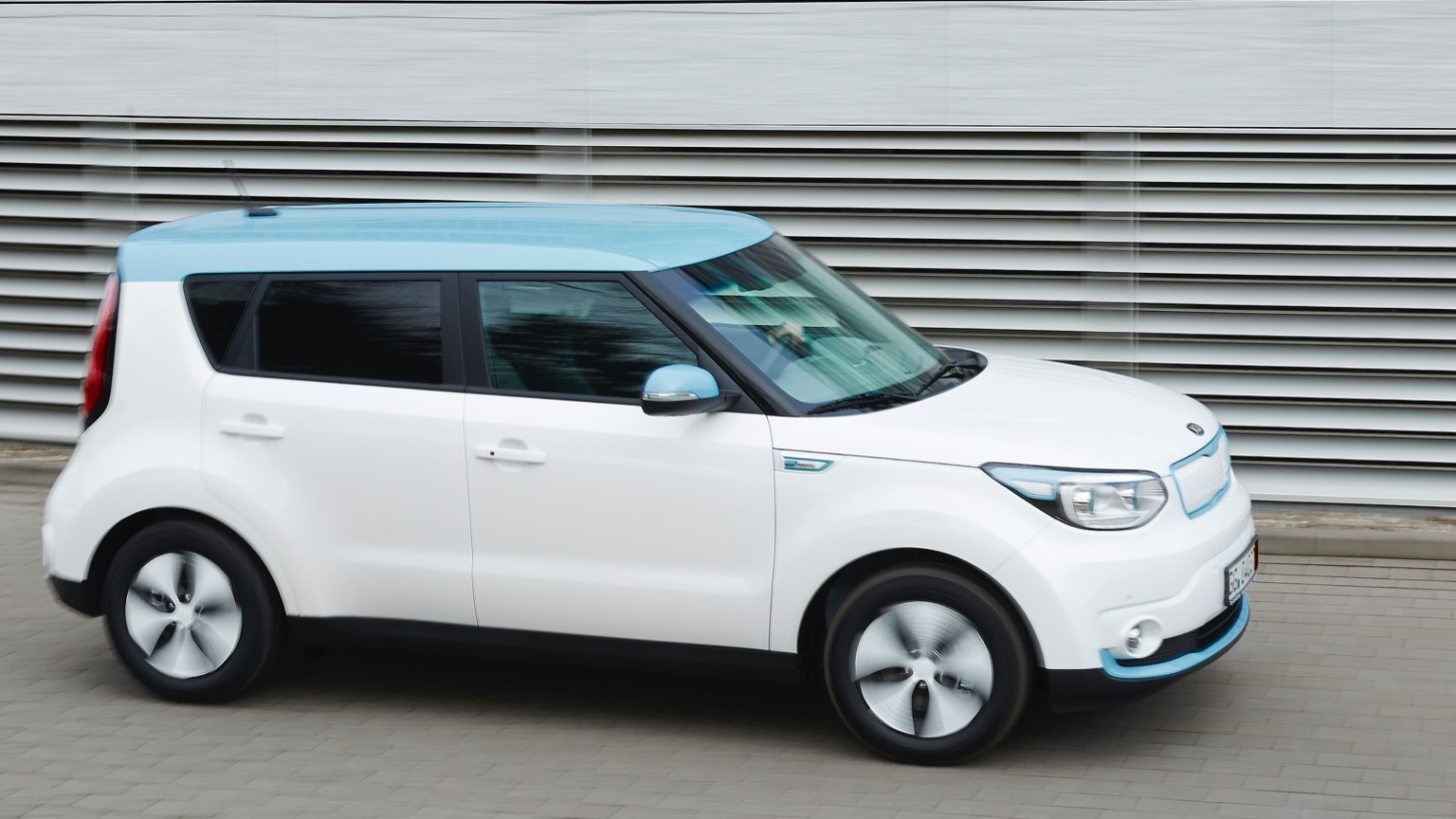
The Soul’s distinctive boxy styling translates to exceptional practicality. The tall roofline provides ample headroom, and the upright seating position offers good visibility in all directions.
The cabin accommodates five passengers reasonably well, with supportive front seats and adequate rear legroom. Cargo capacity is where the Soul EV truly excels 24.2 cubic feet behind the rear seats expands to 49.5 cubic feet with seats folded, rivaling much larger crossovers and making it genuinely practical for hauling cargo, groceries, or sporting equipment.
Interior quality and features exceed expectations for the price point. Kia’s materials and build quality have improved dramatically over the past decade, and the Soul EV benefits from these advances.
The infotainment system includes a touchscreen (7 or 8 inches depending on trim), smartphone integration, navigation on higher trims, and Kia’s UVO eco system for remote monitoring and climate control.
Upper trim levels add heated seats, heated steering wheel, leather upholstery, and a premium audio system genuinely nice amenities in what’s now a budget-priced used vehicle.
Charging capabilities include DC fast charging as standard equipment, a significant advantage over some competitors. The Soul EV can charge from 20% to 80% in about 30 minutes using a 50 kW fast charger, making longer trips or quick top-ups more feasible.
Level 2 charging at 6.6 kW takes approximately four to five hours for a full charge, convenient for overnight home charging. Reliability has proven strong, with Kia’s industry-leading warranty (10-year/100,000-mile battery warranty for original owners, though it doesn’t transfer fully to second owners) providing confidence.
Used Soul EVs typically sell for $10,000-$16,000, depending on model year, mileage, and trim level. The combination of practicality, reliability, standard fast charging, and Kia’s reputation for value makes the Soul EV an excellent choice for buyers seeking no-nonsense electric transportation. It may not be exciting or luxurious, but it’s competent, practical, and affordable qualities that matter most to many buyers.
8. Smart ForTwo Electric Drive (2013-2019)
The Smart ForTwo Electric Drive (later renamed EQ ForTwo) represents the ultimate in urban-focused electric transportation. Measuring just 106 inches long shorter than a Mini Cooper by nearly two feet the Smart is purpose-built for dense city environments where parking is scarce and maneuverability is paramount.
As these tiny EVs depreciate, they’ve become incredibly affordable options for urban dwellers seeking minimal-footprint transportation.
The electric Smart evolved over its production run. The second-generation electric model (2013-2015) featured a 17.6 kWh battery providing approximately 68 miles of range, while the third generation (2017-2019) increased battery capacity to 17.6 kWh with improved efficiency, extending range to about 58 miles EPA-rated (the range decrease reflects changes in EPA testing procedures rather than actual capability reduction).
The electric motor produces 80 horsepower and 118 lb-ft of torque, providing adequate acceleration for city driving, though the Smart feels out of its element at highway speeds.
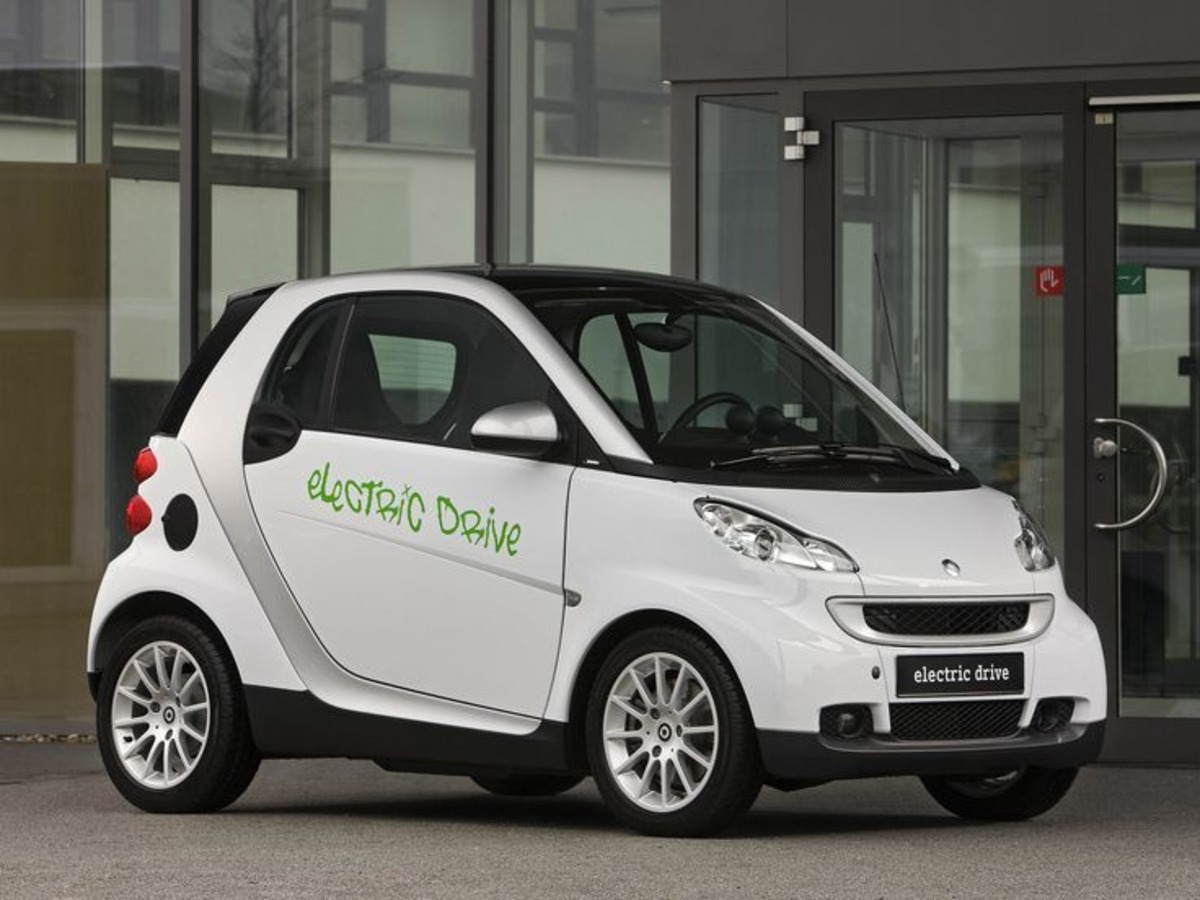
The driving experience is exactly what you’d expect from a car this small: ultra-maneuverable at low speeds with an incredibly tight turning circle (just 22.8 feet, allowing U-turns in impossibly narrow streets), but somewhat nervous and buffeted at higher speeds due to the short wheelbase and light weight.
The Smart excels in stop-and-go traffic where its compact dimensions, instant electric torque, and easy parking make it absolutely ideal. Highway driving is possible but not pleasant, with wind noise, a busy ride, and a general sense that the car is working hard.
The interior is surprisingly pleasant given the exterior dimensions. Two adults fit comfortably in supportive seats with adequate headroom and legroom.
The upright seating position and large windows provide excellent visibility, making the Smart feel less claustrophobic than its size might suggest. Storage is obviously limited there’s essentially no cargo space beyond small cubbies and door pockets, though the rear seat area (which doesn’t exist in the two-seat configuration) can hold shopping bags or a backpack.
The infotainment system is basic but functional, with smartphone integration and navigation available on higher trims. Charging is straightforward, with Level 2 charging taking about six hours for a full charge.
DC fast charging is not available on earlier models but became optional on later versions a worthwhile feature to seek out. The limited range means the Smart is truly a city car; road trips are impractical, and even suburban commutes might push range limits.
Perhaps the most compelling aspect of the used Smart Electric Drive is its price. These cars frequently sell for $5,000-$8,000, making them among the absolute cheapest electric vehicles available. Operating costs are minimal electricity for charging costs just dollars per week for most users, and maintenance is nearly nonexistent.
The Smart appeals to a specific buyer: someone living in a dense urban environment with limited parking, who needs basic transportation for short trips, and who values minimal environmental impact and operating costs above all else. For that specific use case, the Smart Electric Drive is nearly perfect and almost absurdly affordable.
For anyone else, its limitations make it impractical as a primary vehicle, though it can work well as a dedicated city runabout or second car for urban households.
Also Read: Top 10 Cars That Hit the Depreciation Sweet Spot at 5 Years Old
