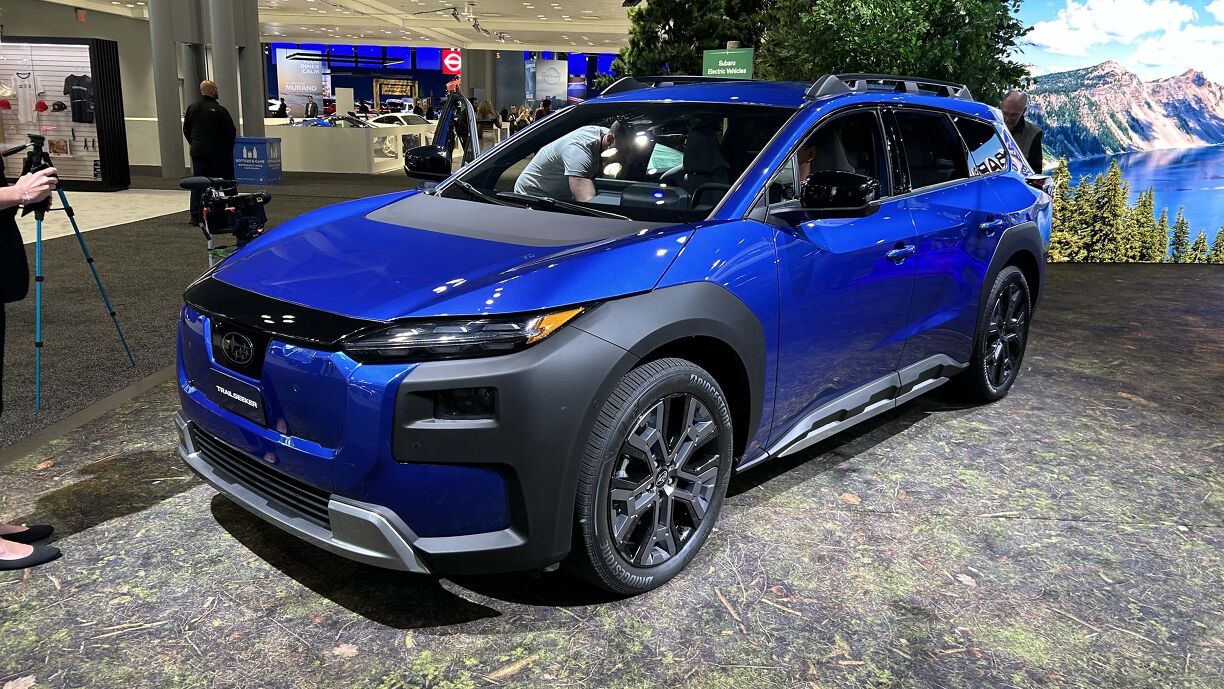
A $39,995 electric wagon has unexpectedly become the quickest production Subaru ever built. That headline figure is compelling, but range limitations and certain design decisions complicate the picture.
Subaru’s first EV, the Subaru Solterra, entered the market cautiously. Modest demand and an early recall limited its impact, making it feel like an exploratory step into electrification rather than a decisive commitment.
The Subaru Trailseeker represents a markedly different approach. It is larger, more powerful, and materially more capable. Almost incidentally, it now stands as the most powerful and quickest production Subaru to date.
Rather than evaluating a fully equipped Touring or mid-level Limited trim, testing focused on the Trailseeker Premium, the base model, priced at $39,995 before destination. Despite the “Premium” designation, this is the entry point most buyers will realistically consider.
Key specifications are notable: dual electric motors, a 74.7 kWh battery pack, 375 horsepower (280 kW), standard Symmetrical AWD, 8.5 inches of ground clearance, and a 3,500-pound towing capacity.
Subaru claims 0–60 mph in 4.4 seconds. Independent GPS-based testing recorded a best run of 3.88 seconds with rollout, or 4.11 seconds without. That is objectively quick, irrespective of brand context.
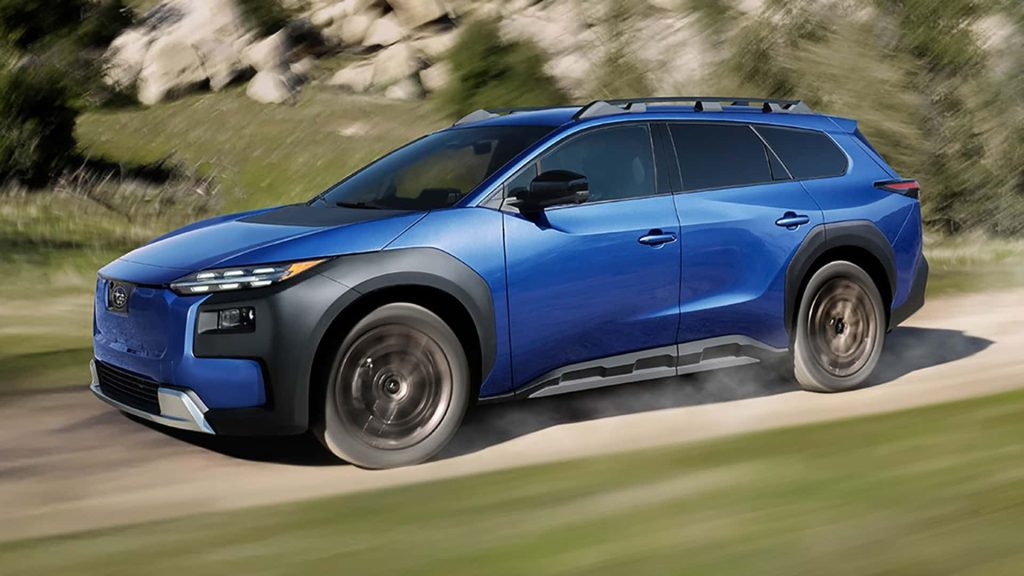
The Trailseeker adopts a more rugged aesthetic than the Solterra. Black lower cladding, squared proportions, ladder-style roof rails, and a full-width rear light bar establish a clear outdoors-oriented identity.
At 190.8 inches long on a 112.2-inch wheelbase, with 8.5 inches of ground clearance, it surpasses several EV competitors in ride height.
That clearance advantage exceeds rivals such as the Volkswagen ID.4, Hyundai Ioniq 5 XRT, and Chevrolet Blazer EV. The 18-inch wheels with aerodynamic covers on the Premium trim reinforce the practical character rather than diminishing it.
Despite its entry-level positioning, the Premium trim avoids obvious cost-cutting. A 14-inch infotainment display, shared technology roots with Toyota, provides intuitive navigation.
Physical controls remain for essential functions such as volume, defrost, hazards, and temperature, while secondary climate adjustments reside within the touchscreen.
Two 15W wireless charging pads sit beneath the display, and storage solutions compensate for the absence of a traditional glovebox. Rear-seat space is sufficient to accommodate taller occupants, though panoramic roof-equipped models marginally reduce headroom.
Cargo capacity exceeds 30 cubic feet behind the rear seats and expands to over 70 cubic feet when folded. A front trunk is absent, but the 3,500-pound towing rating enhances overall utility.
The Trailseeker exhibits dual characteristics. In routine driving, it feels composed and understated. Under full acceleration, it delivers performance consistent with its 375-horsepower output.
Steering response is precise, brake modulation is linear, and the chassis maintains stability across varied surfaces, including gravel and light trails.
Independent front and rear motors enable variable torque distribution. X-Mode includes Snow/Dirt and Deep Snow/Mud settings.
Regenerative braking levels are adjustable via steering-wheel paddles. While not positioned as a WRX successor, it is significantly more engaging than most mid-size electric crossovers.
EPA-estimated range is 281 miles for the Premium trim. Limited and Touring variants are slightly lower at 274 miles.
Charging from 10–80 percent can occur in approximately 28 minutes at up to 150 kW, utilizing a standard NACS port for Tesla Supercharger compatibility.
Primary competitors include the Tesla Model Y, Kia EV6, and Honda Prologue. The Model Y offers greater range and a front trunk but lacks equivalent ground clearance.
The EV6 emphasizes sportiness and on-road dynamics. The mechanically related Toyota bZ Woodland shares much of its architecture, though the Subaru undercuts it in base pricing.
The Trailseeker does not dominate in maximum range or interior luxury. Its strength lies in synthesis: rapid acceleration, meaningful ground clearance, legitimate towing capability, and sub-$40,000 pricing.
The Premium trim retains the full performance specification and capability set, making it the most rational choice within the lineup.
Subaru’s second EV demonstrates clearer brand alignment than its first. It is practical, capable, and unexpectedly quick, attributes consistent with Subaru’s historical identity, now translated into an electric format.
Also Read: 5 EVs With the Most Consistent Range vs 5 That Underperform in Winter