
The 1980s was arguably the most theatrically excessive decade in automotive history. Shoulder pads, synth music, and neon everything had to make an entrance, and cars were no exception.
Two distinct design philosophies defined the era’s sports car scene: the dramatic, almost cinematic reveal of the pop-up headlight, and the sleek, unbroken snout of the fixed-light design. Both approaches were born from the same obsession aerodynamics and style but they arrived at wildly different answers.
Pop-up headlights were the decade’s ultimate party trick. Hidden behind flush body panels, they snapped open at the press of a switch, transforming a smooth wedge into something that looked alive.
They were theatrical, mechanical, and utterly impractical by modern safety standards which is exactly why enthusiasts adore them. Fixed headlights, by contrast, demanded that designers work harder.
Without the luxury of hiding the lights away, the entire front fascia had to be beautiful at all times. The result was often a cleaner, more cohesive look that aged just as well.
From Japanese legends to Italian exotica and American muscle reimagined, both camps produced cars that defined the decade and continue to command reverence today. Here are five iconic representatives from each school of thought.
5 Iconic 1980s Sports Cars With Pop Up Headlights
These exceptionally distinctive vehicles feature retractable headlight mechanisms and sleek aerodynamic profiles perfectly embodying 1980s sports car design philosophy, providing dramatic styling through flush nose sections and mechanical theater as hidden headlights rotated upward before night drives creating the signature look that defined an automotive era.
Their characteristic engineering includes rotating or flip-up headlight assemblies and carefully sculpted front ends that resisted the aerodynamic compromises found in fixed-light designs while delivering wind-cheating profiles impossible with exposed headlamps, dramatic transformation from smooth daytime appearance to aggressive nighttime stance, and mechanical complexity adding personality that modern regulations permanently eliminated from automotive design.
1. Mazda RX-7 FC (1985–1992)
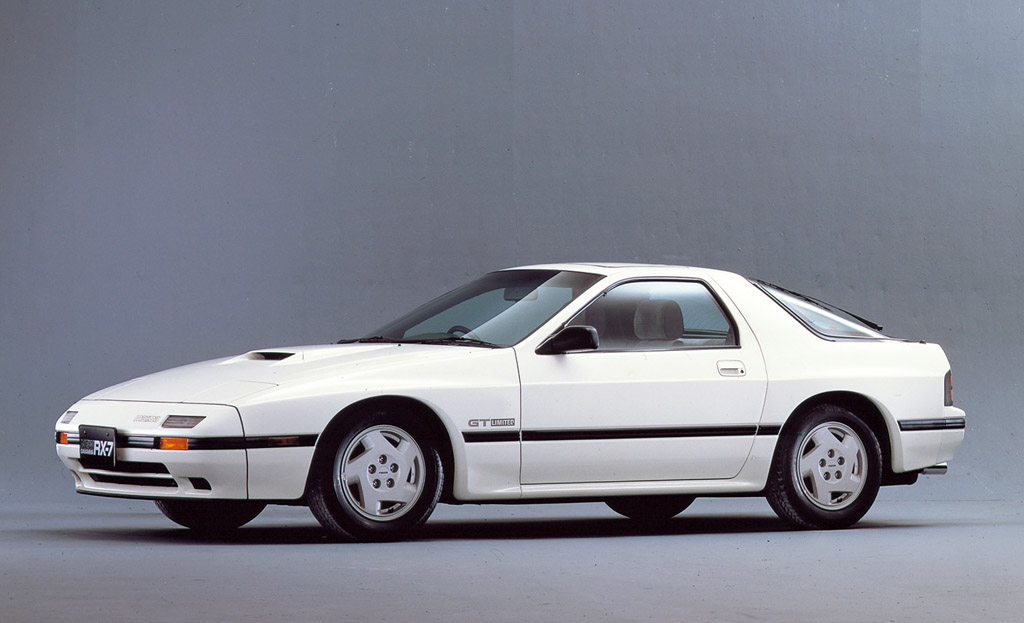
Few cars of the 1980s managed to balance affordability, performance, and sheer visual drama quite like the second-generation Mazda RX-7, known internally as the FC. Launched in 1985 as the successor to the original SA22C, the FC arrived with a bold new silhouette long hood, short deck, and a set of pop-up headlights that snapped open with mechanical precision every time you fired it up after dark. It was a car that understood the assignment completely.
The FC’s pop-up headlights weren’t just a stylistic flourish. They were a functional necessity born from the aerodynamic demands of its low, swooping hood line.
The nose of the RX-7 FC dipped so dramatically toward the road that conventional fixed headlights simply couldn’t be integrated without ruining the car’s drag coefficient and visual purity.
By hiding the lights beneath flush body panels, Mazda’s designers achieved a front end that was impossibly clean during daylight hours a smooth, unbroken wedge that cut through air with minimal resistance.
Underneath that dramatic skin lived the car’s most defining feature: Mazda’s 13B rotary engine. In naturally aspirated form, it produced around 146 horsepower, later upgraded to a turbocharged variant pushing 200 horsepower remarkable figures for the era.
The rotary’s compact dimensions allowed it to be mounted low and far back in the engine bay, achieving near-perfect 50/50 weight distribution. Combined with fully independent suspension at all four corners, the FC handled with a balance and fluidity that contemporary rivals from Europe struggled to match at twice the price.
Inside, the FC felt futuristic without being alienating. A deeply cowled instrument binnacle, a low driving position, and a short-throw gear change reinforced the sense that this was a serious driver’s car dressed in accessible clothing.
The cabin was snug but purposeful, with the driver positioned low between high sill lines a design choice that made every journey feel slightly conspiratorial.
The pop-up headlights became the FC’s most enduring visual signature. At night, that slow mechanical rise accompanied by a subtle whir of electric motors transformed the car’s front end from a smooth mask into something predatory and alert.
It was automotive theater of the highest order. Decades later, the FC’s headlights remain one of the most iconic design details of the entire decade, a mechanical gesture that no modern LED strip can replicate. The RX-7 FC proved that sometimes the best design solutions are the ones that hide in plain sight.
2. Ferrari Testarossa (1984–1991)
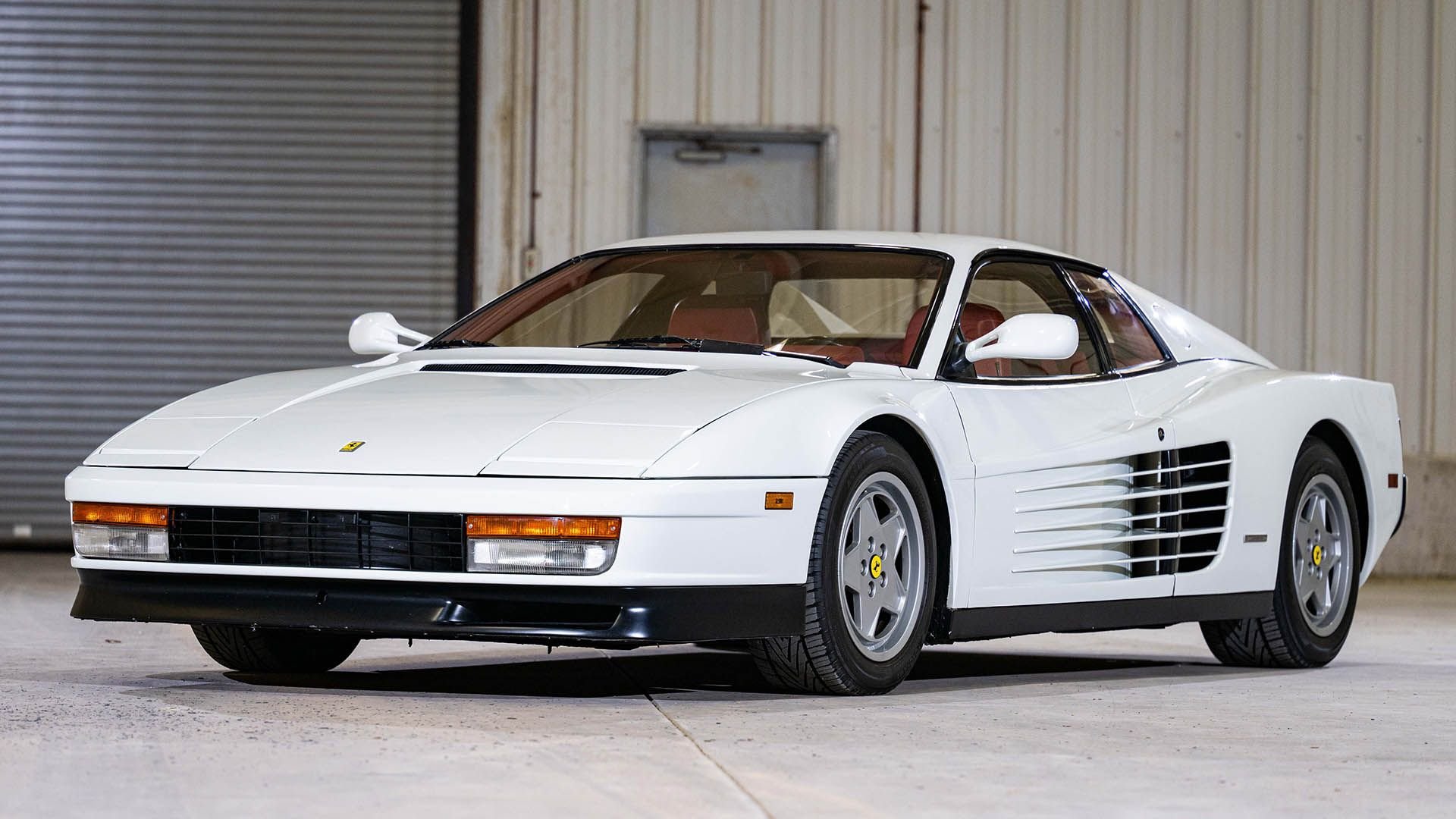
If the 1980s had an official sports car, it was the Ferrari Testarossa. Designed by Pininfarina and revealed at the 1984 Paris Motor Show, the Testarossa was an exercise in controlled excess wider than anything Ferrari had produced before, lower than seemed possible, and so aggressively styled that it looked like it had been designed to intimidate motorways rather than simply travel on them.
And yes, it had pop-up headlights dramatic, wide, and perfectly flush with that impossibly flat nose. The Testarossa’s front end was a study in tension.
The pop-up headlights sat within a nose so low and wide that it seemed to press itself into the road. When retracted, the front of the car was a smooth, almost featureless plain of red (or any of Ferrari’s available colors), interrupted only by the narrow front air intakes and the central prancing horse badge.
When deployed, the headlights rose in unison, giving the Testarossa a wide-eyed, almost startled expression that matched the shock-and-awe proportions of the rest of the car perfectly.
Power came from a 4.9-liter flat-twelve engine mounted longitudinally behind the driver a layout that required those now-iconic side strakes to channel cooling air to the massive rear-mounted radiators.
The engine produced 390 horsepower in standard form, enough to push the Testarossa to a top speed of 180 mph. The exhaust note was operatic, a rolling thunderstorm of mechanical music that announced the car’s presence long before it came into view.
The Testarossa’s cultural impact was immense. Miami Vice embedded it permanently in the public consciousness Sonny Crockett’s white example became one of the most recognizable television props of the decade.
It appeared on bedroom walls, in video games, and in the dreams of an entire generation of children who grew up measuring all other cars against it. The pop-up headlights were a key part of that mythology.
They gave the car a sense of transformation, as if the Testarossa existed in two states: dormant predator by day, illuminated apex machine by night.
Today, the Testarossa’s values have climbed steadily as nostalgia and genuine appreciation for its engineering converge. The pop-up lights remain central to its appeal a mechanical detail that belongs to an era when cars were allowed to be theatrical without apology.
3. Lamborghini Countach LP5000 QV (1985–1988)
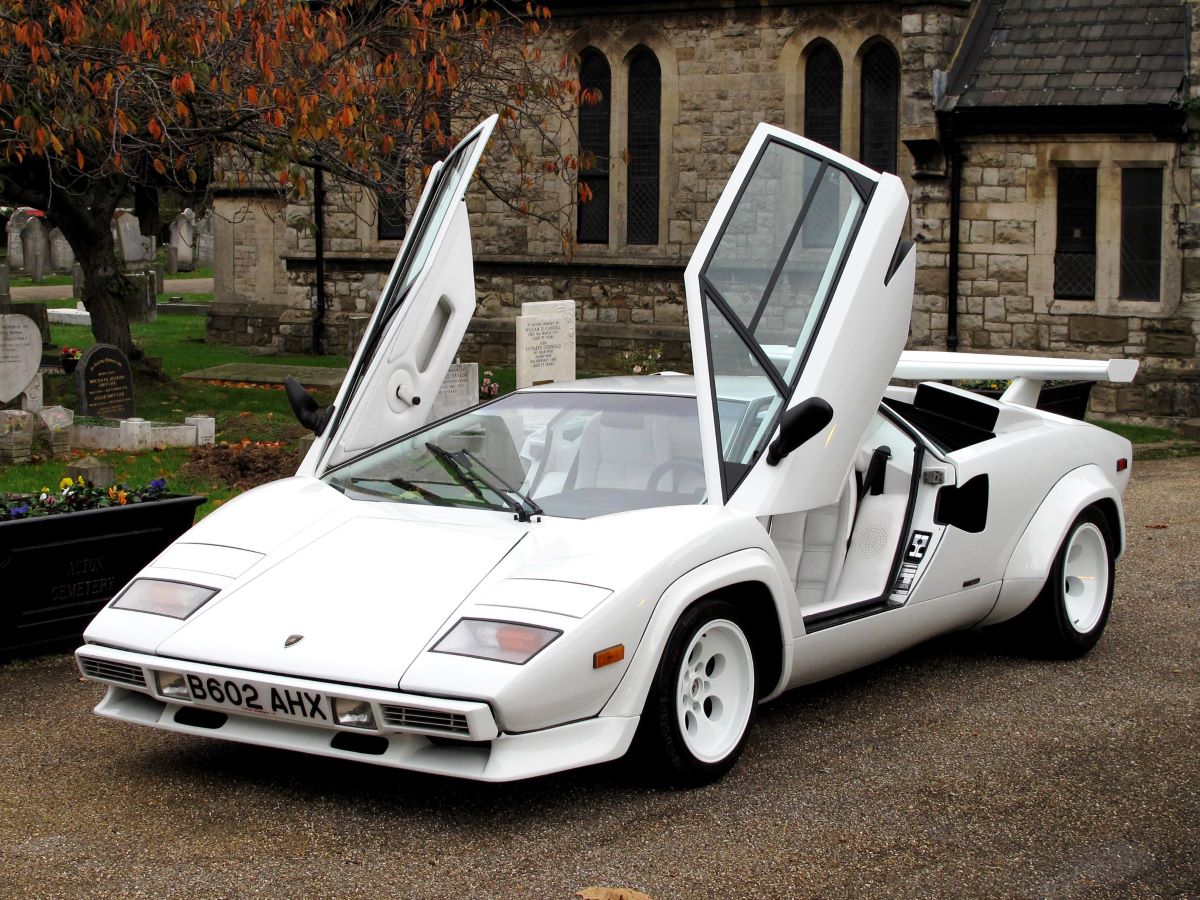
To call the Lamborghini Countach LP5000 QV extreme is to dramatically understate the case. Designed by Marcello Gandini and first shown in 1971, the Countach had evolved by the mid-1980s into something that bordered on the surreal.
The LP5000 QV — Quattrovalvole, meaning four valves per cylinder represented the car at the peak of its original design ambition, and its pop-up headlights were among the most unusual in automotive history.
Unlike the smooth, symmetrically rising units found on Japanese sports cars of the era, the Countach’s headlights were housed in angular, rectangular pods that popped up from the very tips of the front fenders.
The mechanism was deliberately exposed, almost brutalist you could see the pivot points, the housings, the raw engineering of the thing. It looked like something a science fiction set designer would propose and expect to be rejected, except Lamborghini built it anyway and the world was grateful.
The LP5000 QV’s 5.2-liter V12 produced 455 horsepower through four Weber carburetors, making it one of the fastest production cars.
Zero to sixty took around five seconds extraordinary for 1985 and the top speed approached 180 mph, though precise figures were notoriously difficult to verify given the car’s dramatic aerodynamic profile.
The cabin was an exercise in driver intimidation: massive A-pillars, minimal rearward visibility, and a seating position so low you felt you were wearing the car rather than sitting in it.
The pop-up headlights on the Countach functioned, but only just. The light output was mediocre at best, a known weakness of the design. But this was Lamborghini, and mediocre light output was considered an acceptable trade-off for the visual theater of those angled pods rising from the fenders like a cat’s ears.
The headlights were never really about illuminating the road they were about completing one of the most visually coherent, outrageous automotive statements ever committed to metal.
The Countach LP5000 QV is the logical endpoint of pop-up headlight design a car where the mechanical theater of the lights was so integral to the effect that without them, the Countach would be a lesser object entirely. They are inseparable from its identity.
4. Toyota Supra MK III (1986–1993)
By 1986, Toyota had taken the Supra in a decisively more serious direction. The third-generation car the A70, or MK III arrived with a longer wheelbase, a more sophisticated suspension setup, and a front end dominated by a broad set of rectangular pop-up headlights that gave it a wide, authoritative face.
Where its predecessor had been a refined cruiser, the MK III Supra had ambitions that reached toward genuine sports car territory. The pop-up headlights on the MK III Supra were among the cleanest and most visually satisfying of the era.
Unlike the sometimes fussy or dated units found on European competitors, the Supra’s lights rose cleanly and evenly, their rectangular housings sitting flush with the hood line when open.
The mechanism was smooth, reliable, and in the typically thorough Toyota fashion engineered to last. They opened quickly enough to feel dramatic without the mechanical hesitancy that plagued some rival systems.
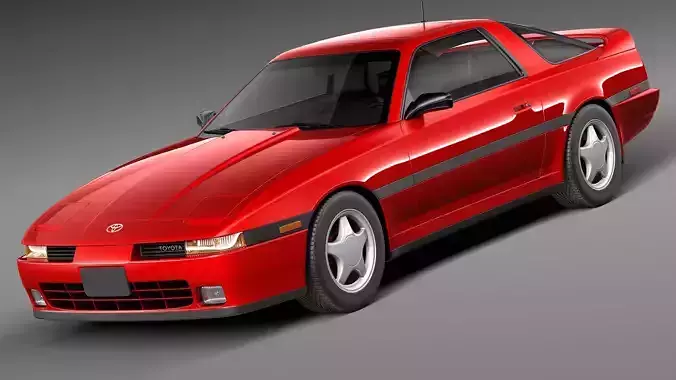
Under the hood, the MK III offered Toyota’s 3.0-liter inline-six in both naturally aspirated and turbocharged forms. The turbo variant produced 230 horsepower later rising to 232 and delivered it with the smooth, linear character that Japanese sports cars had begun to establish as their calling card.
The Supra pulled hard from mid-range and kept pulling, the turbo spool building to a crescendo that made sustained highway overtaking feel effortless and deeply satisfying.
The chassis was a revelation. Toyota had engineered the MK III with a multi-link rear suspension setup borrowed from motorsport thinking, and the result was a car that handled with precision and composure that its size seemed to argue against.
Body roll was well-controlled, steering was accurate, and the brakes ventilated discs all around inspired confidence at speeds where confidence was most needed.
Inside, the MK III was a masterclass in 1980s Japanese luxury sports car thinking: digital instrumentation, a driver-focused center console, and build quality that made some Italian rivals feel embarrassingly flimsy.
The pop-up headlights completed a package that aged remarkably well the MK III Supra looks coherent and purposeful even today, a quality that separates the genuinely well-designed cars of the era from those that merely embodied its excesses.
Also Read: Top 10 Boxy 1980s Sedans That Are Now Considered Modern Classics
5. Pontiac Firebird Trans Am (1982–1992)
While the Japanese and Italians were pursuing aerodynamic efficiency with their pop-up light designs, Pontiac had a different agenda entirely. The third-generation Firebird Trans Am, in production through most of the 1980s, used its pop-up headlights not for aerodynamic purity but for sheer, unashamed visual drama a very American approach to a very American car.
The Trans Am’s headlights were integrated into a front fascia that was among the most distinctive of the decade. The Firebird’s long, low hood swept down to a narrow, aggressive nose, and the pop-up units wide, rectangular, and deliberately menacing completed a face that had become one of the most recognized in American culture.
Kit from the television series Knight Rider used a modified Firebird, and those pop-up headlights were central to the car’s identity as a sophisticated, almost sentient machine.

Mechanically, the Trans Am of the 1980s underwent significant evolution. Early cars used carbureted V8 engines that produced figures embarrassing by 1970s muscle car standards a consequence of emissions regulations but by mid-decade, Pontiac’s 5.0-liter and 5.7-liter engines had recovered considerable performance.
The TPI (Tuned Port Injection) system introduced in 1985 transformed the car’s character, delivering torque in a broad, usable band rather than the narrow powerband of the old carbureted units.
Handling remained the Trans Am’s weakness relative to its Japanese and European contemporaries. The front suspension was competent rather than inspiring, and the car’s weight distribution biased toward the nose required commitment and respect in corners.
But on a straight American highway, preferably at night with those headlights rising to reveal a path ahead, the Trans Am delivered an experience that no amount of superior European handling could replicate. It was an emotional transaction as much as a mechanical one.
The pop-up headlights on the Trans Am were the physical manifestation of its personality hidden threat, revealed purpose. They made the car’s face mobile, expressive, alive. In a decade defined by surfaces and appearances, the Trans Am understood that the best design detail is one that transforms.
5 Iconic 1980s Sports Cars With Fixed Lights Headlights
These pragmatically designed vehicles feature conventional exposed headlights and simplified front-end styling perfectly demonstrating alternative 1980s sports car philosophy, providing reliable illumination through traditional fixed-lens assemblies that sacrificed dramatic appearance for mechanical simplicity, reduced maintenance concerns, and aerodynamic solutions not dependent on complex motorized mechanisms.
Their straightforward engineering includes permanently exposed lighting and integrated bumper designs that resisted the mechanical complexity found in pop-up equipped rivals while delivering headlights that always functioned without motor failures, cleaner front-end styling some designers preferred over pop-up mechanisms, and reduced part counts eliminating maintenance headaches that plagued concealed headlight systems as they aged.
1. Porsche 911 Carrera (1984–1989)
While competitors chased dramatic styling with mechanical light tricks, Porsche looked at the 911 and decided the most powerful design statement was one that needed no explanation and no theater.
The 911 Carrera of the mid-to-late 1980s wore its round, fixed headlights with the quiet confidence of something that has already proven itself a design so right that changing it would be an act of vandalism.
The 911’s fixed headlights were not a compromise or a shortcoming they were a deliberate choice that tied the car to a lineage stretching back to 1963.
Those round units, set wide in the front fenders with a gentle bulge of surrounding bodywork, were immediately recognizable from any angle and in any light.
They gave the 911 a face that was friendly at low speeds and increasingly purposeful as the velocity climbed, an expression that changed with context without the car changing at all.
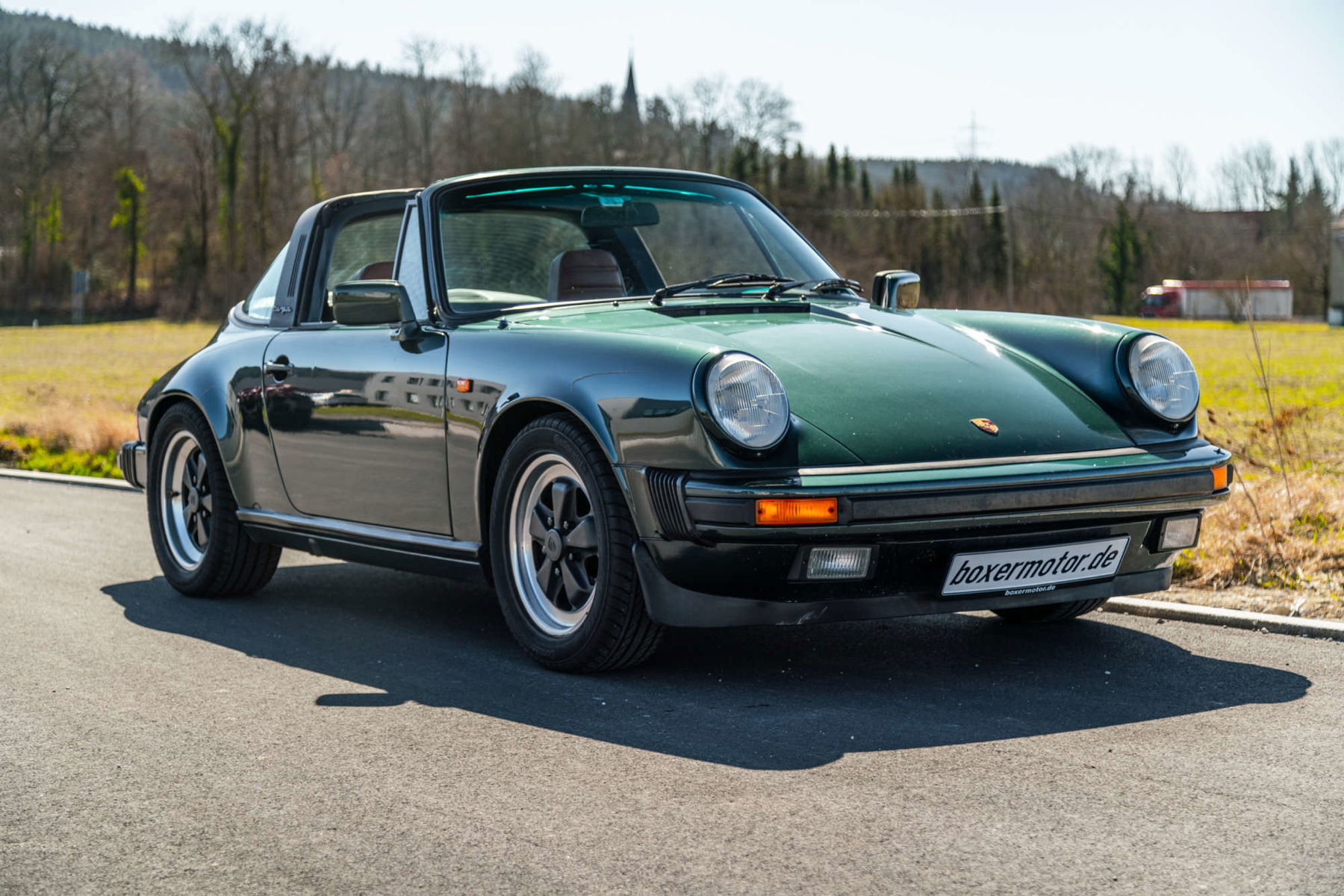
The 3.2-liter flat-six in the Carrera produced 231 horsepower modest by supercar standards, but delivered with the immediacy and mechanical directness that only an air-cooled Porsche engine can provide.
The Carrera rewarded driving skill in a way that few of its contemporaries managed. The rear-engine layout, so often cited as a handling liability by those who hadn’t driven one, became an asset in the hands of a committed driver the pendulum effect of the engine behind the rear axle creating a rotation on turn-in that could be exploited brilliantly or punished unforgivingly.
Porsche’s decision to keep fixed headlights on the 911 was also philosophical. The car was already complex enough the engineering required to make a rear-engined sports car handle predictably at high speed was considerable.
Introducing mechanical headlight systems would add weight, complexity, and potential failure points to a car where simplicity and reliability were core values.
The fixed lights were lighter, more robust, and arguably more aerodynamic than pop-up alternatives, contributing to the 911’s reputation for real-world usability that flashier rivals couldn’t match.
The 1980s Carrera remains one of the most significant 911 variants the last of the pure air-cooled cars before the significant redesigns of the following decade, and a benchmark for what a fixed-headlight sports car could achieve when design ego was set aside in favor of timeless function.
2. Ferrari 288 GTO (1984–1987)
While the Testarossa was pop-up theater, its contemporary the Ferrari 288 GTO took a completely different path. Built as a homologation special for Group B racing a competition series ultimately cancelled before the car ever competed the 288 GTO used fixed headlights integrated into a front bumper design that was purposeful, clean, and free from mechanical complexity.
It was a car built for absolute performance, and unnecessary moving parts had no place in that brief. The 288 GTO’s fixed headlights sat within a front fascia that mixed aggression with aerodynamic intelligence.
Paired with wide front air intakes and a modest chin spoiler, the lights contributed to a nose treatment that was clearly designed in a wind tunnel rather than a styling studio. The result was a car that looked purposeful rather than dramatic a distinction that matters greatly when you understand what the 288 GTO was built to do.
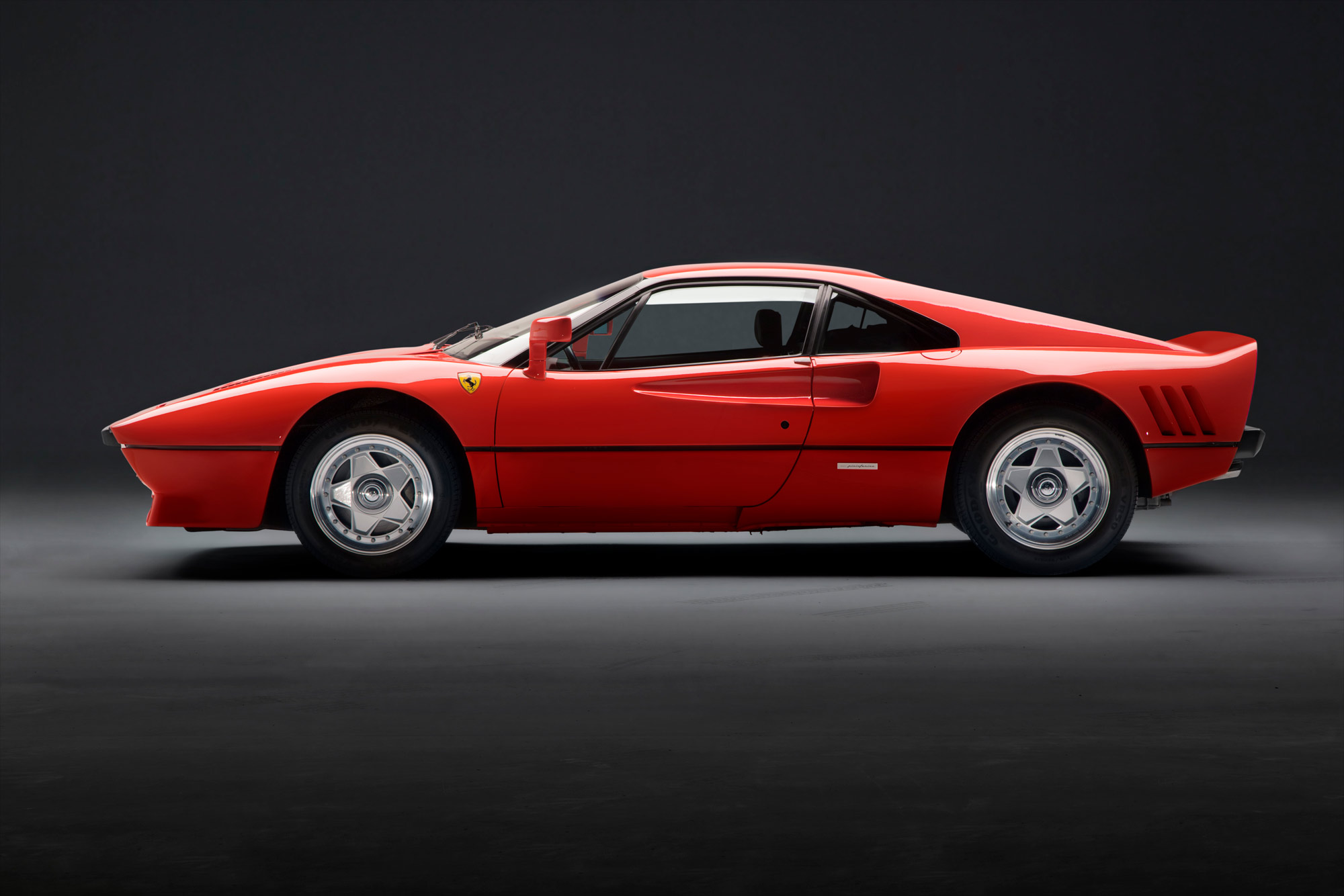
Beneath the body which was lengthened and widened compared to the 308 it was ostensibly based upon lived a 2.8-liter twin-turbocharged V8 producing 400 horsepower.
For a car weighing under 1,200 kilograms, this was a performance package that put the Testarossa in the shade for outright acceleration. Zero to sixty happened in under five seconds, and the top speed exceeded 190 mph, making the 288 GTO one of the fastest road cars of its era.
The fixed headlights were part of a broader philosophy of reduction the 288 GTO eliminated anything that wasn’t essential to performance. Carbon fiber, Kevlar, and fiberglass replaced steel wherever possible.
The interior was stripped and focused, with none of the leather-and-chrome luxury that Ferrari’s grand tourers of the period indulged in. Everything served the mission, and the headlights simple, fixed, reliable served it perfectly.
Only 272 examples were ever built, making the 288 GTO one of the most exclusive Ferraris of the decade. Its fixed headlights, far from being a design limitation, became part of its identity as a car that refused ornament. The GTO didn’t need pop-up theater it had twin turbos and a race-derived chassis to make its point.
3. Lamborghini LM002 (1986–1993)
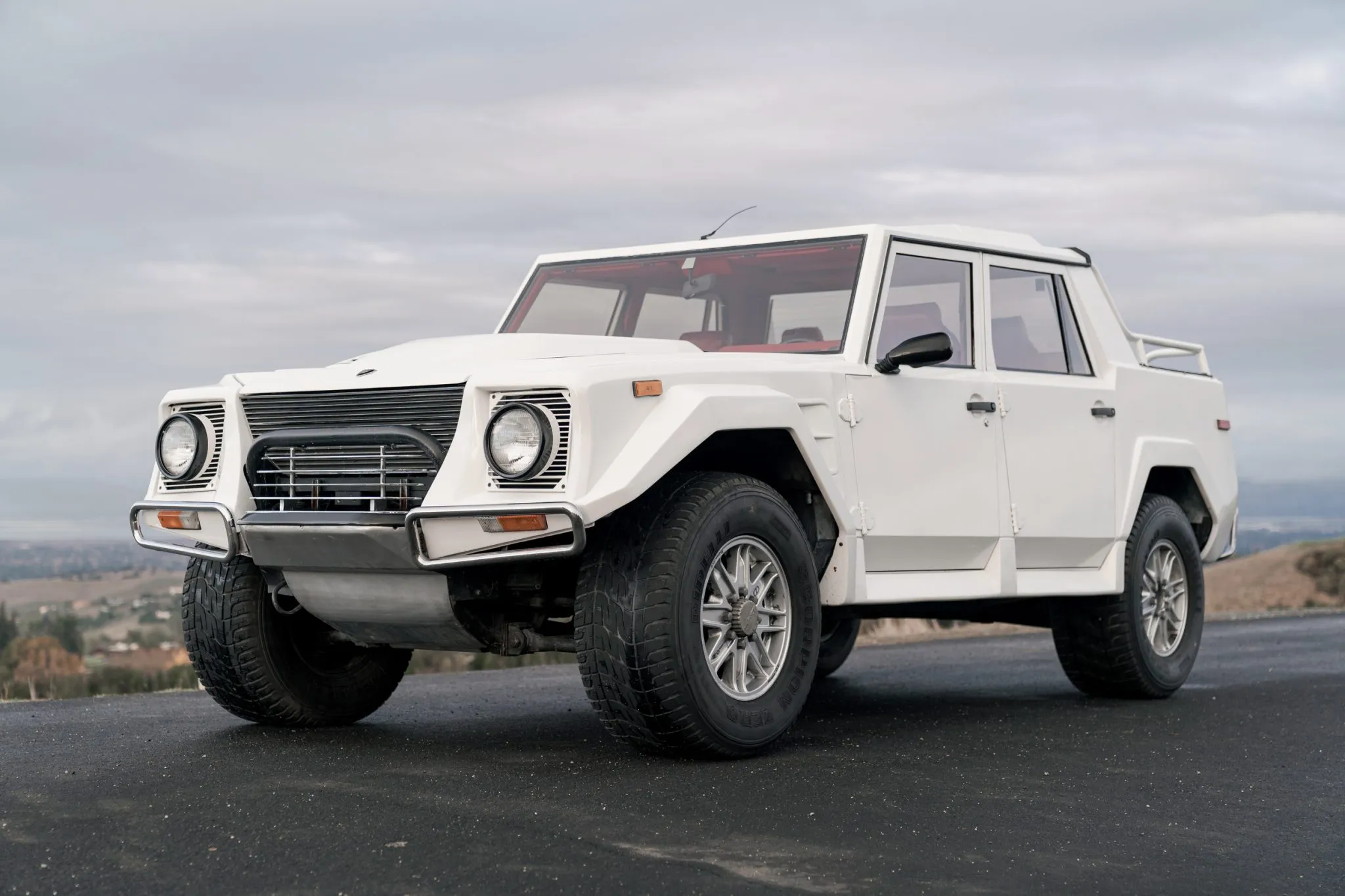
The Lamborghini LM002 occupies a unique position in 1980s automotive history: it was a supercar manufacturer’s answer to the military vehicle, an all-terrain monster powered by the same V12 engine as the Countach, and it wore its fixed headlights with the straightforward purposefulness of something that had work to do.
The LM002 had no interest in theatrical headlight reveals it was too busy being genuinely extraordinary in ways that required no augmentation. The LM002’s fixed headlights were large, round, and mounted high on the front of a body that stood over six feet tall.
They illuminated whatever lay ahead with practical efficiency crucial for a vehicle that was genuinely expected to operate off-road in darkness, in desert conditions, in environments where reliability was a matter of safety rather than convenience. Pop-up mechanisms filled with sand or water would have been unacceptable; fixed lights, sealed and robust, were the only sensible choice.
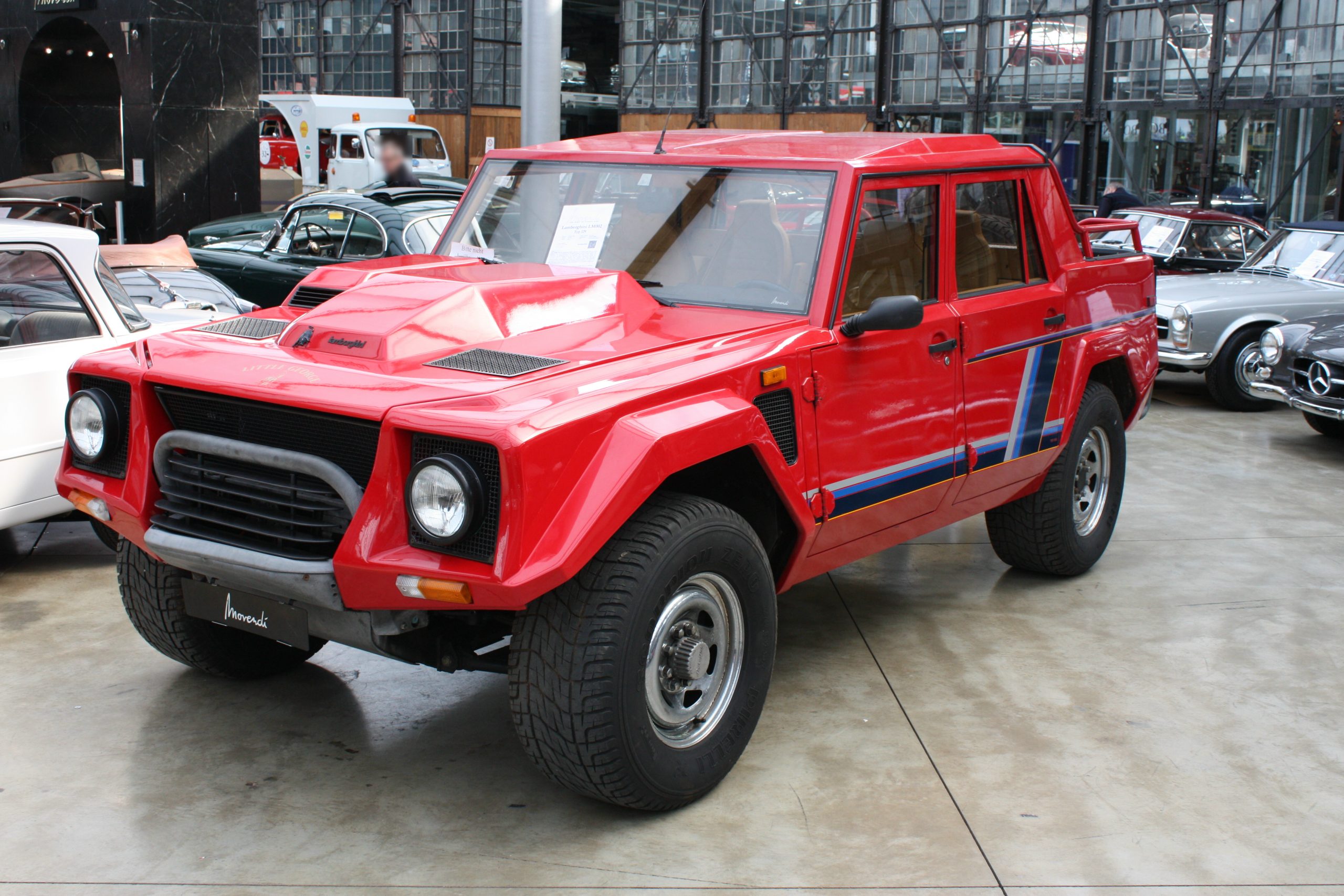
The 5.2-liter V12 under the hood produced 444 horsepower and drove all four wheels through a five-speed manual gearbox. The result was an SUV that could reach 130 mph on paved roads and tackle terrain that would defeat conventional off-roaders — a combination so improbable that it seemed like a joke until you actually drove one.
The LM002 was ordered by military forces, wealthy individuals, and Middle Eastern clients who wanted something that could cross a desert at speed without apology.
At 2,700 kilograms, the LM002 was a vast, heavy machine, and its fixed headlights suited its character perfectly. They were part of a design language that said utility first, drama second though the drama was always present, lurking beneath the surface of a vehicle that put Lamborghini V12 power into a body that could climb a mountain.
The fixed lights gave the LM002 a face that was honest about its intentions: this was a working vehicle of extreme capability, and it looked the part.
The LM002 proved that fixed headlights, deployed with conviction, could be just as expressive as the pop-up variety provided the rest of the car was interesting enough to carry the visual weight.
4. BMW M1 (1978–1981, delivered through 1981)
Technically straddling the late 1970s and early 1980s, the BMW M1 belongs to this conversation because it defined what a fixed-headlight 1980s sports car could and should be.
Designed by Giorgetto Giugiaro of Italdesign, the M1 wore its four rectangular fixed headlights as part of a front end so clean and architecturally resolved that it made most of its contemporary competition look fussy by comparison.
The M1’s headlights were integrated into a full-width front bumper panel that blended the lights, bumper, and lower air intakes into a single, coherent graphic element.
There was no visual noise, no unnecessary detail just a perfectly proportioned face that balanced the car’s wide, low body with authority. The fixed lights meant the front end never changed expression, never winked or surprised it simply existed as a statement of German engineering confidence.
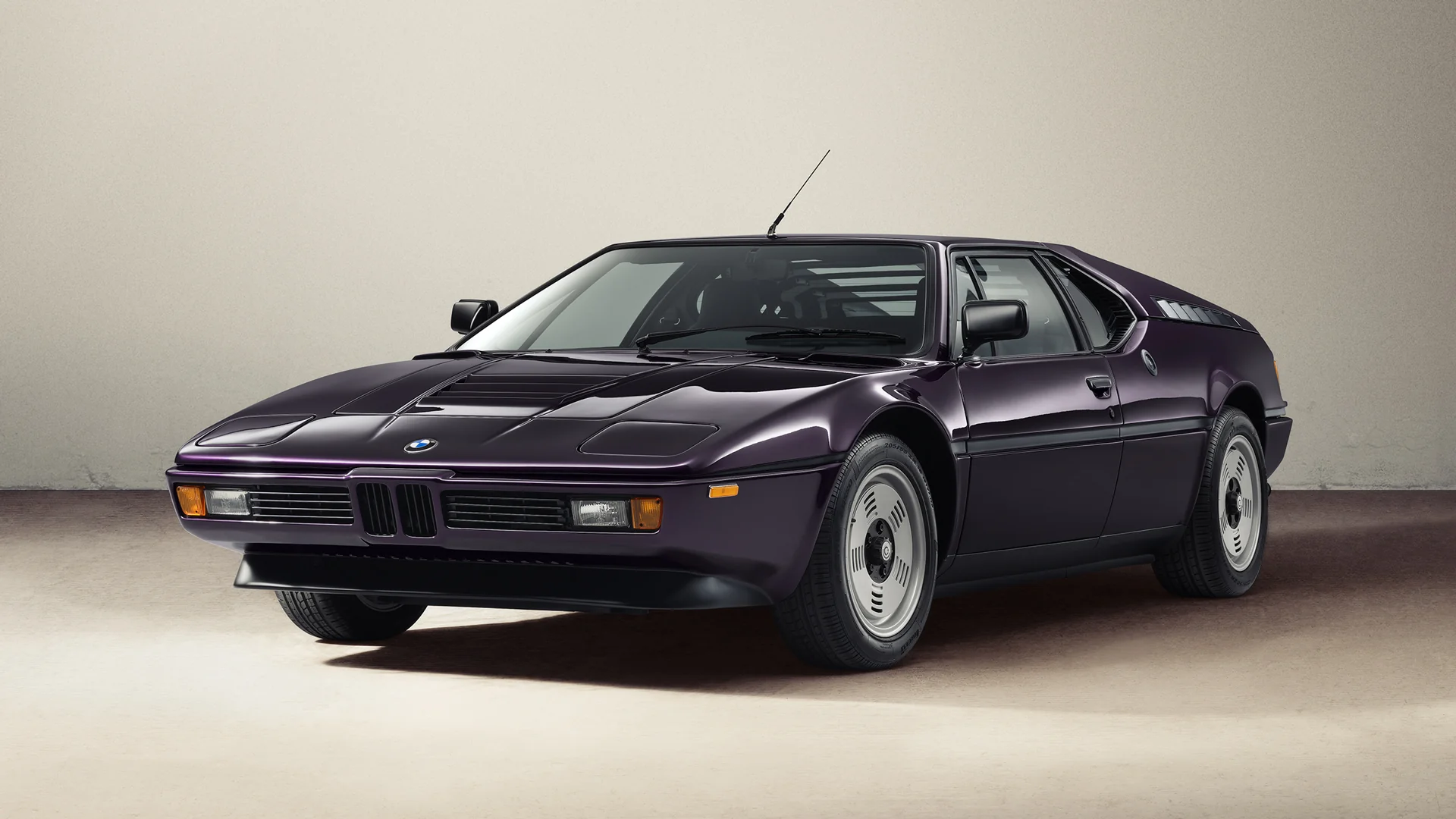
The 3.5-liter inline-six produced 277 horsepower in road-going form, rising to over 470 horsepower in the Procar racing series specification. The mid-engine layout an almost unique configuration for BMW at the time gave the M1 handling balance that the front-engined cars of the era couldn’t approach.
Weight distribution was near-perfect, the steering was precise and communicative, and the chassis rewarded skilled drivers with feedback that was clear without being intimidating.
The M1’s production run was limited fewer than 500 examples were built partly due to the complex joint venture between BMW and Lamborghini that produced the car, and partly because of the financial challenges that beset the program.
But its influence was disproportionate to its numbers. The M1 established BMW Motorsport’s credentials as a genuine performance force and showed that fixed headlights, intelligently designed, could anchor a sports car face as effectively as any mechanical trick. The M1’s front end remains one of the most imitated and referenced designs in German automotive history clean, rational, and quietly perfect.
5. Aston Martin V8 Vantage (1977–1989)
No list of 1980s sports cars is complete without the Aston Martin V8 Vantage a car so British in its values and execution that it seemed almost to disapprove of pop-up headlights on principle.
The Vantage wore its fixed quad-headlight arrangement with the same imperturbable confidence that characterized everything about Aston Martin’s approach to the decade: unhurried, definitive, and quietly certain of its own excellence.
The V8 Vantage’s front end featured two pairs of rectangular fixed headlights set within a broad, low nose dominated by a spoiler that was added for aerodynamic downforce a rare concession to modernity on a car that had been in continuous production since the 1960s.
The fixed lights gave the Vantage a face that was simultaneously classic and contemporary, bridging decades without looking dated in either direction. They were part of a design that communicated presence through restraint the automotive equivalent of an old family title.
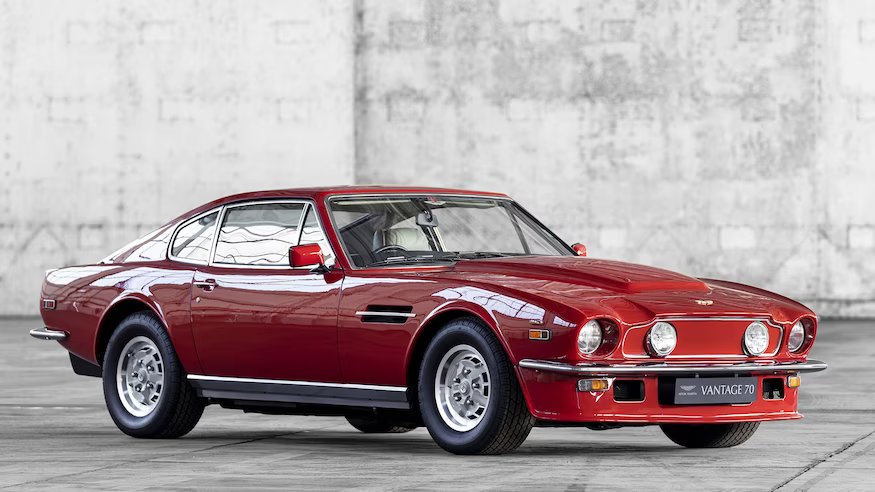
The 5.3-liter V8, developed and hand-assembled at Aston’s Newport Pagnell factory, produced somewhere between 375 and 432 horsepower depending on specification and the willingness of Aston’s engineers to commit to precise figures.
Performance was in any case spectacular the Vantage was, for a period in the early 1980s, the fastest accelerating production car, capable of reaching 60 mph in under five and a half seconds and continuing to a top speed approaching 170 mph.
Inside, the Vantage offered leather, wool carpeting, and hand-crafted detail that no Japanese or American rival could approach. Owning one was an act of faith in British craftsmanship and an acceptance that mechanical character would always be more important than mechanical perfection.
Oil leaks were not unknown. Electrical gremlins were tolerated. None of it mattered when the V8 was singing at seven thousand revolutions and the English countryside was blurring past those fixed, unwavering headlights.
The Aston Martin V8 Vantage made the case for fixed headlights on the most fundamental level: when a car has genuine presence, it needs no theatrical assistance. The lights simply showed you the road ahead and what a road it was.
Also Read: 5 Classic Muscle Cars That Survived the Fuel Crisis vs 5 That Didn’t
