
We are living at the most extraordinary crossroads in the history of transportation. For over a century, the automobile evolved gradually better engines, sleeker bodies, safer brakes but the fundamental experience of driving remained largely unchanged.
A driver sat behind a wheel, pressed a pedal, and steered a machine through traffic. That era is now ending, not with a slow fade but with a seismic, technology-driven rupture that will make today’s most advanced vehicles look as primitive as a horse-drawn carriage seems to us now.
The next decade promises not just improvements to cars but a complete reimagining of what a car is, what it does, and what it means to travel inside one. Artificial intelligence, advanced sensor arrays, solid-state battery chemistry, augmented reality, and vehicle-to-everything communication are converging simultaneously, creating a perfect storm of innovation.
The result will be vehicles that think, adapt, communicate, and protect their occupants in ways that sound like science fiction today but are already being prototyped in laboratories and test tracks around the world.
This is not about adding a fancier touchscreen or a more responsive infotainment system. This is a fundamental reinvention. The five technologies explored in this article represent the leading edge of that transformation five breakthroughs that will look back at your current car and make it seem, in every meaningful way, ancient.
1. Full Autonomy With Emotional Intelligence: Cars That Understand You, Not Just the Road
When most people hear the phrase “self-driving car,” they imagine a vehicle that can go through the highways without human hands on the wheel. That vision, while impressive, is only the beginning of where autonomous vehicle technology is truly headed. The next generation of full autonomy will not merely read road conditions and traffic patterns it will read you.
Through a sophisticated fusion of biometric sensors, emotional AI, and adaptive behavioral systems, the cars of the near future will understand your mood, your stress level, your health, and your intent, adjusting every aspect of the driving experience in real time to suit your physical and psychological state.
Today’s driver-monitoring systems, found in some premium vehicles, can detect drowsiness through eye-tracking cameras and issue a warning. This is rudimentary. Future emotional intelligence systems will go incomparably further. Infrared cameras embedded in the steering column and dashboard will track micro-expressions, pupil dilation, and blink rates to gauge emotional state.
Seat-integrated sensors will monitor heart rate variability and galvanic skin response the same signals used in polygraph testing to detect anxiety, fatigue, or raised stress. Steering wheel grip sensors will measure the subtle tension in your hands. All of this data will be processed in milliseconds by an onboard AI system trained on millions of hours of human behavioral data.
What happens when the car knows you’re stressed? Everything changes. The autonomous system may choose a quieter, less congested route even if it takes a few extra minutes, reasoning that reducing your cognitive load is more valuable than saving time.
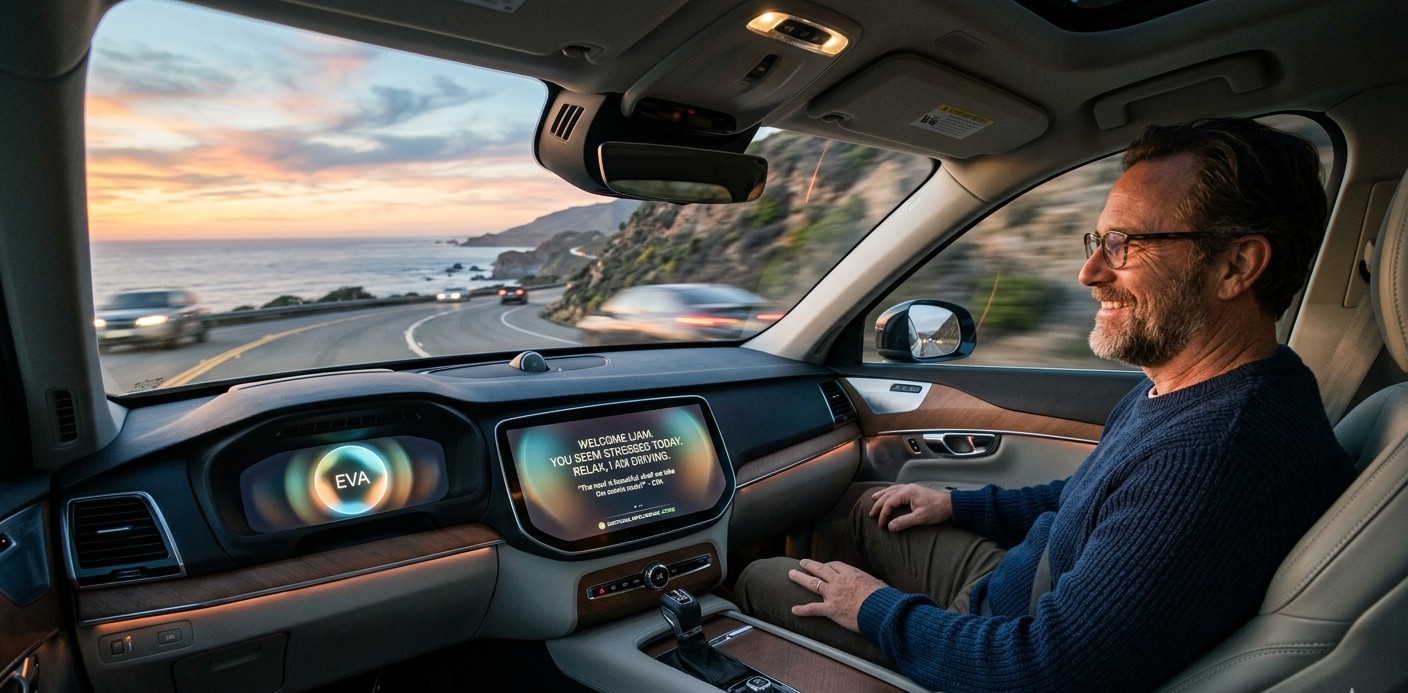
The cabin lighting will shift subtly toward warmer tones, which research shows lower cortisol levels. The seat will automatically adjust to a slightly more reclined position.
The climate control will cool fractionally. Curated music not chosen by genre preference alone, but calibrated by the AI to your specific emotional profile at that exact moment will begin playing through the audio system. The car becomes less a vehicle and more a responsive, empathetic environment.
Beyond stress management, emotional AI in autonomous vehicles will have profound safety implications. If biometric data suggests that a passenger is experiencing a cardiac irregularity, the vehicle can autonomously reroute to the nearest hospital, unlock emergency services communication, and relay vital health data to paramedics before arrival.
If a driver who has overridden autonomous mode shows signs of sudden medical distress, the car will smoothly retake control, decelerate, and pull over safely all without human input.
There is also a personalization dimension that reshapes the very concept of car ownership. Because the AI learns over time, building a detailed model of your preferences, physiology, and behavioral patterns, the car becomes increasingly tailored to you with every journey.
It will remember that you always need five minutes of silence at the start of a commute before you’re ready for conversation with a virtual assistant. It will know that on Friday evenings your stress baseline is lower and you prefer a more spirited driving mode. It will track long-term health trends in your biometric data and, over months of use, might even flag a pattern worth discussing with your doctor.
This is autonomy not as a mechanical convenience but as a deeply personal relationship between human and machine a relationship that makes your current car, with its fixed seat presets and manual climate dials, feel not just outdated but almost indifferent.
2. Vehicle-to-Everything (V2X) Communication: When Every Car Talks to the World
Imagine driving toward an intersection when, completely invisibly, your car receives a message from the traffic light ahead informing it that the signal will turn red in 3.2 seconds.
Simultaneously, your car receives a warning broadcast from a truck two vehicles ahead that its emergency brakes have just engaged. From the municipal road network, a signal arrives indicating that a patch of black ice exists 400 meters ahead on the left lane.
Your car processes all three signals in less than a hundredth of a second and responds decelerating gently, shifting lanes smoothly, adjusting route if necessary before any human driver nearby has even perceived a change in conditions.
This is Vehicle-to-Everything communication, universally known as V2X, and it represents perhaps the single most transformative shift in automotive safety and traffic management since the invention of the seatbelt.
V2X is a broad communications framework that enables vehicles to exchange data not just with each other (V2V, vehicle-to-vehicle) but with road infrastructure such as traffic signals, signs, and sensors (V2I, vehicle-to-infrastructure), with pedestrians and cyclists via their smartphones (V2P, vehicle-to-pedestrian), and with the broader network including emergency services, navigation platforms, and city management systems (V2N, vehicle-to-network).
The technology operates primarily through two competing but complementary protocols: Dedicated Short-Range Communication (DSRC), which is a WiFi-based standard, and Cellular V2X (C-V2X), which uses 4G LTE and 5G cellular networks for both direct and network-based communication.
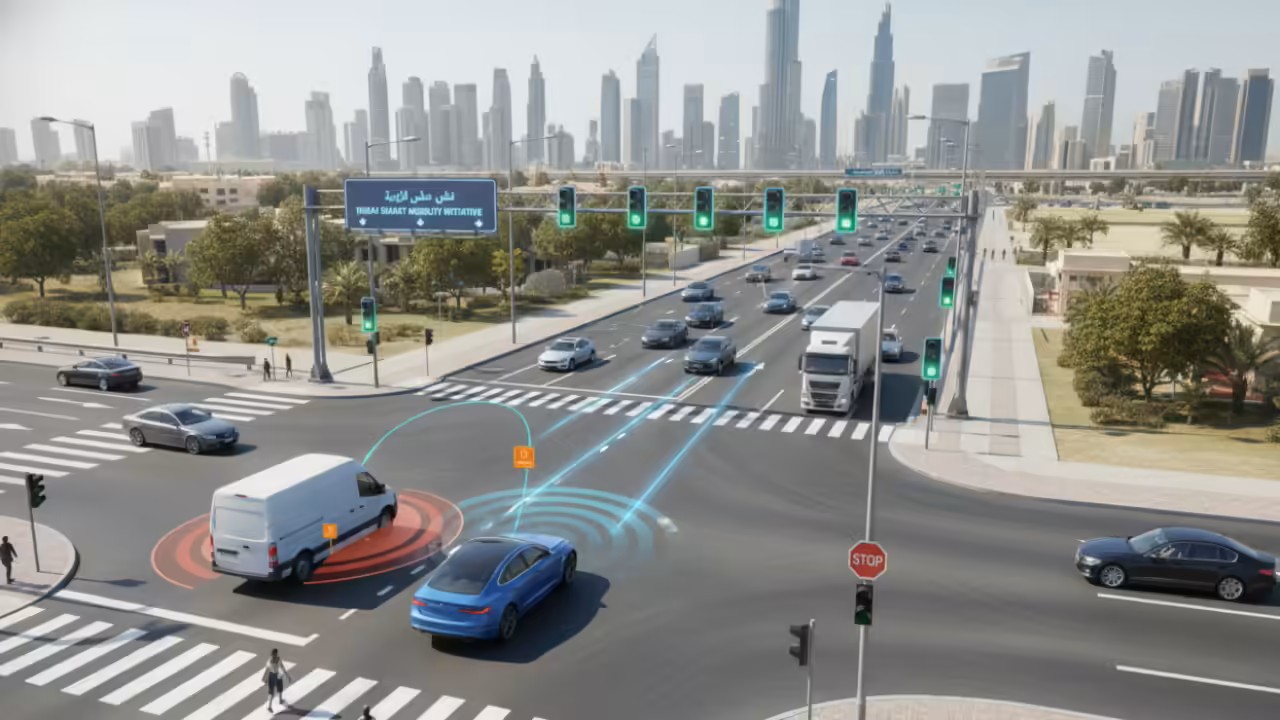
The 5G-enabled version of C-V2X is particularly exciting because it offers ultra-low latency the delay between sending and receiving a signal of under one millisecond, which is fast enough to prevent accidents that unfold in fractions of a second.
The safety implications of a fully V2X-connected road ecosystem are staggering. Studies by transportation researchers suggest that V2X technology, when deployed across a significant percentage of the vehicle fleet and road infrastructure, could prevent up to 80 percent of crashes that do not involve driver impairment which represents hundreds of thousands of lives saved annually across the globe.
The reason is simple: V2X eliminates the most dangerous gaps in a driver’s awareness. It sees around corners. It perceives hazards that are physically hidden from view. It knows about emergencies before they are visible. And crucially, it operates at machine speed, not human reaction speed.
Beyond safety, V2X will radically transform the efficiency of urban transportation. When all vehicles in a city communicate their speed, position, and destination to a central traffic management AI, the entire road network becomes a dynamically optimized system rather than a chaotic collection of individual journeys.
Traffic signals will no longer operate on fixed timers; they will respond in real time to the actual flow of vehicles, eliminating unnecessary red lights and the stop-start congestion that wastes enormous amounts of fuel and time. Convoys of autonomous trucks on highways will travel within meters of each other at high speeds in coordinated “platoons,” dramatically reducing aerodynamic drag and fuel consumption.
For ordinary drivers in non-autonomous vehicles, V2X will still deliver enormous benefits through in-car alerts and advisories. Your dashboard might display a warning about a pedestrian stepping off a curb before you can see them.
Your navigation might dynamically reroute around a collision that happened thirty seconds ago, informed by the V2X broadcast of the vehicles involved. Emergency vehicles approaching from behind will be able to broadcast their presence directly to surrounding cars, giving earlier warning than a siren alone.
Your current car exists in a kind of informational solitude, perceiving only what its own sensors and your own eyes can detect. Future V2X vehicles will exist as nodes in an intelligent, city-wide nervous system an entirely different order of awareness.
3. Solid-State Batteries: The Energy Revolution That Rewrites Everything You Know About Electric Vehicles
The electric vehicle revolution is already underway, but it is currently fighting with one hand tied behind its back. The lithium-ion batteries that power today’s EVs are a remarkable engineering achievement, but they carry fundamental limitations that constrain range, inflate cost, create safety concerns, and make the charging experience frustratingly slow for many users.
Solid-state battery technology promises to untie that hand and when it does, it will not just improve the electric vehicle experience but completely demolish every objection that has ever been raised against it.
To understand why solid-state batteries are so transformative, it helps to understand what they replace. Conventional lithium-ion batteries use a liquid electrolyte a chemical solution to carry charged ions between the anode and cathode during charging and discharging. This liquid electrolyte is simultaneously the battery’s enabler and its greatest vulnerability.
It is flammable, which is why lithium-ion battery fires, though rare, are so difficult to extinguish. It degrades over time, causing the gradual capacity loss that makes older EVs travel shorter distances than when new.
It operates poorly in extreme cold, causing dramatic range reduction in winter conditions. And it limits how quickly energy can be transferred into the battery without causing damage, which is why fast charging today remains slower than refueling with gasoline.
Solid-state batteries replace the liquid electrolyte with a thin layer of solid material typically a ceramic, glass, or polymer compound that performs the same ion-transport function but without any of these drawbacks. The solid electrolyte is non-flammable, eliminating the fire risk entirely.
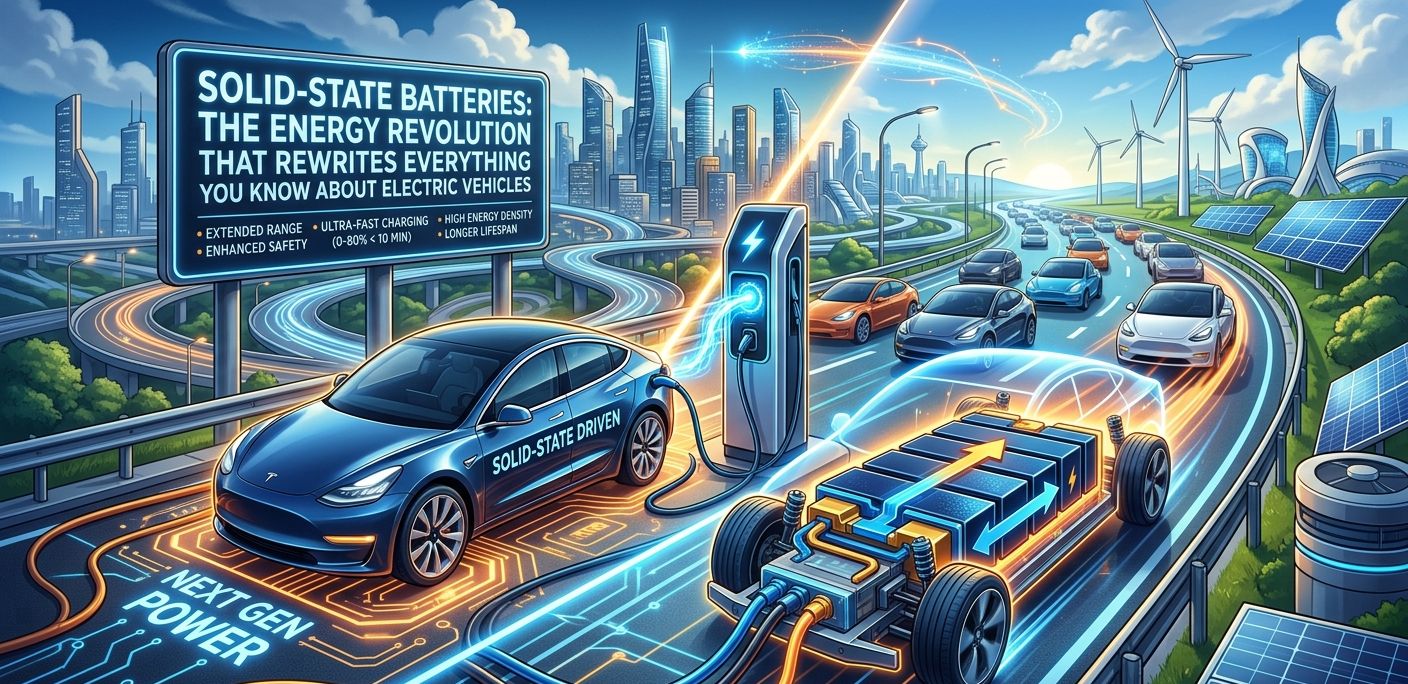
It is far more stable over time, with solid-state cells showing far less degradation over thousands of charge cycles. It allows the use of a lithium-metal anode instead of the graphite anode used in lithium-ion batteries, and lithium metal can store roughly ten times more energy by weight than graphite.
The practical consequences for the vehicle owner are profound. Energy density in solid-state batteries is expected to be roughly two to three times higher than the best lithium-ion cells currently available.
This means an EV with a solid-state battery pack of the same physical size and weight as today’s packs could offer ranges of 600 to 1,000 kilometers on a single charge numbers that not only eliminate range anxiety but make the electric car more capable on a single charge than virtually any gasoline vehicle on the road today.
Charging speed is equally transformed. Because solid electrolytes can handle much higher current flows without the thermal risks associated with liquid electrolytes, solid-state batteries are expected to support charging rates that could refill 80 percent of the battery’s capacity in under ten minutes.
At that point, the charging experience becomes functionally equivalent to stopping for gasoline a brief pause rather than a significant interruption.
Cold-weather performance, long the Achilles’ heel of electric vehicles in northern climates, improves dramatically with solid-state chemistry because the solid electrolyte does not suffer the viscosity changes that reduce ion mobility in cold liquid electrolytes.
The calendar life of solid-state packs the total operational lifespan is also projected to far exceed lithium-ion, with some researchers suggesting that solid-state batteries could outlast the vehicles they power.
Major automotive manufacturers and battery companies across Asia, North America, and Europe have invested tens of billions of dollars into solid-state development.
When these batteries reach mass production and the trajectory strongly suggests they will within this decade every electric vehicle built before them will look like a first-generation prototype: a brave but limited early attempt at something that only later became truly extraordinary.
Also Read: 8 Tips for Finding Local Classic Car Meets in Your Area
4. Augmented Reality Windshields: Driving Inside a Living, Intelligent Display
For generations, the windshield has been a passive object a transparent barrier between the driver and the world, performing the simple but vital function of keeping wind and weather out while allowing vision through.
That centuries-old simplicity is about to end. Augmented reality windshield technology will transform the windshield into an active, intelligent display surface that overlays critical information directly onto the driver’s view of the real world, merging the digital and physical into a seamlessly integrated driving experience.
Today’s head-up displays (HUDs), found in many mid-range and premium vehicles, offer a look of this future. These systems project a small amount of information current speed, navigation arrows, speed limit reminders onto a small portion of the lower windshield, allowing the driver to read it without looking down at the instrument cluster. Useful, certainly, but extraordinarily limited compared to what full AR windshield technology will deliver.
A full augmented reality windshield uses the entire glass surface as a display medium, employing a combination of transparent OLED or electrochromic layer technology, micro-projector arrays, and eye-tracking systems to project information that appears to exist at the correct depth in the real-world scene the driver is viewing.
This last point is critical and technically complex: for AR overlays to be genuinely useful rather than distracting, they must appear to be spatially anchored to the real world, not floating on the glass surface. When the system highlights a pedestrian stepping into the road 30 meters ahead, the highlight must appear to be around that actual pedestrian at that actual distance, not as a flat symbol on the windshield.
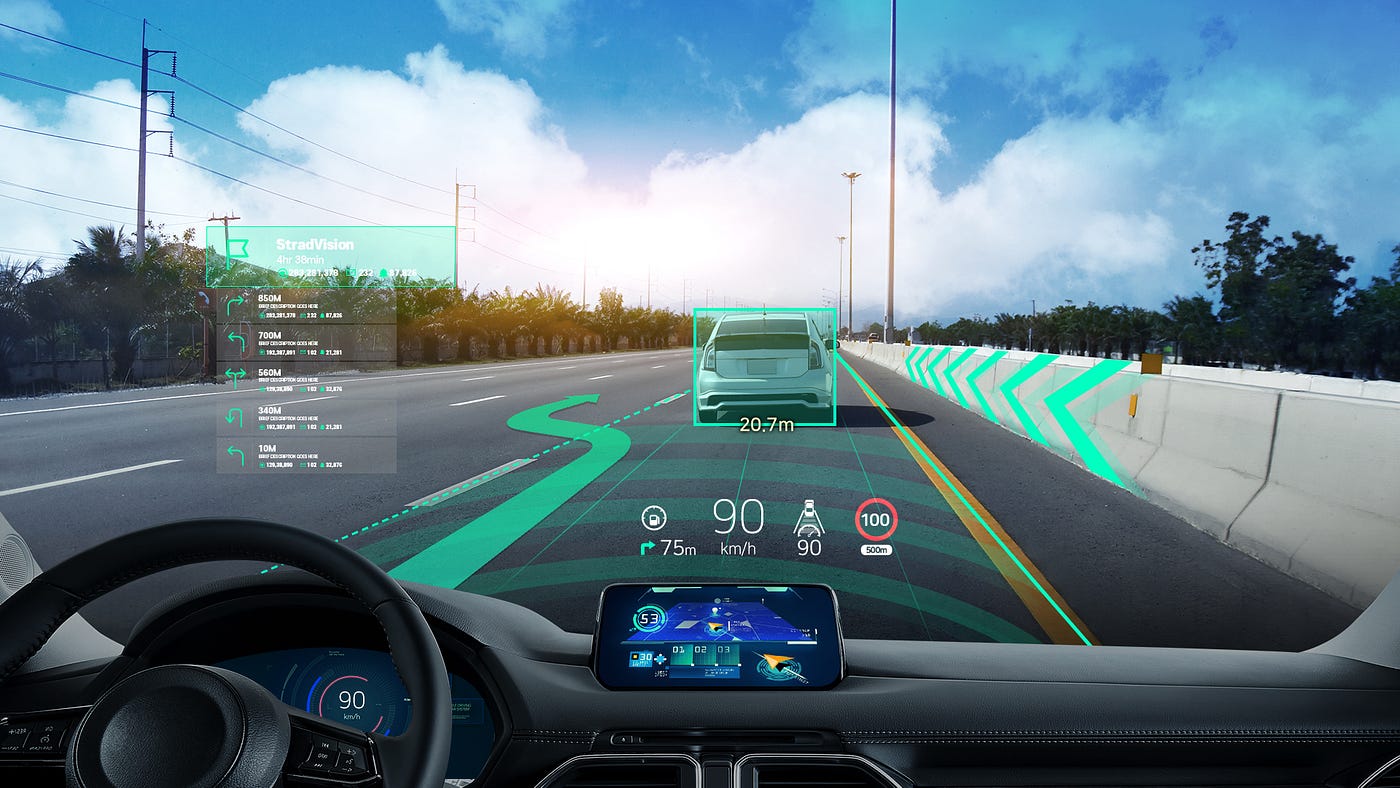
The practical applications are extraordinary in their breadth. Navigation will be transformed: rather than a small arrow in the lower portion of the windshield, the AR system will paint a glowing path directly onto the road surface ahead, making it physically impossible to miss a turn.
In complex urban environments with multiple lanes and confusing junctions, this kind of spatial guidance eliminates the cognitive gap between reading a digital map and interpreting a physical road.
Hazard detection, powered by the vehicle’s sensor suite and AI systems, will be projected as visual highlights directly onto the objects of concern. A car in your blind spot will be subtly outlined in amber as you begin to signal.
A cyclist approaching from a side street will be highlighted before they enter your field of vision naturally. In low-visibility conditions fog, heavy rain, darkness the AR system will use radar and thermal imaging data to display the outlines of vehicles, pedestrians, and road edges that are invisible to the naked eye, giving the driver what amounts to X-ray vision.
Vehicle information that currently requires the driver to glance away from the road will exist exactly where attention is already focused. Speed, remaining range, lane-centering status, and adaptive cruise control target will all appear peripherally in the forward field of view, positioned and scaled so that absorbing them requires no conscious shift of attention.
Night vision functionality will allow the AR windshield to display infrared imagery of the road ahead, detecting animals or pedestrians far beyond the reach of headlights.
The interior design implications are also significant. With the windshield carrying information, the need for a traditional instrument cluster and the visual architecture it demands dissolves. Dashboards of the future will be dramatically cleaner, more spacious, and more focused on passenger comfort than on the display of driving data.
Sitting in today’s car and looking through a plain, information-free windshield, you are flying blind compared to what AR technology will soon make standard. The future driver will exist inside a rich, contextually aware visual environment a world where the road itself speaks to them.
5. Over-the-Air Updates and the Living Vehicle: When Your Car Gets Smarter While You Sleep
There is a peculiar characteristic of almost every product ever manufactured: it is at its best on the day you buy it. From that moment, it begins an irreversible process of obsolescence.
The mechanical components wear down, the software grows stale, the features that seemed cutting-edge become routine, and after a few years, the gap between what you own and what is newly available becomes impossible to ignore.
Cars have always exemplified this pattern more dramatically than almost any other consumer product, given their cost and the pace of automotive innovation.
Over-the-air (OTA) update technology combined with the increasingly software-defined architecture of modern vehicles is about to break this pattern permanently. The car of the future will not be a fixed product that declines from its purchase-day peak.
It will be a living platform that improves continuously, gaining new capabilities, enhanced performance, deeper AI learning, and refined safety systems throughout its entire operational life, most of it invisibly, while the vehicle sits parked and the owner sleeps.
Tesla pioneered this concept in the consumer automotive space, delivering software updates via cellular connection that genuinely added functionality new driving modes, improved autopilot capabilities, new entertainment features, enhanced range efficiency to vehicles already in customer hands.
This was genuinely revolutionary, but it represented only the beginning of what is possible as vehicles become more deeply and comprehensively software-defined.
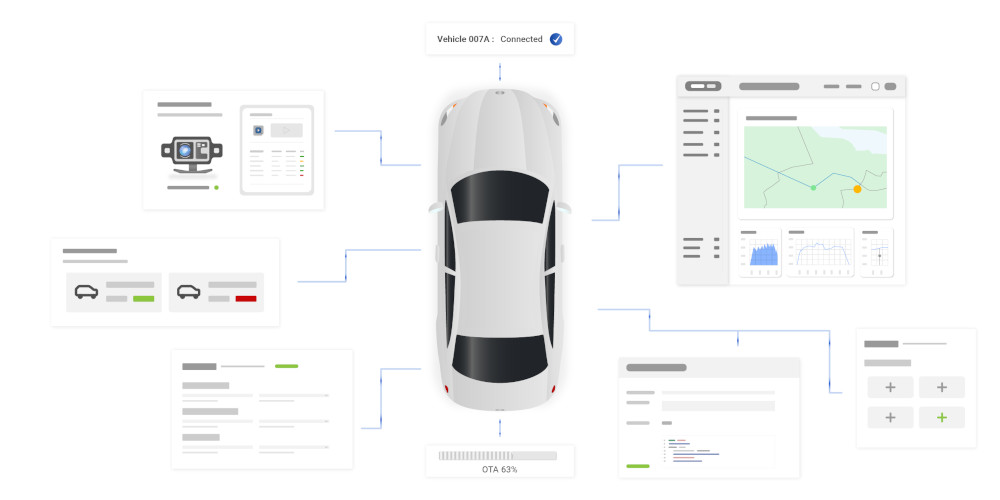
The vehicles of the near future will have virtually every system governed by software rather than fixed hardware calibrations. The suspension tuning, the steering feel, the braking response, the powertrain mapping, the safety system thresholds, the thermal management algorithms for the battery all of it will be software-adjustable.
This means that when engineers discover a better way to manage battery temperature that extends pack life by 15 percent, they can deploy that improvement across every vehicle in the fleet overnight. When a new hazard-detection algorithm reduces false positives in the collision avoidance system, it arrives silently in your vehicle the next morning.
The implications extend far beyond convenience. OTA updates allow manufacturers to respond to safety concerns at a speed that is categorically different from the traditional recall process, in which owners must be notified by mail, schedule a dealership visit, and wait for physical intervention. Software-defined safety systems can be patched remotely within days of identifying a concern or in extreme cases, within hours.
AI systems embedded in the vehicle will also improve through continuous learning not just via updates from the manufacturer but through the vehicle’s own accumulated experience.
Machine learning models governing the autonomous driving stack, the predictive maintenance system, and the route optimization algorithms will refine themselves based on the billions of real-world miles collectively traveled by the connected fleet, with improvements distributed back to individual vehicles through OTA channels. Your car will become a more capable driver with every year that passes, rather than a less capable one.
Personalization will deepen over time in ways that feel almost organic. The vehicle AI will build an increasingly nuanced model of your preferences, habits, and needs, and OTA updates will deliver new capabilities that slot directly into that personalized model.
A new feature for managing fatigue on long drives will arrive pre-configured to your biometric baseline. A new parking assistance mode will know your most common parking environments before you have used it once.
The commercial model of car ownership will also fundamentally change. Features that today require purchasing a more expensive trim level could be unlocked via subscription or one-time purchase on your existing vehicle, without any physical modification.
Manufacturers will maintain a continuous revenue relationship with vehicle owners throughout the car’s life, aligning their financial incentive with the ongoing improvement of the product rather than simply its initial sale.
Compared to all of this, your current car bought at a fixed spec, slowly aging, impossible to meaningfully improve is a snapshot. A photograph of what automotive technology looked like at one moment in time. The cars of the near future will be stories, continuously written and revised, growing richer with every passing year.
Also Read: Top 10 Most Reliable Japanese Sedans From the 1970s Era
