
All-wheel drive is one of the most misunderstood features in the automotive world. Car manufacturers market it as a must-have safety feature. But the truth is far more nuanced than their advertisements suggest.
Many drivers purchase AWD vehicles believing they are making a smart, practical decision. They spend thousands of extra dollars on a system they may rarely or never actually need. The average driver commutes on paved roads in moderate weather conditions. These conditions simply do not demand the capability that AWD provides.
AWD adds mechanical complexity to a vehicle. This complexity means higher purchase prices, increased fuel consumption, and more expensive maintenance over time. Drivers often overlook these hidden long-term costs when shopping for a new car.
Understanding what AWD actually does and what it doesn’t do is essential knowledge for every car buyer. It can genuinely save you money without sacrificing safety or performance. Modern front-wheel drive and rear-wheel drive vehicles have become remarkably capable thanks to advanced traction control systems. This article breaks down the real truth about AWD. It explains who truly needs it and who is simply paying for a marketing myth.
What All-Wheel Drive Actually Does (And Doesn’t Do)
All-wheel drive sends engine power to all four wheels at the same time. This gives the vehicle better grip when moving forward on slippery or uneven surfaces.
Many drivers assume AWD makes their car safer in every possible way. This is a common misunderstanding that car manufacturers do very little to correct.
AWD improves traction during acceleration. It does not improve your ability to brake or steer on slippery roads. When you press the brake pedal, all four wheels slow down regardless of whether your car is AWD or two-wheel drive. Your stopping distance on wet or icy roads remains virtually the same across both systems.
Cornering safety is also unaffected by AWD. A vehicle’s handling during a turn depends on suspension design, tyre quality, and speed, not drivetrain type.
Modern vehicles now come equipped with electronic stability control and traction control as standard features. These systems actively monitor wheel spin and automatically apply brakes to individual wheels to prevent skidding.
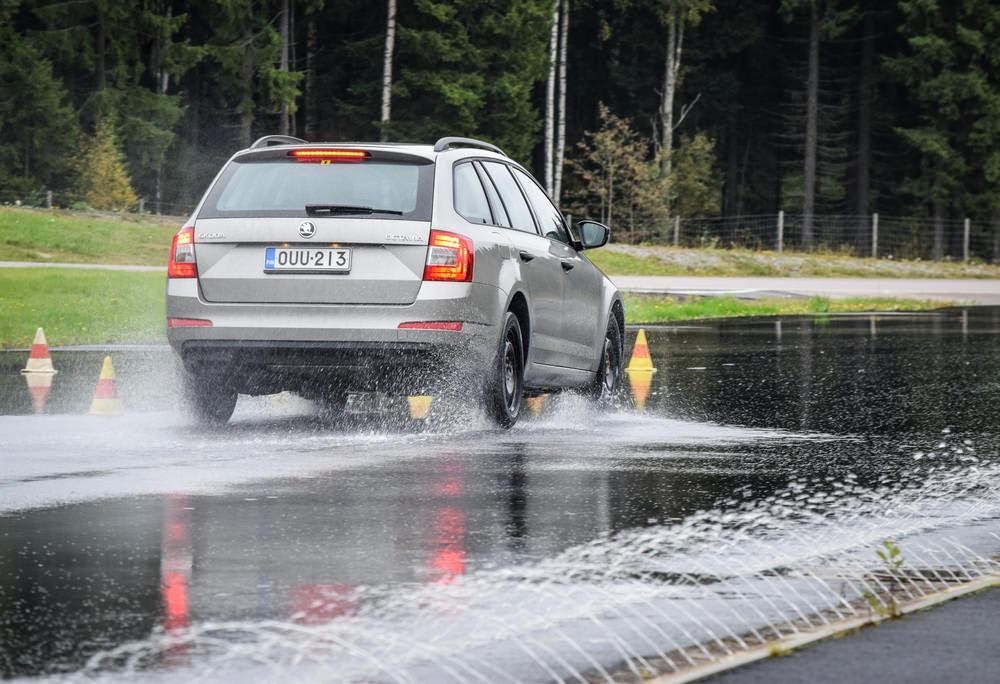
These electronic systems do much of what drivers incorrectly credit to AWD. They are fitted to nearly every new car sold around the world today, including basic front-wheel drive models.
AWD genuinely helps in very specific off-road or extreme weather situations. Deep snow, muddy tracks, steep gravel roads, and rocky terrain are where AWD earns its reputation.
But consider how often the average urban or suburban driver encounters these conditions. For most people, the honest answer is almost never.
A driver in Mumbai, Dubai, Lagos, or London will spend the vast majority of their time on smooth, sealed roads. AWD provides no meaningful advantage in these environments whatsoever.
Even in colder countries, a front-wheel drive car fitted with proper winter tyres handles snowy roads with remarkable confidence. Tyre choice has a far greater impact on winter driving safety than drivetrain configuration.
This is a fact that the automotive industry rarely promotes loudly. Selling a set of winter tyres is far less profitable than selling an AWD upgrade package.
Many drivers are essentially paying a significant premium for off-road and extreme weather capability they will never use. They believe AWD is making them safer when, in reality, the right tyres and careful driving habits achieve the same result at a fraction of the cost. Understanding this distinction is the first and most important step toward making a smarter vehicle purchase decision.
The Real Financial Cost of Choosing AWD
The price difference between an AWD model and its two-wheel drive equivalent is immediately noticeable. Most manufacturers charge between $1,500 and $3,000 more for the AWD version of the same car.
This initial premium is only the beginning of the financial story. The true cost of AWD reveals itself gradually over the years of ownership. AWD systems are mechanically heavier than two-wheel drive setups. This additional weight forces the engine to work harder, which directly increases fuel consumption.
Depending on the vehicle and driving style, AWD models typically consume five to ten percent more fuel than equivalent two-wheel drive versions. Over several years of daily driving, this difference adds up to a considerable sum of money.
For drivers in countries where fuel prices are high, this ongoing cost is especially significant. Every trip to the petrol station costs slightly more than it needs to.

Scheduled maintenance is another area where AWD ownership quietly becomes expensive. AWD vehicles have additional mechanical components that require inspection and servicing over time.
Transfer cases, rear differentials, and driveshafts all require periodic attention. These are components that simply do not exist in a standard front-wheel drive vehicle.
When something goes wrong with an AWD system, the repair costs can be genuinely surprising. A transfer case failure alone can result in a repair bill exceeding $1,000 in parts and labour.
Tyre replacement is another hidden financial burden specific to AWD ownership. Most AWD systems require all four tyres to be replaced together as a matched set.
Installing two new tyres and leaving two old ones can cause the AWD system to overwork certain components, leading to premature mechanical failure. This means every tyre replacement becomes a full set purchase, which is significantly more expensive.
Over a five-year ownership period, the combined extra costs of purchase price, fuel, maintenance, and tyre replacement can easily total several thousand dollars. For most city drivers, this money delivers almost no practical benefit in return.
That financial gap could instead be invested in higher-quality tyres, regular servicing, or simply kept in your pocket. All of these alternatives provide genuine everyday value that most drivers will actually experience.
The financial case against AWD for the average driver is compelling and straightforward. It is one of the most expensive optional features relative to the real-world benefit it delivers for ordinary driving conditions.
Also Read: 5 Trucks Worth Buying New And 5 You Should Always Buy Used
How Modern Two-Wheel Drive Vehicles Have Become Incredibly Capable
There is a widespread perception that two-wheel drive vehicles are somehow inferior or less safe than AWD alternatives. This perception is increasingly outdated and not supported by modern automotive technology.
Front-wheel drive vehicles have improved dramatically over the past two decades. Today’s front-wheel drive cars handle rain, mild snow, and urban road conditions with impressive confidence and stability.
Electronic stability control, now legally required in new vehicles across many countries, constantly monitors the car’s movement. It intervenes within milliseconds to prevent the vehicle from sliding or spinning out of control.
Traction control systems work alongside stability control to detect and reduce wheel spin during acceleration. These systems are sophisticated, fast, and highly effective on the roads that most drivers use every day.
Anti-lock braking systems prevent wheel lockup during emergency stops. This technology ensures the driver maintains steering control even during hard braking on wet or slippery surfaces.
These three technologies, together with stability control, traction control, and ABS, provide a very high level of active safety. They are standard equipment on virtually every new car sold globally, regardless of drivetrain type.
Rear-wheel drive vehicles have also benefited enormously from these advancements. Modern rear-wheel drive cars with electronic stability systems handle daily driving conditions far better than older rear-wheel drive vehicles without such technology.
Performance-oriented rear-wheel drive cars are now driven confidently in wet conditions precisely because of how advanced their electronic safety nets have become. The driving experience is engaging, responsive, and safe.
Tyre technology has also advanced significantly. Modern all-season tyres provide excellent grip across a wide range of road conditions. Quality winter tyres, when used in appropriate seasons, give front-wheel drive vehicles outstanding capability in cold and snowy conditions.
Many professional driving instructors and automotive journalists openly state that a competent driver in a front-wheel drive car with good tyres is safer than an overconfident driver in an AWD vehicle. Driver behaviour and tyre quality remain the two most critical factors in road safety.
AWD can create a dangerous false sense of security in drivers. They push harder into corners and brake later than they should, assuming the AWD system will compensate for their choices.
This overconfidence is a well-documented risk associated with AWD ownership. It can and does lead to accidents that would have been avoided with more cautious driving habits in a simpler vehicle.
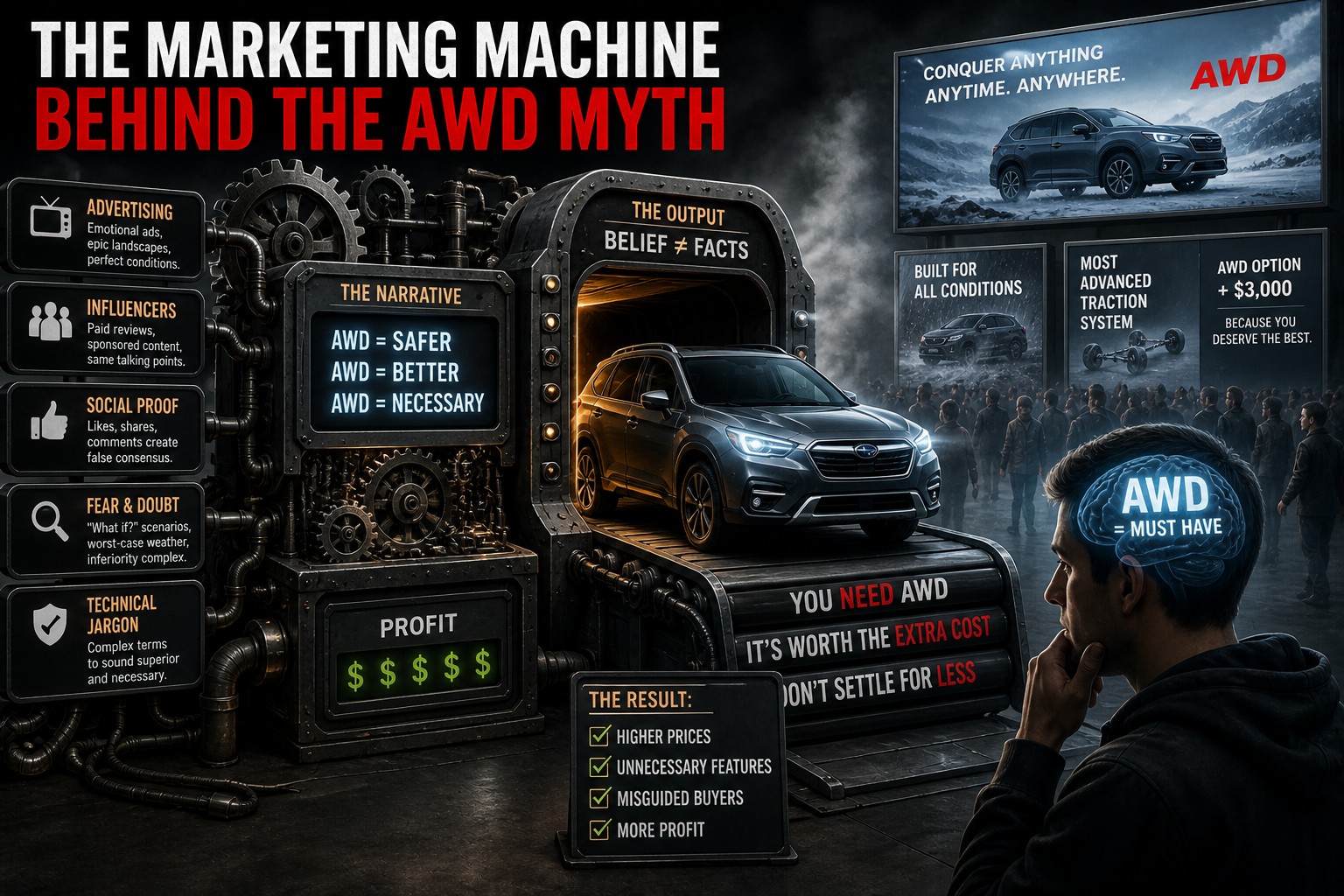
The Marketing Machine Behind the AWD Myth
Understanding why so many drivers believe they need AWD requires understanding how the automotive marketing industry operates. Car manufacturers are exceptionally skilled at creating emotional desire for features that provide maximum profit margin.
AWD systems represent one of the highest-margin upgrades available on a modern vehicle. The actual mechanical cost to a manufacturer is often lower than the premium charged to the buyer.
Advertisements consistently show AWD vehicles conquering mountain passes, going through snowy forests, and powering through muddy terrain. These images are aspirational and deliberately chosen to make viewers feel that without AWD, they are somehow unprepared.
The reality is that the vast majority of people watching those advertisements will never drive in those conditions. They live in cities, drive on highways, and park in underground car parks.
Car manufacturers understand that fear is a powerful motivator in purchasing decisions. The fear of being caught in a sudden snowstorm or losing control on a wet road drives buyers toward AWD options without rational analysis.
Automotive media has historically reinforced this messaging. Many car reviews praise AWD systems enthusiastically, which further normalises the idea that AWD is desirable for all drivers in all situations.
The SUV boom of the past twenty years has made this problem significantly worse. SUVs are now the most popular vehicle category globally, and AWD is heavily associated with the SUV identity.
Many buyers purchase AWD SUVs purely for the image they project. The vehicle signals adventure, capability, and status regardless of whether it ever leaves a smooth city road.
This social dimension of AWD ownership is rarely discussed honestly. People want to feel that their vehicle is ready for anything, even if their actual driving never tests that readiness.
Manufacturers also benefit from the servicing revenue that complex AWD systems generate over time. A simpler, more reliable vehicle means fewer dealer visits and lower long-term revenue for the automotive industry.
The entire ecosystem, from advertisements to dealership conversations to media coverage, is subtly aligned to encourage AWD purchases. Very few voices in mainstream automotive culture push back against this narrative.
Being an informed car buyer means seeing through this carefully constructed image. It means asking practical questions about your actual driving conditions rather than imagining the most dramatic scenario you might ever face.
Choosing a vehicle based on genuine need rather than marketed aspiration is one of the smartest financial decisions a driver can make. The savings are real, the safety trade-off is minimal, and the satisfaction of a smart purchase lasts for years.
Also Read: 10 Cars Where Replacing the Floor Mats Costs More Than a Phone
