
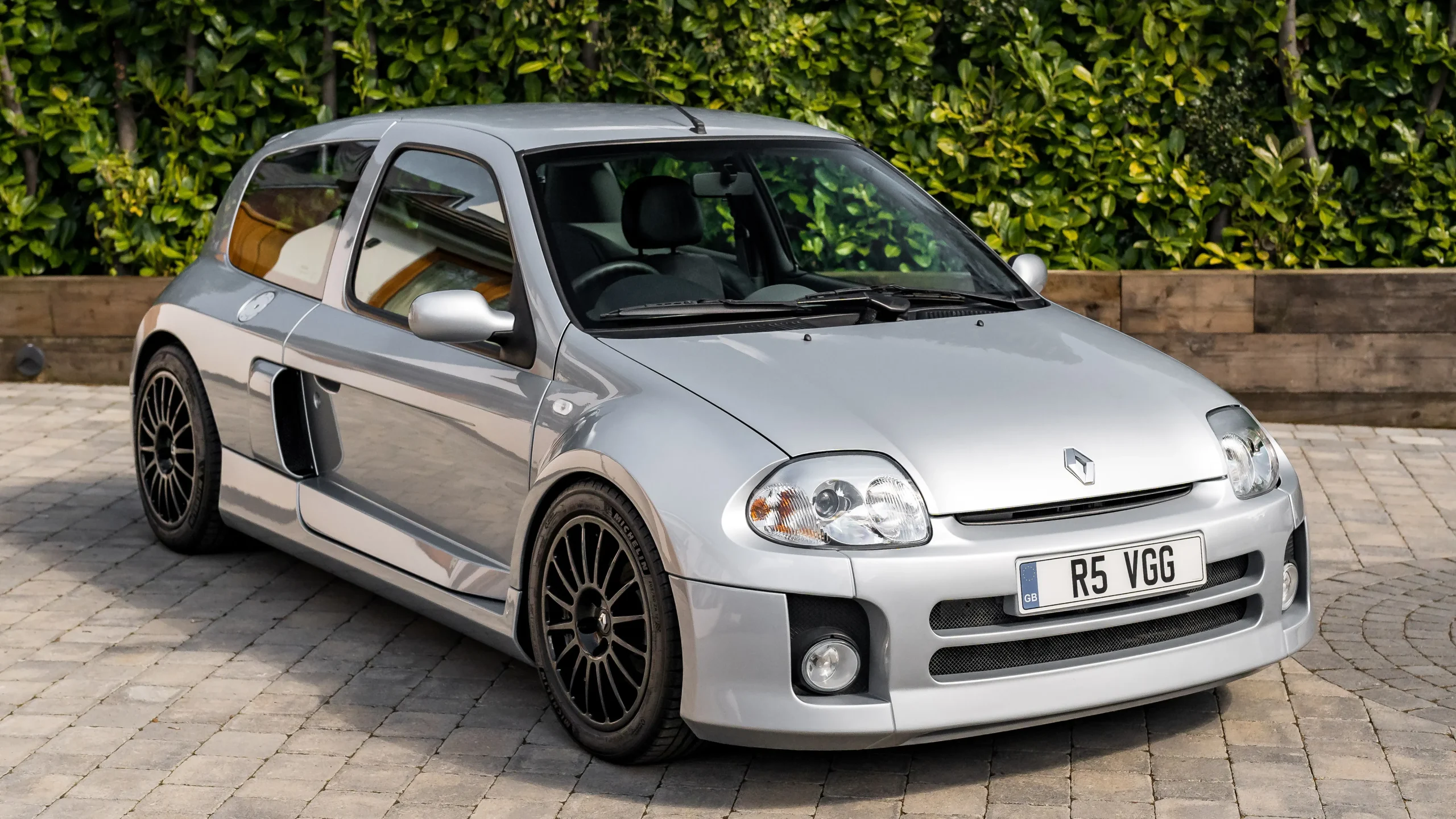
Most hot hatches follow a familiar formula. Manufacturers take a practical compact hatchback, add a more powerful engine, sharpen the suspension, improve the brakes, and create a vehicle that combines everyday usability with spirited performance.
Cars such as the Volkswagen Golf GTI, Honda Civic Type R, and Ford Focus RS became legends by refining that recipe rather than reinventing it. The Renault Clio V6 did the exact opposite.
Instead of simply increasing power and upgrading the chassis, Renault engineers transformed an ordinary front-wheel-drive hatchback into something that bordered on insanity.
The rear seats disappeared, the engine moved behind the driver, and the car gained dramatically widened bodywork that made it look more like an exotic supercar than a practical European hatchback.
When it debuted at the turn of the century, the Clio V6 shocked the automotive world. No major manufacturer had attempted anything quite like it. What began as a humble city car evolved into a mid-engine performance machine capable of embarrassing far more expensive sports cars on the right road.
Even today, more than two decades after its introduction, the Clio V6 remains one of the most outrageous production cars ever built. It combined the practicality and compact dimensions of a hatchback with a layout normally reserved for Ferraris, Lamborghinis, and other exotic machines.
The result was a car that earned a reputation as one of the wildest driver’s cars of its era and, in certain situations, a genuine supercar giant killer.
Also Read: 4 Best And Worst Years For The Toyota 4Runner
Renault Wanted To Build Something Nobody Expected
The story of the Clio V6 began in the late 1990s. Renault already had considerable success with hot hatchbacks through its Renault Sport division. Models such as the Clio Williams had established strong performance credentials and developed loyal followings among enthusiasts.
Yet the company wanted something more dramatic. The inspiration came partly from the legendary Renault 5 Turbo of the 1980s. That rally-inspired machine featured a mid-engine layout and became one of the most memorable performance cars of its generation. Renault believed the concept could be revived for a modern audience.
Instead of creating another conventional hot hatch, engineers decided to perform radical surgery on the second-generation Clio. The transformation was extraordinary.
The rear seats were removed completely. The fuel tank had to be repositioned. Much of the car’s structure was redesigned to accommodate a large V6 engine mounted directly behind the driver and front passenger.
This was not a modified Clio in the traditional sense. It was essentially a completely different car wearing Clio body panels.
By the time development was complete, very little of the original hatchback architecture remained untouched.
The engine was moved to the wrong end.
What made the Clio V6 so fascinating was its layout. Most hot hatches place the engine in the front and send power to either the front wheels or all four wheels. Renault abandoned that formula entirely.
The company installed a naturally aspirated 3.0-liter V6 engine where the rear seats normally sat. Power was delivered to the rear wheels through a six-speed manual transmission, creating a driving experience completely unlike anything else in the hot hatch segment.
The original Clio V6 Phase 1 produced approximately 227 horsepower. That figure may not seem extraordinary by modern standards, but in the early 2000s, it was enough to deliver serious performance in a compact package.
More importantly, the power was located directly behind the occupants, creating handling characteristics that felt far more exotic than those of a traditional hatchback. The engine placement transformed the vehicle’s personality.
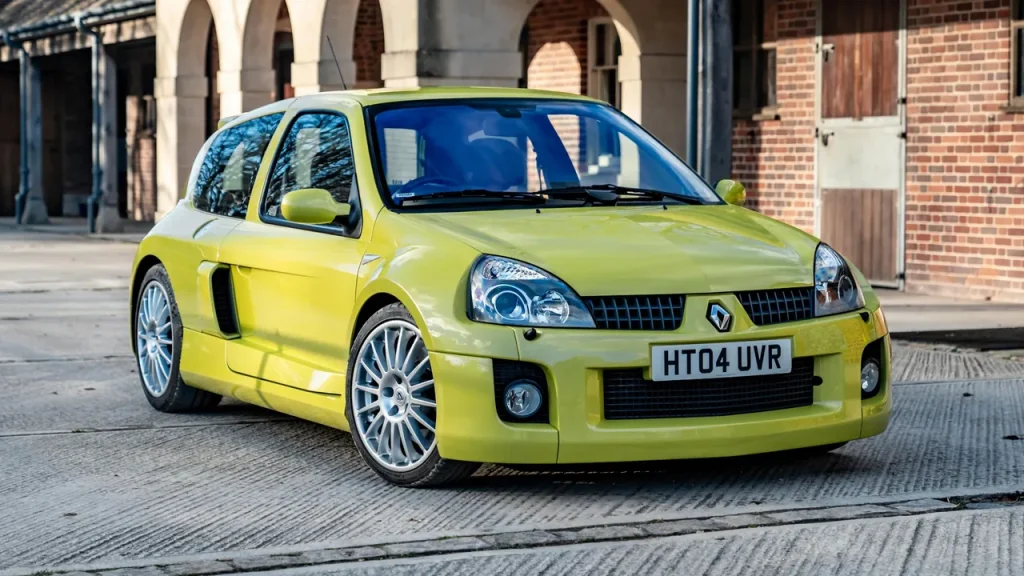
Drivers no longer experienced the predictable behavior associated with front-wheel-drive performance cars. Instead, they encountered a machine that demanded respect and rewarded skill.
The Clio V6 looked like a hatchback, but it drove like something much closer to a mid-engine sports car.
The widebody design looked like a road-legal race car.
One glance at the Clio V6 was enough to understand that this was no ordinary hatchback. Accommodating the V6 engine required massive modifications to the bodywork. The rear track was dramatically widened, resulting in enormous wheel arches that completely changed the car’s appearance.
The standard Clio was a compact city car. The Clio V6 looked like it had spent years in a gym.
Large side air intakes fed cooling air to the engine. Aggressive bumpers enhanced the visual impact. Wider wheels and tires filled the swollen arches. From behind, the car appeared almost cartoonishly muscular.
Yet the design worked. Even today, the Clio V6 remains one of the most recognizable hot hatches ever produced. Its proportions immediately communicate that something unusual lies beneath the surface.
Unlike many modern performance cars that rely on subtle styling cues, the Clio V6 proudly advertised its intentions. There was nothing understated about it. The car looked every bit as dramatic as the driving experience it delivered.
It Was Fast Enough To Trouble Serious Performance Cars
The term “supercar-killer” is often exaggerated in automotive journalism. The Clio V6 was not going to outrun a Ferrari 360 Modena or Porsche 911 Turbo in a straight line. However, performance figures alone fail to tell the full story.
The Phase 1 model could accelerate from 0 to 60 mph in roughly six seconds and reach a top speed approaching 150 mph. Later Phase 2 versions increased output to approximately 252 horsepower and improved acceleration further.
More importantly, the Clio V6 delivered its performance in a package that weighed significantly less than many larger sports cars.
Its compact dimensions made it exceptionally effective on narrow roads where larger, more powerful vehicles struggled to exploit their advantages.
British and European automotive journalists frequently praised the car’s ability to challenge much more expensive machinery on demanding roads. In the right hands, the Clio V6 could maintain astonishing pace through technical sections where agility mattered more than outright horsepower.
The experience felt exotic in a way that few similarly priced vehicles could match. Drivers sat inches away from a V6 engine while controlling a mid-engine rear-wheel-drive machine barely longer than a typical family hatchback. That combination made every drive memorable.
The First Version Was Infamously Demanding
Part of the Clio V6 legend comes from its reputation. The original Phase 1 model developed a reputation for challenging handling characteristics. Reviews from the period frequently described it as exciting, thrilling, and occasionally intimidating.
Several factors contributed to this behavior. The wheelbase remained relatively short despite the dramatic engineering changes.
The rear weight bias created rapid directional responses. Drivers accustomed to front-wheel-drive hot hatches often discovered that the Clio V6 demanded a completely different approach. Lift-off oversteer could arrive quickly if the car is driven carelessly.
For experienced enthusiasts, this unpredictability added to the appeal. The Clio V6 felt alive and engaging in ways that many modern performance cars do not.
However, Renault recognized that improvements were necessary. The later Phase 2 model received suspension revisions, steering updates, and chassis refinements designed to make the car more approachable without sacrificing its unique character.
These changes significantly improved stability while preserving the excitement that made the Clio V6 famous.
Phase 2 Perfected The Formula
In 2003, Renault introduced the updated Clio V6 Phase 2. The changes extended beyond the power increase.
Engineers revised suspension geometry, improved steering response, and refined full vehicle dynamics. The goal was to create a more polished and confidence-inspiring machine.
Most reviewers agreed that Renault succeeded. The additional horsepower enhanced straight-line performance, while the chassis modifications made the car more predictable at the limit. Drivers could exploit the vehicle’s capabilities more effectively without constantly worrying about sudden surprises.
Importantly, the improvements did not dilute the Clio V6’s personality. It remained dramatic, loud, and unconventional. The car still felt radically different from virtually everything else on the road.
Many enthusiasts consider the Phase 2 model the best version because it retained the original’s excitement while addressing some of its weaknesses. Today, these later cars are especially desirable among collectors.
Why The Clio V6 Became A Modern Legend
Few manufacturers would attempt a project like the Clio V6 today. The economics alone would be difficult to justify. Developing a low-volume mid-engine performance car based on a mainstream hatchback would require enormous investment with limited sales potential.
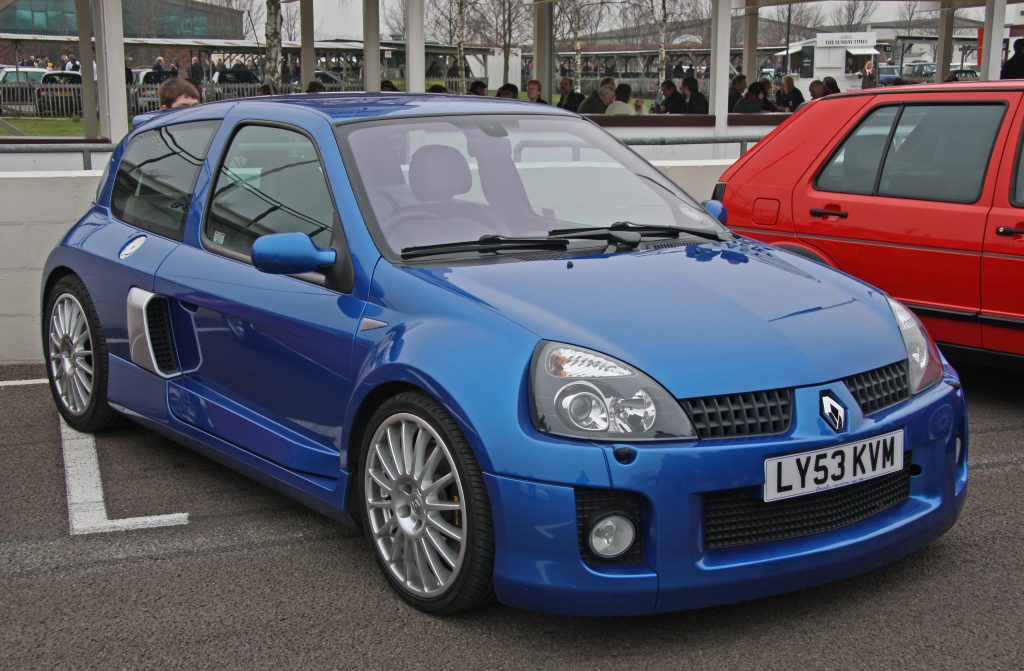
That reality makes the Clio V6 even more remarkable. Renault built the car simply because it could.
The project represented an era when manufacturers occasionally pursued ambitious engineering exercises for passion rather than pure financial logic. The result was a vehicle unlike anything else before or since.
Production numbers remained relatively low, further enhancing the car’s appeal. As the years passed, enthusiasts increasingly recognized how unusual the Clio V6 truly was.
Values have climbed steadily as collectors search for distinctive performance cars from the early 2000s. The Clio V6 occupies a unique place in automotive history because it refuses to fit neatly into any category.
It was not a traditional hot hatch. It was not a conventional sports car. It was not quite a supercar either. Instead, it combined elements of all three.
A Hot Hatch Unlike Any Other
The Renault Clio V6 succeeded because it embraced an idea that seemed completely irrational.
Rather than following established hot hatch conventions, Renault transformed an everyday city car into a mid-engine performance machine with exotic-car architecture and unmistakable styling. The company effectively built a miniature supercar disguised as a hatchback.
Its performance was impressive, but numbers alone do not explain the car’s enduring reputation. What made the Clio V6 special was the experience.
The noise from the V6 engine, the dramatic bodywork, the unusual handling characteristics, and the sheer absurdity of the concept combined to create something unforgettable.
Many performance cars are faster today. Many are more refined and easier to drive. Very few are more interesting.
More than two decades after its debut, the Clio V6 remains one of the boldest production cars ever created. It proved that a humble hatchback could be transformed into a machine capable of challenging far more expensive sports cars while delivering an experience unlike anything else on the road.
That is why the mid-engine hot hatch became a genuine supercar-killer and why enthusiasts continue celebrating it today.
