
The United States is preparing to take another major step in restricting China’s presence in the American automotive market.
A bipartisan proposal advancing through the Senate Commerce Committee would significantly strengthen existing federal restrictions on Chinese-connected vehicles, software, and key automotive technologies, reflecting growing concerns that modern vehicles have become powerful data-collection platforms capable of posing national security risks.
The legislation, scheduled for committee consideration on July 15, comes as Washington continues to broaden its scrutiny of connected vehicles. While tariffs have already made it difficult for Chinese automakers to sell vehicles in the United States, lawmakers now want to make those restrictions more permanent and comprehensive.
The proposal builds upon regulations first introduced in 2025 and seeks to ensure future administrations cannot easily reverse them without congressional approval.
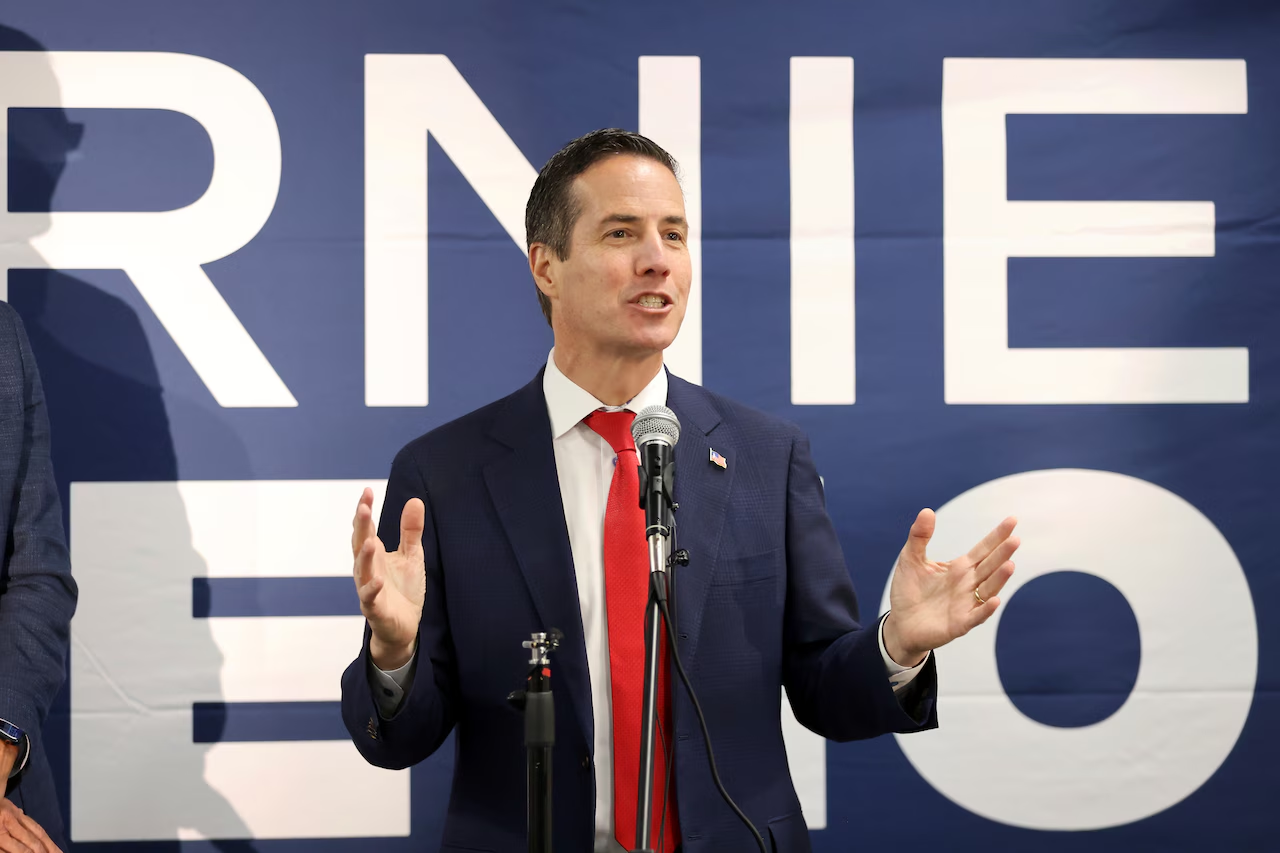
According to Reuters, the bill has bipartisan backing from Senator Bernie Moreno of Ohio and Senator Elissa Slotkin of Michigan, underscoring the rare level of agreement between Republicans and Democrats on automotive security issues.
If enacted, the legislation would have implications well beyond Chinese automakers. Global manufacturers, software suppliers, semiconductor companies, and technology firms operating across international supply chains could all be affected as the United States raises its standards for what qualifies as a secure connected vehicle.
Also Read: 10 Fastest Diesel Pickups Ever Made & Ranked
From Trade Competition to National Security
For years, concerns surrounding Chinese automobiles largely focused on pricing and manufacturing competition. Chinese brands rapidly expanded across Europe, Latin America, Southeast Asia, and Australia by offering electric vehicles equipped with advanced technology at prices significantly below those of many Western rivals.
The debate in Washington has gradually shifted away from economics alone. Modern vehicles generate enormous volumes of information every day.
Connected cars continuously collect GPS location data, driving habits, camera feeds, voice commands, smartphone connections, biometric information, charging patterns, and diagnostic information. Vehicles also communicate with cloud servers through over-the-air software updates and connected services.
According to the U.S. Department of Commerce, these capabilities create potential pathways for foreign adversaries to access sensitive information or disrupt transportation infrastructure if the underlying hardware or software originates from countries considered national security risks.
Those concerns formed the basis of regulations issued during the Biden administration in early 2025 restricting Chinese-connected vehicle technologies. The current Senate legislation would write many of those protections directly into federal law.
Supporters argue that connected vehicles should increasingly be viewed as rolling computers rather than traditional automobiles, making cybersecurity just as important as crash safety.
What the Senate Bill Would Do
The proposed legislation expands existing restrictions in several important ways. Rather than focusing solely on vehicles assembled in China, lawmakers are targeting automobiles designed in China or containing advanced software, connectivity systems, or electronic components linked to Chinese companies.
Reuters reported that the proposal would prohibit Chinese-connected passenger vehicles from entering the U.S. market while also preventing software platforms and advanced connected technologies from becoming embedded within America’s light-duty vehicle fleet.
Similar legislation has also been introduced in the House of Representatives, increasing the likelihood that Congress could eventually send a unified measure to the White House.
The bill is designed to close potential loopholes that could allow manufacturers to relocate production outside China while continuing to rely on Chinese-developed digital systems.
Because today’s vehicles increasingly depend on software-defined architectures, lawmakers believe security reviews must extend beyond where a vehicle is assembled.
Why Connected Cars Are Receiving So Much Attention
The automotive industry has undergone one of its biggest technological transformations in decades.
Vehicles now receive wireless software updates, support remote smartphone access, integrate artificial intelligence, and communicate continuously with cloud-based services. Many new models contain more than 100 electronic control units managing everything from braking and steering to infotainment and battery systems.
Cybersecurity experts have warned that greater connectivity naturally expands the number of potential attack surfaces.
Government officials argue that if foreign-controlled software gained widespread access to American transportation networks, it could theoretically collect sensitive data or interfere with critical systems during geopolitical conflicts.
Although no public evidence suggests Chinese passenger vehicles have been used for such purposes inside the United States, lawmakers increasingly argue that preventing potential vulnerabilities is preferable to responding after security incidents occur.
That preventive approach mirrors recent U.S. actions involving telecommunications equipment, semiconductor technologies, and advanced computing hardware.
Automakers Largely Support Stronger Restrictions
One notable aspect of the proposal is the unusually broad support it has received from much of the automotive industry.
Reuters reported that trade organizations representing nearly every major automaker operating in the United States, including General Motors, Ford, Stellantis, Toyota, Hyundai, Volkswagen, suppliers, dealerships, and parts manufacturers, previously urged the government to maintain strict barriers against Chinese vehicle manufacturers.
Industry groups argued that China’s state-supported automotive expansion represents both an economic and strategic challenge to American manufacturing.
They warned that Chinese automakers benefit from significant government backing while simultaneously developing increasingly sophisticated connected vehicle technologies.
Supporters of the legislation believe that protecting domestic production and protecting national security have become closely linked objectives.
Labor organizations have also expressed support, arguing that stronger protections could help preserve American manufacturing jobs while preventing heavily subsidized imports from rapidly disrupting domestic production.
Global Automakers Face New Compliance Challenges
The legislation does not affect only Chinese brands. Many global automakers maintain extensive engineering partnerships, software development centers, and component suppliers throughout China.
Even manufacturers headquartered in Europe, Japan, or South Korea may need to reassess portions of their supply chains if the legislation becomes law.
The increasing use of centralized computing platforms means a single software supplier may serve multiple global manufacturers.
Companies could therefore face additional certification requirements demonstrating that critical software, connectivity systems, and electronic components satisfy U.S. security standards.
Manufacturers may also accelerate efforts to diversify semiconductor sourcing, cloud infrastructure, and software development away from China to reduce regulatory risk.
Industry analysts believe these changes could increase development costs while adding complexity to future vehicle certification.
Chinese EV Growth Continues Outside America
Although Chinese automakers have virtually no passenger vehicle presence in the United States, their international expansion continues at a rapid pace.
Chinese manufacturers have established strong positions across Europe, Mexico, South America, Southeast Asia, and parts of the Middle East by combining competitive pricing with advanced electric vehicle technology.

Reuters noted that consumer interest in affordable Chinese electric vehicles has increased internationally, particularly as manufacturers introduce longer driving ranges, faster charging capabilities, and increasingly sophisticated driver assistance technologies.
Chinese brands have also captured meaningful market share in Mexico and several European markets despite growing political scrutiny.
Those developments have heightened concerns among American policymakers that Chinese manufacturers could eventually seek broader access to the U.S. market if regulatory barriers weaken.
The Broader U.S.-China Technology Rivalry
The proposed legislation reflects a much wider shift in U.S.-China relations. Over the past several years, Washington has introduced restrictions affecting semiconductors, telecommunications equipment, artificial intelligence technologies, critical minerals, battery supply chains, and advanced manufacturing equipment.
Automobiles have increasingly become part of that broader strategic competition because modern vehicles combine transportation, computing, communications, artificial intelligence, mapping, and cloud connectivity within a single product.
Analysts increasingly describe connected vehicles as mobile digital platforms capable of generating valuable economic and strategic information.
That perspective explains why policymakers now place automotive software alongside telecommunications infrastructure in national security discussions.
According to Reuters, Chinese officials have repeatedly criticized American restrictions targeting Chinese vehicle manufacturers, arguing they unfairly discriminate against Chinese companies and distort international trade.
What Happens Next
The Senate Commerce Committee is expected to vote on the legislation on July 15. If approved, the proposal would advance through the legislative process while lawmakers work to reconcile it with similar House legislation.
Even if the bill undergoes revisions before final passage, the full direction of U.S. automotive policy appears increasingly clear.
Successive administrations from both political parties have steadily expanded restrictions on Chinese automotive technologies, and bipartisan support suggests those policies are likely to remain in place regardless of future political changes.
For automakers, suppliers, and technology companies, the message is equally clear. Vehicle security is no longer evaluated solely through crash tests, emissions compliance, or mechanical reliability.
Software architecture, cloud connectivity, semiconductor sourcing, and digital supply chains are becoming equally important considerations.
As the automotive industry transitions toward software-defined vehicles and increasingly autonomous technologies, governments are treating cybersecurity as an essential component of national infrastructure.
The Senate’s latest proposal demonstrates that Washington views connected vehicles not merely as consumer products but as strategic technologies whose design, software, and data flows could influence both economic competitiveness and national security for decades to come.
Also Read: 8 Trucks That Hold Their Value Past 15 Years
