
For most passenger cars, seating capacity is predictable. Sedans usually carry five people, three-row SUVs commonly offer six to eight seats, and minivans typically stop at seven or eight. However, the broader production-vehicle market includes factory-built passenger vans and high-capacity people movers designed to carry far larger groups.
Some have enough factory seating to transport 12, 14, or even 15 occupants without relying on aftermarket conversions.
These vehicles serve a different mission from conventional family cars. Hotels use them for guest transportation, churches move groups between locations, companies operate employee shuttles, and large families value the extra seating.
Manufacturers therefore have to balance passenger capacity with powertrain strength, interior access, body dimensions, and the ability to carry substantial loads.
This list focuses on genuine series-production passenger vehicles rather than one-off limousines, custom stretch conversions, or full-size buses. Seating figures refer to manufacturer-configured passenger versions, and specifications are based on representative production models because powertrains and dimensions can change by model year.
U.S.-market vehicles are prioritized where applicable, with globally sold factory passenger models included when their unusually high seat counts deserve recognition. These nine machines show just how many people a production vehicle can carry when maximum seating becomes a central part of its design.
Also Read: 10 SUVs That Are Easiest to Get In and Out Of
1. 2024 Ford Transit Passenger Van XLT
Fifteen seats immediately place the Ford Transit Passenger Van in territory far beyond a normal three-row SUV. Ford offered the U.S.-market Transit Passenger Van with seating for up to 15 people, giving one factory-built vehicle the ability to move a group that might otherwise require two large SUVs.
The configuration is available in passenger-oriented transit models rather than being an improvised aftermarket seating conversion. Achieving that capacity requires serious interior space. Extended-length transit configurations stretch to approximately 263.9 inches, while the body measures 81.3 inches wide without mirrors.
Multiple rows of seating fill the cabin, and Ford has offered different roof heights that can move to the passenger compartment considerably more easily than in a low-roof family vehicle.
The powertrain also reflects the demands of a full-size van. The standard 3.5-liter V6 produces 275 horsepower and 262 lb-ft of torque. Buyers seeking additional output can select the 3.5-liter EcoBoost V6, rated at 310 horsepower and 400 lb-ft of torque.
That substantial torque figure is particularly relevant when the van is carrying numerous occupants and their belongings.
What separates the Transit from older passenger vans is its more modern vehicle architecture. Available driver-assistance technologies, contemporary infotainment, and multiple body configurations give operators more flexibility than the traditional one-size-fits-all passenger van formula.
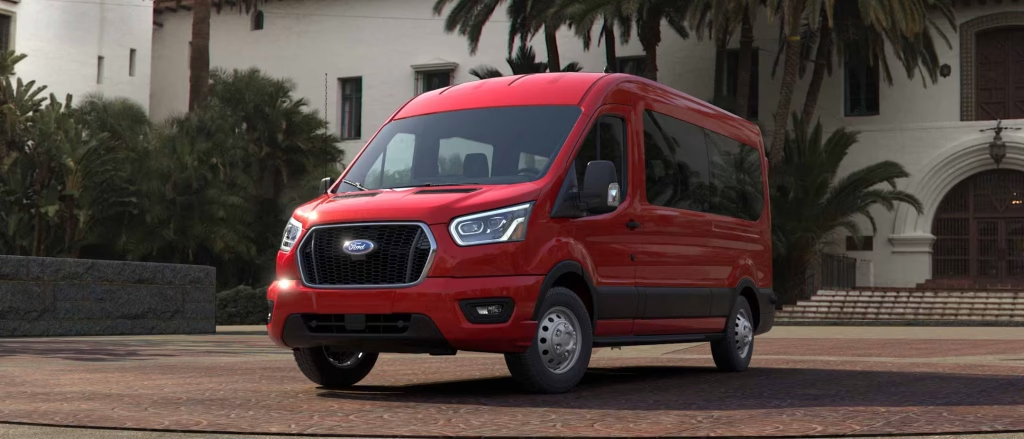
The 15-seat maximum is the key number here. In a factory passenger configuration sold in the United States, the Transit reaches one of the highest seating capacities commonly available without moving into a dedicated bus.
Few production vehicles blur the boundary between a personal vehicle and group transportation quite so effectively.
- Engine: 3.5-liter V6
- Torque: 262 lb-ft
- Horsepower: 275 hp
- Length/Width: Up to 263.9 inches / 81.3 inches
2. 2025 Chevrolet Express Passenger Van
Chevrolet has kept the Express Passenger Van in production for decades for a simple reason: its basic formula remains exceptionally useful. In extended-wheelbase form, the Express can be configured to seat up to 15 passengers.
Chevrolet specifically requires the 155-inch wheelbase for the 15-passenger seating arrangement, turning the long-body Express into one of America’s highest-capacity factory passenger vehicles.
There is nothing delicate about its approach. The Express uses a traditional full-size van layout and prioritizes usable cabin capacity over crossover-like styling.
The extended passenger van measures approximately 243.9 inches long, providing the physical room necessary for multiple rows of seating. At 79.3 inches wide without mirrors, it is a substantial vehicle even before passengers climb aboard.
Chevrolet’s available 6.6-liter gasoline V8 makes the specification particularly interesting. Rated at 401 horsepower and 464 lb-ft of torque, the engine provides far more output than buyers would find in many historical 15-passenger vans.
A 4.3-liter V6 is also associated with the Express lineup, but the V8 better demonstrates how Chevrolet equips the platform for demanding passenger and commercial work.
The Express is frequently associated with shuttle operators, institutions, and group transportation, yet its seat count is what earns it a place on this list. Fifteen people in a single production vehicle is an extraordinary number when compared with even the largest mainstream SUVs.
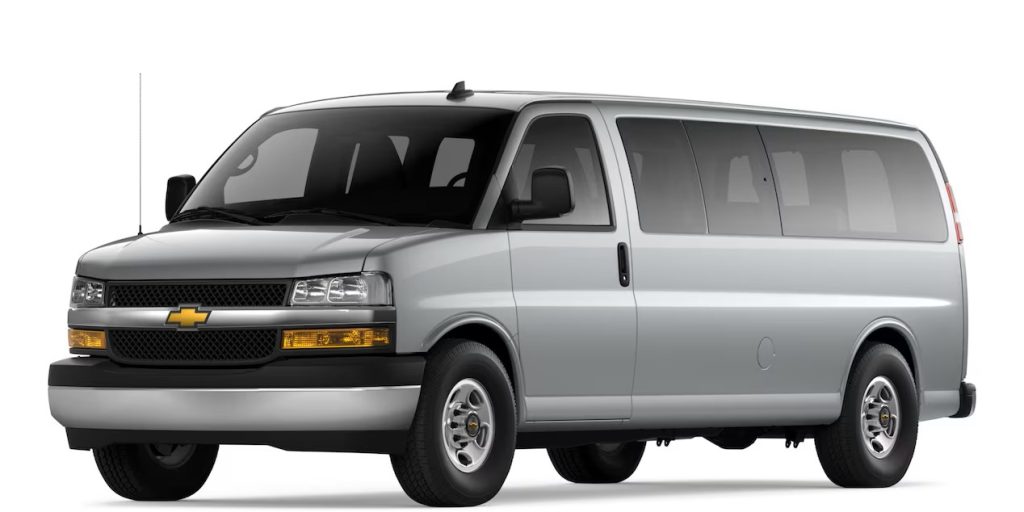
Its longevity can make the Express seem ordinary, but the seating arrangement is anything but normal. Chevrolet has effectively kept a factory-built 15-seat vehicle available to American buyers while much of the passenger market has moved toward crossovers with fewer seats and more lifestyle-focused packaging.
- Engine: 6.6-liter gasoline V8
- Torque: 464 lb-ft
- Horsepower: 401 hp
- Length/Width: 243.9 inches / 79.3 inches
3. 2026 GMC Savana Passenger Van
The Chevrolet Express has a corporate relative that reaches the same remarkable passenger count, but the GMC Savana earns its own place because it remains a distinct production model sold through GMC’s U.S. commercial vehicle lineup.
In extended-wheelbase 3500 form, the Savana passenger van offers available seating for up to 15 people. GMC specifies the 15-passenger arrangement for long-wheelbase LS and LT configurations.
Picture the seating requirement another way. A typical five-passenger sedan would need three vehicles to provide 15 seats. The Savana places its theoretical passenger capacity inside one factory-built van.
This explains its continued relevance for organizations, hotels, transportation services, and other operators that need to move sizable groups without stepping into a dedicated bus.
GMC’s available 6.6-liter gasoline V8 gives the Savana serious mechanical muscle. Factory specifications list 401 horsepower at 5,200 rpm and 464 lb-ft of torque at 4,000 rpm.
Those figures are particularly meaningful in a high-capacity passenger vehicle, where a cabin full of occupants can add well over 2,000 pounds depending on passenger weights and carried items.
Size is equally important to the story. GMC lists the extended 15-passenger Savana at approximately 244 inches long. Its width is 79.25 inches without exterior mirrors. The 155-inch wheelbase creates the space required for the additional seating rows.
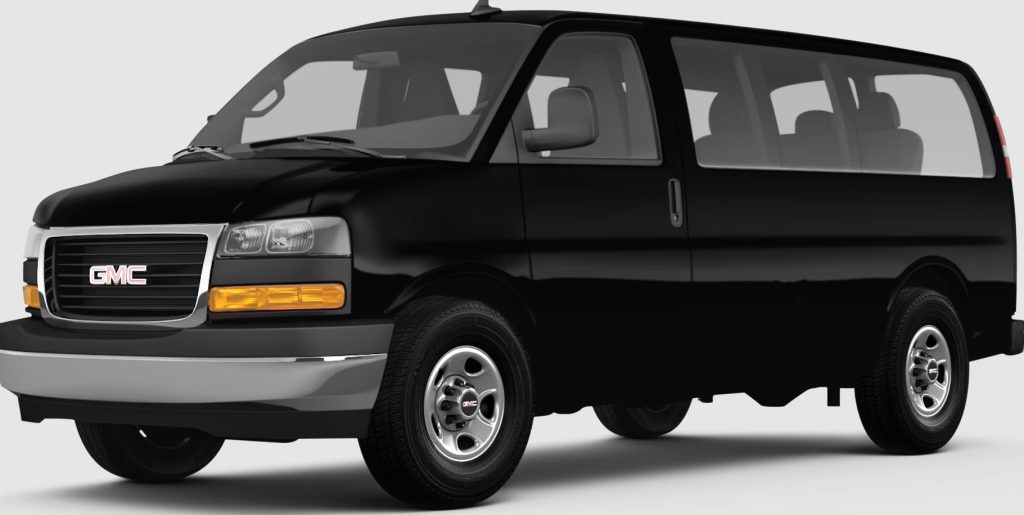
The Savana may use a traditional full-size van formula, yet 15 factory seats remain an exceptional achievement. Passenger capacity, rather than luxury or performance, is the number that defines this GMC.
- Engine: 6.6-liter gasoline V8
- Torque: 464 lb-ft
- Horsepower: 401 hp
- Length/Width: 244.0 inches / 79.25 inches
4. 2025 Mercedes-Benz Sprinter Passenger Van
Mercedes-Benz approached high-capacity passenger transportation with a very different shape and engineering philosophy. The Sprinter Passenger Van is instantly recognizable because of its tall, upright body, a design intended to make the interior genuinely usable for groups rather than simply squeezing additional seats into a conventional vehicle shell.
Depending on the configuration and model-year specification, U.S. Sprinter passenger variants have been listed with high-capacity layouts reaching 15 seats.
Mercedes-Benz’s current passenger van specifications also demonstrate the scale of the platform, with official 2026 materials listing a 12-seat configuration, a 3,219-pound payload capacity, and 82 cubic feet of cargo volume.
The Sprinter’s cabin experience is one of its biggest distinctions. A high-roof body gives passengers far more vertical space than a traditional low-roof American van. This changes how people enter, leave, and move through the cabin.
For shuttle work, where passengers may climb aboard repeatedly throughout the day, interior height can be nearly as important as the raw seat count.
Modern U.S.-market Sprinters use Mercedes-Benz’s 2.0-liter four-cylinder diesel engine family. In high-output form, the diesel produces 211 horsepower and 332 lb-ft of torque. A 9G-TRONIC nine-speed automatic transmission manages the power delivery, giving the Sprinter a substantially different mechanical character from the large-displacement gasoline V8 vans elsewhere on this list.
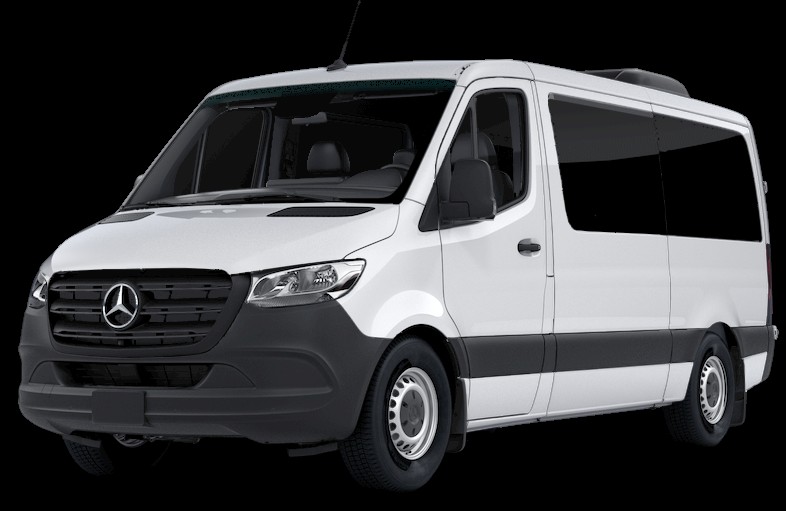
Its 170-inch-wheelbase passenger configuration stretches to roughly 274 inches in length and approximately 80 inches wide without mirrors.
The Sprinter proves that maximum seating is not merely about installing more benches. Mercedes-Benz designed the entire vehicle around carrying people and cargo through a tall, purpose-built passenger space.
- Engine: 2.0-liter high-output turbo-diesel inline-four
- Torque: 332 lb-ft
- Horsepower: 211 hp
- Length/Width: Approximately 274 inches / 80 inches
5. 2025 Nissan Urvan NV350
Not every high-capacity production vehicle follows the enormous American full-size van formula. Nissan’s Urvan NV350 demonstrates how a narrower commercial platform can still accommodate an extraordinary number of occupants.
In factory passenger configurations offered in international markets, the current-generation Urvan has been available with seating arrangements for up to 18 people. Nissan’s own market material also documents passenger conversions accommodating up to 14 occupants, while the 2025 Philippine brochure lists several seating configurations across the Urvan range.
The secret is a cabin shaped around passenger density. A high-roof, wide-body Urvan can measure approximately 205.9 inches long and 74.0 inches wide, based on the 5,230 mm by 1,880 mm dimensions published in Nissan’s 2025 brochure.
Those figures convert the van into a long rectangular passenger space where rows can be arranged efficiently. Unlike a luxury SUV, there is little emphasis on a huge center console or excessively wide individual chairs.
Nissan’s 2.5-liter YD25 turbo-diesel inline-four is closely associated with high-capacity Urvan applications. It produces approximately 127 to 129 horsepower and about 263 lb-ft of torque, depending on the specific market rating.
The power figure may appear modest beside a 400-horsepower American V8, but diesel torque and commercial gearing suit the vehicle’s people-moving mission.
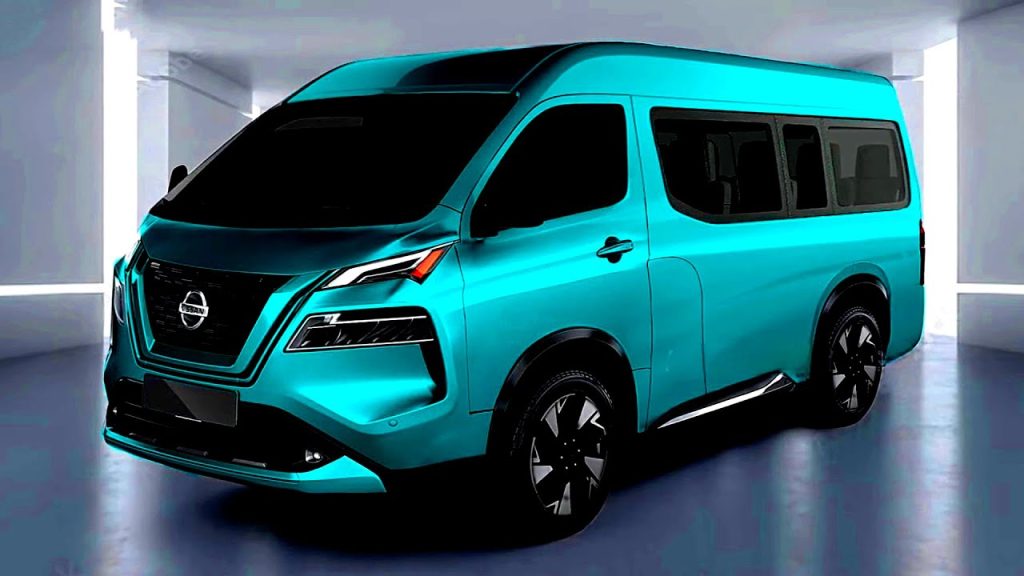
What makes the Urvan noteworthy is its packaging efficiency. Nissan created a production van capable of carrying passenger counts normally associated with small shuttle buses.
Its seating record is not achieved through a stretched limousine conversion or custom coachbuilder body. The capacity comes from a factory-engineered commercial passenger platform built specifically to place many people inside one vehicle.
- Engine: 2.5-liter turbo-diesel inline-four
- Torque: Approximately 263 lb-ft
- Horsepower: Approximately 129 hp
- Length/Width: Approximately 205.9 inches / 74.0 inches
6. 2025 Toyota HiAce Commuter
Toyota’s HiAce has spent decades performing one of the least glamorous but most demanding jobs in the automotive world: moving groups of people every day. Depending on the country and factory specification, HiAce passenger versions have been sold with double-digit seating capacities.
Current sixth-generation Commuter versions in some markets seat 12, while other regional HiAce specifications seat 13 to 15 occupants. Toyota’s production platform has therefore consistently ranked among the highest-capacity passenger vehicles carrying a conventional van identity.
The latest HiAce’s shape explains much of its success. Toyota moved away from the old cab-over arrangement and created a semi-bonnet design with the engine positioned ahead of the cabin. In super-long-wheelbase form, official specification material lists a 3,860 mm wheelbase, equivalent to approximately 152 inches.
The long body and high roof give Toyota enough physical volume to install several passenger rows while preserving an aisle for cabin access.
A 2.8-liter turbo-diesel four-cylinder powers many current commuter configurations. Depending on the specification, the engine produces approximately 156 to 174 horsepower, with stronger versions generating up to about 310 lb-ft of torque.
These figures matter more than a dramatic acceleration time because a HiAce may spend its working life carrying passengers, luggage, and commercial loads through repeated daily journeys.
The HiAce is fascinating precisely because its seating capacity does not feel like a publicity stunt. Toyota engineered the vehicle for airports, hotels, tourism operators, and group transport.
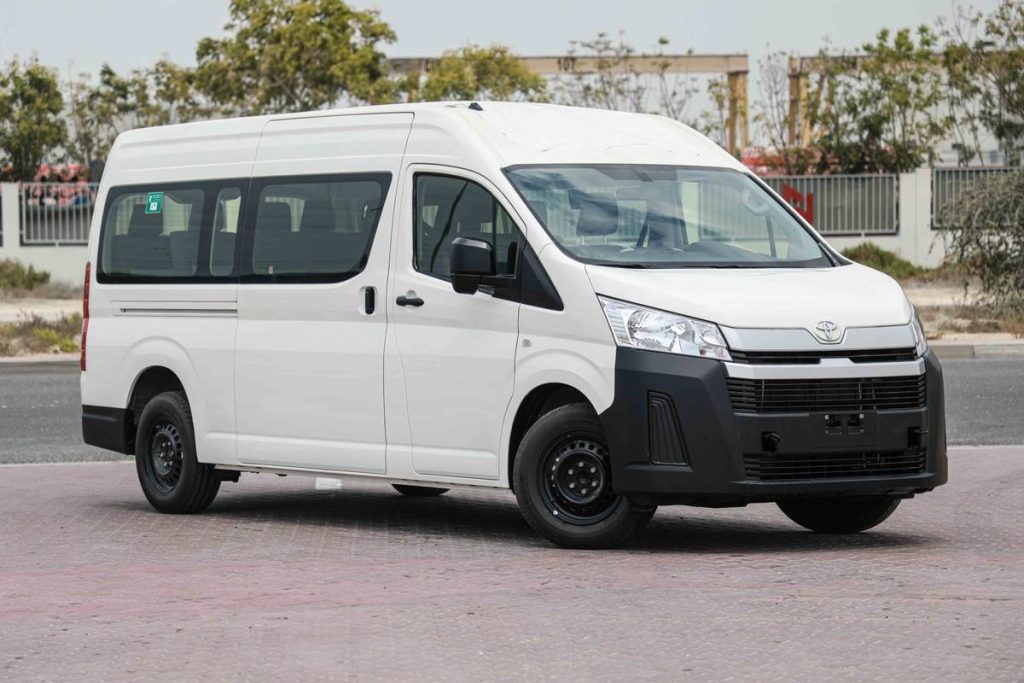
A 12-seat or higher factory layout is simply part of its working identity. Few production passenger vehicles have made high-capacity seating seem so routine.
- Engine: 2.8-liter turbo-diesel inline-four
- Torque: Up to approximately 310 lb-ft
- Horsepower: Up to approximately 174 hp
- Length/Width: Up to approximately 232.1 inches / 76.8 inches
7. Hyundai Solati
Sixteen people inside one factory-built passenger vehicle sounds closer to minibus territory than conventional van ownership.
That is precisely why the Hyundai Solati deserves attention. Hyundai’s commercial passenger platform has been offered in a 16-seat configuration, giving it one more seating position than the 15-passenger Ford Transit, Chevrolet Express, and GMC Savana configurations already discussed.
The Solati, closely related to the Hyundai H350 name used in other markets, was engineered from the beginning as a commercial platform. Its dimensions reveal the scale involved. Hyundai specifications list a length of 6,195 mm and a width of 2,038 mm, equivalent to approximately 243.9 inches long and 80.2 inches wide.
At roughly 112.4 inches tall, it creates a cabin with the vertical room expected from a dedicated passenger shuttle. Hyundai’s commercial documentation identifies bus, van, and truck derivatives of the H350 platform.
Power comes from a 2.5-liter CRDi turbo-diesel four-cylinder. Hyundai’s published Solati specification lists 170 PS and a maximum torque of 43 kg-m. Converted to U.S.-familiar figures, output is approximately 168 horsepower and 311 lb-ft of torque. A six-speed manual transmission has been used with this diesel powertrain.
The seating number is the real headline. Sixteen occupants mean the Solati can theoretically replace four four-seat passenger cars when judged strictly by occupied seats. Large side glass, multiple seating rows, and its tall commercial body make passenger transportation the central mission rather than an afterthought.
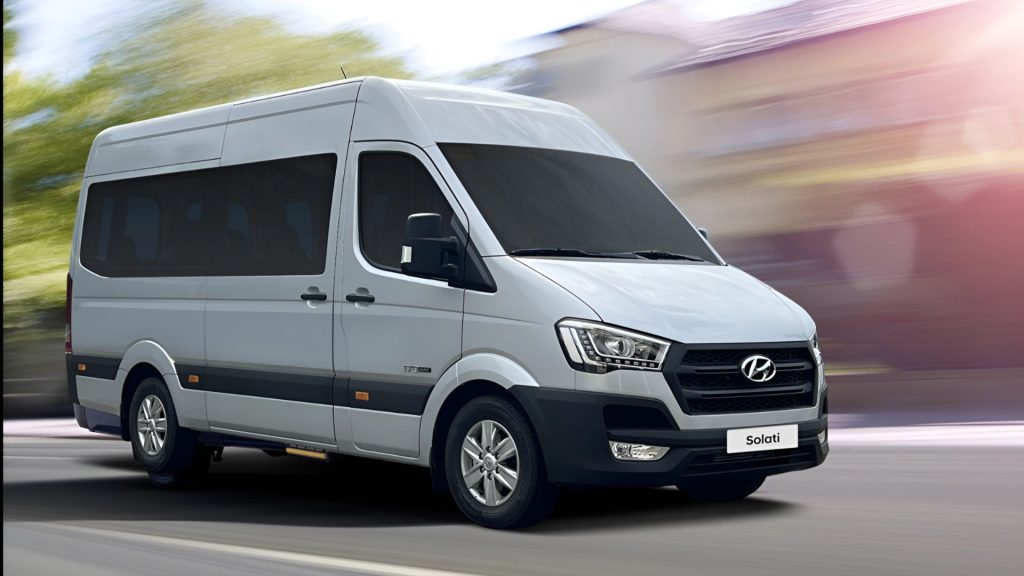
Hyundai did not simply lengthen a family minivan. The Solati is a purpose-built people mover whose physical architecture allows 16-seat passenger configurations to exist as part of a production commercial vehicle family.
- Engine: 2.5-liter CRDi turbo-diesel inline-four
- Torque: Approximately 311 lb-ft
- Horsepower: Approximately 168 hp
- Length/Width: 243.9 inches / 80.2 inches
8. Kia Grand Carnival 11-Seater
The Kia Grand Carnival takes a more surprising route to extreme seating capacity. Unlike the towering Solati or extended American passenger vans, the Carnival is fundamentally an MPV. Yet Kia has produced factory 11-seat versions, complete with four seating rows and flexible arrangements designed to alter the balance between passengers and luggage.
Kia’s own 11-seat Carnival brochure specifically documents configurations for six, seven, eight, or 11 occupants. The fourth row even receives a USB charging port, a small detail that confirms this is a properly engineered seating layout rather than an aftermarket bench installation.
Kia calls the system Multiflex Seats, emphasizing the ability to rearrange the passenger space for different requirements. The 11-seat model documented by Kia uses a 2.2-liter CRDi turbo-diesel engine producing 200 PS and 440 Nm of torque. In U.S. measurements, that is approximately 197 horsepower and 325 lb-ft. An eight-speed automatic transmission handles gear changes.
Those figures give the Carnival considerably more torque than many gasoline-powered family minivans while retaining a vehicle shape that is far less intimidating than a commercial shuttle van.
Its body is also relatively compact when compared with the 15-seat giants near the top of this list. The Grand Carnival generation associated with the official 11-seat brochure measures roughly 201.4 inches long and 78.1 inches wide. Packing four rows and 11 designated seating positions into that footprint is a striking example of passenger-space engineering.
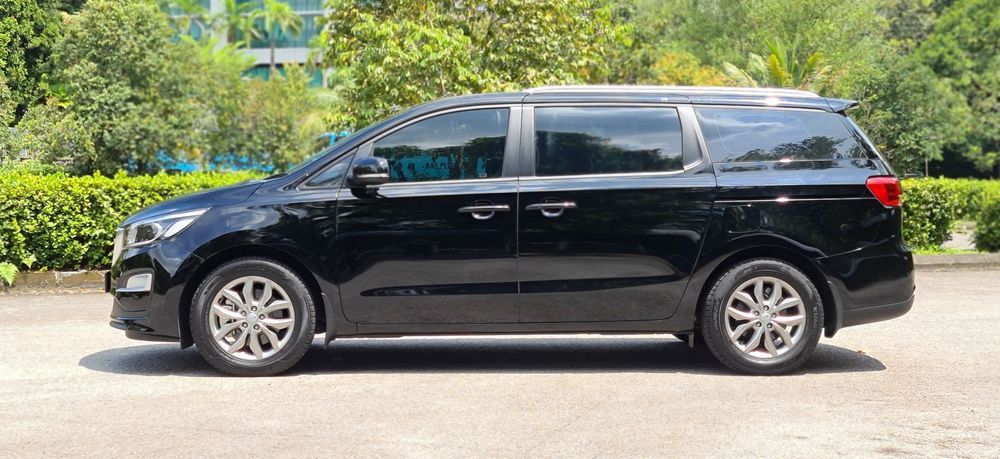
That contrast earns the Kia its position here. A 15-seat commercial van looks capable of carrying a crowd before anyone opens the door. The Grand Carnival can hide 11-seat capability inside a body that still resembles a premium family MPV.
- Engine: 2.2-liter CRDi turbo-diesel inline-four
- Torque: Approximately 325 lb-ft
- Horsepower: Approximately 197 hp
- Length/Width: Approximately 201.4 inches / 78.1 inches
9. Force Traveller N 4020WB
Twenty passenger seats plus a dedicated driver’s position put the Force Traveller N 4020WB into an entirely different capacity class than a family minivan.
Factory specifications from Force Motors list the model with 12, 19, or 20 passenger seats plus the driver. In its largest passenger arrangement, that means 21 people can travel in the vehicle when the driver’s seat is counted.
The Traveller’s design history helps explain why it can carry such a large group. Rather than starting with a passenger car platform, Force Motors developed the Traveller as a dedicated light commercial vehicle with a monocoque body.
The 4020WB designation refers to its approximately 158.3-inch wheelbase, creating enough cabin length for multiple rows of high-back seats. Force lists the body at 6,935 mm long and 1,925 mm wide. Converted to U.S. measurements, those figures are approximately 273.0 inches and 75.8 inches.
Under the body sits a 2.6-liter FM 2.6 CR ED four-cylinder common-rail turbo-diesel. Factory data rate the engine at 114 horsepower and 350 Nm of torque, equivalent to approximately 258 lb-ft. Peak torque arrives from 1,400 to 2,200 rpm, an operating range suited to moving a heavily occupied passenger vehicle. The diesel is connected to a manual synchromesh transmission.
The most impressive figure remains the seating capacity. A Ford Transit Passenger Van can reach 15 occupants in a U.S. factory configuration, while the Traveller N 4020WB offers 20 passenger positions plus its driver in specified factory layouts.
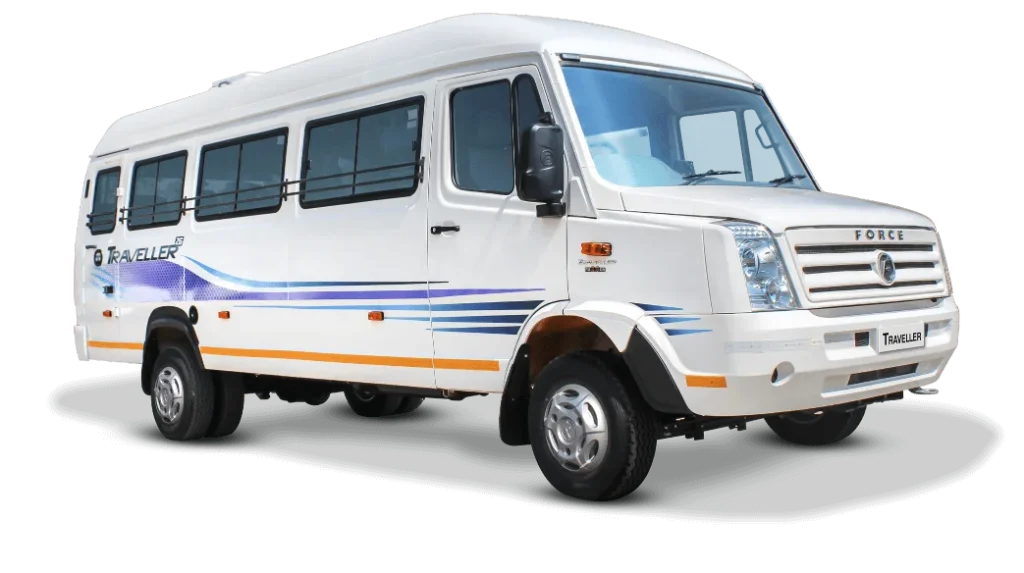
That capacity also highlights an important distinction in this list. Once passenger numbers move beyond 15, the dividing line between a van and a small bus becomes increasingly narrow. The Traveller retains its van-derived identity while carrying a crowd that would normally require several passenger cars.
- Engine: 2.6-liter common-rail turbo-diesel inline-four
- Torque: Approximately 258 lb-ft
- Horsepower: 114 hp
- Length/Width: Approximately 273.0 inches / 75.8 inches
