
Electric vehicle owners often assume charging is always cheap. That’s true at home, but public fast charging tells a different story. DC fast charging, or DCFC, is the rapid-charging technology used on highways and travel corridors. It adds range quickly, often 100 to 200 miles in twenty to forty minutes.
But that speed comes at a price. Networks like Tesla Supercharger, Electrify America, and EVgo charge a premium over home electricity rates. As of mid-2026, national gas prices are hovering near four dollars per gallon. Meanwhile, DCFC rates range from thirty to eighty-five cents per kilowatt-hour depending on the network and state.
This raises a practical question every EV shopper eventually asks. Is fast charging actually cheaper than gasoline, or just marginally so? The answer depends heavily on where you charge, which network you use, and your vehicle’s efficiency. It also depends on whether you have a membership plan or pay standard rates.
Understanding DCFC Pricing in 2026
Public fast charging is priced very differently from home electricity. Most networks charge by the kilowatt-hour rather than a flat fee. Tesla Supercharger rates run between twenty-five and fifty-five cents per kWh nationally. Off-peak hours can dip toward the lower end of that range.
Electrify America is generally the most expensive major network. Standard non-member rates run forty-three to sixty-four cents per kWh, sometimes higher in costly states.
EVgo sits in the middle of the pack. Non-member pricing typically runs thirty-four to fifty-six cents per kWh depending on location. Some high-cost states push Electrify America’s premium “Hyper-Fast” 350kW rate as high as eighty-five cents per kWh. That’s nearly five times the price of cheap residential power.
For comparison, the U.S. average residential electricity rate sits around eighteen to nineteen cents per kWh. Public DCFC is routinely two to four times more expensive than charging at home.
Membership plans can meaningfully reduce these costs. Electrify America’s Pass+ subscription advertises roughly twenty-five percent savings on the energy rate.
EVgo and ChargePoint offer similar membership tiers. Regular fast-charging users often find these subscriptions pay for themselves quickly. Still, even discounted public fast-charging rates remain well above home charging. The convenience of speed carries a real financial cost.
Averaging across networks, a reasonable 2026 blended DCFC rate is about forty-five cents per kWh. That figure will anchor our per-mile calculations in the next section.
It’s worth noting rates aren’t static throughout the day. Some networks offer cheaper overnight or off-peak pricing to shift demand away from busy hours.
Travelers who can time their charging sessions strategically may capture meaningfully lower rates. But most road-trippers charge whenever they need range, not whenever prices are lowest.
State-level variation is also significant. California and Hawaii tend to have the highest public charging costs in the country.
States with cheaper grid electricity, like parts of the Midwest and South, often pass some of that savings through to DCFC pricing. Location matters as much as network choice.
Calculating Cost per Mile: EV vs Gasoline
To compare fairly, we need efficiency numbers for both vehicle types. A typical modern EV uses about twenty-seven kWh per hundred miles. That works out to roughly 3.7 miles per kWh under normal conditions. Highway driving and fast charging losses often reduce that slightly.
At the blended DCFC average of forty-five cents per kWh, a mile costs about twelve cents. That’s the baseline figure most EV drivers should expect on road trips.
Some networks price lower, some higher. Tesla Supercharger drivers often see costs closer to eight or nine cents per mile due to lower rates. Electrify America non-members, especially in expensive states, can face fifteen to eighteen cents per mile. That’s a meaningful spread depending purely on network choice.
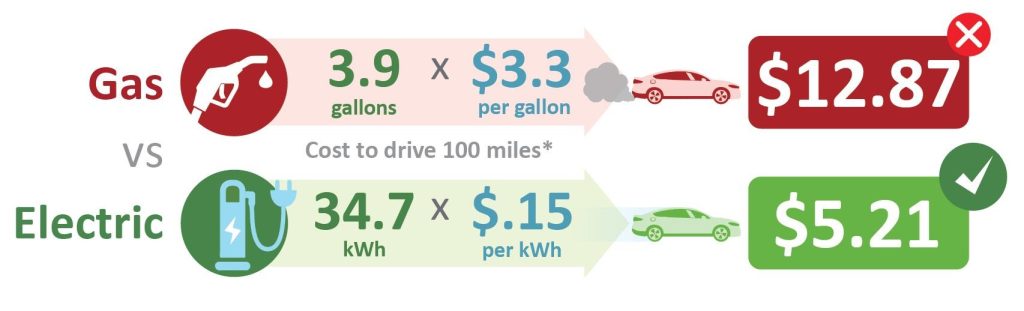
Now consider gasoline. As of late July 2026, the national average gas price is about four dollars and two cents per gallon. A typical gasoline sedan gets around thirty-two miles per gallon combined. Larger vehicles like SUVs and trucks average considerably less.
Dividing four dollars and two cents by thirty-two miles gives roughly thirteen cents per mile. That’s remarkably close to the average DCFC cost calculated above.
This is the central insight many EV buyers don’t expect. Public fast charging, unlike home charging, doesn’t always beat gasoline by a wide margin.
At current 2026 gas prices, DCFC and gasoline costs are often within a few cents of each other per mile. The gap narrows further with expensive networks or thirsty gas vehicles get better mileage.
However, the comparison shifts for less efficient gasoline vehicles. A truck averaging twenty miles per gallon costs about twenty cents per mile at four-dollar gas.
Against that baseline, even pricey DCFC sessions still look cheaper. Vehicle efficiency on both sides changes the entire equation. It’s also worth noting hybrid vehicles complicate this picture further. A hybrid sedan getting forty-five miles per gallon costs under nine cents per mile.
That actually undercuts average DC fast charging costs. In that specific matchup, gasoline can be the cheaper option per mile. The takeaway is nuanced rather than absolute. Public fast charging isn’t automatically cheaper than gas; it depends on the specific vehicles and rates being compared.
Home charging remains dramatically cheaper than both options. At nineteen cents per kWh, home EV charging costs roughly five to six cents per mile. That’s less than half the cost of typical DC fast charging. It’s also well under half the cost of most gasoline vehicles.
This is why EV ownership economics depend heavily on charging habits. Drivers who charge mostly at home see the biggest savings. Drivers who rely heavily on public fast charging see those savings shrink substantially. In some scenarios, they can vanish altogether.
Real-World Scenarios and Practical Takeaways
Let’s walk through a concrete road-trip example. A driver adds fifty-two kWh during a DC fast-charging stop. At the national blended rate of forty-five cents per kWh, that session costs about twenty-three dollars. It covers roughly one hundred ninety miles of highway driving.
The equivalent gasoline trip, using a thirty-two-mile-per-gallon sedan, needs about six gallons. At four dollars and two cents per gallon, that costs around twenty-four dollars.
The two numbers land within a dollar of each other. For this common scenario, fast charging offers only a marginal savings over gasoline. Now compare a Tesla Supercharger session at the cheaper end of pricing. The same fifty-two kWh might cost closer to eighteen dollars instead of twenty-three.
That drops the per-mile cost meaningfully below the gasoline equivalent. Network choice alone can swing the outcome from a tie to a clear EV win.
Flip the scenario toward Electrify America in a high-cost state. The same session could cost thirty dollars or more at premium ultra-fast rates. Here, gasoline becomes the cheaper option per mile. The EV driver pays more for speed and convenience, not less.
These examples show why blanket claims about EV savings can mislead. “EVs are always cheaper to fuel” is true at home, but not universally true on the road.
Drivers who frequently road-trip and rely on premium DCFC networks should budget accordingly. Their real-world savings versus gasoline may be smaller than marketing suggests.
Drivers who charge primarily at home and use DCFC only occasionally see a very different picture. Their blended average cost per mile stays much closer to five or six cents.
That’s the scenario where EV ownership delivers its strongest financial advantage. Occasional fast charging barely dents the savings. Gas price volatility also matters here. Prices in 2026 have swung from under three dollars to over four dollars a gallon within months.
When gas prices spike, as they did during recent geopolitical tensions, the EV cost advantage widens again. When gas prices fall, that advantage narrows or disappears.
Electricity rates for DCFC are comparatively more stable. They don’t swing as sharply with global oil markets or seasonal demand. This stability can be an underrated benefit for budget-conscious drivers. Predictable fueling costs make trip planning and monthly budgeting easier.
For shoppers deciding between EVs and gas cars, the honest answer is: it depends on charging habits. Home-charging-heavy owners save significantly.
Road-trip-heavy owners relying on premium DCFC networks may see costs comparable to gasoline. Neither outcome should be surprising once the math is laid out clearly.
The smartest approach combines both worlds. Charge at home whenever possible, and use fast charging only when necessary for range. Choosing cheaper networks like Tesla Supercharger over premium-priced ones also helps. Memberships and off-peak charging further reduce the gap.
Public fast charging is convenient, fast, and increasingly widespread. But convenience, as with gasoline at a busy highway station, always carries a price premium. Understanding that premium helps drivers make informed decisions. It also sets realistic expectations for EV ownership costs on the road.
Also Read: 10 Cars With Wiper Blades That Streak Before 12 Months
