Performance pickups are no longer unusual. Ford has the F-150 Raptor, Chevrolet builds powerful Silverado variants, and Ram’s own TRX pushed the boundaries of off-road performance.
Two decades ago, however, the idea of a full-size pickup challenging sports cars was almost unthinkable. Pickups were designed to tow trailers, haul construction materials, and serve as dependable workhorses, not threaten performance icons on the highway.
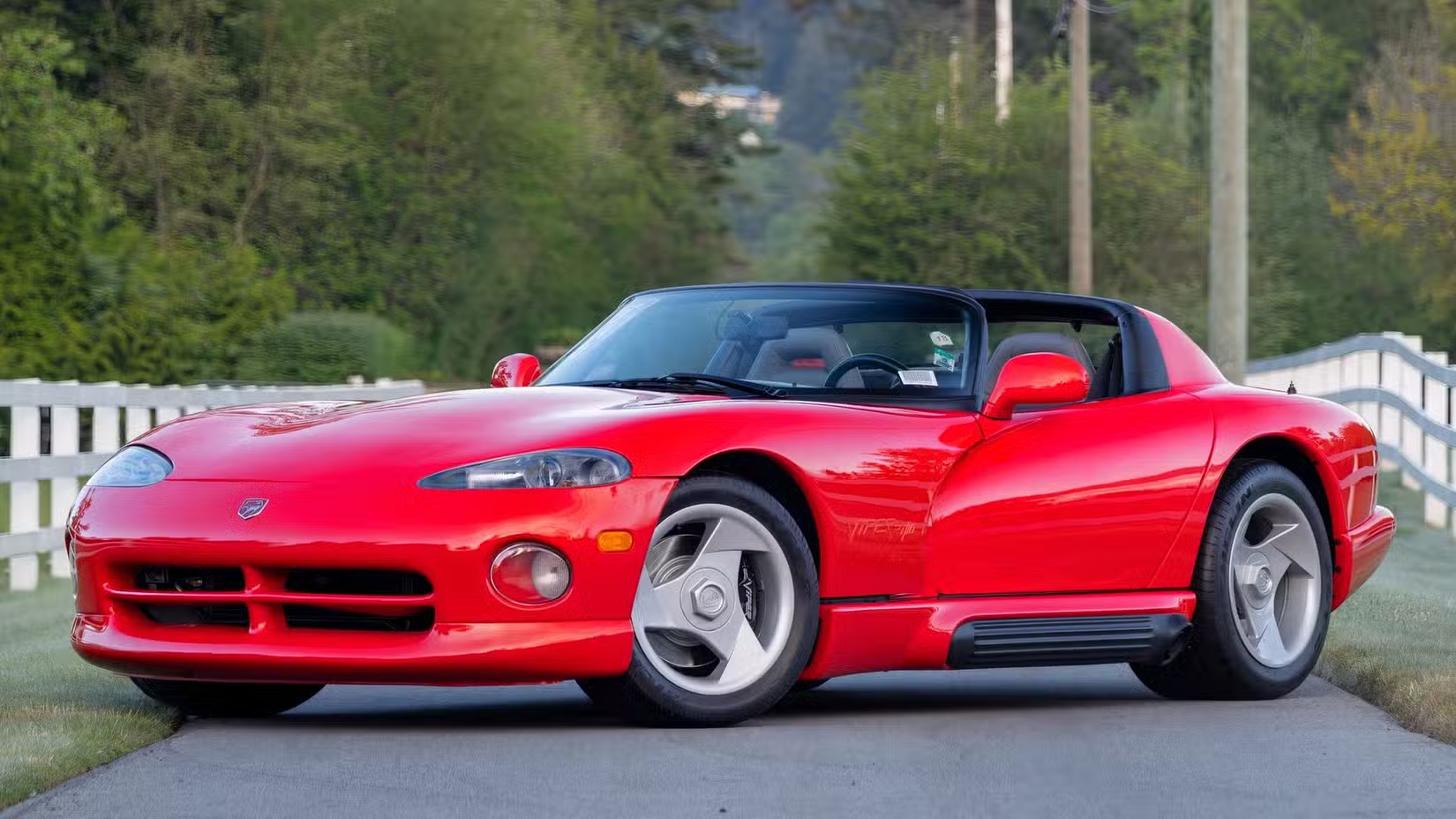
Dodge decided to change that perception spectacularly. Instead of slightly modifying an existing truck engine, engineers took the heart of one of America’s most feared sports cars, the Dodge Viper, and installed its massive 8.3-liter V10 into a regular Ram 1500. The result was the 2004 Dodge Ram SRT-10, a truck unlike anything that had come before it.
The Ram SRT-10 wasn’t built merely to generate headlines. It became the world’s fastest production pickup truck, earning a Guinness World Record after achieving a top speed of 154.587 mph (248.784 km/h) at the DaimlerChrysler proving grounds.
According to Guinness World Records and Dodge, the achievement established a new benchmark for production trucks, proving that utility vehicles could compete with performance cars in outright speed while retaining their everyday practicality.
The record immediately upgraded the Ram SRT-10 into automotive history and demonstrated Chrysler’s willingness to pursue engineering projects few manufacturers would even consider.
Also Read: Which Honda Rebel Is Worth the Money: Rebel 300 vs Rebel 500 vs Rebel 1100
Borrowing the Viper’s Heart
The Ram SRT-10’s defining feature was undoubtedly its engine. Instead of developing a new powerplant, Dodge engineers selected the 8.3-liter naturally aspirated V10 from the third-generation Dodge Viper.
Producing 500 horsepower at 5,600 rpm and 525 lb-ft of torque at 4,200 rpm, it was among the most powerful engines available in any American production vehicle during the early 2000s.
According to Dodge’s official specifications, the V10 represented a substantial increase over the standard Ram’s HEMI V8, transforming the pickup into a genuine high-performance machine.
Installing such a large engine into a production pickup required extensive engineering. The SRT engineering team strengthened the cooling system with a larger radiator and high-capacity electric fan, revised the engine mounts, upgraded the driveline, and recalibrated the electronic control systems to handle the V10’s immense output.
Suspension tuning also received significant attention. Engineers lowered the truck by approximately one inch and installed firmer springs and shocks, thicker anti-roll bars, and performance-oriented steering calibration to improve handling while maintaining acceptable ride comfort.
The truck rode on unique 22-inch forged aluminum wheels, wrapped in 305/40ZR22 Pirelli Scorpion performance tires specifically developed to handle the Ram’s speed and weight. Massive brakes featuring 15-inch front rotors and dual-piston calipers provided the stopping power necessary for a vehicle capable of exceeding 150 mph.
Unlike many performance vehicles that relied on automatic transmissions, the regular cab Ram SRT-10 came exclusively with a Tremec T-56 six-speed manual gearbox, the same transmission family used in the Viper.
That decision reinforced the truck’s enthusiast appeal, allowing drivers to fully exploit the V10’s broad torque curve.
The drivetrain sent power exclusively to the rear wheels through a limited-slip differential, creating a driving experience that demanded respect. With more than 500 horsepower available and no electronic launch control systems common on modern performance vehicles, smooth throttle application became essential.
Performance figures immediately justified Dodge’s ambitious engineering. Independent testing by Car and Driver recorded 0 to 60 mph in approximately 4.9 seconds, with the quarter mile completed in the high-13-second range despite the truck weighing well over 5,000 pounds.
Those numbers placed the Ram SRT-10 alongside contemporary sports cars rather than traditional pickups.
The truck’s soundtrack became another defining characteristic. The naturally aspirated V10 produced a deep mechanical roar unlike any other production pickup, blending the raw exhaust note of the Viper with the unmistakable presence of a large-displacement American engine. Even at idle, there was little doubt the Ram SRT-10 was something extraordinary.
The World’s Fastest Production Pickup
While acceleration impressed enthusiasts, Dodge wanted to accomplish something even more significant. The company targeted the Guinness World Record for the world’s fastest production pickup truck.
To ensure credibility, the speed attempt took place under controlled conditions at DaimlerChrysler’s proving grounds. Professional NASCAR driver Brendan Gaughan piloted the Ram SRT-10 to an officially verified 154.587 mph, establishing a new production truck speed record recognized by Guinness World Records.
That figure mattered because it wasn’t achieved using a specially modified race vehicle. The truck remained fundamentally identical to those available in Dodge dealerships, requiring only mandatory safety equipment for the record attempt.
Buyers could effectively purchase the same pickup capable of exceeding 154 mph, an astonishing claim in 2004.
Aerodynamics played an important role in reaching that speed. Engineers equipped the truck with a unique front fascia, integrated rear spoiler, revised lower air dam, and carefully shaped body components that reduced lift while improving high-speed stability.
Although the Ram’s upright shape could never match the aerodynamic efficiency of a sports car, these refinements made sustained high-speed driving possible.
The record also reflected Dodge’s broader performance philosophy during the early 2000s. Under the Street and Racing Technology (SRT) division, Chrysler was producing increasingly bold vehicles, including the Neon SRT-4, Crossfire SRT-6, Magnum SRT8, Charger SRT8, and Chrysler 300C SRT8.
The Ram SRT-10 became perhaps the most outrageous member of that family because it challenged expectations more dramatically than any other product. Its closest competitors simply couldn’t match it.
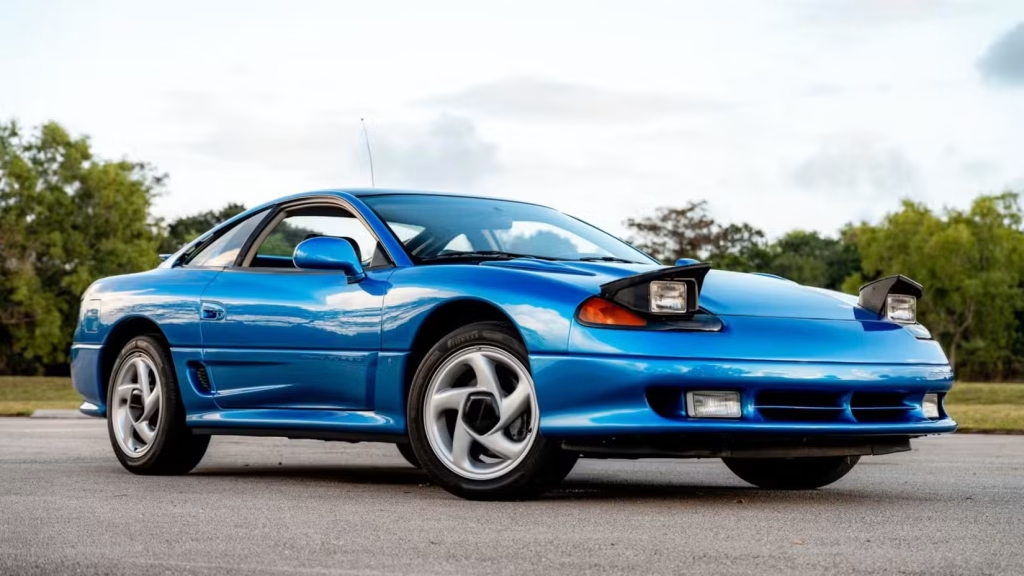
Ford’s SVT Lightning had previously demonstrated that pickups could be quick, but its supercharged V8 produced significantly less horsepower and a lower top speed than Dodge’s V10-powered flagship. Chevrolet had no comparable production truck during this period capable of challenging the Ram SRT-10’s outright performance.
More Than a Marketing Exercise
Despite its headline-grabbing specifications, the Ram SRT-10 remained a practical pickup. It retained a usable cargo bed, respectable towing capability for recreational equipment, air conditioning, comfortable seating, cruise control, premium audio options, and everyday drivability.
Buyers could commute during the week, haul motorcycles or landscaping supplies on the weekend, and still own one of the quickest production trucks ever built.
In 2005, Dodge expanded the lineup by introducing the Quad Cab version. This model added rear seating for improved practicality but replaced the six-speed manual with a 48RE four-speed automatic transmission to accommodate family-oriented buyers.
Although slightly slower than the regular cab, it broadened the truck’s appeal without sacrificing the character created by the Viper-derived V10.
Fuel economy was naturally not a priority. EPA estimates placed consumption around 9 mpg city and 15 mpg highway, figures that reflected both the truck’s size and its enormous naturally aspirated engine. Buyers understood that operating costs would be substantial, but efficiency was never the reason anyone purchased an SRT-10.
Production remained relatively limited. Dodge built approximately 10,000 Ram SRT-10s between 2004 and 2006, making the truck considerably rarer than standard Ram models.
Today, well-preserved manual-transmission regular cab examples command strong prices in the collector market, particularly those retaining original paint, factory wheels, documented maintenance records, and low mileage.
Collectors increasingly view the Ram SRT-10 as one of the defining American performance vehicles of the 2000s because it represents an era when manufacturers pursued ambitious engineering projects without worrying excessively about fuel economy regulations or electrification.
Its naturally aspirated V10, manual transmission, rear-wheel-drive layout, and uncompromising personality have become characteristics unlikely to return in modern production trucks.
The Ram SRT-10 also influenced future high-performance pickups by proving there was genuine demand for factory-built trucks capable of extraordinary speed.
While today’s performance pickups often rely on supercharging, turbocharging, advanced electronics, and sophisticated all-wheel-drive systems, the SRT-10 succeeded using straightforward engineering: install an enormous sports car engine into a full-size truck and engineer everything else to keep up.
More than twenty years after its debut, that formula remains unforgettable. The 154.587 mph Guinness World Record, the thunderous 500-horsepower Viper V10, and the sheer audacity of the project ensured the Dodge Ram SRT-10 would become far more than a novelty.
It stands as one of the boldest production pickups ever built, a vehicle that proved practicality and outrageous performance could coexist in the same machine and forever changed what enthusiasts expected from an American pickup truck.
Also Read: 8 Trucks and SUVs That Tow 10,000 Pounds Under $60,000