
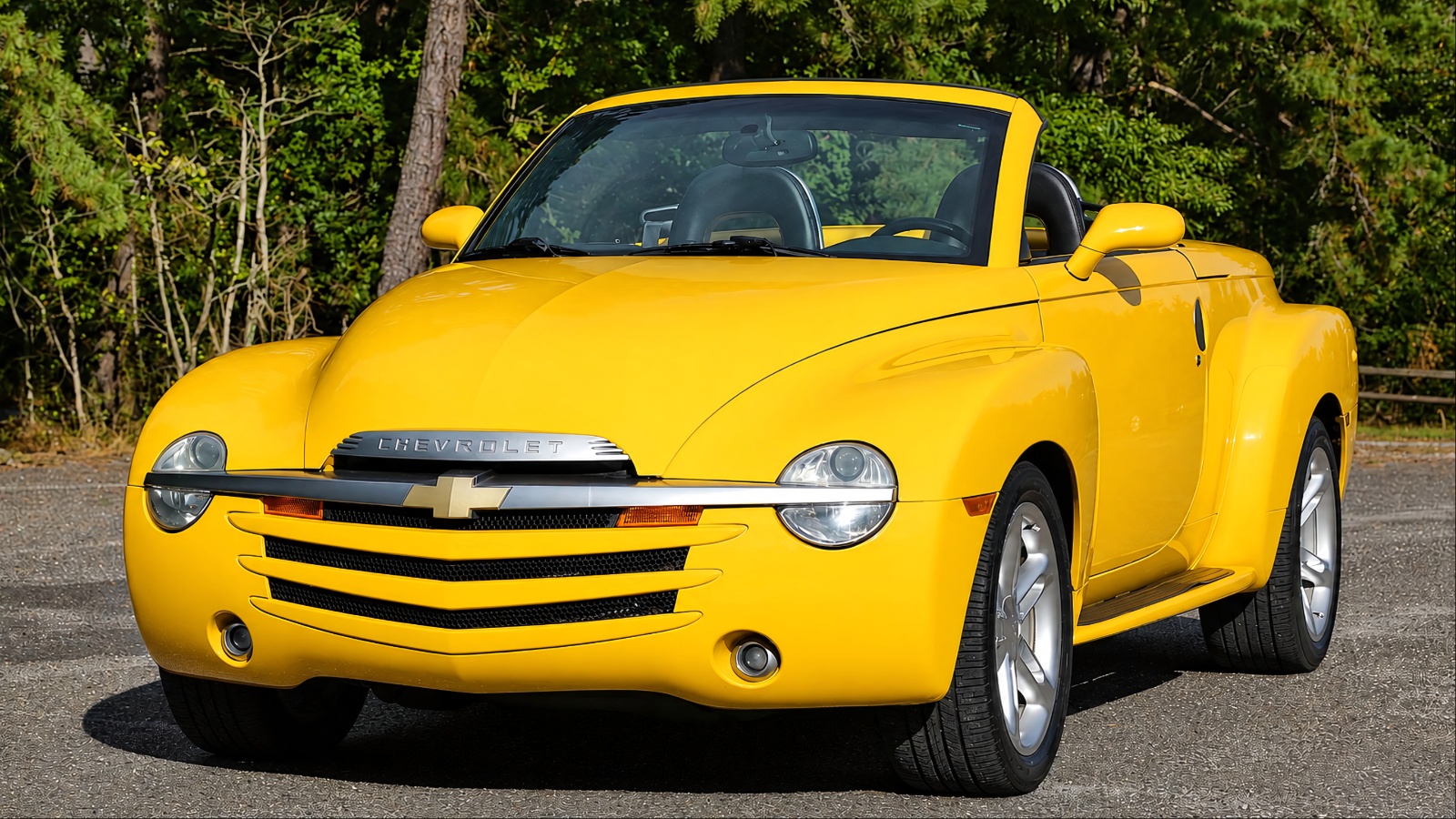
Some vehicles fail because they are badly engineered. Others fail because buyers simply cannot figure out where they fit. The Chevrolet SSR belonged largely to the second category. It was a pickup, but not really a practical truck.
It was a convertible but weighed far more than a conventional sports car. It looked like a hot rod from the 1950s, yet underneath its dramatic bodywork was a heavily modified version of General Motors’ truck hardware.
The SSR was one of the boldest products Chevrolet produced during the early 2000s. It combined a short pickup bed with a power-retractable hardtop, rear-wheel drive, and a V8 engine. Chevrolet even gave it styling inspired by the company’s historic pickups.
The concept appeared at the 2000 Detroit auto show and generated enough public interest for GM to put it into production as a 2003 model. Car and Driver noted that the production vehicle stayed remarkably close to the original concept, retaining its huge fenders and retro proportions.
But attention at an auto show did not translate into sustained showroom demand. Chevrolet eventually ended SSR production after the 2006 model year, with roughly 24,000 examples built.
Hagerty describes the SSR as a vehicle that struggled because it was too expensive and impractical for traditional truck buyers while offering little obvious reason for convertible buyers to choose a pickup instead of a conventional performance car.
A Pickup That Was Designed More for Attention Than Work
The SSR’s roots were unusual from the beginning. GM wanted to create a modern interpretation of a classic Chevrolet pickup, drawing heavily from the 1947-1955 Advance Design trucks.
Car and Driver reported that designers ultimately settled on the 1953 Chevrolet pickup as a major styling influence. The result was a vehicle with an enormous grille, rounded front fenders, a long hood, and a dramatically low windshield.
The most extraordinary feature was its roof. Instead of a conventional soft convertible top, the SSR used a power-retractable hardtop that folded behind the seats. With the roof lowered, the vehicle became a genuine open-air roadster. With it raised, the SSR looked like a miniature custom pickup.
The mechanism was impressive, but it also illustrated the vehicle’s fundamental problem. Chevrolet had invested considerable engineering effort into making the SSR something that very few customers actually needed.
The cargo bed was short and relatively limited compared with a conventional pickup. The vehicle was never intended to compete with a Silverado for hauling equipment.
GM designer Ed Welburn explained to Car and Driver that the SSR was supposed to be about driving rather than carrying large recreational equipment. GM deliberately positioned it as a unique niche vehicle rather than a traditional working pickup.
Underneath, the SSR used the hydroformed structure and suspension architecture related to the Chevrolet TrailBlazer. It was rear-wheel drive and used a solid rear axle, reinforcing the truck character beneath its roadster styling.
Car and Driver measured a 116-inch wheelbase and a curb weight of roughly 4,700 pounds for the production version. That weight became a major issue.
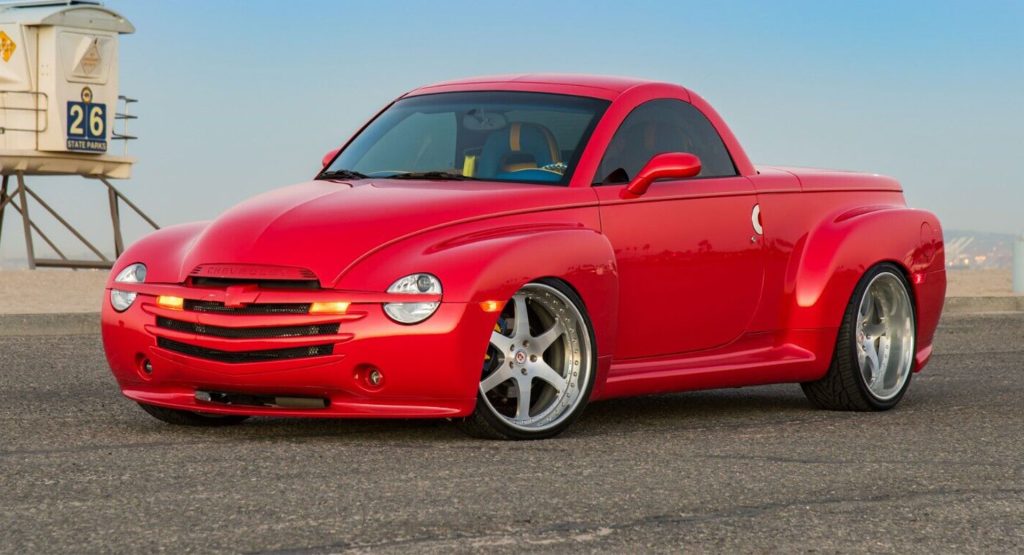
The original SSR launched with a 5.3-liter V8 producing 300 horsepower and 331 pound-feet of torque. Those numbers were respectable, but the vehicle’s mass meant it did not feel nearly as quick as its aggressive appearance suggested.
Car and Driver recorded a 0-to-60-mph time of about 7.0 seconds in its testing of the early SSR. The publication also criticized the truck’s ride and handling, noting that its substantial weight and truck-based mechanicals became apparent when the vehicle was pushed through corners.
The price made the situation worse. The 2003 SSR had an MSRP of $41,995 according to Hagerty’s valuation data, putting it firmly into expensive-toy territory.
That created an awkward sales proposition. Someone looking for a practical pickup could buy a far more capable truck for considerably less money. Someone seeking a sports car could find something lighter and faster. Someone wanting a convertible had many alternatives that offered better performance and driving dynamics.
The SSR’s biggest selling point was therefore something much harder to quantify: its ability to attract attention.
Car and Driver’s early assessment captured that problem. The publication acknowledged that the SSR had an extraordinary visual presence but questioned whether buyers would spend roughly $49,000 simply for novelty. That concern proved justified.
Car and Driver reported that Chevrolet sold 9,648 SSRs during 2004, below the company’s target of 13,000 units. By December of that year, GM reportedly had a 300-day supply of unsold SSRs. Those numbers demonstrated that the initial excitement surrounding the vehicle had not translated into the level of demand Chevrolet had expected.
Chevy Fixed the Performance, But Not the Business Case
GM did recognize one of the SSR’s biggest weaknesses and responded for 2005. The 5.3-liter V8 was replaced by the 6.0-liter LS2, the same basic engine family used in the Corvette and Pontiac GTO. Output rose to 390 horsepower and 405 pound-feet of torque.
Chevrolet also finally gave the SSR a six-speed manual transmission, addressing one of the complaints surrounding the original four-speed automatic-only setup.
The difference was substantial. Car and Driver’s 2005 test SSR reached 60 mph in 5.5 seconds, compared with approximately seven seconds for the earlier model. The publication recorded a 14.1-second quarter-mile at 100 mph, compared with 15.4 seconds at 89 mph for the 2003 version it had tested.
In other words, Chevrolet eventually produced the performance that the SSR’s appearance promised.
For 2006, the engine received another slight power increase. Hagerty lists the manual-equipped 2006 SSR at 400 horsepower and the automatic version at 395 horsepower.
By then, however, the central problem was no longer performance. It was the vehicle’s identity.
The improved SSR could accelerate seriously quickly, but it remained a 4,700-pound retro-styled pickup with a small cargo bed and a retractable hardtop. Its price remained above $40,000, placing it against cars that offered greater practicality or substantially better performance.
The SSR also arrived during a period when General Motors was experimenting heavily with retro-themed vehicles. The Chrysler PT Cruiser, Plymouth Prowler, and Ford Thunderbird were all part of the same broader fascination with bringing historic styling cues into modern vehicles.
Car and Driver later included the SSR among notable automotive flops, pointing to its combination of high price, limited practicality, and questionable market positioning.
That does not mean the SSR was a bad vehicle in every respect. In fact, the later versions became genuinely entertaining performance machines. The 390-horsepower LS2, six-speed manual, and rear-wheel-drive layout gave the final SSR a character that few other production vehicles could match.
Car and Driver’s testing showed that it could run with considerably more conventional sports cars in straight-line acceleration. The problem was that Chevrolet had created a vehicle for a customer who barely existed.
Truck buyers generally wanted towing ability, cargo capacity, utility, and value. The SSR sacrificed most of those characteristics for styling and open-air driving. Sports-car buyers wanted low weight, sharp handling, and acceleration.
The SSR offered the acceleration eventually, but its truck-derived chassis and enormous mass prevented it from delivering the agility associated with a true sports car.
Convertible buyers had another issue: the SSR cost a lot while providing only two seats and limited utility. The vehicle therefore occupied a strange space between several categories without dominating any of them.
Production ended after 2006, leaving the SSR as one of the more memorable experiments of GM’s early-2000s product era. Hagerty estimates that approximately 24,000 were built during its production run.
That relatively small production total has helped transform the SSR from an expensive curiosity into a modern collectible. It was never successful as a mainstream truck, but rarity, unusual styling, and the later LS2-powered versions have given it an appeal that the original sales numbers failed to establish.
The Chevrolet SSR is therefore a particularly interesting automotive failure because the concept itself was not necessarily the problem.
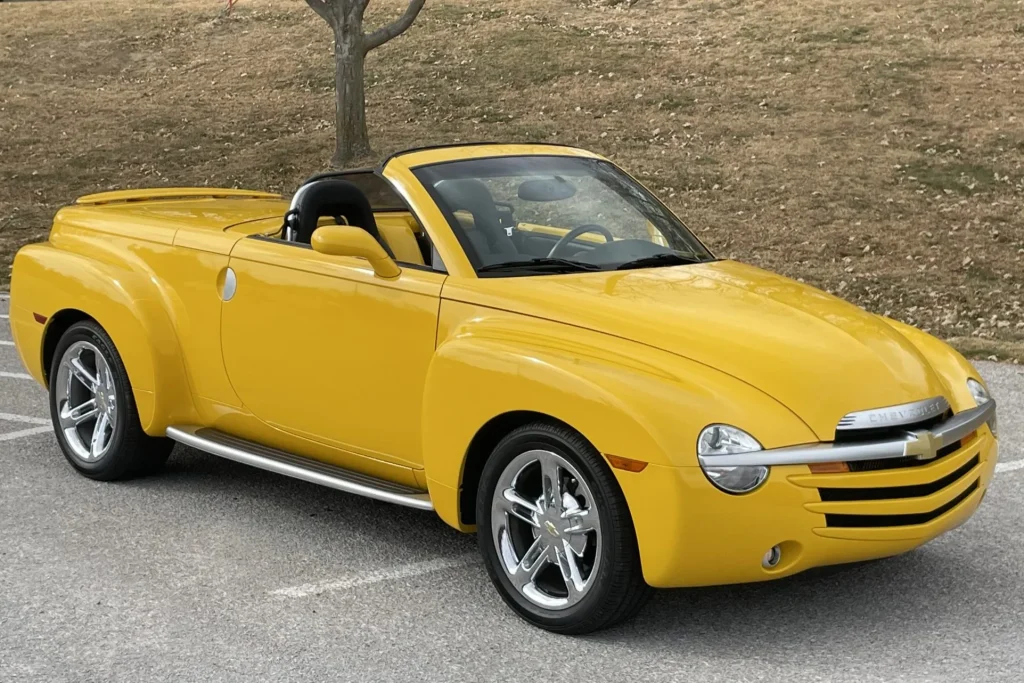
GM successfully turned an outrageous auto-show concept into a production vehicle with a functioning retractable hardtop, V8 power, and genuine pickup-bed utility. It even listened to criticism and substantially improved the engine and transmission. What GM could not fix was the fundamental question of why someone should buy it.
The SSR asked customers to pay more than $40,000 for a vehicle that was neither a capable pickup nor a serious sports car. Its greatest strength was its appearance, and that was also its biggest weakness because styling alone could not overcome the compromises built into the package.
Today, that unusual combination is exactly what makes the SSR interesting. It was excessive, impractical, and commercially unsuccessful, but it was also unmistakably Chevrolet.
Few vehicles have ever combined a pickup bed, a retractable hardtop, retro hot-rod styling, and a Corvette-related V8 in such a strange package. The SSR failed as a mass-market product, but its failure helped make it one of the most recognizable automotive curiosities of its era.
