Electric vehicles are often discussed in terms of range, charging speed, battery size, and electricity costs. One less obvious measure is how much their owners actually drive them. A new analysis from iSeeCars provides an interesting answer: electric vehicles are driven substantially less each year than conventional gasoline vehicles.
According to iSeeCars’ June 2026 study, three-year-old EVs averaged 11,880 miles per year, compared with 13,323 miles for gasoline-powered vehicles.
That puts EV annual mileage 10.8% below the gasoline average, closely matching the 11% figure in the headline. iSeeCars concluded after analyzing odometer readings from more than 2.1 million three-year-old vehicles sold in 2025.
The result is noteworthy because the difference is not simply a matter of electric vehicles being newer or representing a particular type of buyer. iSeeCars compared vehicles by drivetrain and found a clear separation between conventional hybrids, gasoline vehicles, plug-in hybrids, and fully electric models.
The numbers also reveal something more complicated about how Americans are choosing to use electrified vehicles. EVs are not necessarily replacing gasoline vehicles on a one-for-one basis in terms of driving habits.
Some electric vehicles are being used heavily, while others accumulate relatively few miles each year. That distinction becomes particularly important when looking at individual models.
EVs Are Driven Less, But the Gap Is Not the Same for Every Model
The basic numbers from the iSeeCars study are striking. Conventional gasoline vehicles averaged 13,323 miles per year, while EVs averaged 11,880 miles. Plug-in hybrids were driven even less, at 11,660 miles annually.
Conventional hybrids went in the opposite direction, averaging 14,696 miles per year, or 10.3% more than gasoline vehicles. That means the average hybrid in the study accumulated about 2,816 more miles annually than the average EV.
This creates an interesting picture of how different powertrains are being used. iSeeCars Executive Analyst Karl Brauer said the results suggest that consumers who drive a lot have increasingly embraced conventional hybrids because they can reduce fuel consumption without requiring the charging routine associated with a fully electric vehicle.
For EV owners, the lower mileage could have several explanations, although iSeeCars’ study does not establish a single cause. Electric vehicles may be particularly attractive to households that use them for commuting, local transportation, or secondary-car duties rather than long-distance travel.
Some households may also own an EV alongside a gasoline-powered vehicle, allowing the conventional vehicle to handle longer journeys.
The study’s methodology is important here. iSeeCars did not ask owners how they used their vehicles. Instead, it examined odometer readings from three-year-old used vehicles sold in 2025 and calculated average annual mileage.
That makes the data useful for measuring actual accumulated mileage, but it does not establish why one group of owners drove more than another.
The federal government’s broader vehicle-travel data provide useful context. The Federal Highway Administration reported that all light-duty vehicles in the United States averaged about 10,812 miles per vehicle in 2024, although that figure uses a different methodology and vehicle population than the iSeeCars study.
The FHWA figure should therefore not be directly substituted for iSeeCars’ three-year-old used-vehicle comparison. The individual EV results are perhaps even more revealing than the category average.
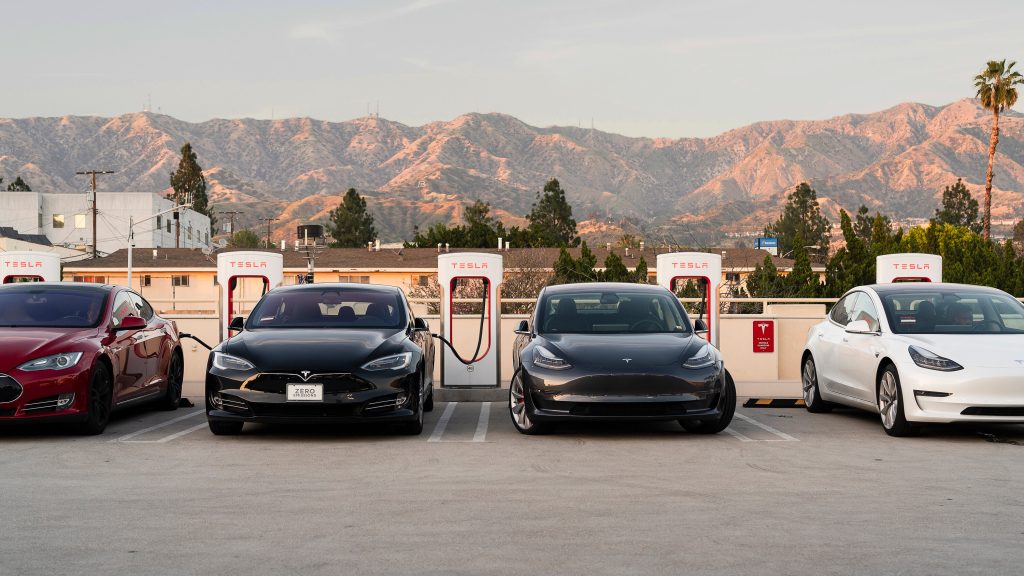
The Tesla Model 3 was the most driven EV in the iSeeCars analysis, averaging 13,759 miles per year. The Tesla Model Y followed at 13,538 miles. Both were driven more than the 13,323-mile gasoline-vehicle average, making Tesla the only EV brand with models that exceeded the gasoline benchmark in the study.
The Hyundai Ioniq 5 averaged 12,271 miles per year, while the Kia Niro EV recorded 11,879 miles, nearly matching the EV average. The Kia EV6 followed at 11,781 miles, with the Hyundai Kona Electric averaging 10,955 miles and the Ford Mustang Mach-E reaching 10,914 miles.
At the other end of the spectrum, some luxury and performance EVs accumulated considerably fewer miles. iSeeCars specifically identified models such as the Audi RS e-tron GT and Lucid Air among the least driven electric vehicles.
The study found that performance and luxury vehicles generally tend to accumulate fewer miles regardless of their drivetrain. That matters because an EV’s mileage is influenced by the type of vehicle it is, not simply by the fact that it uses electricity.
A Tesla Model 3 is a mainstream sedan that can easily serve as a primary household vehicle. A high-performance luxury EV costing substantially more may be purchased as a second vehicle, weekend car, or specialized transportation.
Comparing their odometer readings without accounting for that difference can create a misleading impression about EV ownership. The iSeeCars data therefore show a category-level pattern, but they also demonstrate that the category contains enormous variation.
Lower Mileage Could Change the Economics of EV Ownership
Driving 10.8% fewer miles has practical consequences for both operating costs and vehicle wear. An EV already avoids gasoline purchases, and driving fewer miles means its owner consumes less electricity as well.
iSeeCars’ separate 2026 fuel-cost analysis found that the average EV required approximately $725 per year in energy costs in April 2026, compared with $2,240 for gasoline vehicles. The analysis used the same broad database of more than 2.1 million three-year-old used vehicles and incorporated annual mileage into its calculations.
That means the lower annual mileage of EVs contributes to their relatively low energy bills. However, the study also found that the difference in energy costs is not caused by mileage alone. Electricity is generally much cheaper per mile than gasoline for comparable vehicles, so an EV can still produce substantial energy savings even when driven a similar distance.
The mileage difference could also influence maintenance patterns. EVs generally have fewer mechanical components associated with internal-combustion propulsion, including engine oil systems, spark plugs, and many exhaust-system components.
But fewer miles also simply mean fewer opportunities for tires, brakes, suspension components, and other wear items to accumulate use. There is another important financial implication: depreciation.
If an EV accumulates fewer miles during its early years, its odometer may be more attractive when the vehicle enters the used market. However, mileage is only one factor affecting resale value. Battery condition, age, technology changes, incentives, new-EV pricing, and consumer demand can also influence what a used EV is worth.
The fact that EVs are driven less also challenges one common assumption about electrification. It is tempting to interpret the result as evidence that EVs are unsuitable for long-distance driving, but the iSeeCars study does not establish that conclusion. The data measure how far vehicles were driven, not how far they could travel.
Modern EVs have become increasingly capable of long-distance travel, and many offer highway ranges that are sufficient for substantial road trips. A vehicle can have the capability to travel hundreds of miles between charging stops while still being used primarily for a 20-mile daily commute.
In fact, the Tesla Model 3 and Model Y figures demonstrate that some EVs are already being driven at or above the gasoline-vehicle average. Their mileage suggests that drivers are willing to use at least certain electric models as primary transportation rather than limiting them to short local trips.
The difference between EVs and hybrids is arguably the most interesting part of the research. Conventional hybrids averaged 14,696 miles annually, substantially more than both gasoline vehicles and EVs. iSeeCars interprets that as evidence that high-mileage drivers are embracing hybrids for their fuel efficiency while retaining the convenience of gasoline refueling.
That does not mean hybrids are universally a better choice. It demonstrates that buyers with different driving requirements are gravitating toward different technologies.
A driver covering 15,000 or 20,000 miles a year may value the ability to refuel quickly and eliminate range planning while still benefiting from strong fuel economy. Another driver traveling relatively few miles each year may find an EV particularly attractive because charging at home can eliminate regular trips to a gas station.
The iSeeCars study ultimately provides a useful snapshot of real-world vehicle use rather than a verdict on which drivetrain is superior. EVs averaged 11,880 miles annually, 1,443 fewer miles than gasoline vehicles, producing the reported 10.8% difference.
But the average conceals an important story. Some electric vehicles, particularly the Tesla Model 3 and Model Y, are driven more than the typical gasoline vehicle in the study. Others, particularly expensive performance and luxury models, are driven dramatically less.
That suggests the driving habits of EV owners are shaped by vehicle type, household use and personal circumstances rather than simply by the presence of a battery under the floor.
The headline therefore holds up when stated precisely: EVs in iSeeCars’ three-year-old vehicle sample were driven 10.8% fewer miles annually than comparable gasoline vehicles. The study does not show that every EV owner drives 11% less than every gasoline-car owner, nor does it prove why the difference exists.
What it does show is that electric vehicles are currently being used differently from conventional gasoline vehicles on average. And with more than two million vehicles included in the analysis, the gap is large enough to make the finding worth watching as the American EV market matures.