
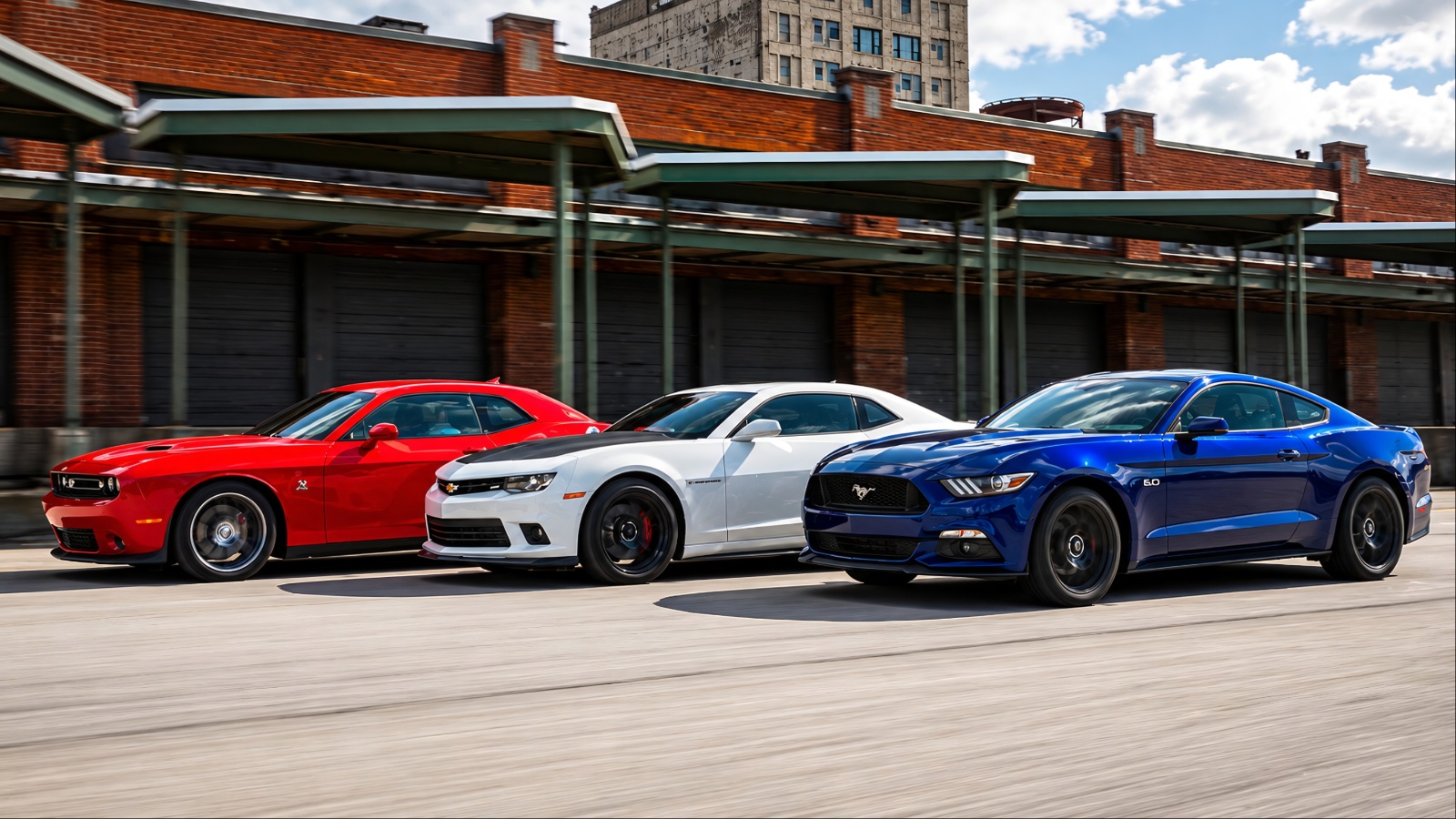
Few American performance cars have been compared as relentlessly as the Ford Mustang, Chevrolet Camaro, and Dodge Challenger.
For years, these three nameplates represented different interpretations of the same basic idea: rear-wheel drive, serious horsepower, aggressive styling, and enough practicality to make performance-car ownership possible without entering exotic-car territory.
There is one major difference in 2026. The Mustang remains in production, while Chevrolet ended Camaro production after the 2024 model year and Dodge ended Challenger production on December 31, 2023. Chevrolet officially confirmed the Camaro’s retirement, while Dodge’s Challenger is now discontinued.
That makes this comparison more interesting. The Mustang is the only one still available new, but the final Camaro and Challenger generations left behind some formidable versions.
The 2024 Mustang GT produced up to 486 horsepower, while the Dark Horse reached 500 horsepower. The final Camaro ZL1 used a supercharged 6.2-liter V8 producing 650 horsepower and 650 lb-ft of torque. The Challenger went even further, with the 2023 SRT Super Stock producing 807 horsepower.
So this is not simply a comparison of three cars from the same model year. It is a comparison of what each nameplate ultimately offered in its modern muscle-car era, while considering the Mustang’s continued production.
Performance and Engine Choices
If the only question is how much performance these cars could deliver, the Challenger has the strongest answer.
Dodge turned the final Challenger generation into a horsepower showcase. The lineup ranged from the 3.6-liter Pentastar V6 and 5.7-liter HEMI V8 to the 6.4-liter 392 HEMI and supercharged 6.2-liter HEMI V8. The range eventually culminated in the SRT Super Stock with 807 horsepower and 707 lb-ft of torque.
The Challenger was not merely powerful on paper. Dodge equipped its highest-performance models with launch control, launch assist, line lock, race cooldown, and performance pages. Widebody versions received wider wheels and tires, while the R/T Scat Pack Widebody used six-piston front Brembo brakes and adaptive damping.
The Camaro answered with a more traditional performance strategy. Its final-generation lineup included four-cylinder, V6, and V8 engines, with the Camaro SS using a 6.2-liter naturally aspirated V8. At the top sat the ZL1, whose supercharged 6.2-liter V8 produced 650 horsepower and 650 lb-ft. Chevrolet also offered the 1LE package for serious track use.
The Mustang took a different route. The seventh-generation GT uses a 5.0-liter naturally aspirated Coyote V8 producing 480 horsepower in standard form and up to 486 horsepower with the active-valve performance exhaust. The Dark Horse raises output to 500 horsepower.
Ford also retained a six-speed manual transmission for the GT and Dark Horse, while a 10-speed automatic remains available. The Dark Horse uses a Tremec six-speed manual.
The Mustang therefore has an impressive combination of modern technology and traditional V8 character. But peak horsepower changes the result.
A 500-horsepower Mustang is seriously fast. A 650-horsepower Camaro ZL1 is substantially more aggressive. An 807-horsepower Challenger Super Stock belongs in another category entirely.
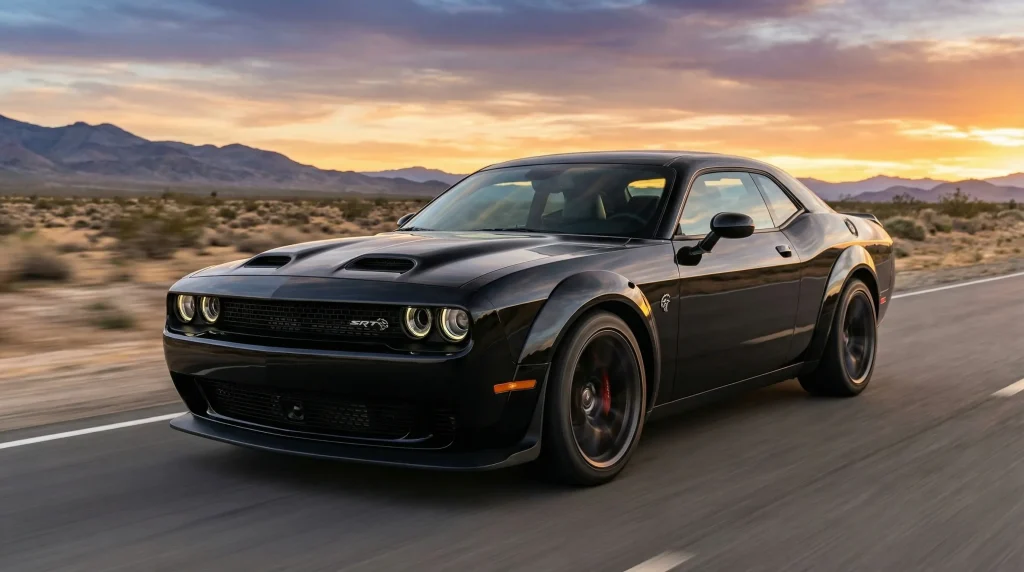
The Challenger also had something neither rival could match: an enormous range of factory power levels. Buyers could choose a relatively affordable V8 and climb the performance ladder until reaching one of the most powerful production muscle cars ever sold.
The Camaro was the sharper track weapon, and the Mustang is the only one that remains available as a new V8-powered coupe.
But for pure engine output and the sheer breadth of its performance lineup, Dodge pushed the Challenger further than either rival.
Winner: Dodge Challenger
Handling and Driving Dynamics
Horsepower tells only part of the story. Once the road begins to twist, the Camaro becomes much harder to beat.
Chevrolet engineered the sixth-generation Camaro around a lightweight architecture and sophisticated suspension. The result was a car that could feel considerably more agile than its muscular appearance suggested.
The Camaro SS was already a serious driver’s car, but the 1LE package pushed the concept much further. It added track-focused suspension tuning, larger brakes, performance tires, and other hardware designed to improve circuit performance.
At the top of the range, the ZL1 1LE became one of the most serious track-oriented American performance cars available without moving into a much more expensive category. Chevrolet described the 650-horsepower ZL1 1LE as the fastest Camaro around its Milford Road Course.
That matters because the Challenger followed a different philosophy. Dodge’s large coupe was built around straight-line performance and muscular road presence. Widebody versions improved cornering capability with wider wheels and tires, while the R/T Scat Pack Widebody received serious braking and suspension upgrades.
Yet the Challenger remained the largest and heaviest-feeling car of the three. The Mustang sits between the two.
The seventh-generation Mustang received a revised chassis, independent rear suspension, and available MagneRide adaptive damping. The GT uses a double-ball-joint front suspension and integral-link independent rear suspension, while the Dark Horse adds specialized performance hardware.
The Dark Horse was designed to give Ford a more track-oriented Mustang that could challenge the Camaro’s performance credentials. Still, the Camaro has the advantage of specialization.
Chevrolet spent the sixth generation’s life refining its chassis. The result was a car with precise steering, strong body control, and excellent balance. The 1LE packages transformed the Camaro into a machine that could handle repeated track use rather than simply deliver quick acceleration.
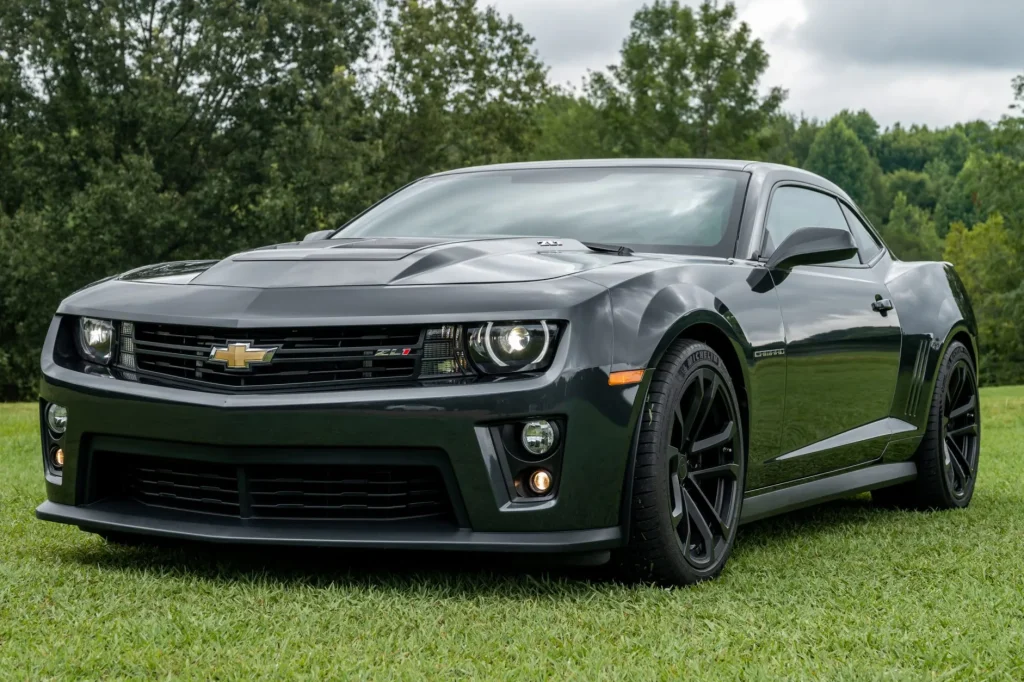
The Mustang is an excellent modern performance car, and the Dark Horse narrowed the gap considerably. The Challenger was never intended to be the ultimate cornering machine. Its mission was different.
The Camaro, however, proved that an American muscle car could be genuinely sophisticated on a demanding road course. For steering precision, chassis balance, braking confidence, and track-focused handling, the Camaro deserves the victory.
Winner: Chevrolet Camaro
Straight-Line Speed and Drag Racing
If the previous category belonged to Chevrolet, this one swings dramatically toward Dodge. The Challenger was built for drivers who wanted overwhelming power under their right foot. Dodge turned its final years into one of the most extreme horsepower battles in modern automotive history.
The 2023 Challenger SRT Super Stock produced 807 horsepower from its supercharged 6.2-liter HEMI V8. Dodge listed a 0-to-60 mph time of 3.25 seconds for the Super Stock.
Dodge also developed specialized equipment around straight-line performance. The Super Stock used drag-oriented tires, launch control, and launch assist. The system could manage wheel slip during hard launches, allowing the engine’s enormous output to be used more effectively.
The Camaro ZL1 was no slouch. Its supercharged 6.2-liter V8 produced 650 horsepower and 650 lb-ft, and Chevrolet equipped it with serious cooling hardware and Brembo brakes. The ZL1 1LE added extensive track equipment.
The Mustang is similarly impressive. The current Mustang GT produces up to 486 horsepower, while the Dark Horse reaches 500 horsepower. Ford’s 10-speed automatic allows strong launches, while the manual versions provide the traditional involvement enthusiasts want.
The Dark Horse is quick enough to satisfy almost any street driver, but its mission is broader than drag racing. The Challenger’s greatest strength was its ability to turn a stoplight into a spectacle.
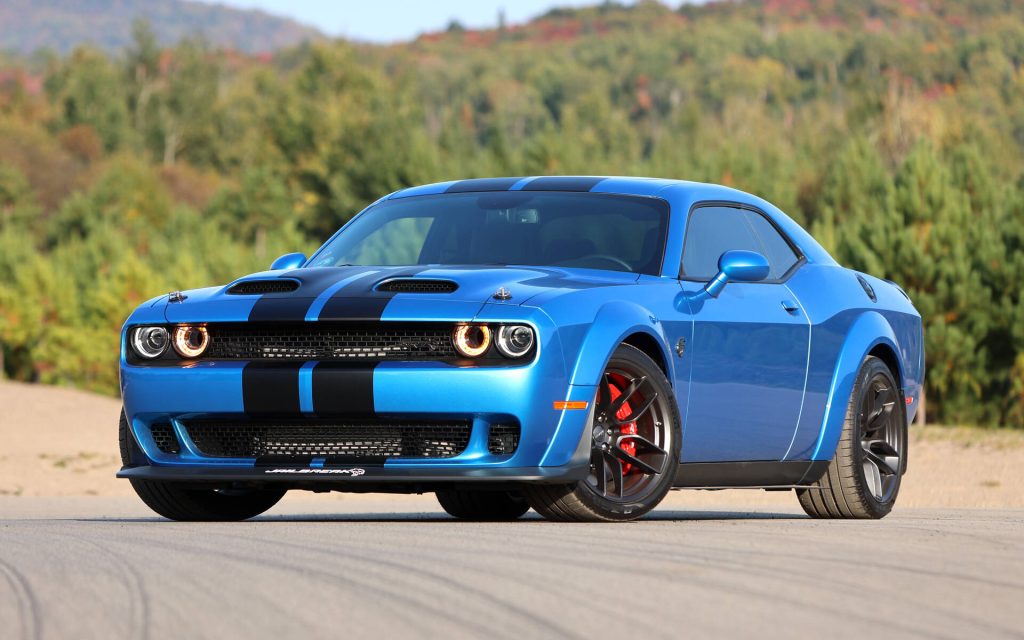
The Demon 170 took this philosophy even further, producing 1,025 horsepower on E85 and becoming a factory-built drag-racing monster. Dodge described it as a street-legal production car capable of eight-second quarter-mile performance.
The Mustang and Camaro were more balanced performance cars. The Challenger was the heavyweight knockout artist.
For drag racing, launch performance, and maximum straight-line drama, nothing in this trio matched what Dodge accomplished with the final Challenger.
Winner: Dodge Challenger
Everyday Usability and Interior Practicality
Performance cars are rarely chosen for practicality, but there is a surprisingly large difference between these three.
The Challenger has the most obvious advantage: it was designed as a genuine five-seat coupe.
Dodge marketed the Challenger as a five-passenger muscle car, giving it a rear seat that was much more usable than the cramped back seats found in many traditional sports coupes.
The Challenger also had a relatively large trunk for the segment. Its long body and traditional proportions allowed Dodge to give owners useful cargo capacity without dramatically changing the car’s styling. The Camaro took the opposite approach.
Its rear seats were extremely tight, and the low roofline and small rear opening limited practicality. Chevrolet was unapologetic about the Camaro’s priorities. It was designed first as a driver’s car, with passenger and cargo space taking a secondary position.
The Mustang has historically occupied a middle ground. The current Mustang remains a 2+2 coupe, but its rear seats are best regarded as occasional-use seating. The fastback body gives it useful cargo flexibility, while the available convertible provides an alternative for buyers who prioritize open-air driving.
The Mustang also received a significantly more modern interior in its seventh generation. Ford fitted a 13.2-inch center display and digital instrumentation, creating a cabin that feels substantially more technologically advanced than the outgoing generation.
The Camaro’s interior technology was less impressive by the end of its production run. Its 8-inch touchscreen supported wireless Apple CarPlay and Android Auto, although higher trims could be equipped with a head-up display and performance data.
That made the Camaro feel increasingly dated. The Challenger’s cabin was also showing its age, but its physical space remained a major advantage.
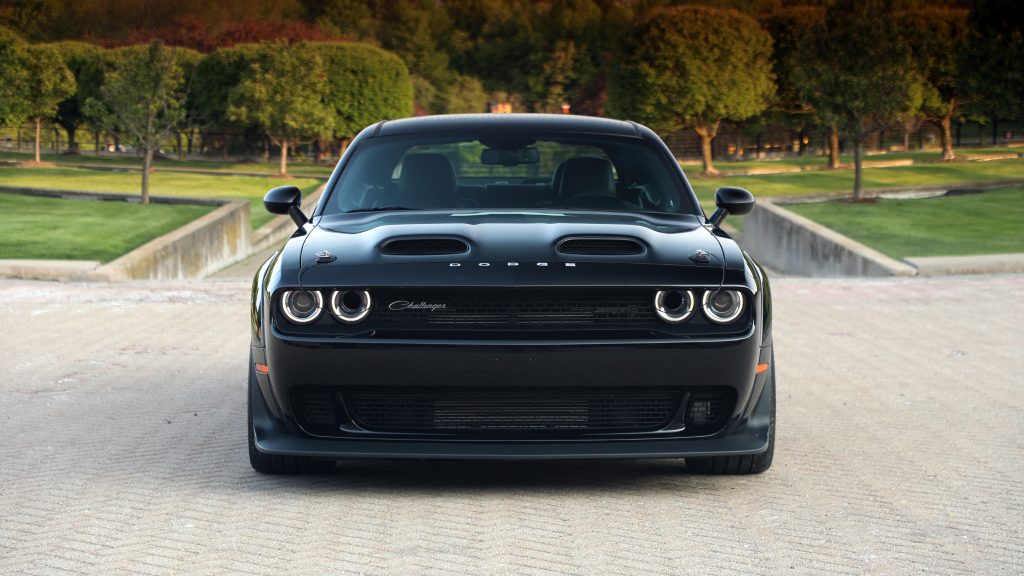
It offered more rear-seat room than either competitor and could serve as a genuine four- or five-person vehicle when necessary. That is one reason the Challenger attracted buyers who wanted muscle-car performance without giving up the ability to take passengers.
The Mustang is more modern and easier to live with from a technology perspective. The Camaro has the strongest driver-focused cockpit.
But the Challenger’s larger body allowed it to deliver something the other two could not: legitimate passenger capacity in a performance coupe.
Winner: Dodge Challenger
Technology, Features, and Modernity
This is the category where the Mustang’s continued production becomes impossible to ignore.
The Camaro and Challenger were both nearing the end of their product cycles when production ended. The Mustang, meanwhile, entered a new generation with a major technology upgrade.
The seventh-generation Mustang features a digital cockpit built around a large configurable display and a 13.2-inch center touchscreen. Ford also provides wireless Apple CarPlay and Android Auto, wireless charging, and available premium audio.
The Camaro’s technology was functional but dated by the end of its life. Its 8-inch touchscreen supported wireless smartphone connectivity, while higher-performance models could be equipped with a head-up display, performance data, and other driver-focused technology.
The Challenger faced a similar problem. Its Uconnect system remained easy to use, and its 8.4-inch screen was competitive when the platform was newer. Dodge also integrated SRT Performance Pages that could display information such as g-force, acceleration, and other performance data.
The Mustang’s modernity extends beyond its screens. The Dark Horse introduced specialized performance technology, including a six-speed Tremec manual transmission, while Ford retained multiple selectable drive modes such as Normal, Sport, Slippery, Track, and Drag Strip.
That gives drivers a wide range of ways to configure the car. The Mustang also benefits from being actively developed. Ford can continue updating software, equipment, and powertrain technology because the model remains part of the company’s current lineup.
The Camaro and Challenger are now products of the used-car market. That does not make them technologically irrelevant, but buyers have to accept designs and electronic systems that date back several years.
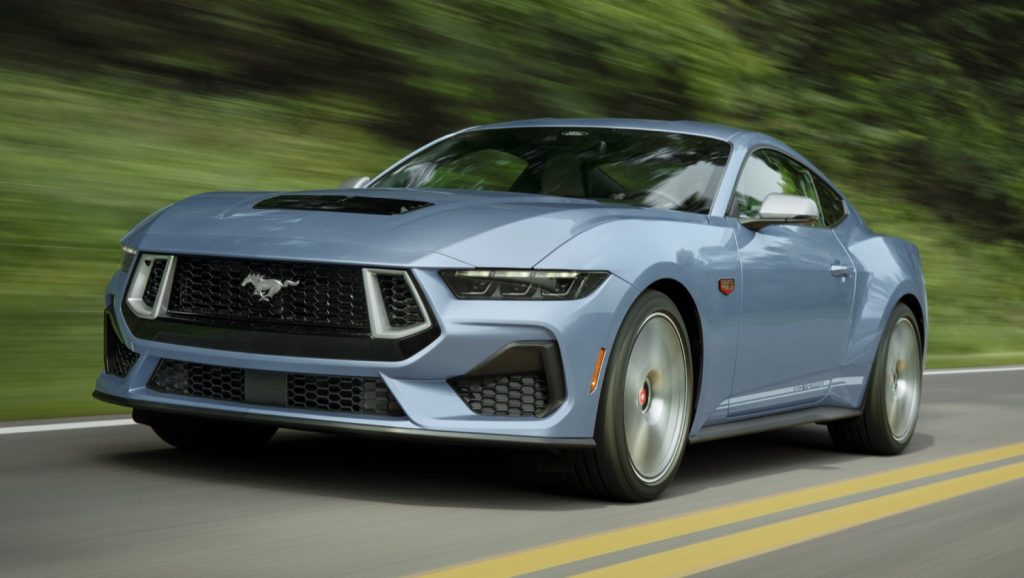
The Mustang does not sacrifice its traditional character to become modern. It still offers a naturally aspirated 5.0-liter V8, rear-wheel drive, and a manual transmission.
The Camaro’s technology was adequate for performance driving. The Challenger’s technology was simple and enthusiast-oriented.
But the Mustang has the clear advantage when comparing digital displays, connectivity, current-generation electronics, and ongoing development.
Winner: Ford Mustang
Value, Availability, and Long-Term Appeal
The final category is complicated because the three cars no longer occupy the same market position.
The Mustang is still being manufactured. The Camaro ended production after the 2024 model year, and the Challenger ended production on December 31, 2023. That immediately changes the ownership equation.
A buyer who wants a brand-new American performance coupe with a factory warranty, current technology, and a naturally aspirated V8 can still buy a Mustang GT or Dark Horse.
The same buyer cannot do that with a Camaro or Challenger. The Camaro and Challenger, however, have developed a different kind of appeal.
Because production ended, desirable examples can attract enthusiasts looking for a final-generation car. The Challenger is particularly interesting because its final years included the “Last Call” program, which commemorated the end of the HEMI-powered Charger and Challenger era.
Dodge’s final lineup included special editions and extreme models such as the Super Stock and Demon 170.
The Camaro also has collector appeal because Chevrolet officially ended the sixth-generation Camaro after 2024. The company’s final performance versions included the ZL1 1LE, which demonstrated the platform’s serious track capability.
That makes certain Camaros particularly interesting to enthusiasts. But collector appeal and everyday value are different things.
The Mustang’s ongoing production means Ford continues to support the platform, while its huge aftermarket gives owners extensive choices for parts and modifications.
The Camaro and Challenger also have enormous aftermarket communities, but future buyers are purchasing discontinued vehicles. That can be positive for rarity but makes condition, mileage, service history, and factory specification increasingly important.
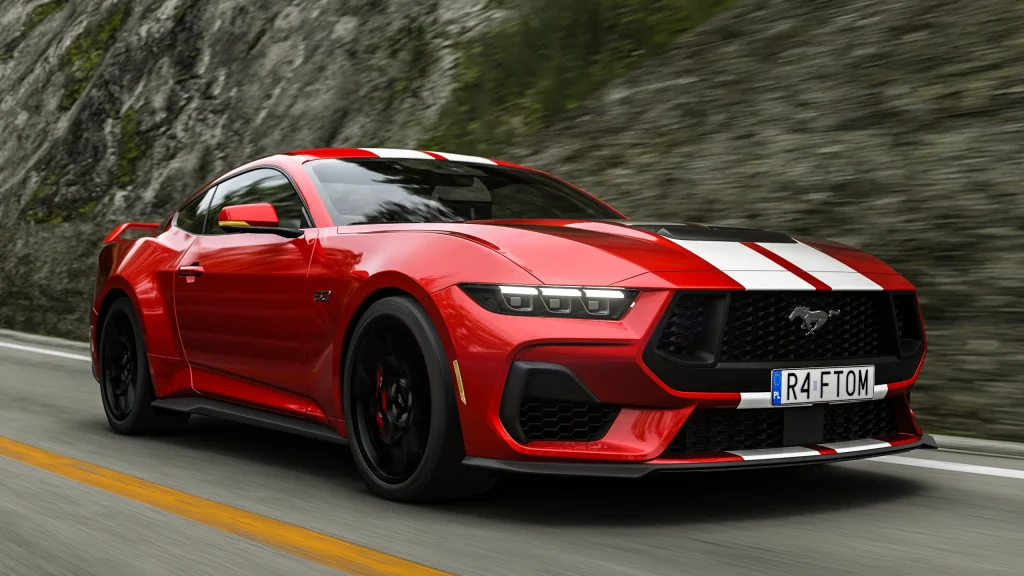
For someone seeking an investment-style collectible, the answer could change depending on the exact Camaro or Challenger version.
For someone asking which model is the safest recommendation as a performance car to own today, the Mustang is much easier to justify.
It combines current technology, modern engineering, factory support, V8 power, and an active production program.
Winner: Ford Mustang
The Mustang, Camaro, and Challenger each represent a different philosophy of American performance.
The Dodge Challenger was the horsepower king. Its final generation offered everything from a 5.7-liter HEMI to the 807-horsepower Super Stock, while the Demon 170 pushed factory output to 1,025 horsepower.
The Chevrolet Camaro was the handling specialist. The sixth-generation platform became particularly impressive in SS 1LE and ZL1 1LE form, proving that an American muscle car could be exceptionally effective on a road course. Chevrolet’s ZL1 produced 650 horsepower and received extensive cooling and braking hardware.
The Ford Mustang has the strongest modern proposition. The seventh-generation GT offers up to 486 horsepower, the Dark Horse produces 500 horsepower, and Ford retained both a six-speed manual and 10-speed automatic while adding substantially more modern technology.
Here is how the six categories shake out:
| Category | Winner | The Edge |
|---|---|---|
| Performance and Engine Choices | Dodge Challenger | Massive engine range and up to 807 horsepower made it the power leader. |
| Handling and Driving Dynamics | Chevrolet Camaro | Lightweight architecture and track-focused packages delivered exceptional cornering ability. |
| Straight-Line Speed and Drag Racing | Dodge Challenger | Super Stock power and launch technology produced extraordinary acceleration. |
| Everyday Usability and Interior Practicality | Dodge Challenger | The larger cabin and five-passenger seating made it the most usable muscle car. |
| Technology, Features, and Modernity | Ford Mustang | Newer architecture brings the most advanced displays and connectivity here. |
| Value, Availability, and Long-Term Appeal | Ford Mustang | Continued production provides new-car support, current technology, and factory availability. |
