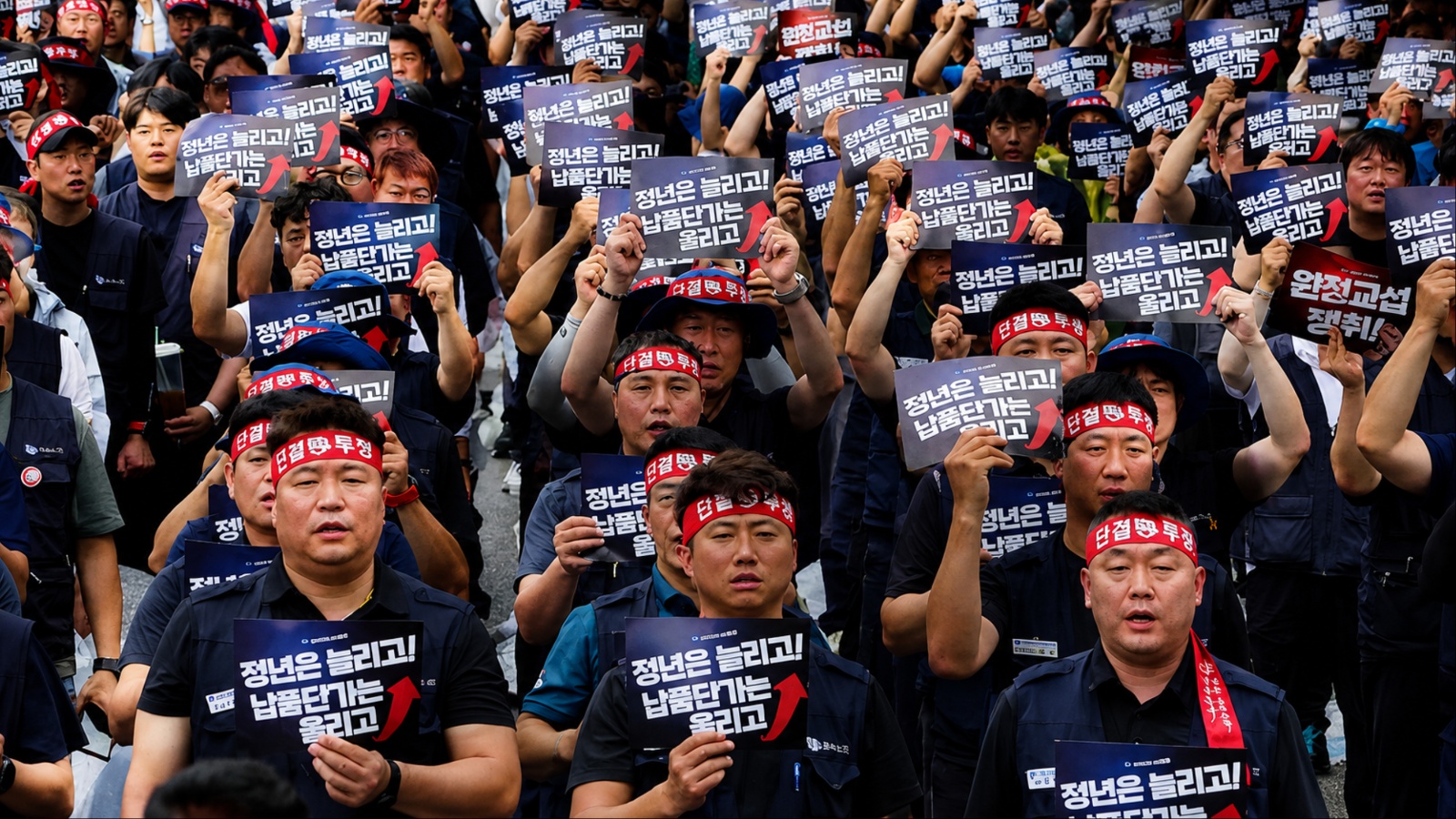
Hyundai Motor’s South Korean union has reached a tentative wage agreement with the automaker, ending a rare full-scale strike and reducing the immediate risk of further production disruptions at Hyundai’s Korean factories.
The preliminary agreement comes after a prolonged labor dispute that escalated into Hyundai’s first full strike in a decade. Workers had been pushing for higher pay and bonuses, a higher retirement age, and stronger employment protections as Hyundai accelerates the use of artificial intelligence, automation, and robotics in vehicle manufacturing.
According to Reuters, the agreement includes a 4.1% increase in base salary, a performance bonus equivalent to 400% of base pay, additional cash and bonus payments, and provisions for discussions about extending the retirement age beyond 60 if Korean law is changed. Hyundai also agreed to hire 500 new technical workers annually through 2028.
The agreement still requires approval from union members in a vote scheduled for the following Monday. Until that vote takes place, the settlement remains tentative rather than a finalized labor contract.
The deal nevertheless represents an important step toward restoring normal production at Hyundai’s Korean factories after weeks of industrial action.
Strike Exposed Growing Concerns Over Pay and Automation
The dispute developed during Hyundai’s annual wage negotiations and became increasingly contentious as workers raised concerns about how the automotive industry’s transformation could affect their jobs.
The union represents roughly 40,000 workers and has demanded higher compensation, an increase in the retirement age, and guarantees concerning employment as Hyundai increases its use of automation and artificial intelligence.
The dispute eventually escalated into partial stoppages beginning in July, followed by the first full-scale strike in 10 years on August 21. Reuters reported that the industrial action affected production of more than 55,200 vehicles, with the value of the disrupted output estimated at 2.3 trillion won, or approximately $1.67 billion, according to Yonhap News Agency.
The strike was unusual for Hyundai because the company has historically maintained relatively stable labor relations compared with some periods of intense industrial conflict in South Korea.
This year’s dispute was different because workers were negotiating over more than traditional wage increases.
Artificial intelligence and automation have become increasingly important to Hyundai’s manufacturing strategy. The company is investing in robotics and autonomous production technologies as it attempts to make its factories more efficient and adapt to the changing automotive industry.
Hyundai Motor Group owns Boston Dynamics, the robotics company known for its advanced mobile robots, and has been developing plans to introduce humanoid robots into manufacturing operations.
Reuters reported that Hyundai intends to begin deploying humanoid robots at its U.S. plant in Georgia in 2028, with broader integration across its operations planned over time. That prospect has increased concerns among Korean workers about whether automation could eventually reduce the need for human labor.
The tentative agreement attempts to address some of those concerns without preventing Hyundai from pursuing the technology it considers necessary for future competitiveness.
One of the most important provisions is the commitment to hire 500 new technical workers each year through 2028. The agreement also calls for continued discussions about job security as AI is introduced into manufacturing.
That reflects a larger challenge facing traditional automakers. Companies need to automate factories to reduce costs and improve productivity, but workers want guarantees that technological improvements will not simply eliminate existing jobs.
Hyundai Avoids More Production Disruptions
For Hyundai, the immediate benefit of the agreement is the prospect of restoring uninterrupted production at its Korean plants.
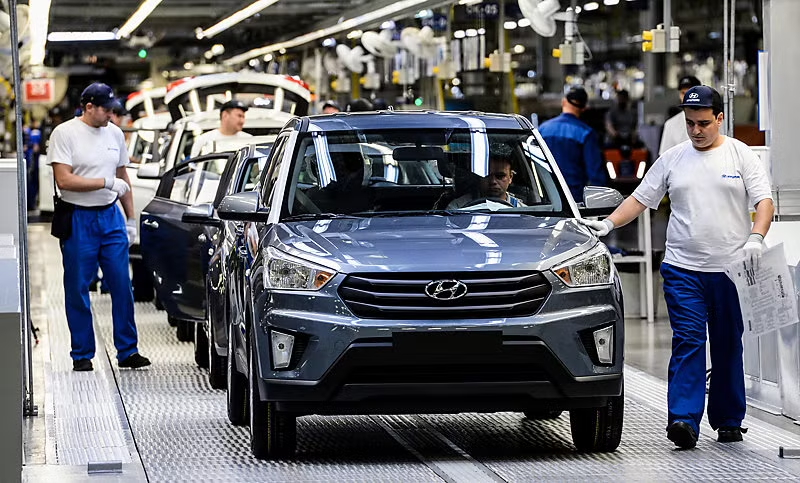
The company operates several major manufacturing facilities in South Korea, and prolonged strikes can quickly affect vehicle inventories, exports, and the wider supplier network. Hyundai’s Korean factories also produce vehicles for international markets, meaning disruptions at home can have consequences well beyond South Korea.
The agreement comes as Hyundai is attempting to expand its global manufacturing footprint while managing a major transformation in vehicle technology.
The company is investing heavily in electric vehicles, hybrids, robotics, and artificial intelligence while maintaining production of conventional vehicles. That transition requires significant capital and creates pressure to improve manufacturing efficiency.
The 4.1% base-pay increase and substantial bonus package will increase compensation costs, but avoiding a prolonged strike could be considerably more valuable if it allows Hyundai to maintain production schedules and vehicle deliveries.
The proposed retirement-age change is also significant. The agreement would allow the retirement age to move beyond the current 60 if South Korean legislation is amended. The issue is increasingly important as South Korea’s population ages and workers seek longer careers.
For Hyundai, retaining experienced employees could also help transfer manufacturing knowledge as factories become more technologically sophisticated.
The agreement does not completely resolve the issue, however. The retirement-age provision is conditional on changes to the law, meaning the actual extension cannot happen solely through the Hyundai labor contract.
The job-security provisions related to AI are similarly open-ended. Rather than prohibiting automation, the agreement creates a framework for further discussions as Hyundai introduces new technologies. That may become one of the most important aspects of future labor negotiations.
Hyundai is increasingly describing itself as a technology and mobility company rather than simply a vehicle manufacturer. Its 2026 sustainability report says the company is pursuing a transformation toward a high-technology mobility business and has established an AI governance framework alongside its electrification and robotics initiatives.
Those investments will inevitably change the type of work performed inside Hyundai’s factories.
Some repetitive manufacturing tasks can be automated, while demand should increase for employees with expertise in robotics, software, battery technology, electrical systems, and advanced manufacturing. The agreement’s commitment to hiring technical workers could therefore help Hyundai shift its workforce rather than simply reduce it.
The settlement also comes shortly after Kia, Hyundai Motor Group’s sister company, reached its own tentative wage agreement with its South Korean union.
Reuters reported that Kia’s August 25 agreement included a 100,000-won monthly base-pay increase, a performance package worth 400% of monthly wages plus an additional 12.7 million won, helping avert planned partial strikes.
The simultaneous agreements at Hyundai and Kia reduce the immediate risk of broader labor disruption across Hyundai Motor Group.
A Temporary Truce in a Changing Automotive Industry
The Hyundai agreement is important, but it should not be viewed as the end of the labor challenges created by the automotive industry’s transformation.
The union’s concerns about AI, robotics, and job security are likely to become more prominent as manufacturers deploy increasingly capable machines.
Hyundai’s investments in robotics are part of a broader industry trend. Automakers worldwide are using automation to improve factory productivity, reduce manufacturing costs, and address labor shortages. New AI-powered systems can also perform increasingly complex tasks that once required human workers.
That creates a difficult balance for companies and unions. Hyundai needs to remain competitive against automakers in China, Japan, Europe, and the United States, many of which are investing heavily in automation.
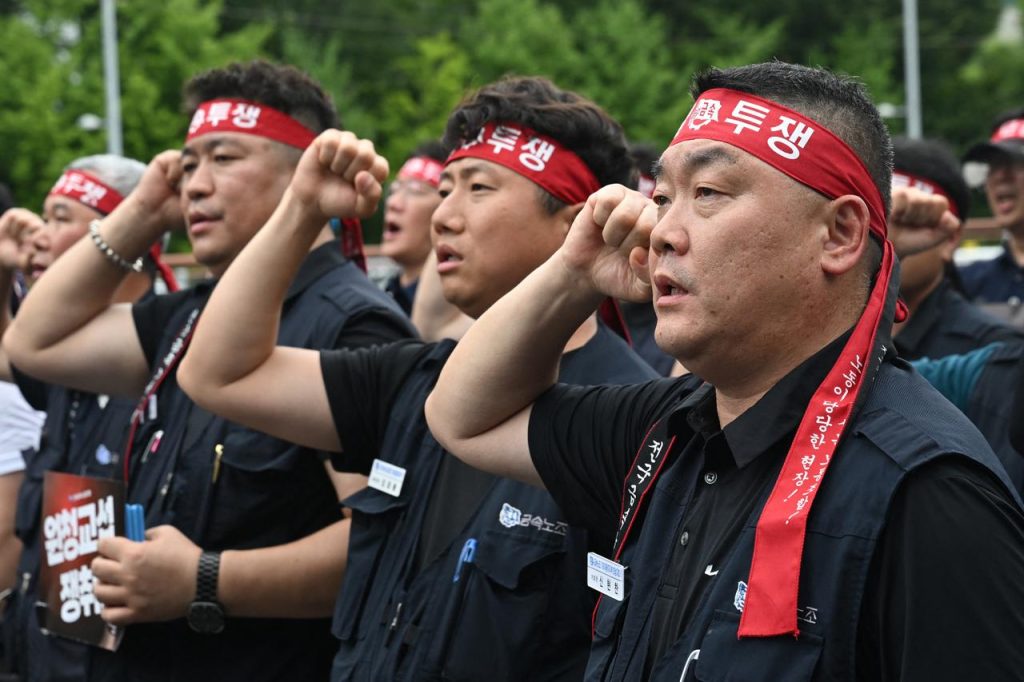
At the same time, its Korean workforce wants assurances that technological progress will not come at the expense of long-term employment.
The tentative agreement provides a compromise. Hyundai receives labor stability and retains the ability to introduce new technology, while workers receive higher compensation, additional hiring commitments, and a formal mechanism for addressing employment concerns linked to automation.
The next immediate test is the union membership vote. If workers approve the agreement, Hyundai can move beyond the strike and concentrate on production and its broader global strategy. If members reject it, the dispute could return and create another round of uncertainty for the automaker.
For now, however, Hyundai has achieved something both sides needed: a pause in the confrontation.
The agreement prevents further planned industrial action, protects Hyundai from additional near-term production losses, and gives workers concrete improvements in pay and employment protections.
More importantly, it establishes a framework for dealing with a larger question facing the automotive industry: how manufacturers can introduce AI, robotics, and automation without leaving their existing workforce behind.
That issue is unlikely to disappear when this year’s wage negotiations end. As Hyundai moves toward more automated factories and greater use of AI, it could become one of the defining issues in the company’s future labor relations.