
LED headlights are widely marketed as brighter, more efficient, and more advanced than traditional halogen systems. However, the Insurance Institute for Highway Safety says the type of lighting technology does not determine how well a headlight performs in safety testing.
IIHS takes a technology-neutral approach, judging headlights by how well they illuminate the road and how much glare they create for other drivers. LED, high-intensity discharge, and halogen systems can all earn good or poor ratings depending on their design and performance.
This means consumers should not assume that newer lighting technology automatically provides better nighttime visibility. Factors such as headlight design, aiming, beam pattern, and system performance have a greater impact than the type of light source.
IIHS began evaluating headlights in 2016 after finding major differences in nighttime illumination. Performance has improved considerably since then. In 2016, only about 1% of tested systems earned a Good rating, while 62% received a Poor rating. By 2025, 51% earned Good ratings, and just 10% were rated Poor.
The improvement shows that better engineering, rather than a specific bulb technology, has played the biggest role in improving headlight performance.
IIHS Judges’ Performance, Not the Bulb Type
Headlight technology has changed significantly over the past several decades. Halogen systems were once standard across much of the industry, followed by high-intensity discharge systems and, increasingly, LEDs.
LEDs have become common because they offer design flexibility, lower energy consumption, and compatibility with advanced lighting functions. But none of those characteristics automatically earns a favorable IIHS rating.
The organization evaluates headlights based on actual performance, rather than assigning an advantage to one technology. IIHS measures illumination along straightaways and curves using low and high beams. It also evaluates glare created for drivers approaching from the opposite direction.
A headlight can therefore use modern technology and still perform poorly if its beam pattern does not adequately illuminate the roadway.
The opposite is also possible. An older system can perform better if it has an effective beam pattern and proper aiming.
This is important because a headlight’s purpose is not simply to generate large amounts of light. The beam needs to illuminate the areas where the driver needs visibility without unnecessarily shining into another driver’s eyes.
IIHS uses four ratings to assess these measurements, which are Good, Acceptable, Marginal, and Poor. The results show that advanced safety technology does not always translate into a strong final rating.
The long-term improvement has nevertheless been substantial. When IIHS introduced its ratings, 82% of tested systems were Marginal or Poor. For 2025 models, only about 16% fell into those categories.
The market has therefore become much better at producing effective headlights, but significant differences remain between individual vehicles.
That is why buyers should look beyond descriptions such as “full LED,” “projector headlights,” or “adaptive lighting.”
Why LED Does Not Automatically Mean Better Visibility
One of the biggest misconceptions surrounding modern headlights is that LED automatically means superior nighttime illumination.
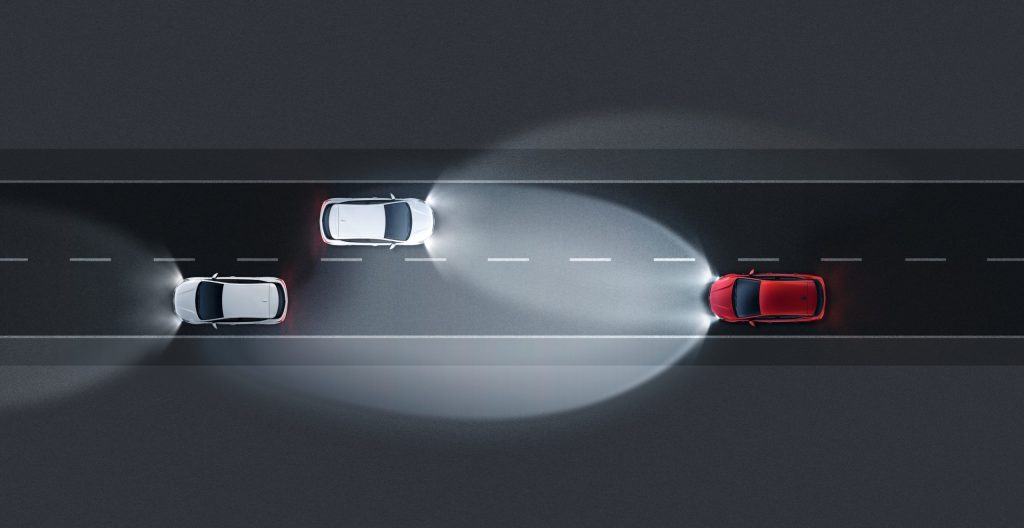
LEDs offer several engineering advantages. They are compact, can be arranged into precise patterns, and can be controlled individually in sophisticated adaptive systems. Their low energy consumption also makes them well suited to modern vehicles.
However, those advantages only become meaningful when the complete system is properly engineered.
The housing, lens, reflectors or projectors, beam shape, mounting height, and aiming all influence where light reaches the road.
An LED system with an ineffective beam pattern can therefore provide worse visibility than a well-designed halogen system.
IIHS has found poor and marginal systems among different lighting technologies, demonstrating that there is no automatic relationship between the light source and the safety rating.
This also explains why two vehicles equipped with LED headlights can receive very different ratings.
Manufacturers frequently develop different lighting systems for different trims. A base model may use a relatively simple LED projector, while an expensive version may receive a more sophisticated adaptive system. Both may technically use LEDs while producing different nighttime performances.
IIHS reported that manufacturers reduced the number of headlight systems available for individual vehicle models by 17% between 2019 and 2021, with more companies moving toward a single system capable of delivering stronger performance across the range.
That can benefit consumers because safety performance becomes less dependent on purchasing an expensive trim.
Headlight aiming is another important factor. A system can produce plenty of light but still fail to illuminate the road properly if the beam is aimed incorrectly. A beam aimed too high can also increase glare for other drivers.
IIHS’s testing therefore considers both visibility and glare. The organization says glare has become less common as manufacturers have improved headlight designs. For 2026 model-year vehicles, only 5% of tested systems had excessive glare, compared with 21% in 2017.
That improvement has occurred as LED systems have become more widespread, but it should not be interpreted as proof that LEDs themselves solved the glare problem. Better engineering did.
The same principle applies to nighttime visibility. IIHS research found that vehicles with Good-rated headlights experienced 19% fewer nighttime single-vehicle crashes than vehicles with Poor-rated headlights. Good-rated systems were also associated with 23% fewer nighttime pedestrian crashes.
Those findings show why the rating matters more than the technology label. A driver needs to see a pedestrian, animal, stopped vehicle, or road hazard early enough to react. Whether the light comes from a halogen bulb or LED is less important than whether the beam actually illuminates the hazard.
Better Technology Helps, But Testing Still Matters
The progression of IIHS ratings demonstrates how much the industry has improved headlight performance.
In 2016, only approximately 1% of tested systems were good, while 62% were poor. Another 19% were marginal and 18% acceptable.
For 2025 models, the results looked very different. About 51% earned a Good rating, while 33% were rated Acceptable, 6% Marginal, and 10% Poor. In total, 84% of the tested systems received either a Good or Acceptable rating.
The latest 2026 data show 46% are good-rated systems, while approximately 17% are marginal or poor. Although the distribution changes from year to year, the long-term improvement remains substantial.
Manufacturers have improved beam patterns, aiming systems, and automatic high-beam technology. Automatic high beams can help drivers use stronger illumination more consistently by switching between high and low beams when other vehicles are detected.
Adaptive headlights can go further by changing the direction or distribution of light as the vehicle turns. Matrix-style systems can selectively dim portions of the beam to maintain high-beam illumination without shining directly at another vehicle.
These technologies have significant potential, but IIHS still judges the finished system according to measured performance.
That technology-neutral approach helps keep the ratings relevant as lighting technology continues to evolve. Whether a vehicle uses halogen, LED, HID, or advanced adaptive systems, the key question remains the same. How well does the system light the road while minimizing glare for other drivers?
That makes IIHS testing particularly useful for consumers. A vehicle buyer should treat “LED” as a description of the lighting technology, not a guarantee of safety performance.
The same applies to terms such as “adaptive,” “projector,” “automatic high beam,” and “premium LED.” These features may be beneficial, but none automatically means the headlights will receive a Good IIHS rating.
The actual rating provides a more reliable comparison. There is also an important distinction between brightness and useful illumination. A headlight can appear extremely bright to another driver while providing relatively poor visibility for the vehicle using it.
A well-designed system can provide strong forward illumination while controlling the beam so approaching drivers are not excessively exposed to glare.
That is why IIHS evaluates the pattern of illumination rather than simply measuring how bright a headlight appears.
The data support this approach. The dramatic improvement from 1% Good-rated systems in 2016 to 51% in 2025 shows that headlight performance can improve substantially when manufacturers focus on measurable results. Yet the continued presence of poor systems proves that newer technology alone is not enough.
For consumers, the takeaway is straightforward. An LED system is not automatically better, and a halogen system is not necessarily worse.
When choosing a vehicle, independent headlight ratings are more useful than the type of bulb listed on the specification sheet. A well-designed halogen system can outperform a poorly engineered LED system, while a sophisticated LED or adaptive system can provide excellent visibility when properly designed and aimed.
The broader trend is encouraging. Most new vehicles now have headlights that perform considerably better than those tested when IIHS began its program.
But the remaining differences still matter because nighttime visibility has a direct connection to crash risk.
IIHS research shows that good-rated headlights are associated with fewer nighttime crashes and fewer nighttime pedestrian crashes than poor-rated systems. That makes headlight performance a genuine safety consideration rather than merely a matter of styling or convenience.
The most accurate way to judge modern headlights is therefore not by asking which technology they use, but by asking how effectively that technology illuminates the road. That is precisely what IIHS’s technology-neutral testing is designed to measure.
