Some motorcycles are built to feel light, agile, and almost effortless to move. Others take a very different approach. They pack enormous engines, large fuel tanks, touring equipment, audio systems, luggage, substantial frames, and passenger-focused hardware into one machine.
The result can be a motorcycle weighing well over 800 pounds before the rider even climbs aboard. For this list, the focus is on production motorcycles with documented U.S. specifications, using ready-to-ride or curb weight where manufacturers provide it.
Because manufacturers use different terminology for weight, the figures are not always directly identical. Still, these motorcycles demonstrate just how massive a road-going two-wheeler can become.
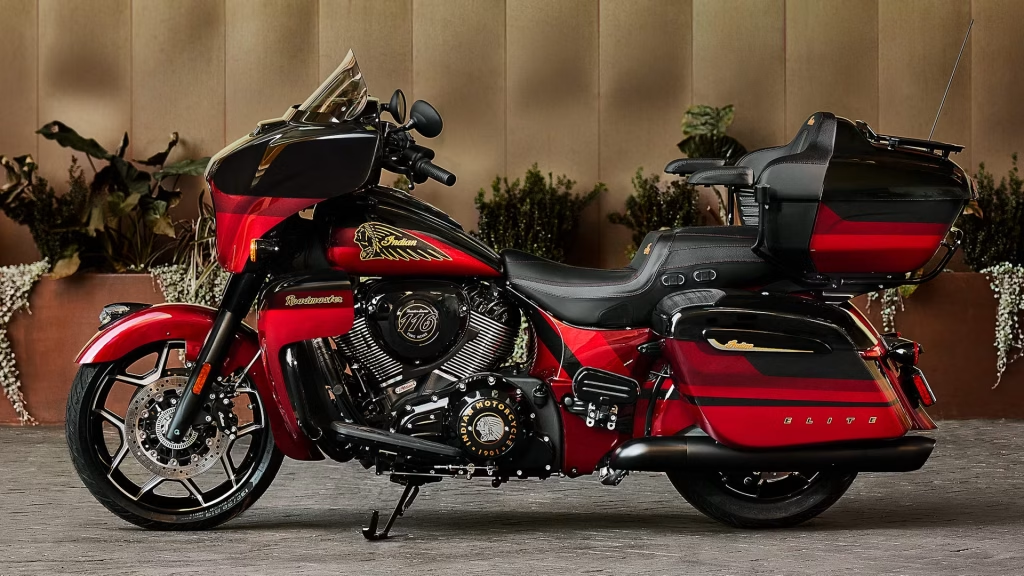
1. Indian Roadmaster
The Indian Roadmaster is not merely a large touring motorcycle. Its factory specifications put it firmly into heavyweight territory. The 2025 Roadmaster is listed by Indian Motorcycle at 919 pounds, including the equipment associated with the production touring machine.
That figure puts it substantially above many conventional cruisers and even some full-size touring motorcycles.
A major reason for that mass is the Roadmaster’s mission. This motorcycle is designed for long-distance travel rather than minimalism. It carries a large fairing, saddlebags, passenger accommodations, touring electronics, and a substantial fuel capacity.
Indian pairs those features with its 116-cubic-inch Thunderstroke V-twin, a large air-cooled engine producing 126 lb-ft of peak torque.
That weight changes the character of the machine. At highway speed, a substantial motorcycle can feel planted, particularly when carrying luggage and a passenger. At parking-lot speeds, however, 919 pounds demands deliberate control.
Riders need to think about where they stop, how much steering input they use, and how they position the motorcycle before putting a foot down.
The Roadmaster also demonstrates why curb or running weight is more meaningful than engine displacement alone. A motorcycle can have a huge engine without being among the heaviest production bikes, while a fully equipped touring model can add hundreds of pounds through its chassis, bodywork, luggage, and equipment.
For riders who prioritize interstate comfort and passenger capability, that mass is part of the package rather than simply a disadvantage.
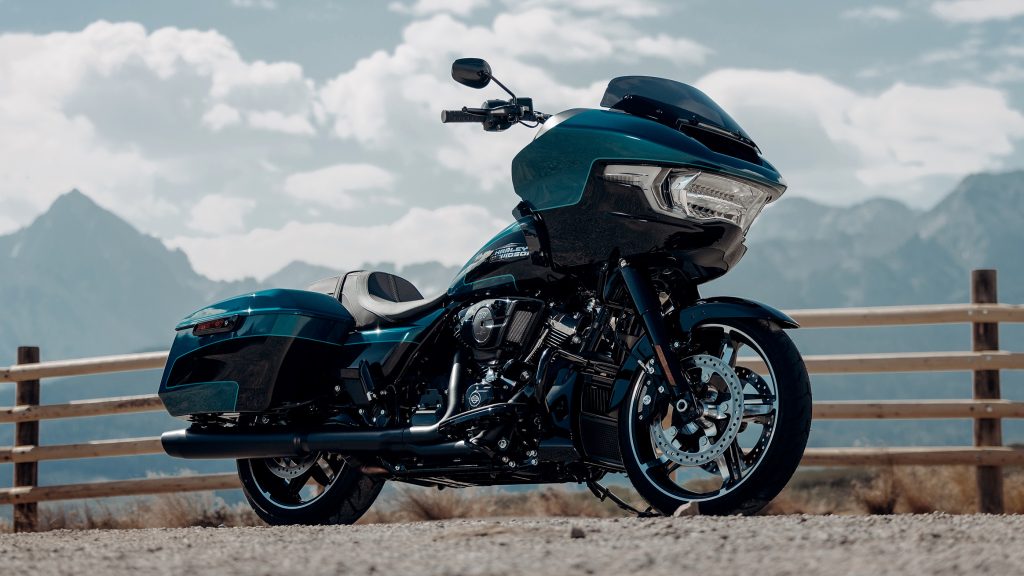
2. Harley-Davidson Road Glide Limited
Harley-Davidson’s Road Glide Limited takes heavyweight touring to another level. Its published running-order weight is 919 pounds, placing it in the same extreme-weight class as the Indian Roadmaster.
The important detail is that Harley’s figure represents the motorcycle in running order, so it accounts for the equipment and operating fluids that make the number meaningful for a rider preparing to use the bike.
The Road Glide Limited is designed around long-distance travel. Its large fixed fairing, saddlebags, top case, passenger accommodations, and touring-oriented chassis all contribute to the machine’s substantial mass. A 22.7-liter fuel capacity also means the motorcycle is built to carry a considerable amount of fuel for extended rides.
Power comes from Harley-Davidson’s Milwaukee-Eight 117 V-twin. The 1,923 cc engine produces 107 horsepower and 175 Nm of torque, equivalent to about 129 lb-ft. That combination gives the motorcycle substantial low-speed pulling power despite its enormous size.
The sheer number on the scale becomes most noticeable away from the highway. Once rolling, the chassis, suspension, and steering geometry are designed to make the motorcycle manageable.
Maneuvering it into a tight parking space is a different proposition. A rider has to respect the machine’s momentum because a 919-pound motorcycle does not change direction or stop like a lightweight standard bike.
The Road Glide Limited shows why modern touring motorcycles can become so heavy. Manufacturers are not simply adding weight for its own sake. They are combining large engines with weather protection, luggage, passenger comfort, electronics, and long-distance equipment.
For riders who regularly cross states rather than simply commute across town, that massive footprint can make considerable sense.
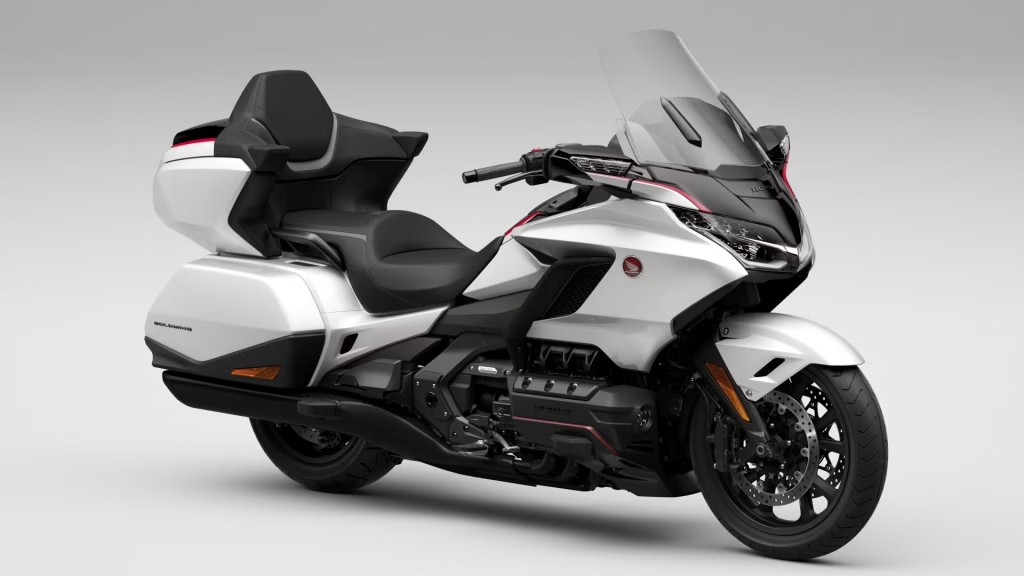
3. Honda Gold Wing Tour
The Honda Gold Wing Tour is one of the clearest examples of how far a production motorcycle can go when comfort takes priority over low weight. Honda lists the 2025 Gold Wing Tour at 845 pounds in curb weight, a figure that includes standard equipment, required fluids, and a full 5.5-gallon fuel tank.
That number is significant because the Gold Wing is not simply a large cruiser with a big engine. Honda built it as a complete long-distance touring platform. It carries integrated saddlebags, a rear trunk, passenger equipment, advanced suspension, and substantial bodywork.
Honda says the saddlebags provide 60 liters of storage while the trunk adds another 61 liters, giving the motorcycle 121 liters of integrated luggage capacity.
Power comes from a 1,833 cc liquid-cooled horizontally opposed six-cylinder engine. The flat-six layout is one of the Gold Wing’s defining mechanical features, giving the motorcycle strong power delivery while keeping the engine relatively low in the chassis.
Honda pairs it with either a six-speed manual transmission or a seven-speed dual-clutch transmission, depending on configuration.
The Gold Wing’s weight becomes most noticeable during slow maneuvering. Honda addresses that challenge with reverse and walking mode functions on equipped versions, features specifically intended to make moving the large motorcycle around at low speeds easier.
On the highway, however, its mass becomes part of the touring formula. The substantial chassis, long wheelbase, and full bodywork are designed around stability and rider comfort rather than lightweight handling.
4. BMW K 1600 Grand America
BMW’s K 1600 Grand America proves that a motorcycle does not need a huge V-twin to become exceptionally heavy. BMW lists the 2025 model at 809.1 pounds in road-ready, fully fueled condition. That specification includes all fluids, standard equipment, and at least 90 percent of usable fuel capacity, making it a particularly useful real-world figure.
The motorcycle’s weight comes with an impressive mechanical package. At its center is a 1,649 cc oil- and water-cooled inline six-cylinder engine producing 160 horsepower at 6,750 rpm and 132.7 lb-ft of peak torque at 5,250 rpm. BMW sends that power through a six-speed transmission and shaft drive.
This is not simply a motorcycle made heavy by oversized bodywork. BMW packs sophisticated suspension, electronic controls, luggage, and touring equipment into the K 1600 Grand America. Standard equipment includes side cases, a top case, heated grips, heated seats, Dynamic ESA electronic suspension, and a 10.25-inch color TFT display.
Its dimensions reinforce the machine’s substantial presence. BMW lists a 100.8-inch length over the top case and a 39.4-inch width including the side cases. The fuel tank holds approximately 7 gallons, providing considerable range but also adding weight when filled.
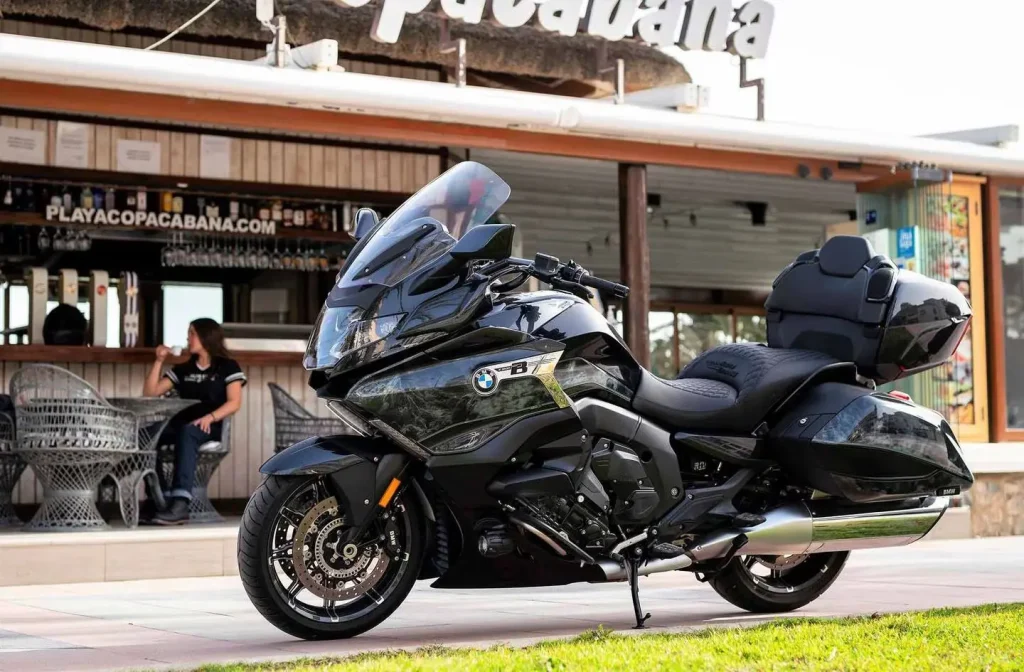
Despite its mass, BMW engineered the Grand America with several features intended to make low-speed operation easier, including Reverse Assist. That matters because 809 pounds becomes very different when the motorcycle is stationary than when it is traveling down an open highway.
The K 1600 Grand America demonstrates that heavyweight touring can combine substantial mass with sophisticated chassis technology and serious performance.
5. Indian Pursuit Limited
If sheer size is the goal, the Indian Pursuit Limited belongs near the top of the conversation. Indian Motorcycle lists the 2025 Pursuit Limited at 937 pounds in running order, including its operating fluids and approximately the standard fuel load.
That makes it heavier than many compact cars and firmly establishes it as one of the largest production motorcycles available in the United States.
The weight is easier to understand once the motorcycle’s purpose becomes clear. The Pursuit is a full-dress touring machine with a large fairing, integrated luggage, passenger accommodations, and substantial electronic equipment.
It also carries a 6.0-gallon fuel tank, so the machine is designed to remain comfortable and capable over long highway distances rather than prioritize minimum mass.
Power comes from the Indian’s 108-cubic-inch PowerPlus V-twin. The liquid-cooled engine produces 122 horsepower and 128 lb-ft of peak torque at 3,800 rpm. That output gives the Pursuit enough muscle to move its substantial mass without making the motorcycle dependent on extremely high engine speeds.
Its dimensions reinforce the scale. Indian lists the motorcycle at 101.5 inches long and 41.9 inches wide, with a 65.7-inch wheelbase.
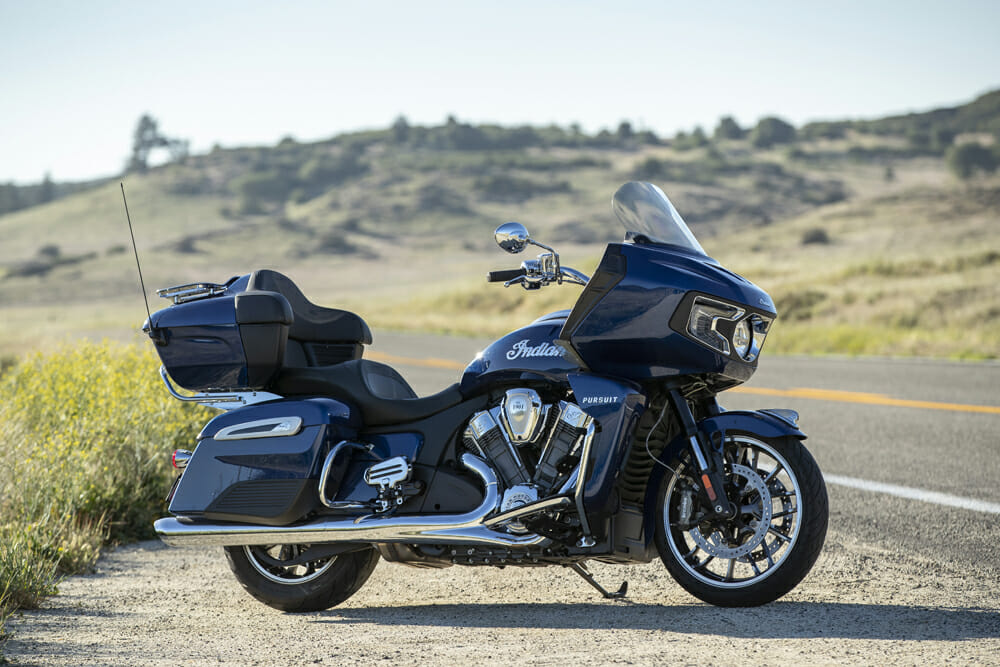
Yet the number on the scale is only half the story. Once moving, the Pursuit’s substantial chassis and touring-oriented geometry are designed to make highway travel stable and predictable. The challenge comes when the rider is maneuvering at a walking pace, backing into a parking spot, or recovering from an awkward stop.
That is where experience matters. A 937-pound motorcycle rewards smooth inputs and careful positioning.
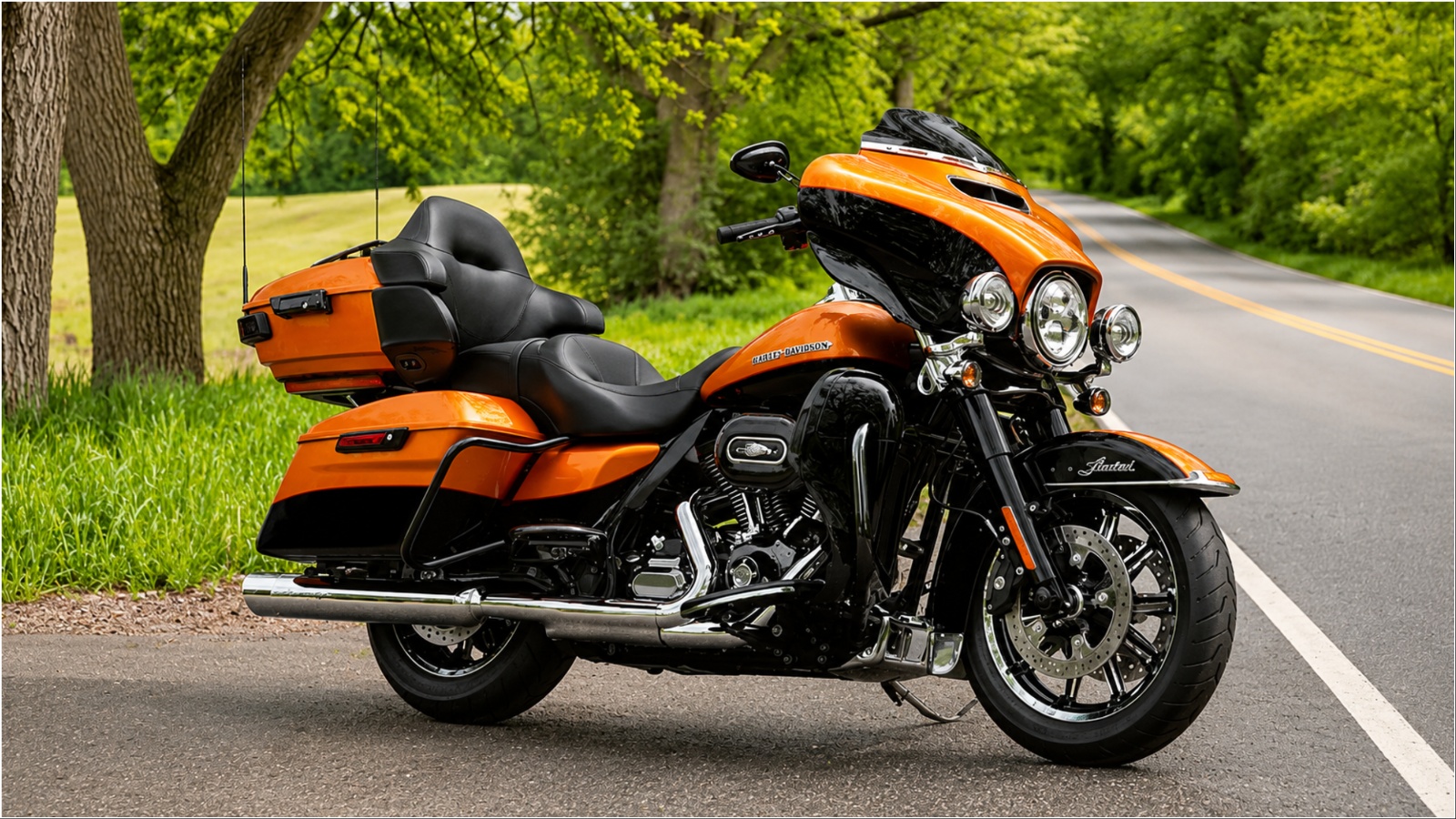
6. Harley-Davidson Electra Glide Ultra Limited
The Harley-Davidson Electra Glide Ultra Limited demonstrates that heavyweight touring is not exclusive to Indian or Honda. Harley-Davidson’s service information lists the Ultra Limited at 917 pounds in running weight, a figure that includes the motorcycle’s fluids and approximately 90 percent of its fuel.
That figure places the Ultra Limited among the heaviest production motorcycles in the modern touring category. It is built around the idea that a motorcycle can provide many of the conveniences associated with a long-distance automobile while retaining two-wheel mobility.
The equipment explains much of the mass. The Ultra Limited carries a large front fairing, saddlebags, Tour-Pak luggage, passenger accommodations, and touring hardware. Its fuel capacity is approximately six gallons, while its published luggage capacity is about 4.7 cubic feet.
The motorcycle’s Milwaukee-Eight 114 engine has a displacement of 113.99 cubic inches. Harley-Davidson lists 118 lb-ft of torque at 3,000 rpm, giving the big touring machine strong pulling power without requiring high engine speeds.
Its 102.4-inch length and 64-inch wheelbase further emphasize how much motorcycle is being controlled by the rider.
There is an interesting consequence to this design philosophy. The Ultra Limited’s weight is not simply dead mass. Much of it represents equipment riders would otherwise have to carry separately or sacrifice entirely on a lighter motorcycle.
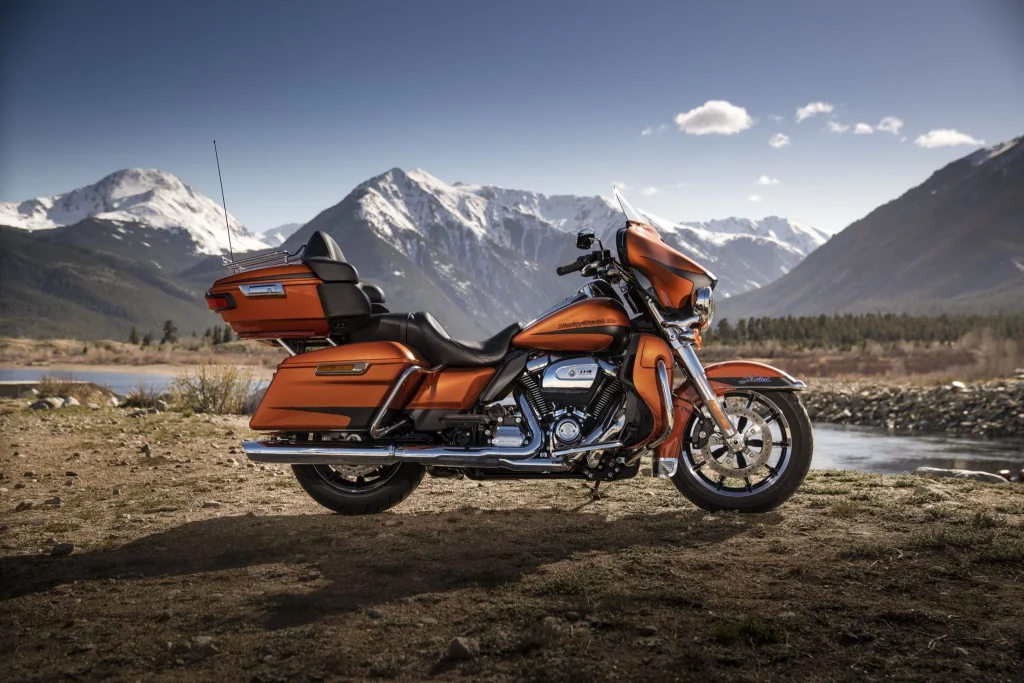
For cross-country touring, that can make the machine feel less like an oversized cruiser and more like a dedicated traveling platform.
The compromise becomes obvious in tight spaces. A 917-pound machine requires planning when reversing, parking, or making a slow U-turn.
For riders who spend their time on long highways rather than narrow urban streets, however, that substantial construction is precisely what makes the Ultra Limited so appealing.
7. Indian Chieftain PowerPlus
The Indian Chieftain PowerPlus shows that a motorcycle does not need a full touring trunk to become seriously heavy. Indian lists the 2025 Chieftain PowerPlus at 833 pounds in running order, including operating fluids and fuel. That makes it one of the heavier production baggers available in the U.S. market.
The Chieftain’s mass comes from a combination of large-engine hardware, fairing equipment, saddlebags, chassis components, and touring technology. Indian lists more than 18 gallons of storage, along with a six-gallon fuel tank. That gives the motorcycle a substantial carrying capability without requiring a separate top case.
Under the fairing sits Indian’s liquid-cooled 108-cubic-inch PowerPlus V-twin. It produces 122 horsepower and 128 lb-ft of peak torque at 3,800 rpm. That torque figure is particularly important on a motorcycle this heavy because strong low- and mid-range output helps move the machine without demanding constant high engine speeds.
The Chieftain is a substantial motorcycle in terms of size. Indian gives it a length of 98.5 inches, a width of 41.9 inches, and a 65.7-inch wheelbase. Despite its considerable weight, the 26.5-inch laden seat height provides a surprisingly accessible riding position.
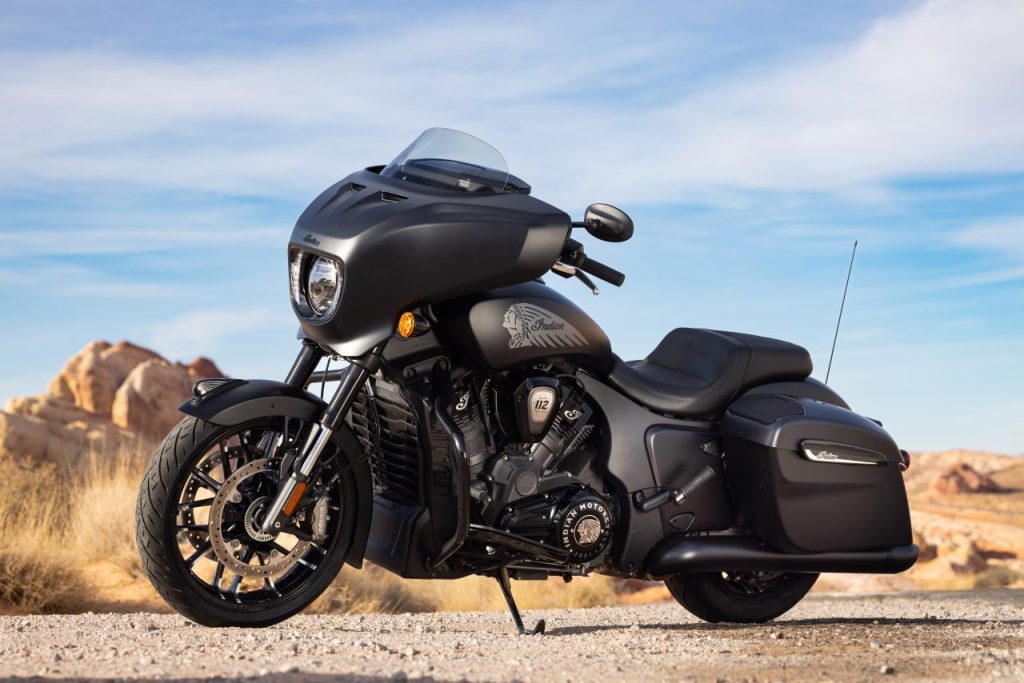
Once moving, the weight is easier to manage because the motorcycle’s design is intended for stable highway travel. The difficult moments arrive during parking, reversing, and tight low-speed turns, where 833 pounds demands smooth control.
What makes the Chieftain interesting is how efficiently Indian packages this mass. It delivers serious engine performance, integrated luggage, electronic equipment, and long-distance capability without reaching the weight of the company’s full-dress touring machines.
8. Indian Chieftain PowerPlus Dark Horse
The Indian Chieftain PowerPlus Dark Horse takes the same heavyweight bagger formula and pushes the scale slightly higher. Indian lists the 2025 Dark Horse at 842 pounds in running order, making it nine pounds heavier than the standard Chieftain PowerPlus.
That difference may sound insignificant, but the figure becomes impressive when combined with everything the motorcycle carries.
The Dark Horse has a six-gallon fuel tank, hard saddlebags, a large fairing, and a long list of electronic and rider-focused equipment. Indian lists more than 18 gallons of storage, giving the motorcycle genuine long-distance practicality.
The standard PowerPlus engine is a 108-cubic-inch liquid-cooled V-twin producing 122 horsepower and 128 lb-ft of torque. Indian also offers higher-output PowerPlus configurations in the Chieftain family, including a 112-cubic-inch version producing 126 horsepower and 133 lb-ft of torque.
The Dark Horse measures 98.5 inches from end to end and 41.9 inches across, with a 65.7-inch wheelbase. Its 1,385-pound gross vehicle weight rating also illustrates how much combined rider, passenger, luggage, and motorcycle weight the chassis is engineered to support.
There is an interesting balance here. The motorcycle is undeniably heavy, but its relatively low seat and substantial torque make the size less intimidating once the wheels are turning. The real test is maneuvering it before the engine gets to do any work.
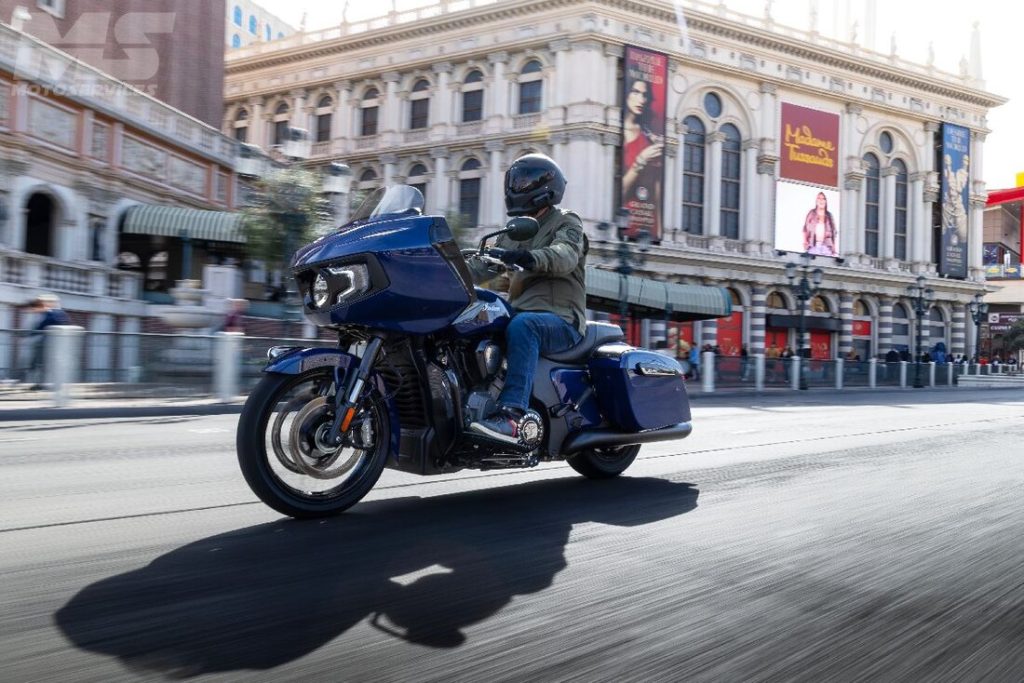
For experienced touring riders, that mass can actually become part of the appeal. A heavy bagger can feel planted on the highway, carry substantial luggage and provide the physical presence expected from a premium American touring machine.
The Chieftain PowerPlus Dark Horse therefore earns its place through a combination of weight, equipment and performance rather than simply being a giant motorcycle for the sake of being giant.
9. Harley-Davidson CVO Road Glide
Harley-Davidson’s CVO Road Glide proves that a motorcycle can become exceptionally heavy even without carrying a rear trunk. The 2025 CVO Road Glide has a running-order weight of 866 pounds, according to Harley-Davidson’s U.S. specifications.
That figure includes the motorcycle in usable operating condition, making it a much more meaningful number than its unloaded shipping weight.
This machine earns its weight through a combination of premium touring equipment and a large powertrain. It uses Harley-Davidson’s Milwaukee-Eight VVT 121 engine, displacing 121 cubic inches. The variable-valve-timing V-twin produces 115 horsepower and 139 lb-ft of torque at 3,000 rpm.
The CVO designation also means this is not a stripped-down motorcycle. Harley-Davidson equips it with a fixed Sharknose fairing, saddlebag speakers, premium finishes, upgraded suspension, and substantial electronic equipment. Its six-gallon fuel tank and 2.2 cubic feet of luggage capacity add further practical mass.
Its dimensions show why the CVO Road Glide looks so substantial in person. Harley-Davidson lists a 94.9-inch length and 37.2-inch width, along with a 64-inch wheelbase.
That combination makes the motorcycle particularly suited to long highway journeys. The large engine provides plenty of torque, while the fairing and touring equipment are designed around rider comfort.
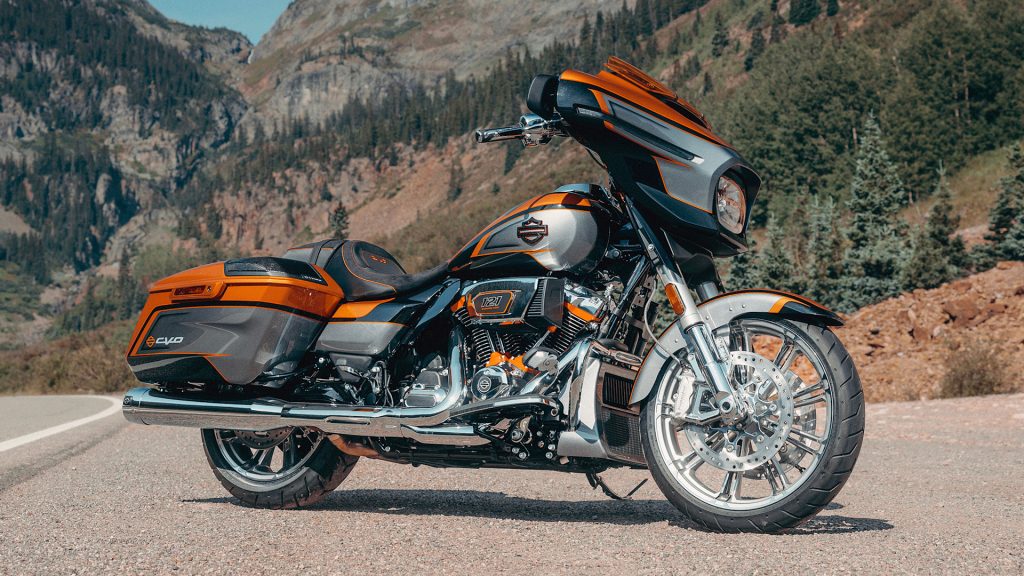
Parking is where the 866-pound figure becomes impossible to ignore. A rider must manage momentum carefully during tight turns, reversing, and uneven surfaces.
The CVO Road Glide demonstrates that premium equipment can add considerable mass, but that weight serves a purpose. This is a motorcycle engineered to cover long distances with substantial power and comfort rather than chase minimum weight.
10. BMW K 1600 B
BMW’s K 1600 B takes a completely different engineering approach to heavyweight motorcycles. Rather than using a large American-style V-twin, BMW installs an inline-six engine and surrounds it with sophisticated touring hardware.
The result is a motorcycle weighing 758.4 pounds when fueled with at least 90 percent of its usable tank volume and fitted with standard equipment.
That figure is lower than several full-dress touring motorcycles already mentioned, but it is still substantial for a production motorcycle. BMW’s specifications also give the K 1600 B a permitted total weight of 1,234.6 pounds, leaving a payload capacity of 476.1 pounds for the rider, passenger and luggage.
The engine is the star of this machine. BMW uses a 1,649 cc oil- and water-cooled inline six-cylinder, producing 160 horsepower and 129 lb-ft of torque.
That gives the K 1600 B a very different personality from heavyweight V-twin baggers. Instead of relying primarily on low-rpm character, the six-cylinder engine combines strong torque with substantially higher peak output.
BMW also equips the motorcycle with technology designed to make its size easier to manage. Standard equipment includes Dynamic ESA electronic suspension, Hill Start Control Pro, multiple ride modes, traction control, and Reverse Assist.
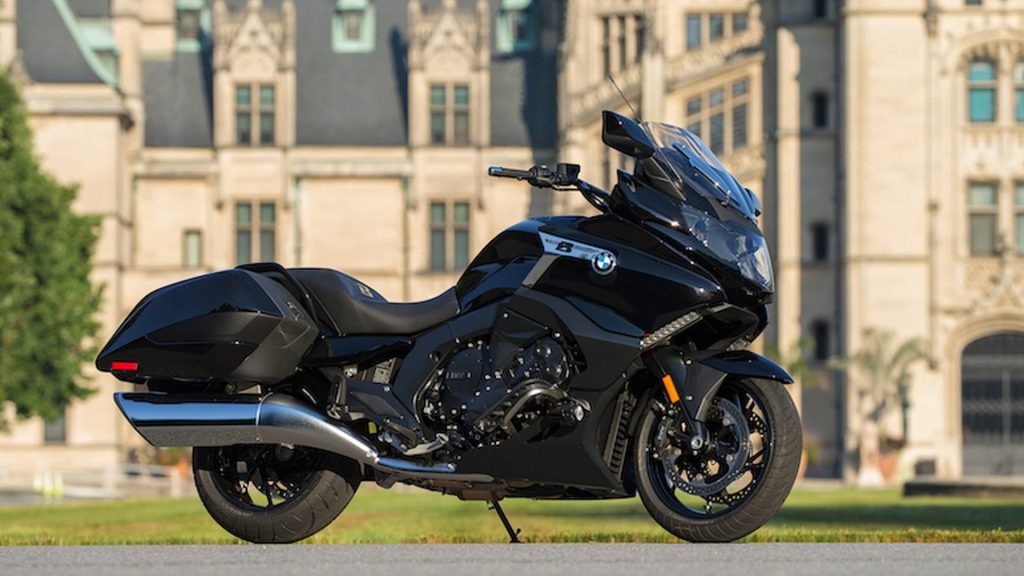
That last feature is particularly relevant when discussing weight. A motorcycle approaching 760 pounds is manageable once moving, but reversing it manually on an incline is an entirely different challenge.
The K 1600 B demonstrates how modern engineering can make a heavy motorcycle feel less intimidating than its specification sheet suggests. Its mass comes with performance, electronics, suspension technology, and touring capability. It is a heavyweight, but it is also a highly engineered one.