
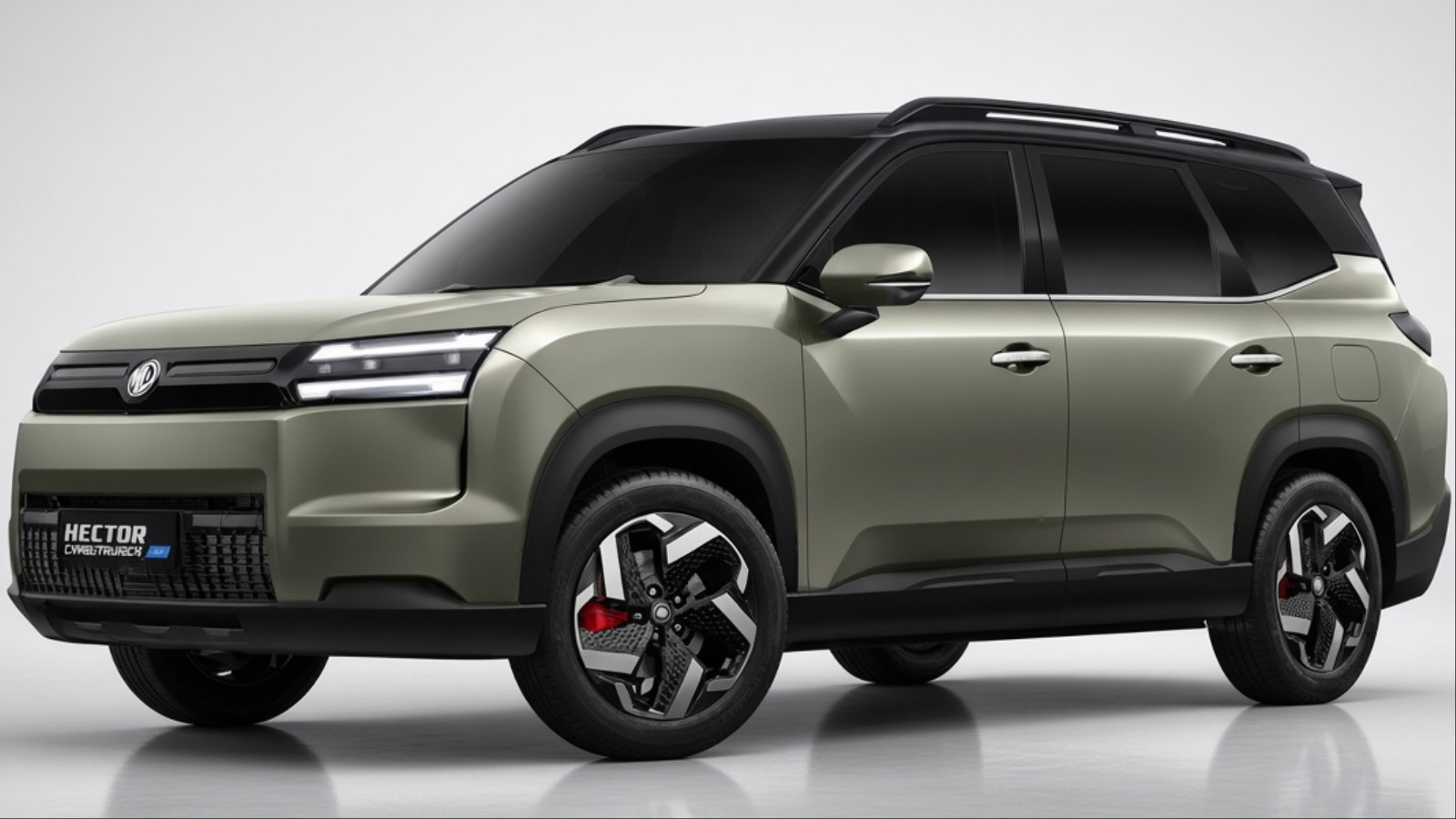
MG is taking a different approach to making electric SUVs more accessible in India with the launch of the new Hector Tomahawk EV. The three-row electric SUV combines family-friendly space, a 517-km claimed range, and a long list of technology features, but its most unusual selling point is not the powertrain. Instead, it is the way customers can pay for the battery.
Under MG’s Battery-as-a-Service (BaaS) model, buyers can purchase the Hector Tomahawk EV without paying the full battery cost upfront and instead pay a usage-based rental charge.
According to Carscoops, the arrangement lowers the starting price to about $14,600, with customers then paying roughly $0.06 per kilometer for battery use. By comparison, the conventional purchase price starts at around $20,300.
The strategy is significant because battery cost remains one of the biggest factors influencing EV pricing. By separating the battery from the vehicle’s upfront purchase price, MG is attempting to make a large electric SUV appear much closer in price to conventional petrol-powered vehicles.
The Hector Tomahawk is also notable because it offers both five- and seven-seat configurations, giving buyers the flexibility to use it as either a spacious family SUV or a three-row vehicle.
MG says the model is based on its new ADAPT multi-energy platform, which has been developed to support different powertrain technologies.
A Three-Row EV With 517 km of Claimed Range
The Hector Tomahawk EV is 4,745 mm long and has a 2,810-mm wheelbase, giving it substantial interior space for a vehicle positioned in the mainstream SUV market. MG offers the EV with both five- and seven-seat layouts, although cargo capacity changes considerably depending on the configuration.
Carscoops reports that the SUV provides 610 liters of cargo space in five-seat form, while that figure falls to 192 liters when the third row is being used. That trade-off is typical of three-row SUVs, where the rearmost seats consume a significant portion of available luggage space.
The EV uses a 69.2-kWh battery and a front-mounted electric motor producing 150 kW, equivalent to approximately 201 horsepower. MG claims a 517-km MIDC range on a full charge. The battery supports DC fast charging at up to 90 kW and also enables vehicle-to-load and vehicle-to-home functionality.
The combination gives the Hector Tomahawk an interesting position in India’s EV market. Buyers who need three rows have relatively few affordable electric options, while larger electric SUVs can become expensive quickly. MG is effectively trying to address both problems with one vehicle.
The company is also emphasizing battery durability and safety. MG says its battery system has undergone more than 2,000 bench tests and 490 vehicle validations, while a 24-hour battery-management system continuously monitors battery health. The company also highlights reinforced battery protection and structural strength.
MG has not yet provided an official NCAP crash-test rating for the Hector Tomahawk. Its own website states that the official rating will be shared once certification is completed, so claims about the SUV’s crash performance should not be confused with an independently verified safety rating.
Inside, the Tomahawk is designed to compete through technology as much as space. Equipment includes a large 15.6-inch infotainment display, an 8.8-inch digital instrument cluster, a panoramic sunroof, 256-color ambient lighting, and a 10-speaker audio system.
MG has also added an AI-powered assistant with a karaoke function and access to more than 8,000 songs.
The SUV also features gesture controls, wireless smartphone connectivity, and a range of connected functions. Higher-end safety equipment includes a 360-degree camera and Level 2 advanced driver-assistance technology, according to reporting around the launch.
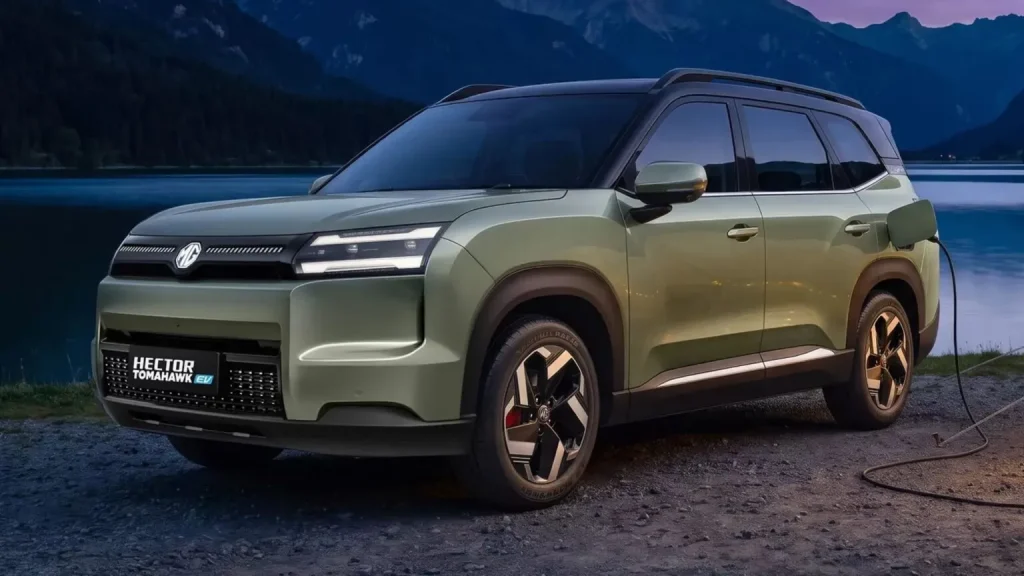
One particularly unusual feature is Vehicle-to-Home (V2H) capability. MG says the Hector Tomahawk EV can use its battery to supply power to a home during an outage, going beyond the simpler vehicle-to-load function that allows an EV to operate external electrical devices.
Battery Leasing Changes the EV Ownership Equation
The BaaS system is arguably the most important part of the Hector Tomahawk story. Rather than requiring customers to purchase the vehicle and battery as one package, MG allows the battery to be leased separately.
For the Hector Tomahawk EV, Carscoops reports that the BaaS version starts at about $14,600, compared with roughly $20,300 for the model with the battery included. That puts the initial price difference at about $5,700. Buyers choosing the BaaS option then pay around $0.06 per kilometer for battery use.
MG also confirms the BaaS pricing structure on its new energy vehicle page, listing the Hector Tomahawk EV from about $14,600 plus $0.06 per kilometer.
The arrangement changes the way buyers need to evaluate the vehicle. The lower headline price does not mean the battery is free. Instead, part of the cost of owning and using the EV is shifted from the initial purchase to ongoing usage.
For customers who drive relatively few kilometers each year, that could make the lower upfront price particularly attractive. A buyer who travels extensively, however, will accumulate higher battery rental charges over time. The most economical choice therefore depends heavily on annual mileage and how long the customer plans to keep the vehicle.
The concept is not entirely new in India’s EV market. MG has previously used a similar battery-leasing approach with the Windsor EV, demonstrating that the company sees BaaS as a broader ownership strategy rather than a one-off promotion.
Its current new-energy lineup also displays the Hector Tomahawk EV alongside other models using the same general pricing philosophy.
The Hector Tomahawk’s BaaS option becomes even more interesting because MG is applying it to a larger seven-seat SUV. The company is effectively trying to make a vehicle with the space and equipment of a much more expensive electric SUV accessible to a broader group of buyers.
The Tomahawk is also available as a plug-in hybrid. It pairs a 1.5-liter naturally aspirated engine with an electric motor and a 20.5-kWh battery. The setup provides more than 1,100 km of combined range and about 115 km of electric-only driving. According to Carscoops, the BaaS version starts at approximately $22,700, with an additional charge of around $0.04 per kilometer.
That gives MG two different answers to the same consumer concern. The EV eliminates gasoline, while the plug-in hybrid adds a combustion engine for longer journeys where charging infrastructure may be less convenient.
MG Is Testing a New Formula for Affordable EVs
The Hector Tomahawk EV is ultimately important because it combines several trends that are reshaping India’s automotive market. It is a large family SUV, an electric vehicle, a highly connected product, and an example of an alternative ownership model designed to reduce the upfront cost of electrification.
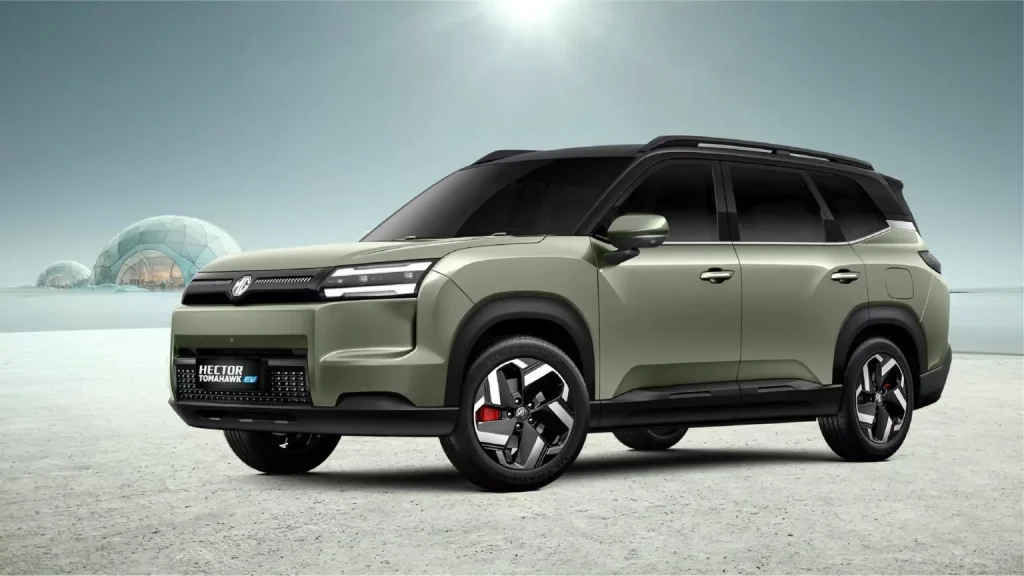
MG is also using the Tomahawk to establish its new ADAPT platform. The company describes ADAPT as a multi-energy architecture capable of supporting EV, plug-in hybrid, hybrid, and range-extender configurations. That gives MG greater flexibility as consumer preferences continue to evolve.
The vehicle is essentially a rebadged version of the Wuling Starlight 560, according to Carscoops, giving the Tomahawk an international connection within the wider SAIC-GM-Wuling ecosystem. The Indian version has been adapted with MG-specific styling and equipment.
Deliveries of the Hector Tomahawk EV are scheduled to begin in September 2026, while the PHEV is expected to follow in November. MG is therefore positioning the model as an immediate addition to its growing new-energy portfolio rather than a distant technology exercise.
The bigger question is whether Indian consumers will embrace battery leasing for a mainstream family vehicle. The lower entry price is certainly attractive, but buyers will need to calculate their expected mileage and ownership period before deciding whether BaaS provides better value than purchasing the battery outright.
Nevertheless, MG’s approach could prove influential. If consumers respond positively, other manufacturers may become more willing to separate battery ownership from vehicle ownership, particularly as automakers search for ways to make EVs more affordable.
The Hector Tomahawk EV therefore represents more than another electric SUV launch. Its three-row practicality, 517-km claimed range, and extensive technology make it competitive on conventional specifications, but the BaaS model is what makes the vehicle particularly distinctive.
By moving part of the battery cost from the showroom price to an ongoing per-kilometer charge, MG is testing whether a different ownership model can accelerate EV adoption without requiring customers to pay the full battery cost upfront.
