
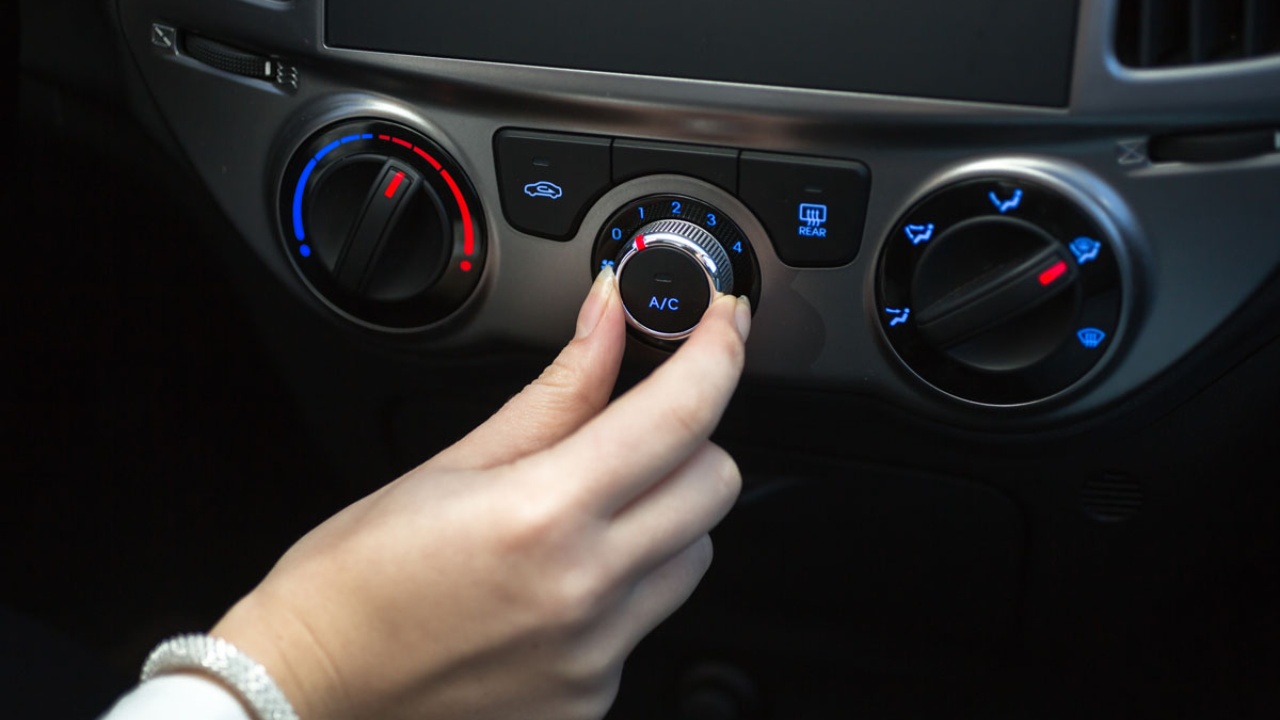
For years, drivers have followed a common fuel-saving habit. At lower speeds, they are often told to turn off the air conditioning and open the windows. Once speeds increase, the advice switches to closing the windows and relying on the AC. The logic behind this approach seems fairly simple.
An air-conditioning compressor places an additional load on the engine, while open windows disturb airflow around the vehicle and increase aerodynamic drag. At highway speeds, that drag can become significant.
However, putting a precise number such as 45 mph on the crossover point is misleading. There is no universal speed at which running the AC suddenly becomes more efficient than driving with the windows down. The result depends on the vehicle, how far the windows are opened, outside temperature, AC load, speed, and aerodynamic design.
Testing by Oak Ridge National Laboratory (ORNL) demonstrates why. In a 2013 SAE study involving a 2009 Ford Explorer and 2009 Toyota Corolla, researchers compared fuel consumption with the AC operating and with the windows open.
At steady speeds from 40 to 70 mph, both vehicles used more fuel with the AC running at maximum cooling load than with the windows down.
The Corolla did not reach a point where the windows-down configuration became less efficient than maximum AC until approximately 75 mph. At 80 mph, its windows-open fuel consumption exceeded the AC result.
That makes the underlying principle more complicated than the popular 45-mph rule suggests.
Why Open Windows Increase Fuel Consumption
The basic argument for closing the windows at highway speeds comes from aerodynamics. A moving vehicle must push air out of its way, and aerodynamic drag increases rapidly as speed rises. Opening windows changes the airflow around the vehicle and allows air to enter the cabin rather than smoothly passing around the body.
The effect varies substantially with vehicle design and the size and position of the openings. A sedan, SUV, hatchback, and pickup can respond differently because their shapes, frontal areas, and aerodynamic characteristics are not identical.
A 2015 SAE study examining different window-opening configurations on a production hatchback found that all tested window-opening arrangements increased aerodynamic drag compared with the windows-closed baseline. The researchers used computational fluid dynamics and concluded that the increased drag implied greater fuel consumption.
A separate Oak Ridge National Laboratory study published through SAE in 2014 provides useful real-world measurements. Researchers found that driving with all four windows open reduced fuel economy by approximately 4% to 8.5% on the tested compact sedan and 1% to 4% on the tested SUV. The penalty therefore depended considerably on the vehicle.
That is why saying open windows become inefficient above a particular speed can be misleading. The aerodynamic penalty is real, but its magnitude is not identical for every car. The AC system has its own energy penalty.
A conventional gasoline vehicle’s air-conditioning compressor is driven by the engine. When the compressor engages, the engine has to supply additional mechanical power, increasing fuel consumption. How much additional fuel is required depends on cooling demand and system operation.
The AC Penalty Changes With Conditions
ORNL’s 2013 experiments are particularly useful because they compared the two approaches under controlled conditions rather than relying solely on theory.

Researchers tested a Ford Explorer and Toyota Corolla at steady speeds between 40 and 70 mph, using different AC settings and comparing them with the AC switched off and windows open.
At maximum cooling load, with the compressor operating at 100% duty cycle, both vehicles consumed more fuel with AC than with the windows down throughout that 40-to-70-mph range. The results changed at higher speeds.
For the Explorer, maximum AC continued to consume more fuel than driving with the windows down beyond 70 mph. For the Corolla, fuel consumption with the windows open approximately matched the maximum-AC result at 75 mph, while at 80 mph the windows-down configuration consumed more fuel.
That is very different from a universal 45-mph crossover. It also demonstrates why the AC setting matters. Maximum cooling is not necessarily representative of ordinary driving. Once the cabin reaches a comfortable temperature, the compressor does not necessarily need to operate continuously at maximum capacity.
SAE information on mobile AC systems notes that energy requirements vary according to climate and operating conditions. It also explains that windows-open driving increases vehicle drag, while closed windows and lower AC demand can require less energy than maintaining comfort with the windows open.
The distinction is critical. A car sitting in direct sunlight may initially place a substantial demand on the AC system. Once the cabin cools, however, the required cooling load can fall considerably.
The U.S. Department of Energy recommends opening the windows at lower speeds and using the air conditioner at highway speeds. It also suggests briefly opening the windows before turning on the AC so hot cabin air can escape, reducing the initial cooling demand.
Ford offers similar guidance, stating that at highway speeds vehicles are generally more aerodynamic and fuel-efficient with the windows closed and AC operating than with the windows down and AC off. At lower speeds, the drag penalty from open windows becomes less significant.
So where does 45 mph come from?
It is better understood as a rough rule of thumb rather than an engineering constant. Aerodynamic drag becomes increasingly important as speed rises, but the exact point where it exceeds AC energy consumption depends on the vehicle and conditions.
The ORNL testing provides a direct counterexample. Under maximum AC load, the Toyota Corolla’s windows-open configuration did not become less efficient until around 75 mph, while the Ford Explorer still favored the windows-down configuration beyond 70 mph.
Those findings do not mean drivers should automatically open their windows at 70 or 75 mph. They show that there is no single speed that applies to every vehicle.
Modern vehicles complicate the comparison further. Improved compressors, more efficient engines, better insulation, and sophisticated climate-control systems can alter the energy required to maintain cabin temperature.
Electric vehicles add another major difference because their AC systems draw electricity from the battery rather than directly loading a gasoline engine.
For a gasoline-powered car, the practical advice is therefore straightforward even if the exact crossover point is not.
At low speeds, opening the windows can be a sensible way to cool the cabin without running the compressor. As speed increases, aerodynamic drag from open windows becomes more important, making closed windows and moderate AC use increasingly attractive.
Once the cabin is comfortable, recirculating cabin air and avoiding unnecessary maximum cooling can reduce the workload on the system. When entering a very hot parked vehicle, briefly venting the cabin before engaging the AC can also help it cool faster.
The main takeaway is that the familiar 45 mph guideline is too simplistic. The underlying physics makes sense because open windows can create additional aerodynamic drag, and that drag becomes more significant as speed increases. However, the point where using the air conditioner becomes more efficient than driving with the windows open depends on the vehicle.
For long highway trips, keeping the windows closed and using the AC is generally the sensible approach. But claiming that doing so becomes definitively cheaper than open windows at 45 mph gives a level of precision that the available testing does not support.
The key point is that there is no single speed that determines whether using the air conditioner or opening the windows is more efficient. Aerodynamic drag increases as speed rises, while AC energy use varies based on how much cooling the system needs to provide. The better choice depends on the vehicle and driving conditions rather than a fixed 45 mph threshold.
