

Certified pre-owned warranties sound like a safety net. Buyers assume the extra cost mostly pays for real protection. The truth is more complicated. A big share of that price tag is pure dealer profit, not risk coverage.
Dealers buy these contracts wholesale, then resell them at retail. The gap between those two numbers is where the money lives. This article breaks down the real math behind CPO warranties. It uses documented industry figures, not guesses or dealer talking points.
You’ll see what a warranty actually costs a dealer to acquire. You’ll also see what commission structures do to the final price. We’ll cover the F&I office, where most of this profit gets built. We’ll also cover reinsurance, chargebacks, and why some dealers earn far more than others.
By the end, you’ll understand why the same warranty can cost wildly different amounts. You’ll also know which numbers are worth pushing back on. This isn’t about avoiding warranties altogether. It’s about knowing what you’re actually paying for.
What the Dealer Actually Pays for a Certified Warranty
Every CPO warranty starts as a wholesale product. Dealers buy it from a warranty company or third-party administrator, not from thin air. That wholesale cost typically runs $400 to $800 per contract. A dealer typically purchases an extended warranty from a warranty company for $400 to $800 per contract.
That’s the base cost before any markup happens. Everything charged above that number becomes gross profit for the store. On top of the base contract, there’s a certification cost layer. This covers the inspection process required before a used car can wear the CPO badge.
Industry estimates put this closer to $500 to $1,000 per vehicle. These typically run $500-$1,000; let’s call it $750 based on industry norms. That figure covers inspection labor, minor repairs, and paperwork. It’s separate from the actual warranty contract cost.
So a dealer’s real cash outlay per certified unit sits somewhere around $900 to $1,800. That’s before the customer sees a price at all. Retail prices for these same warranties look nothing like that. Full CPO packages, including the warranty and certification premium, commonly run $1,500 to $3,500.

CPO markups typically range from $1,500 to $3,500+, depending on the vehicle brand and market. Luxury brands push that ceiling even higher. Some luxury brands push it even higher.
Cadillac dealers, for example, have been documented marking up CPO units by $2,000 to $4,000. The price markup at some Cadillac stores can reach $2,000 to $4,000 above comparable non-certified inventory.
That’s not the warranty cost rising. That’s the retail price stretching far past what the dealer actually paid. Stand-alone extended service contracts follow a similar pattern. Markups on these products commonly run 50% to 200% above wholesale cost.
Depending on pricing strategy, dealers may apply markups ranging from 50% to 200% above wholesale cost. Put plainly, a warranty that cost the dealer $600 might retail for $1,800. That’s not unusual. It’s the standard model across the industry. This is why the CPO badge alone doesn’t tell you much. The badge signals inspection and paperwork, but the price behind it is negotiable.
How Dealers Turn Warranties Into a Profit Center
The person selling you the warranty isn’t neutral. The F&I manager’s job is built around commission, not disinterested advice. Warranty commissions typically run 30% to 50% of the retail sale price. The profit margin on an extended warranty can be 30% to 70% or more.
Some dealer training materials cite an even wider range. Vehicle service contracts represent the single most profitable F&I product you’ll sell, with commission rates typically running 40-60% and average PVRs exceeding $1,000.
That means on a $2,800 warranty, the dealer might pocket $1,000 to $1,400 in pure commission. A $2,800 VSC generates $840-1,400 in commission.
Multiply that across a full month of sales, and the numbers get large fast. At 50% penetration on 100 monthly sales, that’s $42,000-70,000 in monthly gross.
This is why warranties get pushed so hard at the finance desk. It isn’t really about your car. It’s about hitting a monthly target. Front-end vehicle profit has been shrinking for years. Online pricing tools made it harder to mark up the car itself.

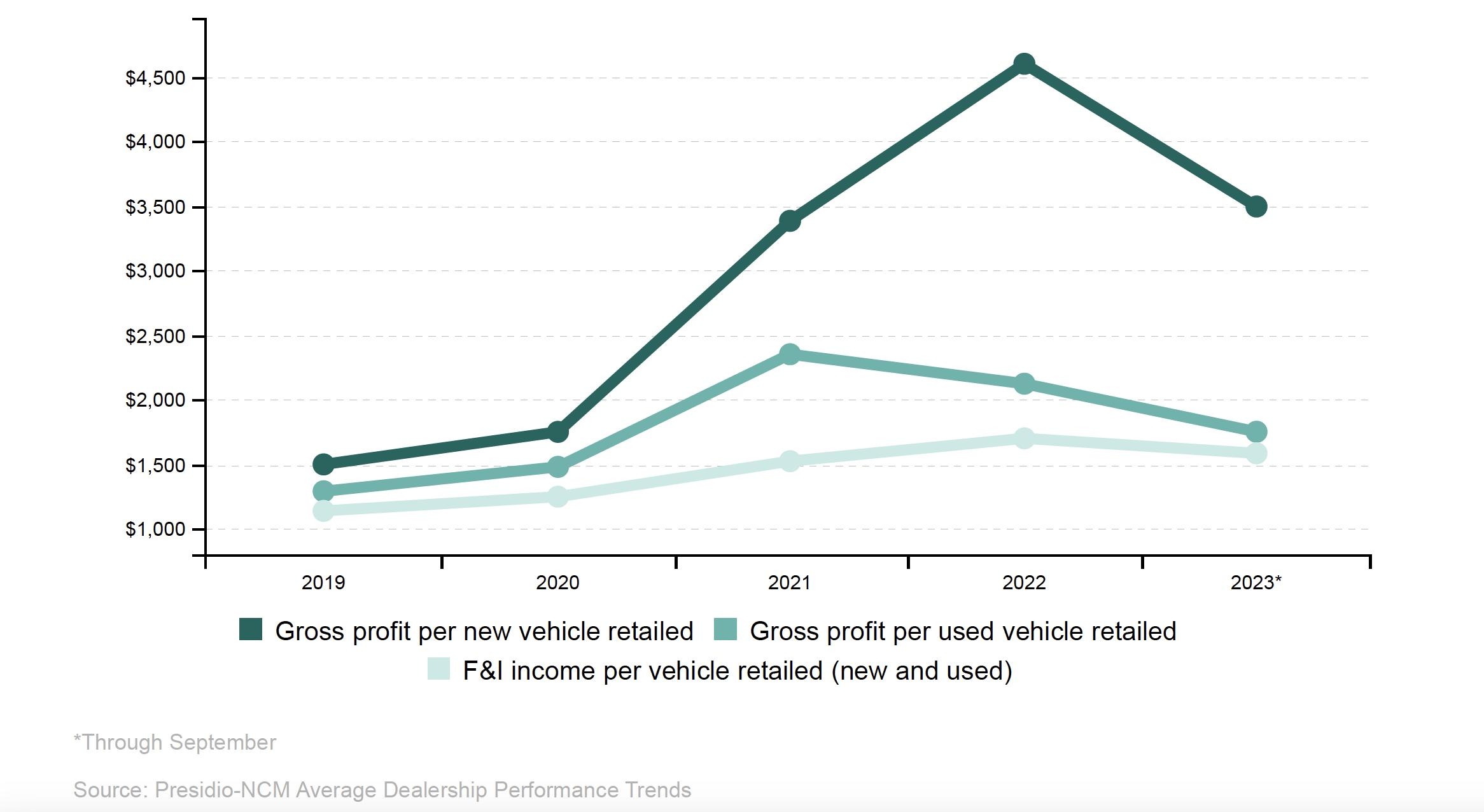
New vehicle front-end gross averaged $3,284 in the second quarter of 2025. New vehicle front-end gross averaged $3,284 in Q2 2025; used vehicle gross came in at just $1,642 in Q1 2025.
A single warranty can beat that used-car margin on its own. A single VSC, by contrast, can add $1,000+ in pure gross profit per deal with minimal negotiation resistance once financed into monthly payments.
That’s the key detail buyers miss. Warranty costs get rolled into monthly payments, so the sticker shock disappears. A $1,800 markup feels invisible at $30 a month over 60 months. That’s exactly why F&I departments favor financing the warranty rather than itemizing it upfront.
This shift has changed dealership economics. F&I products now make up roughly a quarter of total dealership gross profit. F&I products now represent approximately 25% of total dealership gross profit, up from just 15% in 2009.
That’s a real structural shift, not a minor trend. Dealerships increasingly depend on the back office, not the car lot, for their margin. There’s also an internal penetration-rate game. Dealers track what percentage of buyers accept the warranty offer.
Going from 40% penetration to 75% penetration adds real money per unit sold. The difference between 40% VSC penetration and 75% penetration is about $600 per vehicle in additional gross profit, or $60,000 per month on 100 units.
That gap is the entire reason for the sales scripts you hear at the finance desk. Every phrase is designed to move that penetration number higher. None of this makes the warranty worthless. It just means the price you’re quoted has enormous room built into it.
Where the Money Really Ends Up
Not all of that commission stays with the salesperson. Warranties pass through several layers before the profit settles anywhere permanent. The first layer is the retail sale itself, split between the dealership and the F&I manager’s personal commission. That’s how the game works, with the F&I manager making $500 to $1,500 in commission on that single warranty sale.
The second and third layers involve the warranty administrator and any reinsurance structure. Administrator income and reinsurance reserves flow to third-party companies unless the dealer owns a reinsurance structure.
Some larger dealer groups set up their own reinsurance companies. This lets them capture underwriting profit that would otherwise go to an outside administrator. When contracts expire, the underwriting profits that would have gone to an external administrator flow back to the dealer instead.
That structure changes the math significantly. Reinsurance ownership adds returns from invested premium reserves during the life of each contract. Generates returns from premium reserves invested during the contract term.
Dealers without this setup leave real money on the table. Dealers without a reinsurance structure commonly surrender six figures in annual profit to external providers.
That’s not a small leak. That’s structural, recurring lost revenue across an entire year of sales. Chargebacks complicate the picture further. If a customer cancels early, or the finance contract gets paid off ahead of schedule, some of that commission gets clawed back.
One documented example showed an 8% chargeback rate on warranty sales. A finance manager selling a $1,200 extended warranty on every retail unit sounds great until you see the chargeback rate is running 8% because customers didn’t understand the coverage limits.
Across 200 units a month, that adds up to a serious dent in reported profit. That’s $96 per unit coming back off the books, and over 200 units a month at a multi-rooftop dealer group, that’s nearly $20,000 in lost revenue.
This is why some warranty deals get pitched as non-refundable, or heavily prorated on cancellation. If a customer cancels the extended warranty before it expires, the dealership or provider may only refund a prorated amount, keeping a portion of the initial cost.
The dealer protects their commission even if you change your mind. That’s a detail worth reading closely in the contract. Finance reserve adds another income stream on top of all this. Rate markups on the loan itself, usually capped around 2% to 2.5%, generate additional dealer profit.
Regulations limit how much you can mark up, typically 2-2.5%, and reserve on a $30,000 72-month loan at a 2% markup is about $1,800-2,000. That’s separate money, on top of the warranty markup itself. It’s part of why the finance office, not the sales floor, has become the real profit engine.
Regulatory rules vary by state on how these contracts are held. Some states require that you hold service contract premiums in a segregated reserve account.
That doesn’t change what you pay at the counter. It just changes how the money is legally warehoused behind the scenes. For buyers, the practical lesson is straightforward. Ask for the dealer’s actual cost basis, or at minimum, shop the same coverage through an independent VSC provider before signing anything.
Third-party providers routinely undercut dealer pricing for identical coverage. If you want extended coverage, buying directly from a third-party VSC provider is likely cheaper. The warranty itself may still be worth having. The markup attached to it, however, is almost always negotiable and rarely disclosed upfront.
