
Motorcycle helmet laws are not uniform across the United States. Some states require every rider and passenger to wear a helmet, while others impose helmet requirements only on younger riders.
The difference becomes especially important for motorcyclists crossing state lines, because a helmet that is optional at home can become legally mandatory a few miles later.
The Insurance Institute for Highway Safety lists 17 states and the District of Columbia with universal helmet laws as of August 2026. These states stand out for requiring helmets for riders regardless of age. Here are eight with particularly comprehensive requirements and important details riders should know.
1. California
California has one of the country’s strongest motorcycle helmet requirements because its law applies to every motorcycle operator and passenger, regardless of age.
The California Department of Motor Vehicles states that motorcycle riders must wear a U.S. Department of Transportation-compliant helmet. The state’s motorcycle handbook also explains that the helmet must comply with applicable federal safety standards.
This is important because California does not provide an age-based exemption for an experienced adult rider. Whether someone has been riding for 30 years or is taking their first trip, the helmet requirement applies.
Passengers are covered as well, meaning the person sitting behind the operator cannot legally ride without the required protective headgear.
California’s approach is particularly significant because the state has required helmets for all riders since 1992. IIHS reports that after California’s universal helmet law took effect, motorcycle fatalities decreased by 37 percent, according to research cited by the organization.
The state’s helmet requirement also goes beyond simply putting something on your head. The California DMV warns riders about noncompliant novelty helmets and specifically directs buyers to look for the appropriate U.S. DOT certification markings.
A decorative helmet that does not meet the required federal standard is not an acceptable substitute merely because it resembles a motorcycle helmet.

California also strongly emphasizes protective equipment and responsible riding. Its DMV motorcycle guidance recommends protective clothing and stresses visibility, communication, and adequate following space.
For riders entering California, the requirement is simple. Every motorcycle rider and passenger must wear a helmet that meets the state’s safety standards. Being an experienced adult does not create an exception, as California law does not provide an age-based exemption from the helmet requirement.
2. Alabama
Alabama takes a similarly strict position by requiring all motorcycle operators and passengers to wear approved protective headgear. The Alabama Law Enforcement Agency’s current motorcycle manual states that no person may operate or ride upon a motorcycle or motor-driven cycle without wearing approved protective headgear.
The state’s requirement is not limited to highways or high-speed riding. The wording covers motorcycle operation generally, making the helmet requirement relevant even when a rider is making a short local trip. That matters because a common misconception among motorcyclists is that helmets are primarily necessary for long-distance or high-speed riding.
Alabama’s motorcycle safety rules also specify other equipment and riding requirements. Riders must wear shoes, and the state restricts motorcycle handlebars to no more than 15 inches above the portion of the seat occupied by the operator.
Alabama also prohibits a motorcycle rider from carrying a package or other article that prevents both hands from remaining on the handlebars.
The helmet requirement has a significant safety rationale. Alabama reported 125 motorcycle fatalities in 2024, its highest number in the previous decade, according to the Alabama Law Enforcement Agency. ALEA also cites CDC research indicating that motorcycle helmets reduce the risk of head injury by 69 percent.
For enforcement purposes, violating Alabama’s helmet requirement can have serious consequences. ALEA states that failing to wear the required helmet is a misdemeanor punishable by a fine of up to $100 and up to 180 days in jail.
Alabama therefore belongs firmly in any discussion of strict motorcycle helmet states. The law covers both riders and passengers, and the requirement is paired with detailed rules concerning motorcycle operation and protective equipment.
A rider entering Alabama should not assume that age, experience, or a short journey changes the helmet requirement.
3. Connecticut
Connecticut has one of the more comprehensive motorcycle helmet requirements in the Northeast. State law requires motorcycle operators and passengers to wear protective headgear that complies with the standards established by the Commissioner of Motor Vehicles.
The requirement applies broadly rather than being limited to younger riders, placing Connecticut among the states with universal motorcycle helmet laws.
The state’s rules also address what constitutes acceptable protective equipment. Connecticut law requires the protective headgear to meet standards established by the Commissioner, meaning riders cannot assume that any helmet sold as motorcycle equipment automatically satisfies the legal requirement.
Properly approved equipment is therefore important both for safety and compliance. Connecticut’s motorcycle safety requirements are not limited to helmets. State law requires motorcycle operators to use appropriate lighting equipment, and motorcycles must be equipped with specified braking and other safety equipment.
The state also imposes requirements concerning passengers, including restrictions related to seating and footrests.
The helmet requirement becomes particularly relevant for riders crossing between northeastern states. Motorcycle trips through Connecticut can involve relatively short distances between neighboring jurisdictions, but helmet requirements can differ once the rider crosses a border.
A rider who begins a trip in a state with a different rule should therefore verify Connecticut’s requirements before entering.
There is also a practical reason for Connecticut’s broad approach. Motorcyclists have far less physical protection than occupants of passenger vehicles, making head protection one of the most important pieces of riding equipment.

IIHS identifies universal helmet laws as an important factor in motorcycle safety and reports that helmet use is substantially higher in states with universal requirements.
Connecticut’s law consequently leaves little ambiguity for riders. The safest assumption when operating a motorcycle in the state is that both the operator and passenger need compliant protective headgear. Checking the helmet’s certification and condition before starting the trip is just as important as remembering to wear it.
4. Delaware
Delaware has a universal motorcycle helmet requirement that applies to operators and passengers, making the state’s rule significantly broader than laws that apply only to younger riders.
Under Delaware law, a person operating or riding upon a motorcycle must wear protective headgear that meets the standards adopted by the state’s Secretary of Transportation.
The state also requires motorcycle operators and passengers to use protective devices that comply with applicable requirements. That makes the exact helmet important. A rider should not assume that a decorative or novelty helmet provides the protection required by Delaware law simply because it is marketed for motorcycle use.
Delaware’s motorcycle requirements also include rules affecting the motorcycle itself. State law establishes equipment standards covering items such as brakes, lamps, and other required components.
These provisions mean that helmet compliance is only one part of the equipment checklist for a motorcycle being operated legally on Delaware roads.
The state’s geography makes helmet-law awareness particularly useful. Delaware is relatively small, and riders can cross into Maryland, Pennsylvania, or New Jersey during an ordinary recreational trip.
Those neighboring states have their own motorcycle helmet requirements and enforcement rules. A rider planning a multi-state journey should therefore check every jurisdiction on the route instead of relying on the law where the motorcycle is registered.

IIHS classifies Delaware among the states with universal helmet laws. Its research notes that universal helmet requirements are associated with higher helmet use and lower motorcycle fatality rates than states with weaker requirements.
For riders in Delaware, the key point is that the helmet requirement applies regardless of age or riding experience. Both the rider and passenger must wear protective headgear that complies with the state’s requirements.
A properly fitted, approved helmet should be treated as standard equipment before the motorcycle leaves the driveway, not something added only when a trip crosses into a stricter jurisdiction.
5. Massachusetts
Massachusetts has a universal motorcycle helmet requirement, meaning the rule does not disappear once a rider reaches a certain age or gains years of experience.
The state’s law requires a motorcycle operator and passenger to wear protective headgear that meets the standards established by federal regulations. IIHS lists Massachusetts among the states requiring helmets for all riders.
That distinction matters because motorcycle helmet laws across the country vary dramatically. In some states, an adult with sufficient riding experience can legally ride without a helmet. Massachusetts takes a much stricter approach. A rider cannot simply point to age or experience as a reason for leaving the helmet at home.
The Massachusetts requirement also concerns the quality of the helmet, not merely whether something is worn on the head. Federal motorcycle helmet standards are established under Federal Motor Vehicle Safety Standard No. 218, commonly referred to as FMVSS 218.
Riders should therefore use properly certified motorcycle helmets rather than novelty headgear that offers little meaningful protection.
There is a practical advantage to such a straightforward rule for riders crossing the state. Massachusetts borders five other states, and motorcycle trips through New England can cross multiple jurisdictions in a single day.
With different helmet requirements in nearby states, checking the law for every state on the route is important. Massachusetts itself leaves considerably less room for interpretation because the requirement applies to both occupants.

The safety implications are also significant. IIHS reports that helmet use is substantially higher in states with universal helmet laws. In 2024, 89 percent of fatally injured motorcyclists in states with universal helmet laws were wearing helmets, compared with lower helmet-use levels in states with weaker requirements.
For Massachusetts riders, the safest approach is to wear a motorcycle helmet that meets state requirements on every ride. This applies whether you are taking a long trip on the interstate or simply riding a few miles around town.
6. Vermont
Vermont’s motorcycle helmet law is unusually clear in its wording. Under Vermont statute, a person may not operate or ride upon a motorcycle on a highway unless that person properly wears protective headgear conforming to federal Motor Vehicle Safety Standards. The requirement applies regardless of the rider’s age or experience.
The law specifically references 49 C.F.R. § 571.218, the federal standard governing motorcycle helmets. That gives riders a useful benchmark when choosing equipment. Rather than relying on appearance, price, or a seller’s description, a motorcyclist should make sure the helmet actually conforms to the required federal standard.
Vermont also has a limited exception written directly into the statute. The helmet requirement does not apply to occupants of fully enclosed autocycles.
That distinction is important because an autocycle can have characteristics that set it apart from a conventional two-wheeled motorcycle. For an ordinary motorcycle rider, however, the helmet requirement remains in force.
Vermont’s law is particularly relevant to touring riders because the state sits within a dense network of New England motorcycle routes.
A trip through the Green Mountains can easily involve crossings into New York, Massachusetts, New Hampshire, or other neighboring jurisdictions. Riders should not assume that a helmet exemption available elsewhere follows them into Vermont.
IIHS currently lists Vermont among the states requiring helmets for all riders, while noting that some states impose requirements only on younger motorcyclists and three states have no motorcycle helmet requirement at all.
The difference is more than a technical legal issue. IIHS research has found a substantial safety advantage associated with universal helmet requirements.
Its research indicates that if all states had maintained all-rider helmet laws from 1976 through 2022, an estimated 22,058 motorcyclist deaths could have been prevented, representing about 11 percent of motorcyclist fatalities during that period.
For anyone riding in Vermont, the simplest way to follow the law is to wear a properly certified motorcycle helmet whenever operating or riding on a motorcycle on the state’s highways. This approach helps ensure compliance while prioritizing rider safety.
7. New York
New York has one of the broadest motorcycle helmet requirements in the country. State law requires every motorcycle operator and passenger to wear a helmet that meets federal safety standards.
There is no general age-based exemption allowing an experienced adult rider to legally operate without one. IIHS classifies New York as a state with a universal motorcycle helmet law.
New York’s statute is also specific about the type of protection required. The helmet must meet federal standards, so simply wearing any type of protective headgear is not enough.
For riders, that means choosing equipment designed and certified for motorcycle use rather than relying on bicycle helmets, novelty helmets, or other products that do not meet the applicable requirements.
The rule covers passengers as well as operators. That can be easy to overlook when carrying someone who does not regularly ride motorcycles.
Before leaving, the operator should make sure the passenger has appropriate protective headgear rather than assuming the responsibility applies only to the person controlling the motorcycle.
New York’s geography makes this especially relevant for touring riders. Motorcyclists can move between New York, Pennsylvania, New Jersey, Connecticut, Massachusetts, and Vermont during a single trip.
Helmet requirements differ among jurisdictions, but New York does not provide the type of adult exemption found in some states. A rider crossing the state line should therefore be prepared to comply immediately.
The safety case behind the requirement is substantial. IIHS reports that helmets are estimated to be 37 percent effective in preventing motorcycle deaths for operators and 41 percent effective for passengers. The organization also notes that helmets reduce the likelihood and severity of head injuries when crashes occur.
New York’s universal requirement consequently removes the need for riders to make an age-based judgment about whether a helmet is necessary. Whether the trip is a daily commute through New York City, a weekend ride through the Adirondacks or a passenger trip across the state, both occupants need compliant head protection.
For anyone planning a motorcycle trip through New York, checking the helmet’s certification and ensuring that both rider and passenger wear it before departure is one of the simplest ways to remain within the state’s requirements while adding an important layer of crash protection.
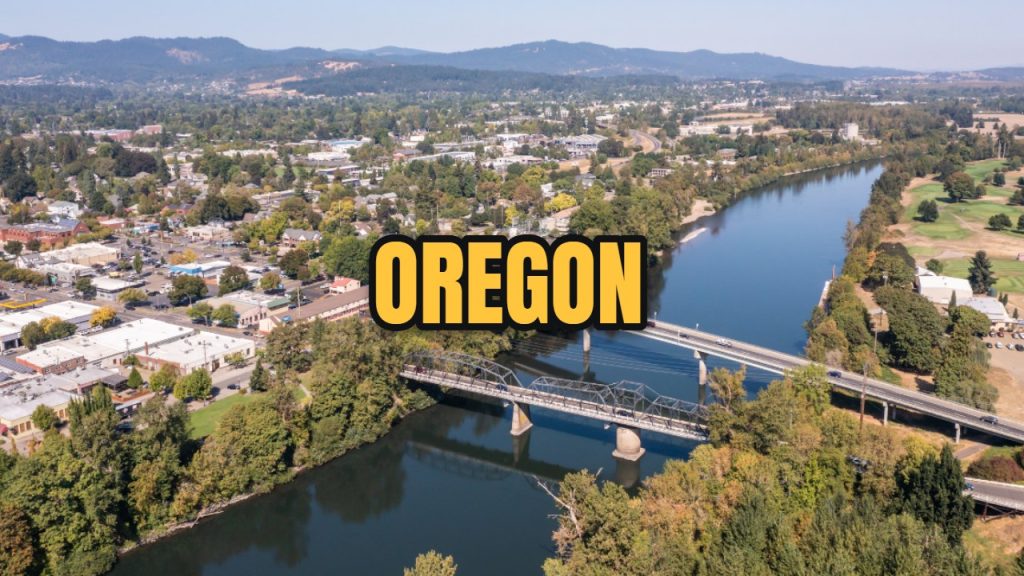
8. Oregon
Oregon is another state where motorcycle helmet requirements apply broadly to riders rather than being restricted to younger motorcyclists.
Oregon law requires a person operating or riding on a motorcycle to wear protective headgear that complies with standards established by the Oregon Department of Transportation. The requirement applies to both operators and passengers.
The state’s approach is significant because Oregon has a large recreational motorcycle community and a wide variety of riding environments.
A motorcyclist might travel through Portland traffic, cross mountain roads in the Cascades, or spend hours on rural highways. The helmet requirement remains applicable throughout the trip.
Oregon also connects directly with several jurisdictions that have their own motorcycle laws. Riders can cross into Washington, Idaho, Nevada, or California during longer journeys, and each state has its own requirements concerning helmets and other motorcycle equipment.
A helmet that is already appropriate for Oregon therefore provides a useful common denominator for interstate riding.
The legal standard matters as much as the presence of the helmet. Riders should select a helmet that meets the applicable federal safety requirements and should follow the manufacturer’s instructions concerning proper fit and use. A loose or incorrectly fitted helmet may provide less protection in a crash, even when the helmet itself is certified.
IIHS identifies Oregon as a state with a universal helmet requirement. Its motorcycle safety research consistently distinguishes these laws from partial requirements that cover only younger riders. Universal laws are associated with substantially higher helmet use among motorcyclists.
The reason these laws remain important is reflected in national crash data. According to IIHS, motorcyclists are substantially more vulnerable than occupants of passenger vehicles because motorcycles lack the structural protection provided by a vehicle’s passenger compartment.
In 2024, 6,228 motorcyclists were killed in crashes in the United States, making motorcycle safety a continuing concern.
For Oregon riders, compliance is therefore straightforward. The operator and passenger should both wear appropriate protective headgear before the motorcycle enters a public roadway. That rule remains relevant regardless of age, experience, destination, or whether the ride is a quick trip across town or a multi-state adventure.
