
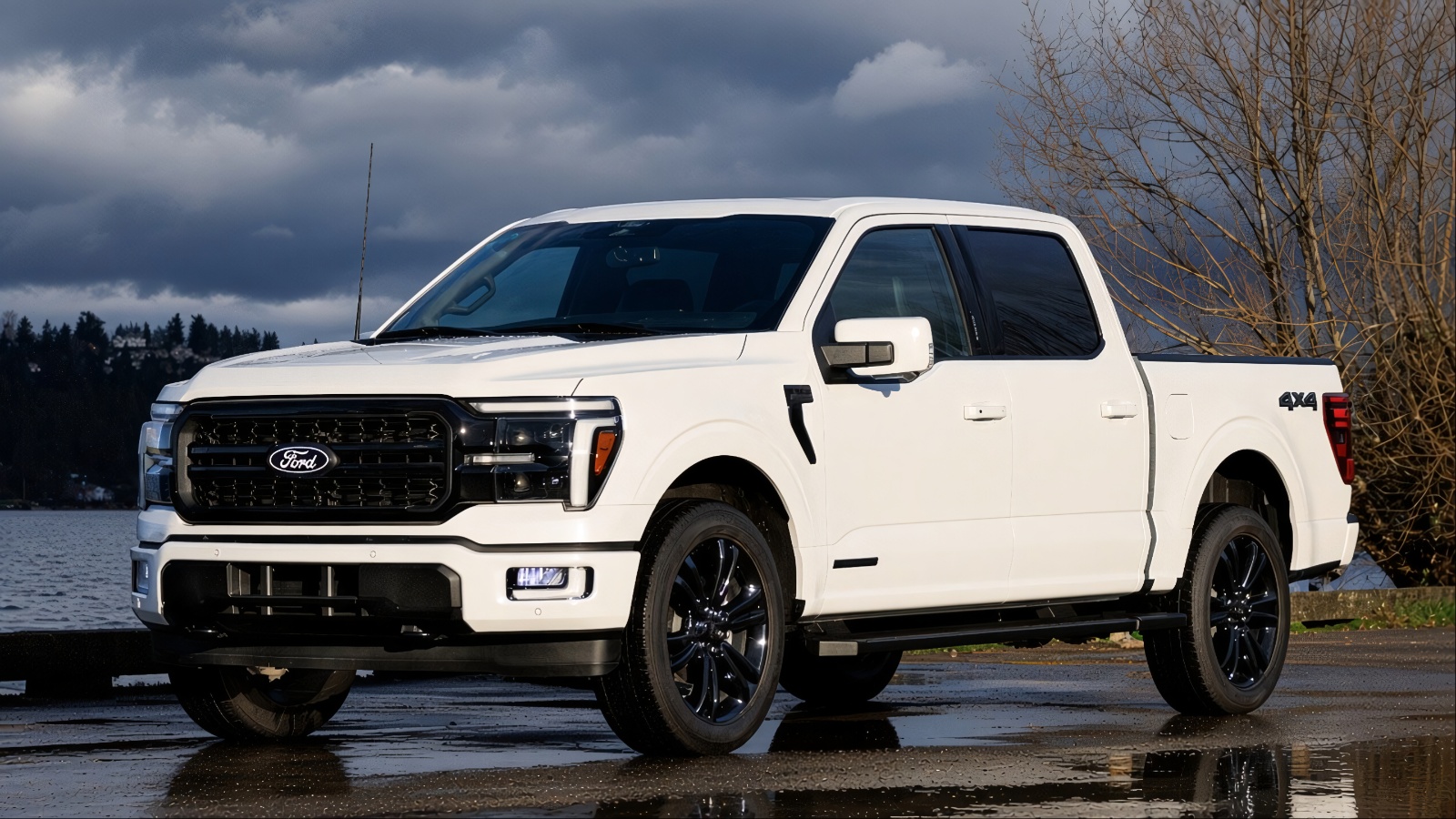
Ford is expanding the role of its BlueCruise hands-free driver-assistance system with a new towing capability for the 2027 F-150. The feature will allow drivers to use hands-free highway driving while pulling compatible boats, campers, and trailers, bringing one of the most requested truck functions into Ford’s advanced driving technology.
Business Insider reported on September 15 that Ford tested roughly 800 trailer configurations as it developed the system. The technology will operate on more than 130,000 miles of prequalified divided highways, known as Blue Zones.
It will be available on every BlueCruise-equipped 2027 F-150, beginning with the XLT, rather than being restricted to premium versions.
The update arrives as truck manufacturers increasingly combine towing technology with advanced driver assistance. General Motors has offered hands-free trailering capability since 2022, while Tesla’s Full Self-Driving Supervised system does not operate when a trailer is detected.
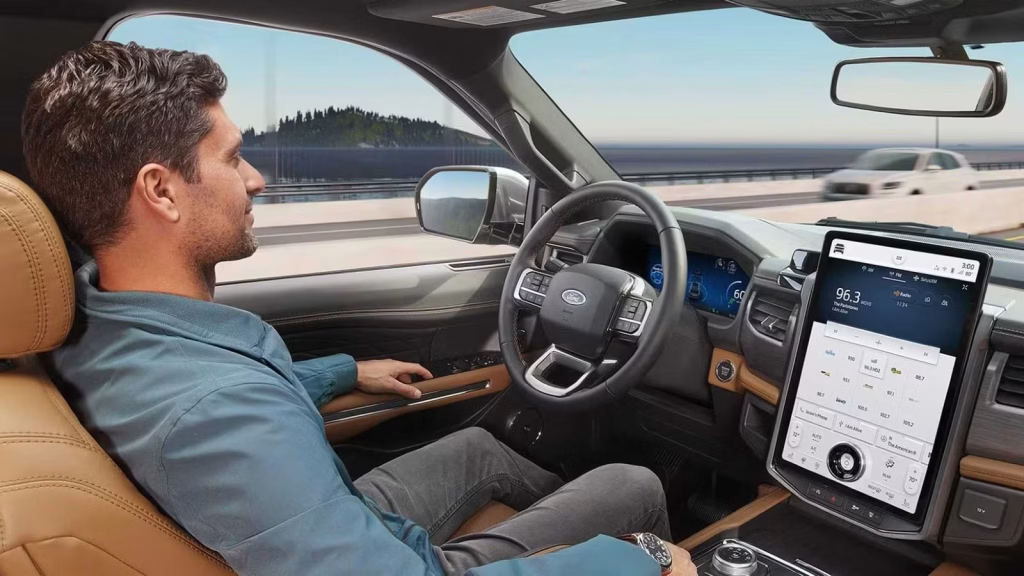
Ford’s new system is not autonomous driving. The driver must continue watching the road, remain alert, and be prepared to take control whenever necessary. Ford specifically describes BlueCruise as a driver-assistance feature rather than a replacement for the driver.
BlueCruise Learns to Handle a Trailer
Towing changes how a truck behaves on the road. A trailer adds weight, changes braking distances, and affects steering response. Wind can create additional movement, while an incorrectly loaded trailer can increase sway. Those variables make hands-free driving considerably more complicated than operating the truck by itself.
Ford says its engineers logged thousands of real-world testing miles across different road conditions, elevations, curves, and high-wind environments. The company also used its Driving Dynamics Lab to simulate hundreds of truck-and-trailer combinations.
Business Insider reported that approximately 800 configurations were evaluated during development. Ford considered trailer type, size, weight, and loading, along with factors such as trailer sway and tire pressure.
The system requires drivers to create a unique trailer profile before using BlueCruise with Towing. That profile includes the relevant dimensions of the trailer, helping the vehicle understand the combination it is being asked to control.
Ford has also built several restrictions into the system. BlueCruise with Towing is limited to 75 mph, compared with an 80 mph maximum for the system when the truck is not towing. If persistent trailer sway is detected, the truck can automatically reduce speed, limit the system, or transition back to hands-on driving.
The truck continuously monitors the combined vehicle and trailer weight. If the system determines that the combination exceeds the permitted operating weight, BlueCruise with Towing will not function. It also becomes unavailable if the truck’s tire-pressure monitoring system detects an active warning.
Not every BlueCruise function is available while towing. Ford says hands-free lane changes are disabled, meaning the driver must perform lane changes manually. In-lane repositioning is also unavailable, and the system can request hands-on driving when it detects a construction zone.
These restrictions show that Ford is treating towing as a separate operating condition rather than simply extending existing BlueCruise software to a vehicle with something attached behind it.
The capability can be used with up to 10,000 pounds of maximum available towing capacity when the F-150 is properly configured. Ford says that figure applies to BlueCruise with Towing when the truck has the required Tow/Haul Package and available Max Tow Axle, although actual capacity depends on configuration, passengers, cargo, and accessories.
Ford says customers with an active BlueCruise subscription will not have to pay an additional charge to use the towing function. That makes the feature an expansion of the existing service rather than a separate subscription product.
The 2027 F-150 Gets More Than a Software Update
The towing capability is the headline change, but Ford is also making several mechanical and equipment changes to the 2027 F-150.
The most notable powertrain adjustment is the replacement of the familiar 2.7-liter EcoBoost V6 with a new 3.0-liter EcoBoost V6 as the standard engine. Ford says the new engine delivers 325 horsepower and 400 pound-feet of torque, with the main improvement coming from stronger torque delivery during normal driving.
The 2027 lineup will continue to offer larger gasoline engines, including the 5.0-liter V8 and 3.5-liter EcoBoost V6.
Ford’s published information lists the 5.0-liter V8 at 400 horsepower and 410 pound-feet of torque, while the 3.5-liter EcoBoost produces 500 pound-feet of torque and can provide up to 13,500 pounds of maximum towing capacity when properly equipped.
The 3.5-liter PowerBoost hybrid remains part of the range as well. Its combination of gasoline power and electric assistance gives the F-150 another option for customers who want substantial torque and onboard electrical capability.
Ford is also bringing the 5.0-liter V8 back to the King Ranch and Platinum trims after it was removed from those versions following the 2023 model year. The move gives buyers in those premium trims another choice beyond the turbocharged engines.
The 2027 truck receives visual updates too. Ford is introducing redesigned grilles and new wheel designs on XLT, Lariat, King Ranch, and Platinum models. These changes are relatively subtle, keeping the familiar F-150 shape while giving the updated truck a fresher appearance.
A new Carhartt package is also joining the lineup. Available on the XLT Crew Cab 4×4, it adds workwear-inspired styling and durable interior details. Business Insider reports a starting price of $62,660 before destination charges.
Lower-Cost Raptor and Tremor Versions
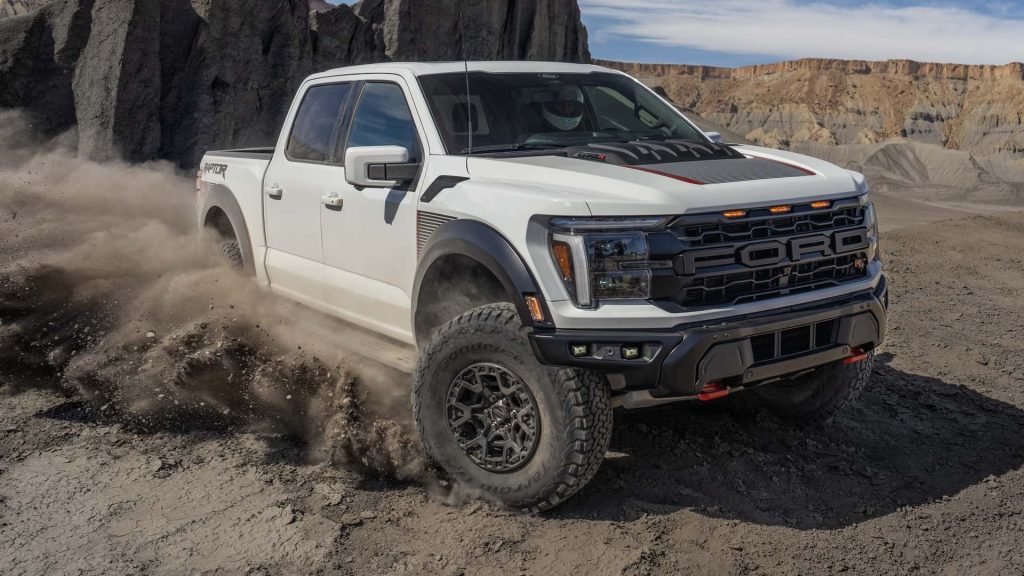
Ford is also changing the way customers can enter its performance-oriented F-150 range. For 2027, the company is introducing lower-priced versions of the Raptor and Tremor. Business Insider reports that the Raptor Low will cost approximately $4,000 less than the comparable 2026 model, while the Tremor Low will be around $5,300 cheaper.
The lower prices come from removing equipment rather than changing the basic character of the trucks.
The Raptor Low eliminates several luxury and convenience features, including the head-up display, fog lamps, 2-kilowatt Pro Power Onboard outlet, power passenger seat, under-seat storage, Mobile Office package, and 14-speaker B&O audio system. It instead uses an eight-speaker system and a manual tilt steering column.
The Tremor Low starts with the more basic F-150 STX configuration and gives up features such as dual-zone climate control, heated front seats, off-road running boards, and a power-sliding rear window.
The changes give Ford another way to broaden the F-150’s appeal at a time when full-size pickup prices have climbed substantially. Buyers who prioritize off-road capability may prefer a less expensive truck without paying for equipment they do not need.
At the same time, Ford is using software to make the F-150 more useful for customers who tow regularly. The company says 76% of F-150 customers use their trucks for towing, making the new BlueCruise capability particularly relevant to a large part of its customer base.
Ford has already invested heavily in towing assistance. Earlier technologies include Pro Trailer Hitch Assist, which helps align the truck’s hitch ball with a trailer coupler, as well as systems for trailer monitoring and weight management.
BlueCruise with Towing takes that approach a step further by addressing the highway portion of a towing trip. Instead of requiring drivers to maintain constant steering input on compatible roads, the system can handle steering, acceleration, and braking within its operating limits while the driver remains responsible for supervision.
The feature will debut on the 2027 F-150, with Ford planning to make it available across all BlueCruise-equipped versions. The company says this is only the beginning and that it expects to expand the capability to other new vehicle lines in the future.
The technology does not remove the driver’s responsibilities when towing. The trailer still needs to be properly attached, loaded, and configured, while drivers must follow applicable speed limits and remain ready to take control. Ford’s system may also disengage when conditions fall outside its operating parameters.
The 2027 F-150 is expected to reach dealerships in the first quarter of 2027. Its combination of updated engines, new equipment packages, and towing-focused BlueCruise gives Ford a broader strategy for improving the truck without relying solely on a major redesign.
For customers who spend long periods towing boats, campers, or work trailers on highways, the biggest change will be the ability to use hands-free driving assistance during those journeys.
Ford’s extensive testing and the system’s numerous restrictions indicate that the company is treating towing as a specialized use case that requires additional safeguards.
The result is not a self-driving pickup. It is a more capable driver-assistance system designed around one of the F-150’s most common jobs.
By bringing towing into BlueCruise while simultaneously expanding powertrain and equipment choices, Ford is making the 2027 F-150 a technology and product update rather than simply a new model-year refresh.
