
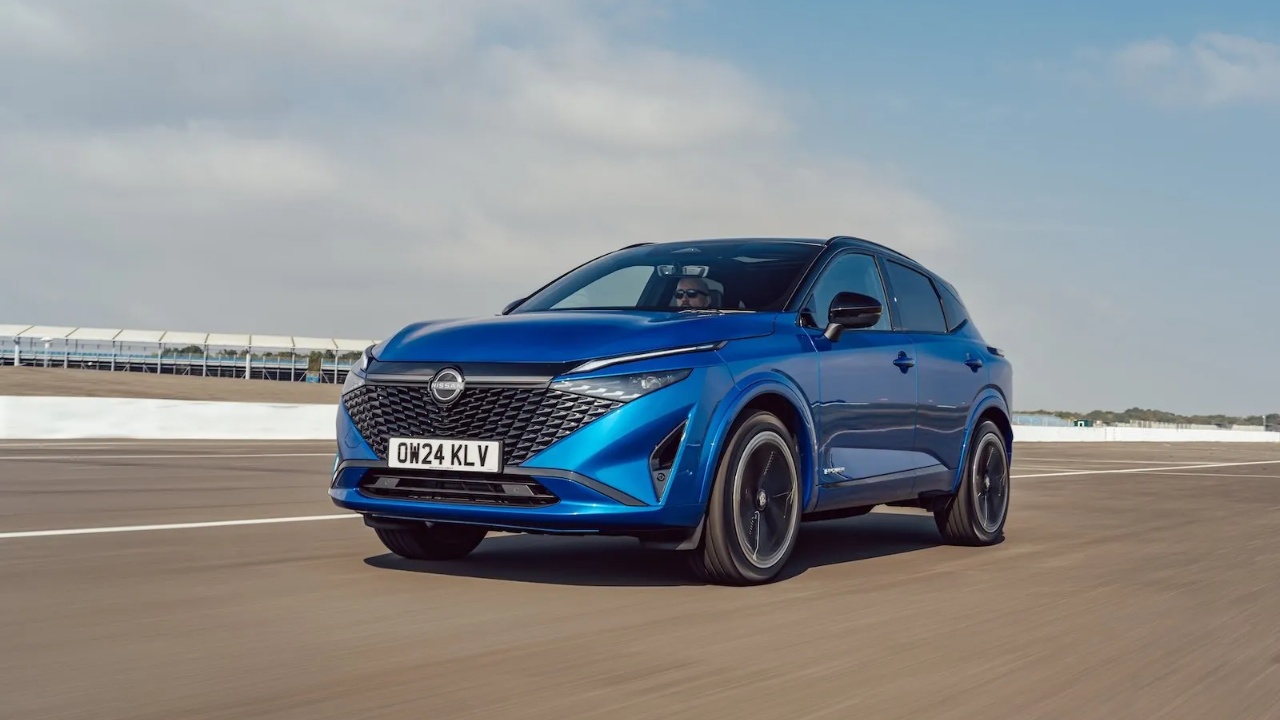
Nissan is introducing a substantially different hybrid powertrain to one of its key U.S. vehicles. The automaker has introduced the 2027 Nissan Rogue Hybrid with its third-generation e-POWER technology, making it the first Nissan model with an e-POWER system to be sold in the United States.
The launch gives Nissan a new electrified option in the highly competitive compact SUV market, where hybrid versions of models such as the Toyota RAV4 and Honda CR-V have become increasingly important to buyers.
According to Nissan, the new Rogue Hybrid combines a gasoline engine, battery, and two electric motors, but unlike a conventional hybrid, the gasoline engine does not mechanically drive the wheels.
Instead, it operates primarily as a generator, producing electricity for the battery and electric motors. Nissan says the system is designed to provide the driving response of an electric vehicle while retaining the convenience of gasoline refueling.
The U.S. introduction also comes as demand for hybrids gains momentum. MarkLines reported that U.S. new-vehicle sales declined in August 2026, but strong hybrid demand helped offset some of the weakness in the broader market.
That environment allows Nissan to use the Rogue, its core U.S. nameplate, to attract customers who want greater efficiency without moving to a fully electric vehicle.
Nissan Brings Its e-POWER Technology to America.
The biggest change for U.S. customers is not simply the addition of a hybrid badge. It is the architecture Nissan has chosen for the Rogue.
The 2027 Rogue Hybrid uses the third generation of Nissan’s e-POWER system. Nissan describes e-POWER as a series-hybrid system in which the wheels are driven exclusively by electric motors.
The gasoline engine is not connected directly to the wheels. Instead, it generates electricity that can be stored in the battery or sent to the electric drive system.
That makes the Rogue’s operation different from conventional hybrid systems used by many competitors. In a traditional hybrid, the gasoline engine and electric motor can both provide mechanical power to the wheels.
Nissan’s approach instead allows the electric motors to handle propulsion at all times, giving the vehicle characteristics that Nissan says are closer to an EV.
The system uses a 1.5-liter turbocharged three-cylinder gasoline engine specifically designed as a generator. Nissan says the latest engine was developed exclusively for e-POWER applications and achieved a thermal efficiency of 42 percent under certain operating conditions.
The third-generation system also incorporates a redesigned electric powertrain intended to improve efficiency, refinement, and packaging.
For the U.S. Rogue, two electric motors provide all-wheel drive. Nissan lists combined system output at 225 horsepower. The front electric motor produces 202 horsepower and 243 pound-feet of torque, while the rear motor produces 134 horsepower and 144 pound-feet.
Those individual motor outputs should not be added together to determine total system horsepower because the motors operate as part of an integrated system.
Every U.S.-market Rogue Hybrid will come with electric all-wheel drive. The system also supports e-Pedal operation, allowing the driver to use regenerative braking to slow the vehicle with accelerator-pedal inputs in many driving situations.
Nissan has been developing e-POWER for years, first introducing the technology in 2016. The company says nearly two million e-POWER-equipped vehicles have been sold globally, making the Rogue an important expansion of technology that has already been used in other Nissan models and markets.
2027 Rogue Hybrid Targets Efficiency and Mainstream Buyers
Nissan is developing the Rogue Hybrid as a practical mainstream SUV rather than simply a showcase for new technology. The latest e-POWER system has been calibrated for North American driving conditions, with particular attention to improving efficiency during extended periods of high-speed highway driving. This addresses one of the key challenges faced by series-hybrid powertrains.
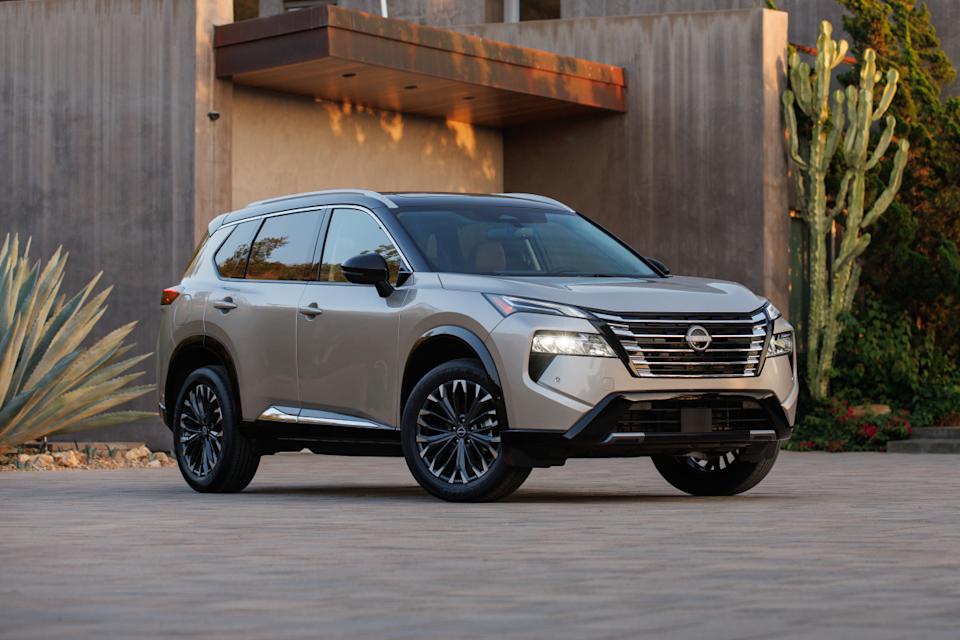
Jiji Press reported that earlier versions of e-POWER were considered less suitable for the U.S. because efficiency could deteriorate during long periods of high-speed driving. Nissan says the third-generation system improves high-speed efficiency and reduces operating noise, making it better suited to American driving patterns.
Nissan is currently targeting fuel economy of approximately 38 mpg combined, with estimates of around 40 mpg in city driving and 36 mpg on the highway. Those figures are based on Nissan’s testing and remain subject to final EPA certification. Nissan has not yet published final EPA ratings for every configuration.
The Rogue Hybrid will also arrive with a new design for the 2027 model year. Nissan is treating the vehicle as an important part of its U.S. product strategy, with the Rogue already serving as one of the company’s key vehicles in its largest market.
Nissan’s own financial presentation identified the Rogue e-POWER as one of its upcoming U.S. launches as the company focuses on market-specific products.
Pricing starts at $35,490, excluding destination charges, for the Rogue Hybrid SV. The SR starts at $37,490, while the Platinum reaches $43,490 before destination.
Nissan says the SR with its Technology Package will begin reaching U.S. dealers in limited quantities in late fall 2026, while the SV, SR, and Platinum grades are scheduled to go on sale in early 2027.
The pricing puts the Rogue Hybrid directly into a competitive portion of the compact SUV market. Buyers are increasingly able to choose between conventional gasoline models, traditional hybrids, plug-in hybrids, and fully electric SUVs.
Nissan’s e-POWER approach gives it another way to differentiate the Rogue without requiring customers to plug the vehicle into a charger.
The equipment list also reflects Nissan’s attempt to make the Rogue competitive beyond its powertrain. The SUV will offer features including a 12.3-inch digital instrument display, a 12.3-inch infotainment screen, wireless Apple CarPlay and Android Auto, Qi2 wireless charging, ProPILOT Assist, and a power liftgate.
Higher trims add larger displays, enhanced driver-assistance technology, premium audio, and additional comfort features.
Why the Rogue Hybrid Matters to Nissan
The timing of the Rogue Hybrid’s arrival is important for Nissan. The company is attempting to strengthen its U.S. lineup while the market is moving through a period in which consumers are showing strong interest in hybrids but remain divided on fully electric vehicles.
The Rogue is particularly important because it competes in one of America’s largest vehicle categories. Nissan therefore does not need the hybrid to serve as a technology experiment. It needs the vehicle to appeal to everyday SUV buyers who want better fuel economy without changing how they refuel.
That is where e-POWER could give Nissan a distinct selling point. Drivers receive electric-motor propulsion and regenerative braking, but there is no need for charging equipment or lengthy charging stops. The gasoline engine can generate electricity when required, while the battery manages energy between the engine and motors.
There are also potential trade-offs. A series-hybrid system can be highly effective in urban and mixed driving, but highway efficiency remains an important consideration for U.S. customers who frequently cover long distances.
Nissan’s decision to develop a dedicated third-generation engine and revise the e-POWER architecture specifically for larger vehicles and higher-speed operation reflects the company’s attempt to address that issue.
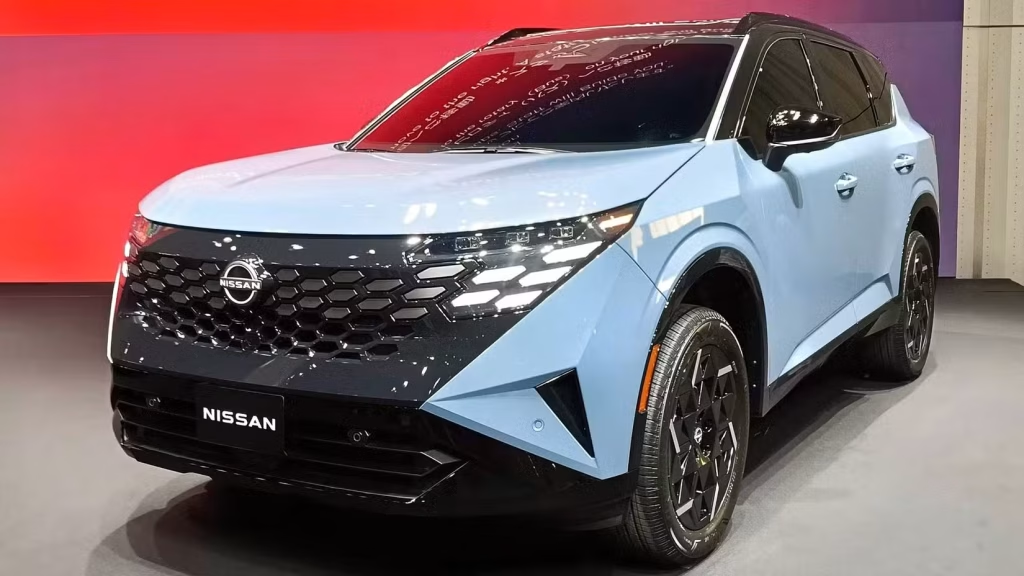
The Rogue Hybrid also arrives at a time when Nissan is expanding its electrification strategy rather than relying on a single technology. The company continues to sell conventional gasoline vehicles and fully electric models while now adding a hybrid system designed around electric propulsion.
For Nissan, the 2027 Rogue Hybrid could therefore become an important bridge between gasoline and fully electric vehicles. Its electric-drive characteristics give buyers a taste of EV-style propulsion, while its gasoline generator preserves the familiar refueling process.
With a starting price below $36,000, standard all-wheel drive and 225 horsepower, the Rogue Hybrid enters the U.S. market with a specification aimed squarely at mainstream SUV buyers. The bigger question will be how consumers respond to Nissan’s unconventional hybrid layout once the vehicle reaches dealerships.
The launch gives Nissan a new tool in one of America’s most competitive SUV segments and brings its e-POWER technology to the U.S. for the first time.
If the system delivers the promised combination of electric-like response, useful fuel economy, and gasoline convenience, the Rogue Hybrid could become a significant part of Nissan’s broader effort to rebuild momentum in the American market.
