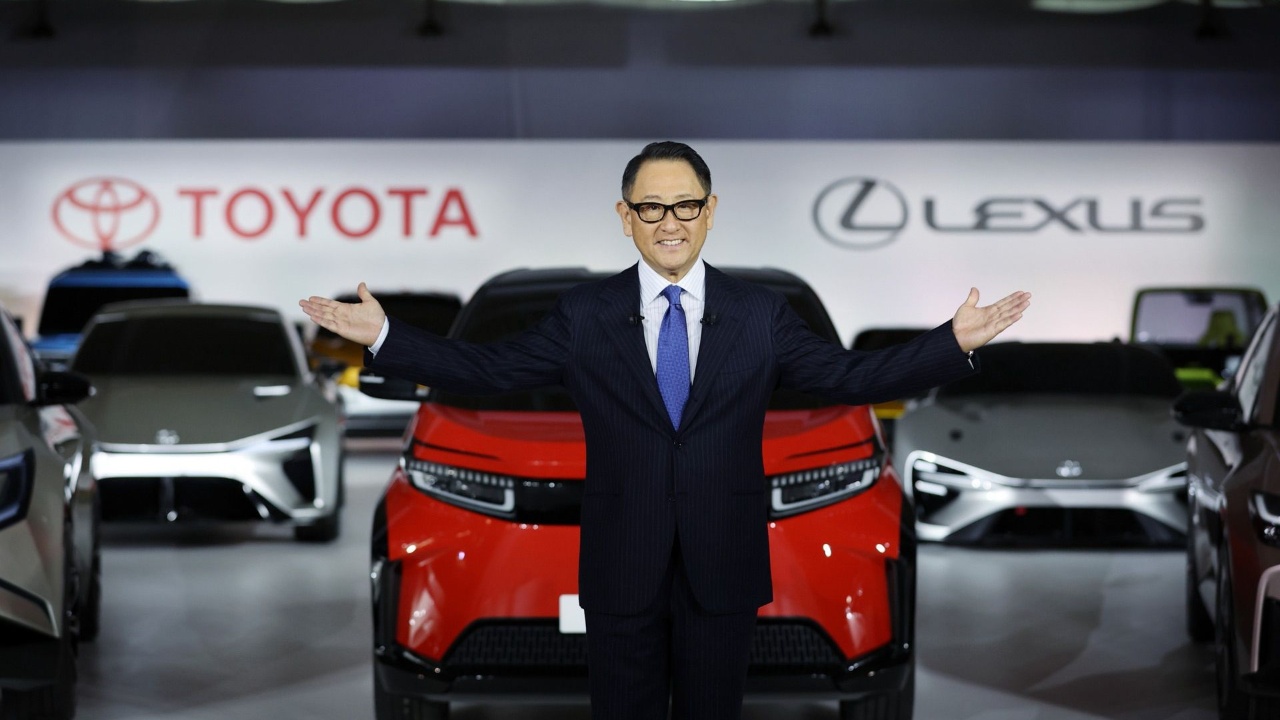
Akio Toyoda used his induction into the Automotive Hall of Fame to make a broader appeal to the auto industry. He argued that automakers may need to work more closely together as they face the enormous technological and financial challenges shaping the industry’s future.
Speaking in Detroit on September 23, the Toyota chairman urged companies across the automotive sector to combine their strengths rather than treating every competitor as an opponent.
According to CarFwd, Toyoda told an audience of more than 700 automakers, dealers, suppliers, and motorsports professionals that the industry has an extraordinary ability to improve people’s lives when it works together.
His comments came as automakers spend billions of dollars developing electric vehicles, batteries, software-defined vehicles, advanced driver-assistance systems, and artificial intelligence while still trying to keep gasoline and hybrid vehicles competitive.
Chinese manufacturers have also raised the level of competition across many of these technologies.
Toyota’s remarks did not announce a new alliance or specific joint development program. CarFwd reported that Toyota did not present the speech as the launch of a new partnership.
Instead, Toyoda made a broader argument that companies could accomplish more by combining capabilities where appropriate while continuing to compete where their products and brands differ.
Why Cooperation Is Becoming More Important
The traditional automotive industry was built around competition. Automakers developed their own engines, transmissions, platforms, and manufacturing systems, then competed through styling, performance, reliability, pricing, and brand reputation.
That model is becoming harder to maintain as vehicles turn into increasingly complex technology products.
Developing a modern vehicle can require expertise in semiconductors, cloud computing, artificial intelligence, battery chemistry, cybersecurity, operating systems, and autonomous-driving technology. Maintaining all of those capabilities internally can require enormous investment.
The pressure is particularly visible in electric vehicles. Battery development requires major investments in factories, raw materials, chemistry and engineering. Automakers must also develop software capable of managing energy consumption, charging, thermal systems and vehicle functions.
Autonomous driving presents another challenge. Advanced systems require massive amounts of data, computing power and artificial intelligence expertise. Mercedes-Benz’s agreement with British autonomous-driving company Wayve is one example of a major automaker turning to an outside technology specialist rather than developing every capability internally.
Toyota itself has extensive experience with cooperation. The company has developed relationships with Japanese automakers, including Subaru, Mazda, and Suzuki. Toyoda previously explained that these alliances were intended to combine different strengths in technology, production engineering, and sales rather than simply increase vehicle volume.
Toyota has also worked with Mazda and Denso through EV C.A. Spirit to investigate new approaches to electric-vehicle development. That history makes Toyoda’s latest comments less surprising.
Toyoda is not arguing that automakers should stop competing. Instead, he is suggesting that there are areas where cooperation can make more sense than having every company solve the same expensive technical problem independently.
Shared technology can reduce duplicated development work. Common components can increase production scale. Joint research can spread expensive development costs across multiple companies, while shared supply chains could potentially improve resilience as geopolitical tensions complicate the industry.
The difficult question is determining where cooperation ends, and competitive advantage begins.
Chinese Automakers Are Changing the Competitive Equation
Toyoda’s message arrives as Chinese automakers put additional pressure on established manufacturers.
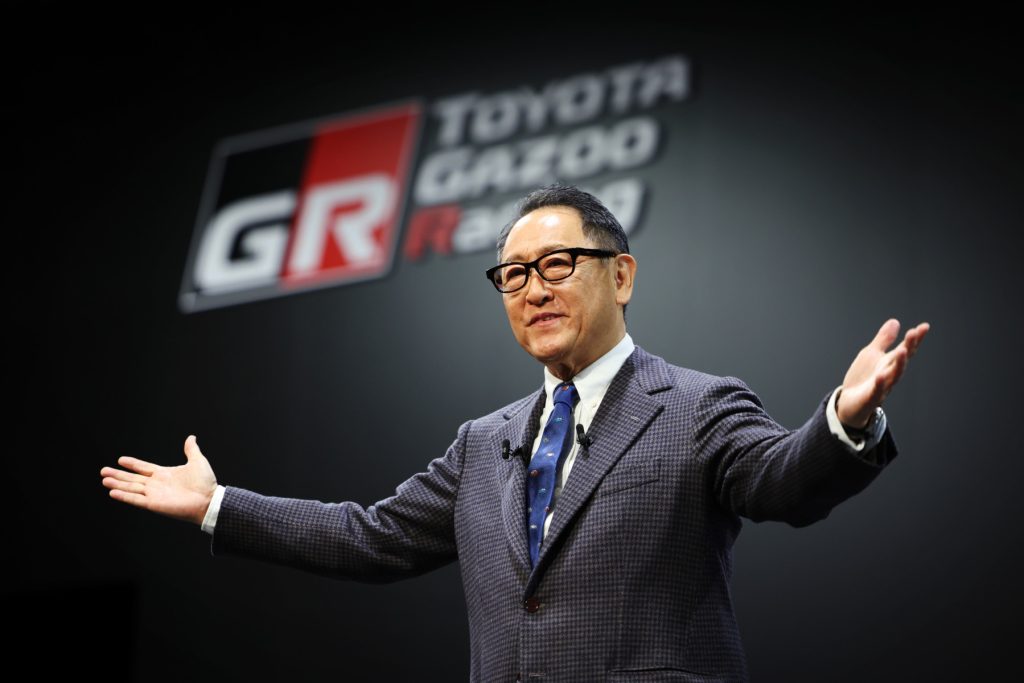
Companies such as BYD, Geely and Chery have become increasingly competitive in electric vehicles, batteries and vehicle software. Reuters has reported that foreign automakers have been losing ground in China as local manufacturers gain market share while the country’s automotive industry faces intense competition and excess production capacity.
Toyota is among the global manufacturers dealing with this changing environment. China was once a market where international automakers could rely heavily on joint ventures, established brands, and rapidly growing consumer demand.
That formula is under increasing pressure as Chinese companies develop vehicles specifically for local buyers and compete aggressively on technology and price.
Reuters also reported that Toyota was considering changes to its Chinese joint-venture structure, highlighting the broader pressure on foreign automakers as they confront overcapacity, faster EV development, and changing market share.
That environment makes cooperation more attractive. If several automakers can share expensive development work while retaining their individual brands, they may be able to respond faster without each company carrying the entire financial burden.
The idea is particularly relevant to software. Traditional mechanical engineering allowed automakers to differentiate products through unique engines, transmissions, and chassis tuning. Software works differently.
An operating system, connectivity platform, or driver-assistance architecture can potentially be used across multiple vehicle lines with relatively little physical change.
That creates economies of scale. A company that develops a competitive software platform can spread development costs across millions of vehicles, while smaller production volumes make those investments harder to recover.
Toyoda’s argument fits directly into that environment. Cooperation can effectively create scale without requiring companies to merge completely.
One automaker may have stronger manufacturing expertise. Another may have better software capabilities. A third may possess advanced battery technology or a strong regional supply chain. Combining those strengths can potentially produce a stronger result than trying to duplicate every capability internally.
This approach is already appearing across the industry. Toyota and other companies have worked together on hydrogen technology, while European manufacturers are increasingly forming partnerships with technology companies for autonomous driving and software.
Toyota has also participated in efforts involving Daimler Truck, Volvo Group, Bosch, and others to develop infrastructure and an ecosystem for hydrogen-powered commercial vehicles in Europe.
Competition Will Not Disappear
Toyoda’s call for cooperation should not be interpreted as an argument that automotive competition is becoming obsolete. It could actually make competition more focused.
If companies cooperate on basic technologies, they can devote more resources to areas where consumers can clearly see differences.
Automakers could share underlying software architecture while competing on how that software is used. They could share battery technology while differentiating vehicles through efficiency, design, suspension tuning, and performance. They could cooperate on charging infrastructure while competing over range, pricing, and customer experience.
The automotive industry has historically been different from many technology industries because manufacturers maintained deep control over vehicle development. But electrification and software are weakening some of those boundaries.
A modern vehicle increasingly resembles a collection of interconnected technology systems rather than simply an engine, transmission, and body. That makes partnerships more practical.
There are limits, however. Cooperation between competitors can create concerns around intellectual property, data ownership, cybersecurity and antitrust regulations. Automakers would have to determine carefully which technologies can be shared without weakening competition.
Safety also complicates the equation. If several manufacturers depend on the same software or electronic architecture, a problem could potentially affect vehicles across multiple brands. That makes validation, cybersecurity, and quality control particularly important.
Toyoda’s message therefore does not represent an easy solution. It is better understood as recognition that the automotive industry may have reached a point where fighting every technological battle alone is increasingly difficult.
His own career provides additional context. Toyota said Toyoda became company president in 2009 during a difficult period for the automaker.
During his leadership, Toyota emphasized quality controls, customer relationships, and its philosophy of making ever-better cars. He later became chairman of the board and was inducted into the Automotive Hall of Fame in Detroit on September 23, 2026.
The recognition also gave his comments significance beyond Toyota. Toyoda became the fourth member of the Toyoda family inducted into the Hall of Fame, joining Kiichiro Toyoda, Shoichiro Toyoda, and Eiji Toyoda.
Rather than using the occasion simply to celebrate Toyota’s history, he directed attention toward the future of the wider industry. That future will require enormous investment.
Automakers need to develop electric powertrains without abandoning customers who still want hybrids or gasoline vehicles. They need increasingly sophisticated software while maintaining traditional standards for reliability. They must respond to Chinese competitors while navigating tariffs, trade restrictions, and regional manufacturing requirements.
Trying to solve every one of those challenges independently could become prohibitively expensive.
Cooperation offers one possible answer. It does not mean automakers have to become identical. The most effective partnerships may be those that allow companies to share expensive foundations of modern vehicles while preserving differences in design, engineering, branding and customer experience.
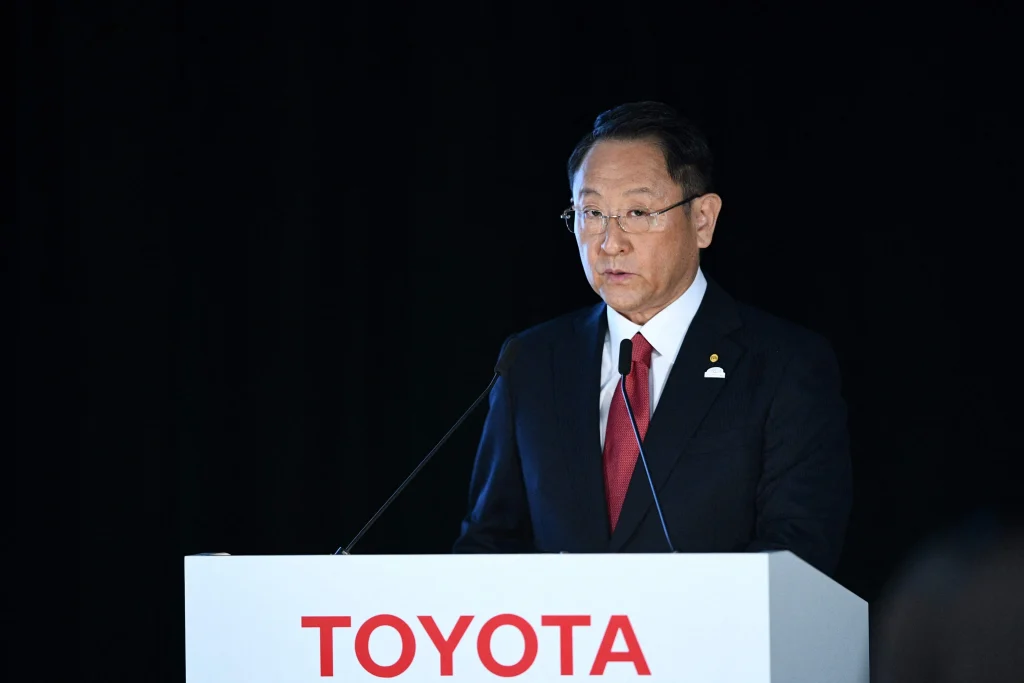
That is likely the more practical interpretation of Toyoda’s message. The automotive industry will remain intensely competitive. Toyota will continue competing against Volkswagen, General Motors, Ford, Hyundai, BYD, Tesla and other manufacturers.
But the technologies required to build the next generation of vehicles are becoming too complex and expensive for every company to develop completely alone.
Toyoda’s call for cooperation is therefore less about ending competition and more about changing where companies choose to compete.
As the industry moves deeper into electrification, software, artificial intelligence and advanced mobility, the companies that know when to cooperate may have an advantage over those that insist on doing everything themselves.
For Toyoda, that may be one of the clearest lessons from more than a century of automotive history. Progress does not always depend on one company winning every competition. In some cases, the industry can advance more quickly when rivals identify the challenges they can tackle together.