
Cars have carried some remarkably unusual equipment over the decades. Long before touchscreens, smartphone integration, and advanced driver-assistance systems became normal, automakers were already experimenting with ideas that sounded impressive in a showroom but could look bizarre in everyday use.
Some features were created to solve genuine engineering problems. Others were intended to improve comfort, entertainment, or convenience, while a few seemed designed mainly to make a vehicle stand out. Some disappeared quickly because the technology was not ready, while others anticipated features that eventually became common.
The most interesting examples came from manufacturers willing to challenge conventional automotive thinking. These are 10 unusual features that actually made it into production cars.
1. In-Car Record Player
Putting a record player inside a moving automobile sounds like an obvious recipe for problems, yet Chrysler actually offered one in the 1950s. Called Highway Hi-Fi, the system was introduced for the 1956 model year as an attempt to give motorists something considerably more advanced than the AM radios of the period.
The idea was surprisingly sophisticated for its time. Highway Hi-Fi used specially produced seven-inch records rather than ordinary vinyl albums. The player was mounted beneath the dashboard, allowing the driver or passenger to select music without carrying a conventional home turntable into the vehicle.
The appeal was easy to understand. Portable music technology was extremely limited compared with today’s smartphones and streaming services, so having a dedicated music player inside the car represented a significant step toward personalized in-car entertainment.
The problem was that automobiles are hostile environments for conventional record players. Roads produce constant vibration, bumps, and sudden movements, while temperatures inside parked vehicles can become extreme.
The specialized records and stylus were designed to resist skipping, but the system still had limitations. AAA notes that poor road surfaces could cause the records to skip, while the proprietary format meant owners could not simply use their existing record collections.
That limited selection was one of the system’s biggest weaknesses. Owners needed recordings specifically compatible with Highway Hi-Fi, making the available library much smaller than the music collections people could play at home.
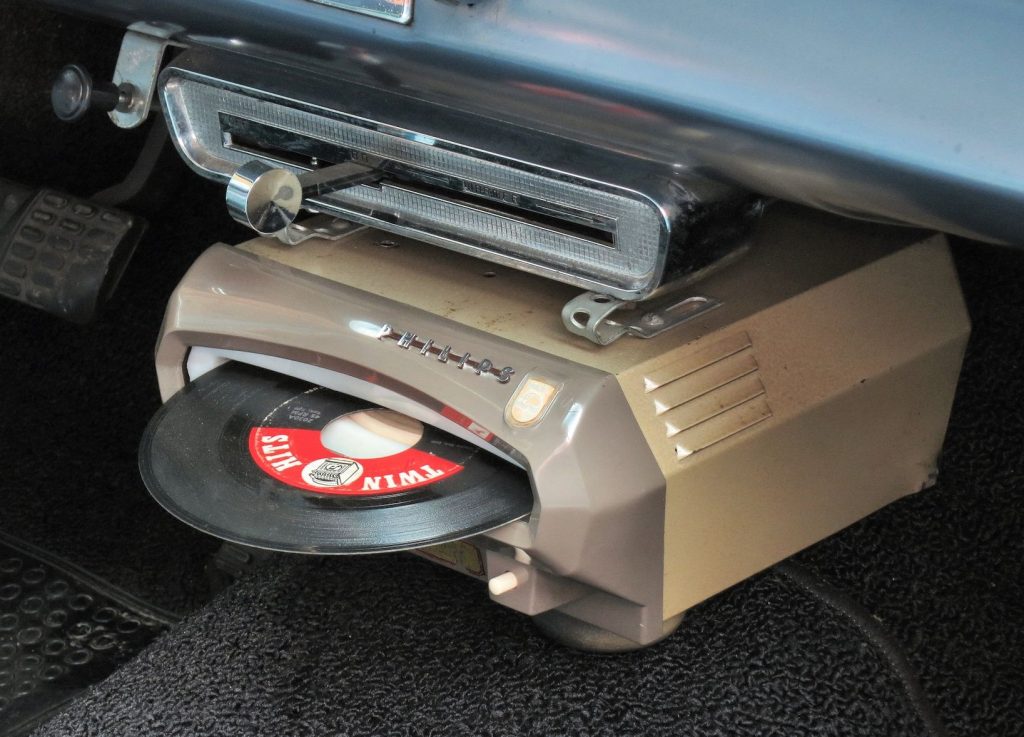
The system did not become a long-term success, but its significance goes beyond its short production life. It represented one of the earliest attempts to give vehicle occupants control over their entertainment instead of forcing them to rely on whatever was available through broadcast radio.
Today’s vehicles can stream almost unlimited music from a smartphone. Highway Hi-Fi required a specialized player and specially produced records to achieve a much more limited version of the same basic objective. It was technologically ambitious, commercially awkward, and undeniably strange.
2. Touch-Sensitive Controls Before Touchscreens
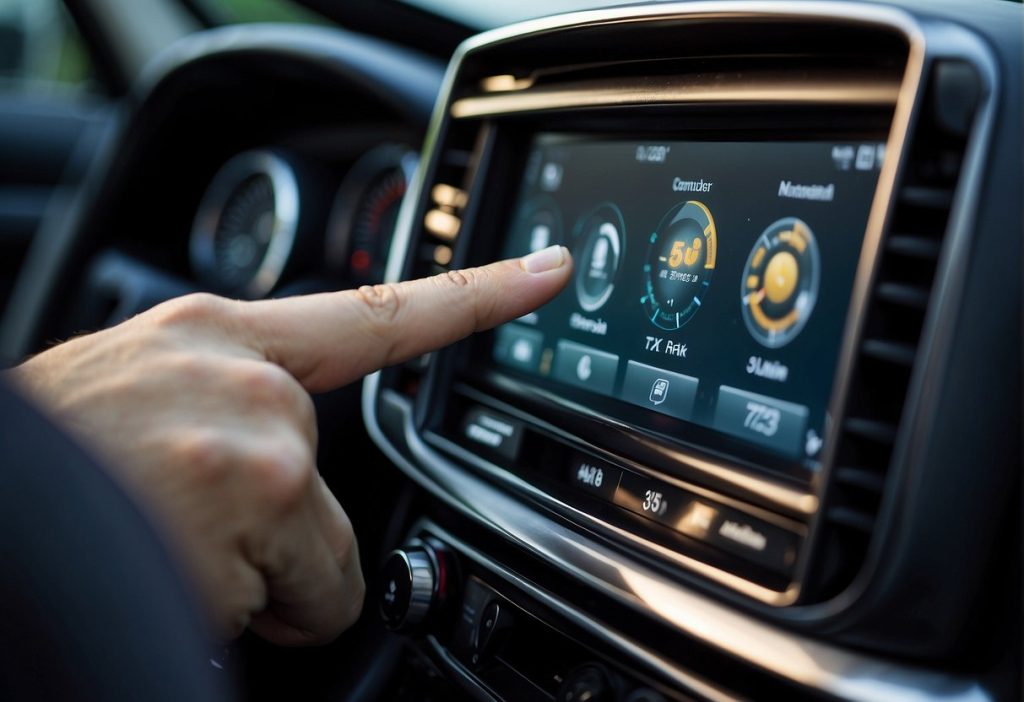
Decades before modern cars began replacing physical buttons with large infotainment displays, Aston Martin attempted something remarkably similar. The Series 2 Lagonda, introduced in 1976, used touch-sensitive electronic controls instead of relying entirely on conventional switches and mechanical gauges.
The Lagonda’s interior was radically different from the luxury dashboards of its era. The car reportedly used more than 40 touch-sensitive controls for functions including the headlights, windows, air conditioning, cruise control, door locks, and seat memory.
Digital displays replaced information that would normally have been shown through conventional gauges. For the 1970s, this was extraordinary.
Modern drivers are familiar with electronic interfaces, capacitive controls, and digital displays, but automotive electronics were far less mature when Aston Martin attempted this approach. The company was effectively trying to create a digital vehicle interface decades before such systems became commonplace.
The futuristic controls also matched the car’s exterior. The Lagonda featured sharp, angular styling that looked deliberately different from traditional luxury automobiles. Aston Martin wanted the vehicle to appear as though it had arrived from the future.
The biggest problem was reliability. Early electronic components were not nearly as dependable as modern automotive electronics, and the Lagonda’s complicated systems became part of the model’s reputation. The controls looked impressive, but diagnosing and repairing them could be difficult.
That makes the Lagonda particularly interesting in hindsight. The fundamental idea was not wrong. Modern cars have adopted many aspects of the concept. The problem was that Aston Martin attempted to introduce the technology before electronic interfaces had reached the reliability needed for widespread adoption.
The Lagonda therefore stands as one of the strangest automotive features because it was simultaneously ambitious, problematic, and remarkably ahead of its time.
3. Headlights That Turned With the Steering Wheel
Adaptive headlights may seem like a modern invention, but the basic idea dates back much further. Citroën introduced one of the most unusual versions on the DS following its 1967 redesign.
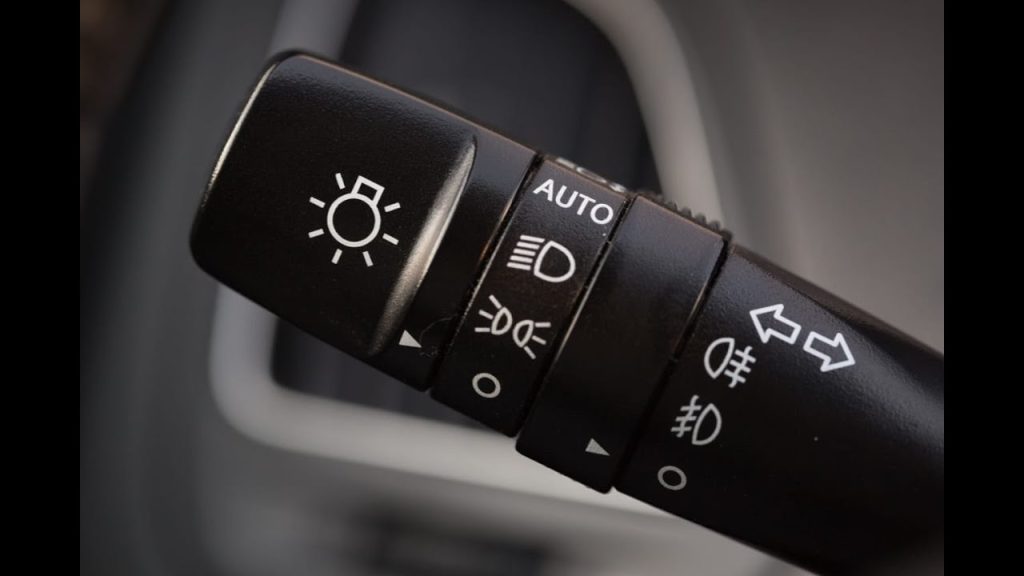
Instead of keeping all four headlights fixed, the inner high-beam headlights were mechanically linked to the steering system. When the driver turned the steering wheel, the headlights turned with it, directing light toward the road the vehicle was entering rather than continuing to illuminate straight ahead.
On tighter corners, the inner headlight could pivot dramatically, with documented movement reaching roughly 80 degrees.
The advantage was obvious when driving at night. A conventional headlamp illuminates the area directly ahead of the vehicle, but on a sharp bend, the car may begin turning long before the headlights point toward the road beyond the corner. Citroën’s system attempted to solve that problem mechanically, decades before electronic adaptive lighting became widespread.
The system was integrated into the DS’s distinctive nose. Four headlights were positioned beneath smooth covers, contributing to the car’s futuristic appearance.
There was one major complication for American buyers. Moving headlights did not comply with U.S. lighting regulations at the time, so American-market DS models used fixed headlights instead.
The feature is fascinating because it was not strange simply for the sake of being unusual. Citroën had identified a genuine nighttime-driving problem and developed a mechanical solution long before modern sensors, computers, and adaptive LED systems could perform the same task electronically. What once looked futuristic has since become normal in a much more sophisticated form.
4. A Tire-Pressure System Built Into the Wheels
Modern tire-pressure monitoring systems are so common that most drivers barely notice them. In the 1980s, however, Porsche was already experimenting with a highly advanced approach on the 959, and its implementation was anything but ordinary.
The Porsche 959 used magnesium wheels with hollow spokes that formed sealed chambers connected with the tires. This construction allowed the vehicle to monitor tire pressure electronically and provide the driver with information about tire-pressure conditions.
That was remarkable technology for the period. The 959 itself was essentially a technological showcase that happened to become a production car.
Porsche combined advanced all-wheel drive with adjustable dampers, self-leveling suspension, ABS, and other sophisticated systems. Tire pressure was especially important because the vehicle’s performance depended heavily on maintaining predictable tire behavior.
What made the system particularly unusual was its integration. Porsche did not simply attach a basic pressure sensor to the wheel. The wheel, tire, and monitoring equipment were engineered as part of a specialized package.
Porsche’s historical material identifies tire-pressure monitoring among the 959’s innovations and notes that only 292 examples were built in series production from 1987 to 1988.

Today, a tire-pressure warning can appear in an inexpensive commuter car. Drivers rarely think about the complexity behind it because the technology has become routine.
The 959 demonstrates how dramatically automotive technology can change. What was once an exotic feature on one of the world’s most advanced performance cars eventually became a normal safety system. The feature was strange partly because it was so far ahead of its time.
5. A Built-In Telephone
Before smartphones and Bluetooth transformed vehicle connectivity, some luxury cars attempted to turn the automobile itself into a communications device. Factory-installed car telephones were among the strangest premium features because they made the cabin resemble an executive office more than a normal automobile.
The technology appeared in high-end vehicles, particularly during the 1980s and 1990s. Unlike today’s wireless smartphone integration, these systems used a dedicated handset physically installed inside the vehicle, often positioned within reach of the driver or in the center console.
For wealthy customers and business users, the idea made considerable sense. Mobile phones were expensive, bulky, and inconvenient at the time, so having a permanent telephone in the vehicle provided a useful alternative.
It was also a status symbol. A factory-installed telephone demonstrated that the car contained technology normally associated with a corporate office.
The hardware was cumbersome by modern standards. The system required a dedicated handset, communications electronics, and an external antenna. It also depended on the cellular networks available during the vehicle’s production period.
As mobile phones became smaller, cheaper and more capable, the advantage disappeared. Carrying a personal phone became far easier than maintaining a dedicated telephone installation inside the car.
The interesting part is that the objective has not changed. Drivers still want to make calls while traveling. What changed was the technology used to accomplish it.
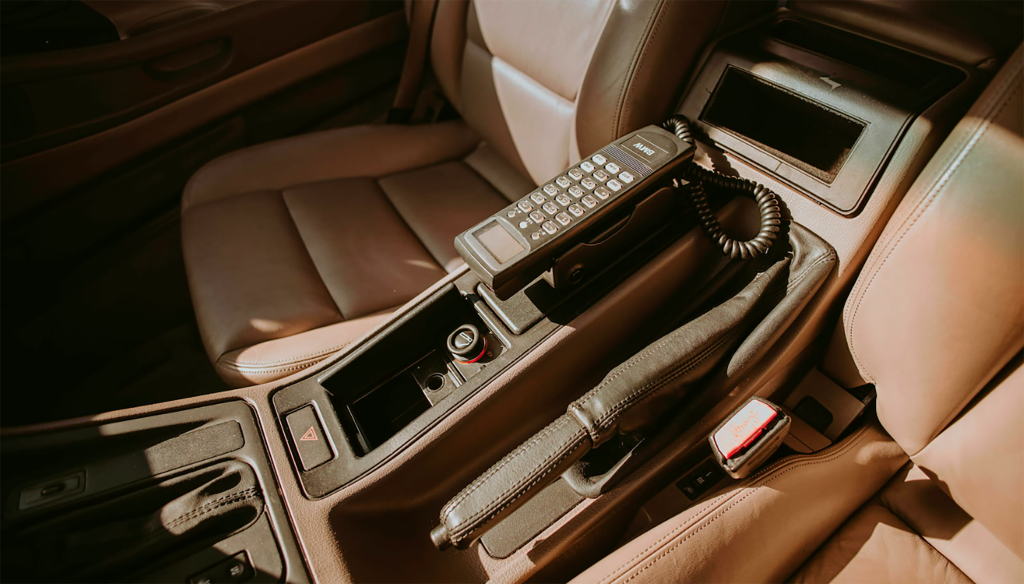
The factory car phone was therefore an early version of something that is now routine. What once required a permanent telephone installation can now be handled by a device that fits inside a pocket.
For a short period, however, the built-in car telephone represented the height of automotive luxury and technological sophistication.
6. A Refrigerator in the Center Console
A refrigerator inside a car sounds excessive until the type of vehicle is considered. Ultra-luxury manufacturers have experimented with cooled storage for decades, and few features demonstrate the industry’s pursuit of passenger comfort more clearly.
One notable example was the Maybach 57 and 62, which offered refrigerator compartments as part of their extensive luxury equipment. The vehicles were positioned above conventional luxury sedans and intended to provide limousine-like comfort to wealthy occupants.
The refrigerator was particularly appropriate for rear passengers. A Maybach could combine cooled drinks with powered rear seats, entertainment systems and other equipment intended to make long journeys feel more like traveling in a private lounge.
The strange part is not that a vehicle can cool something. Modern vehicles already provide air conditioning and, in some cases, cooled storage. The unusual decision was to dedicate valuable space, electrical capacity and engineering effort specifically to keeping drinks cold.
In an ordinary commuter car, that would add cost and complexity for a task easily handled by an insulated bottle or small cooler.
In an ultra-luxury vehicle, however, the purpose was different. The buyer was not simply paying for transportation. The entire product was designed around eliminating small inconveniences. The refrigerator was therefore more about exclusivity than necessity.
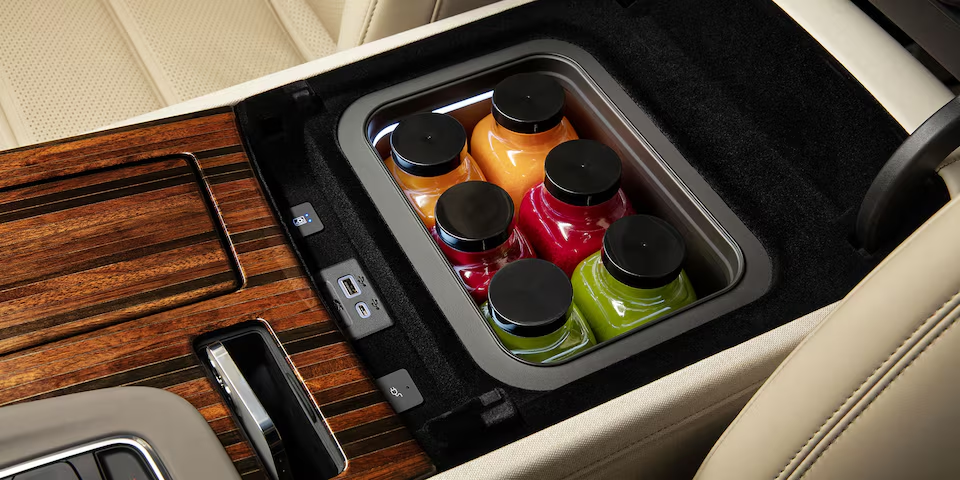
This illustrates how luxury manufacturers compete at the highest end of the market. Once a vehicle already provides power, comfort, leather, entertainment and advanced climate control, manufacturers need additional ways to distinguish it from less expensive alternatives.
A refrigerator may have little effect on driving, but it can become part of the passenger experience.
For most drivers, cooled storage remains an unnecessary luxury. In an ultra-expensive limousine, however, even a chilled bottle within arm’s reach can become a selling point.
7. A Built-In Umbrella
An umbrella seems completely unrelated to automotive engineering, yet Rolls-Royce has made carrying one part of the vehicle itself. Several Rolls-Royce models have featured dedicated umbrella storage integrated into the doors.
The idea is remarkably simple. Instead of leaving an umbrella loose in the trunk or somewhere inside the cabin, the vehicle provides a specially shaped compartment where it can be stored. On models such as the Phantom, the umbrella slides into a dedicated holder within the door area, making it accessible without opening the trunk.
It may sound like a minor convenience, but it reflects an important philosophy behind ultra-luxury vehicles. The objective is not merely to transport occupants. The vehicle is supposed to anticipate small inconveniences and remove them.
The feature becomes particularly useful during rain. An umbrella buried inside the trunk is not much help when the owner is standing outside the vehicle in a downpour. Keeping it immediately accessible allows the occupant to retrieve it while opening the door.
Rolls-Royce also designed the storage area so that the umbrella could be returned to the vehicle without simply being placed on a seat or carpeted floor while wet.
There is no major technological breakthrough involved. No complicated electronics are required, and the feature does nothing for horsepower, braking or fuel economy. Its importance comes entirely from convenience.
That is precisely why it stands out. Most manufacturers expect owners to bring their own umbrellas. Rolls-Royce effectively treated one as part of the vehicle’s equipment.

The idea also fits the brand’s broader emphasis on craftsmanship and attention to detail. The feature is simple enough to understand immediately, but distinctive enough to reinforce the impression that the car has been designed around the passenger.
In an industry where unusual features often involve complicated technology, the Rolls-Royce umbrella compartment demonstrates that simplicity can be just as memorable.
8. A Built-In Vacuum Cleaner
Few automotive features sound as unexpected as a vacuum cleaner installed inside the vehicle. Honda turned that unusual idea into production equipment with the Odyssey minivan in Japan and later used similar concepts elsewhere.
The attraction was straightforward. Family vehicles can become messy quickly, particularly when they carry children, pets, food and sports equipment. Instead of forcing owners to take the vehicle home and use a household vacuum or carry a separate portable unit, an integrated vacuum could be available whenever needed.
Honda’s system placed the vacuum inside the vehicle and included a hose that allowed occupants to clean different areas of the cabin. The system could use the vehicle’s electrical supply, effectively turning the minivan into a self-contained cleaning station.
For a family vehicle, the feature actually made considerable sense. A minivan is fundamentally a utility machine. It is expected to transport people and belongings, often under messier conditions than a sports car or luxury sedan. Food crumbs, dirt and other debris are unavoidable when children are involved.
The integrated vacuum addressed that genuine problem. What made it strange was the fact that manufacturers normally keep transportation and cleaning separate. A vehicle can carry a vacuum cleaner, but it does not normally become the vacuum cleaner.
Honda blurred that distinction. The feature also demonstrates a different approach to automotive design. Manufacturers often focus on horsepower, efficiency, handling or electronic technology, but owners experience their vehicles in many other ways.
A practical feature that makes everyday life easier can sometimes have greater value than a complicated technical system.
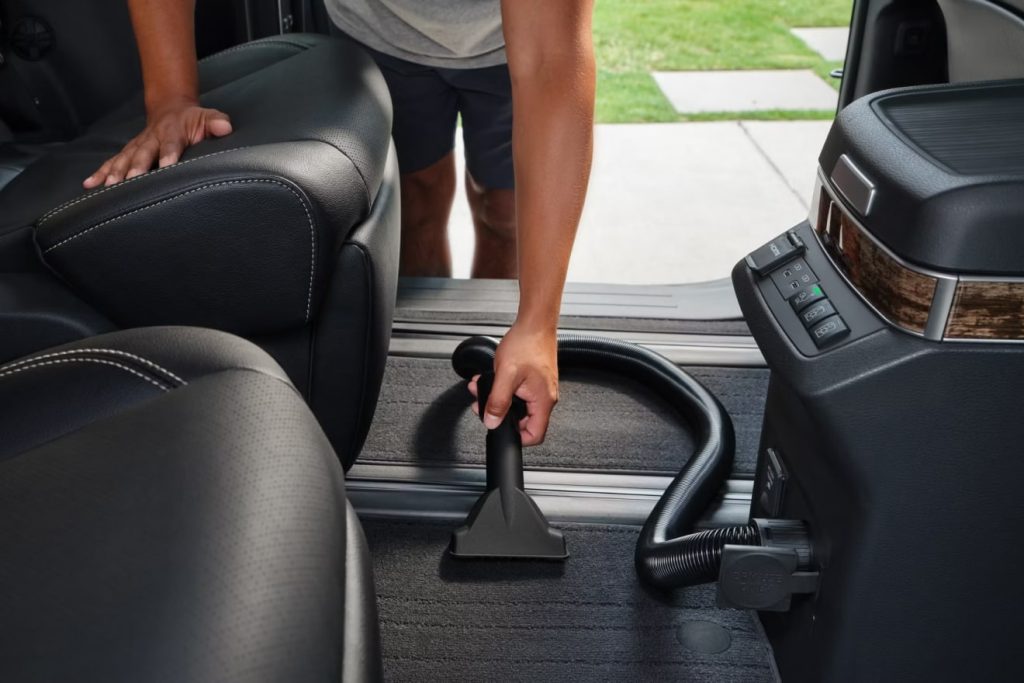
The vacuum cleaner did nothing to improve acceleration or fuel economy. Its value came from solving a small but recurring ownership problem. That makes the idea surprisingly clever beneath its unusual appearance.
In a market increasingly filled with sophisticated electronics, an integrated vacuum cleaner feels almost charmingly simple. It takes an ordinary household appliance and asks why the owner should have to bring one to the car when the car could carry its own. For families, that can be more useful than many far more expensive automotive gadgets.
9. A Dashboard-Mounted Flower Vase
A flower vase may be one of the least automotive objects ever placed inside a production vehicle, yet Volkswagen made one part of the classic Beetle’s interior identity. The small vase was mounted on the dashboard and provided a place for a flower or small decorative arrangement.
The feature had little connection to performance, safety or mechanical engineering. Its purpose was largely emotional.
The Beetle was designed as an approachable people’s car, and the vase added a small personal touch to an otherwise simple interior. Rather than hiding the feature inside a compartment, Volkswagen placed it in a visible location within the driver’s surroundings.
That made it part of the car’s personality. Compared with modern dashboards filled with digital displays, cameras and electronic controls, the idea of dedicating space to a flower seems almost absurd. Yet that simplicity was part of its charm.
The vase helped distinguish the Beetle from more serious-looking vehicles. It was playful and entirely nonessential, suggesting that an automobile could have personality without relying on expensive technology.
There was also almost nothing to maintain. No electronics were involved, and no complicated mechanism could fail. Owners simply placed a flower inside.
That simplicity is one reason the feature remains memorable. Most vehicles from the same period had radios, ashtrays and mechanical gauges, but very few provided a dedicated location for a flower.
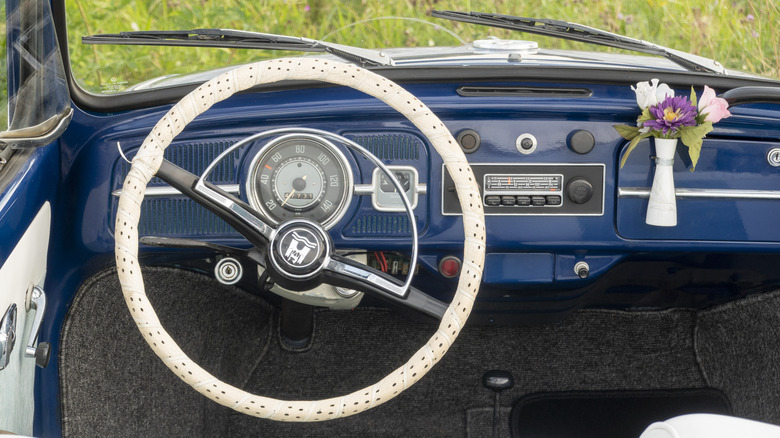
The feature also demonstrates that strange automotive equipment does not always need a practical purpose. Sometimes manufacturers add something simply because it gives a product character.
The Beetle’s vase became part of that character. It turned an ordinary dashboard into a more personal environment and gave owners a small opportunity to make the car their own.
In an industry where manufacturers constantly compete to make interiors more technically impressive, Volkswagen demonstrated that an inexpensive decorative feature could be just as recognizable. Few automotive features have ever been less essential and more memorable.
10. A Built-In Picnic Table
Some automakers have moved beyond traditional storage features by incorporating unusual equipment directly into their vehicles. One example is the built-in picnic table, a feature designed to provide a practical surface for eating, writing, preparing equipment, or handling other tasks while away from home.
The concept has appeared on vehicles aimed at outdoor recreation and passenger convenience, including certain Range Rover models with a deployable rear picnic table. The feature complements the luxury SUV’s ability to serve as both a comfortable road vehicle and a tool for outdoor activities. When parked without access to conventional facilities, occupants can use the built-in table for food, drinks, equipment, or other items without carrying separate furniture.
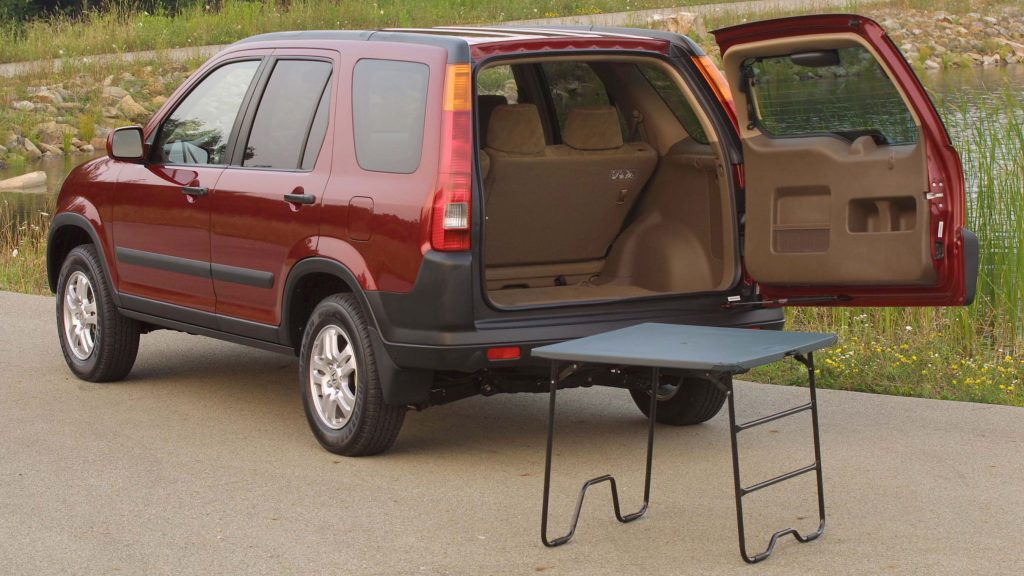
The idea also reflects how modern SUVs and luxury vehicles have evolved into lifestyle products. Owners increasingly use them for camping, road trips, tailgating, sporting events, and other outdoor activities where practical equipment can be valuable.
A picnic table does not improve performance, fuel economy, or handling. Its benefit appears after the vehicle reaches its destination. By providing a stable surface wherever the vehicle stops, it allows the car to serve as more than transportation. While unusual, the feature demonstrates how manufacturers are increasingly designing vehicles around the broader ownership experience and the activities that take place beyond driving.
