The automobile industry has produced millions of conventional cars, but some manufacturers have never been afraid to try something radically different.
From vehicles with doors built into their noses to cars that could travel on both roads and water, automotive history contains production models that seem almost impossible to imagine coming from a normal factory.
What makes these vehicles particularly interesting is that they were not merely one-off prototypes. They were genuine production models offered to paying customers, with some built in meaningful numbers and others produced for several years.
Their unusual designs often came from attempts to solve practical problems involving cost, space, fuel economy, urban mobility, or local regulations.
Here are eight production cars whose designs pushed far beyond conventional automotive thinking.
1. BMW Isetta
Few production cars have ever looked as unusual as the BMW Isetta. Its tiny rounded body, narrow rear track, and front-opening door made it resemble a household appliance more than a conventional automobile. Yet this strange little vehicle became an important postwar product for BMW, with more than 161,000 examples produced between 1955 and 1962.
Its strangest feature was also its most obvious. Instead of conventional side doors, the entire front section opened forward. The steering column was connected to the door, allowing the driver and passenger to enter directly through the nose.
For a vehicle designed around extreme compactness, this was an ingenious solution because there was very little conventional side structure available for normal doors.
The Isetta was tiny by any American standard. It was never intended for highway cruising or carrying a large family. Instead, it belonged to the European microcar movement that developed when consumers needed inexpensive transportation but could not justify a full-sized automobile.
BMW extensively re-engineered the original Italian design and replaced its powerplant with a BMW single-cylinder motorcycle-derived engine. A 247 cc version produced about 13 horsepower, while later versions received larger engines.
Its tiny footprint was the main advantage. Crowded European cities had limited parking, expensive fuel, and narrow roads, making a vehicle that occupied very little space extremely useful.
The Isetta was also commercially important to BMW during a difficult postwar period. It was not simply a novelty vehicle. Its success demonstrated that unconventional engineering could provide a practical answer to the economic realities of its era.
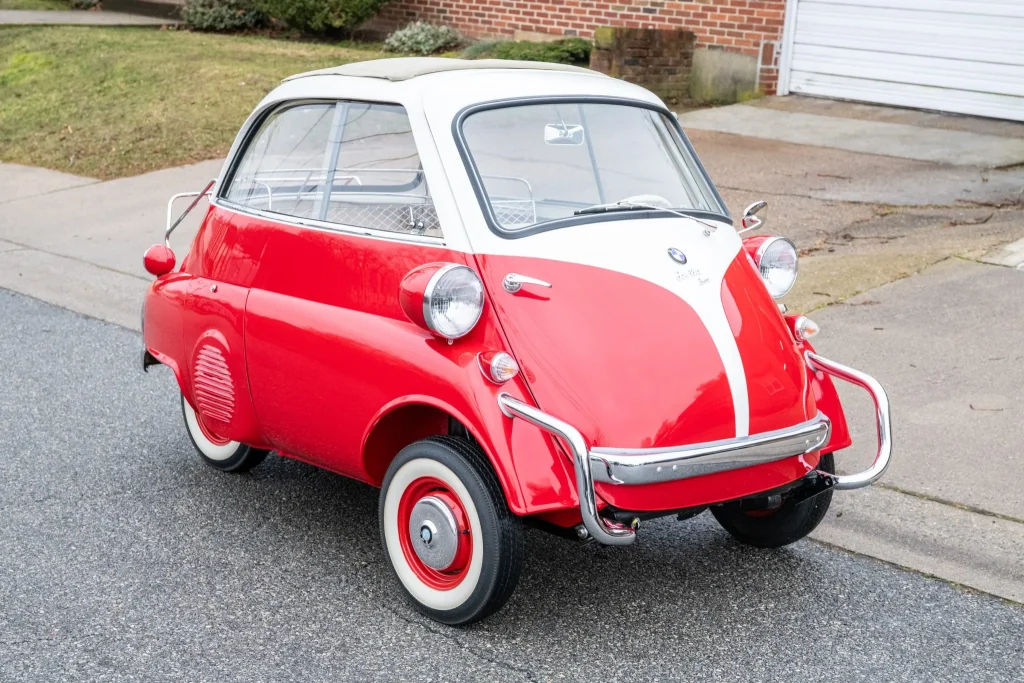
What makes the Isetta so strange today is its complete absence of familiar proportions. There is no long hood, conventional trunk, or traditional sedan profile. The driver sits almost directly behind the windshield, while the rounded roof makes the vehicle look more like a compact cabin mounted on wheels.
Its unusual appearance was therefore a consequence of engineering rather than styling for its own sake.
2. Peel P50
The Peel P50 takes the concept of a small car to an almost absurd conclusion. Built on the Isle of Man beginning in 1962, it was designed as a tiny urban vehicle and became famous for its extraordinarily compact dimensions. Peel Engineering identifies it as the world’s smallest production car, with just 50 original examples built.
Calling it a car requires some imagination. The P50 had three wheels, one door, and a cabin barely large enough for a single adult. Peel’s own description emphasizes its ability to carry one adult and a shopping bag.
That tells you almost everything about its purpose. The P50 was designed for short urban journeys rather than conventional family transportation. Its tiny size allowed it to occupy very little road and parking space, while its lightweight construction kept its mechanical requirements extremely simple.
One of its strangest features was the absence of reverse gear. Instead of selecting reverse, the driver could physically move the lightweight vehicle using a handle at the rear.
From a modern perspective, that sounds ridiculous, but the engineering logic is understandable. A vehicle this small and light did not necessarily need the mechanical complexity of a conventional reverse system.
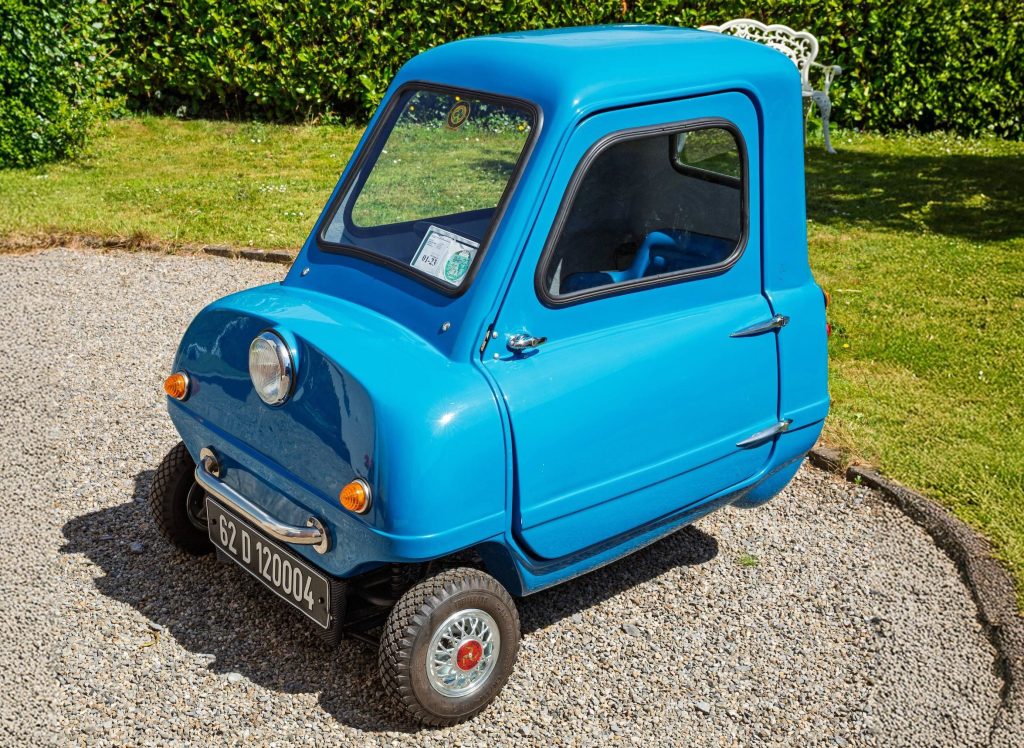
The original P50 was equally minimalist. It had a single headlight, one windscreen wiper, and one door. Only 50 original examples were produced, making it exceptionally rare, but it was still a genuine production vehicle sold to customers rather than a prototype.
Its philosophy was almost the opposite of the typical American automobile. Instead of asking how much power, space, and equipment could be placed into a vehicle, Peel effectively asked how little was necessary.
That radical minimalism is why the P50 remains famous. It was not merely a small car. It was an attempt to redefine what a car needed to be.
3. Messerschmitt KR200
If the BMW Isetta looked unusual, the Messerschmitt KR200 looked as though someone had taken an aircraft cockpit and placed it on three wheels.
Produced in Germany from 1955 to 1964, the KR200 was one of the most distinctive products of the European postwar microcar boom.
Its aviation-inspired appearance was not accidental. Messerschmitt had been an aircraft manufacturer, and its involvement in microcars came during a period when Germany was rebuilding and demand for inexpensive transportation was strong.
The KR200 broke almost every visual rule associated with a normal automobile. Instead of side-by-side seating, occupants sat in tandem, with the passenger behind the driver. Its narrow body helped keep the vehicle compact, while the transparent canopy gave it an unmistakable aircraft-like appearance.
Getting inside was another unusual experience. The canopy opened upward, making the vehicle resemble a tiny fighter aircraft parked on the street. Inside, the driver faced a narrow cockpit rather than a conventional dashboard.
The engineering was equally unconventional. The KR200 used three wheels and a small two-stroke engine mounted at the rear. Its lightweight construction meant that it did not require anything close to the power of a conventional family car.
Yet the KR200 was not merely a bizarre styling exercise. Its philosophy made sense in postwar Europe. Consumers needed affordable transportation, but many could not afford a full-sized automobile. Microcars provided an inexpensive bridge between motorcycles and conventional cars.
The unusual seating arrangement also allowed the body to remain exceptionally narrow, reducing material requirements and making the vehicle easier to maneuver through crowded streets.
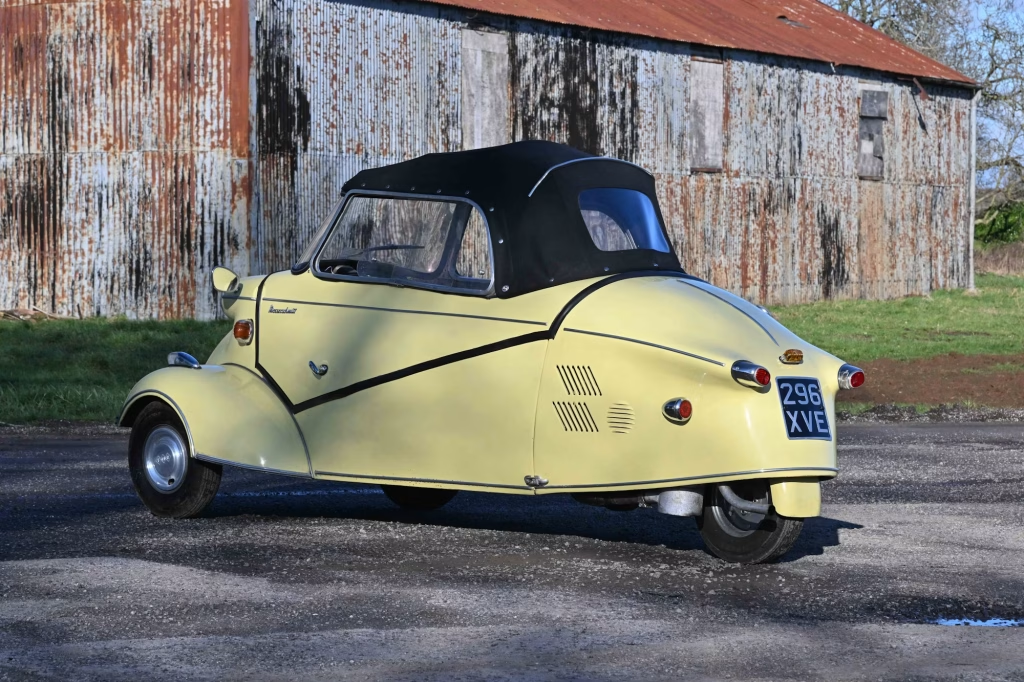
The KR200 became one of the best-known German bubble cars of its period and was produced for several years.
What makes it fascinating today is how completely different it was from conventional automotive thinking. A modern manufacturer would normally use four wheels, side-by-side seating, and conventional doors.
Messerschmitt effectively asked what would happen if a road vehicle were designed around the dimensions and seating arrangement of an aircraft cockpit. The result was strange, impractical by modern standards, and undeniably memorable.
4. Amphicar Model 770
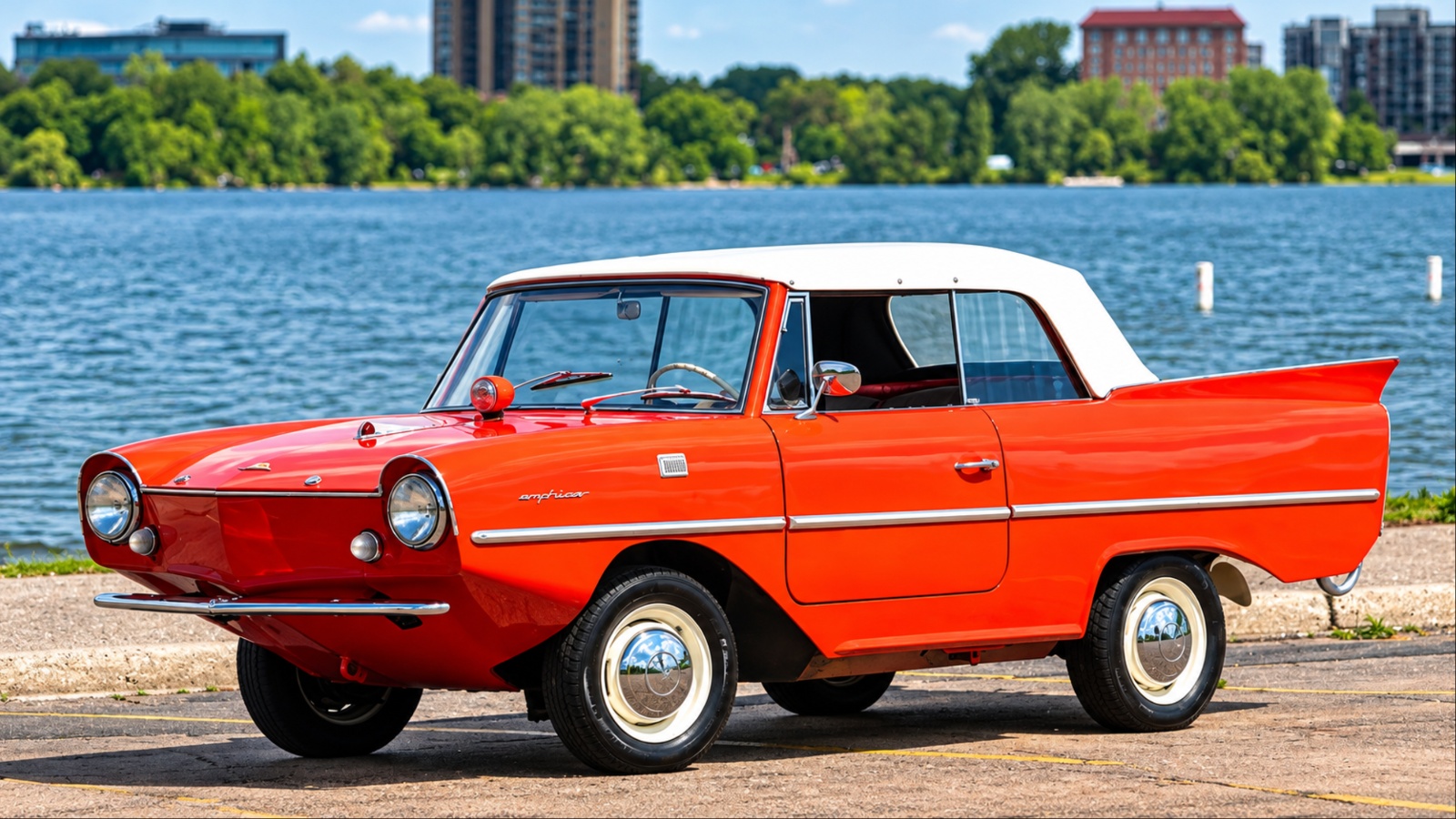
The Amphicar Model 770 stands out as one of the most unusual production vehicles ever offered. Its defining feature was its ability to travel on both roads and water, something that remains exceptionally rare in the automotive world.
Introduced in the early 1960s, the Amphicar was a genuine amphibious automobile rather than a conventional car fitted with temporary flotation equipment. It used a sealed body and propulsion systems designed to allow it to enter the water and continue moving under its own power.
The concept sounds like something from science fiction, but the Amphicar was manufactured and sold to ordinary customers. Approximately 3,878 examples were built between 1961 and 1968.
The name itself explained the concept by combining “amphibious” and “car.” On land, the Amphicar behaved like a small conventional automobile. Once in the water, rear-mounted propellers provided propulsion.
The Model 770 name referred to its claimed performance targets, with approximately 7 knots on water and 70 mph on land associated with the model. It was not intended to be the fastest boat or the fastest car. Its goal was to combine both functions in a single package.
That created enormous engineering compromises. A normal automobile is designed to move efficiently through air while remaining firmly connected to the road. A boat requires buoyancy, water resistance management, and a watertight structure. Combining those requirements inevitably affects both functions.
The Amphicar’s tall body and raised sides were necessary because the vehicle had to remain afloat. Its underside and propulsion system also had to accommodate aquatic operation.
The vehicle became particularly popular in the United States, where buyers were attracted to its novelty and recreational possibilities. Owners genuinely drove Amphicars into water and used them as boats, although water intrusion and corrosion were serious concerns.
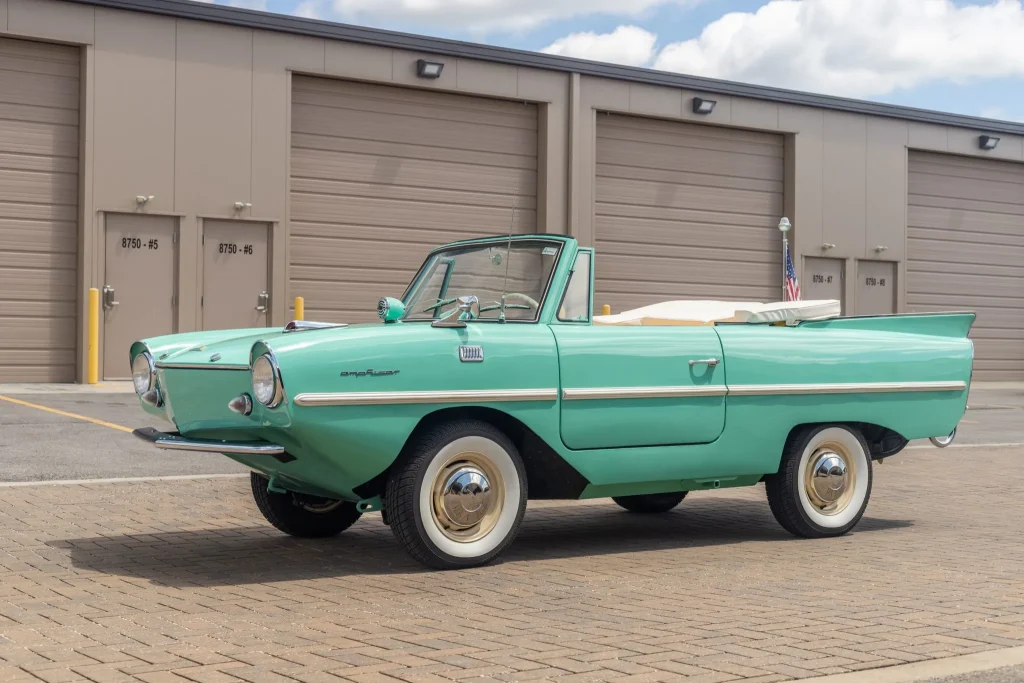
The Amphicar eventually disappeared because its price, performance compromises, and limited practical market made it difficult to compete with ordinary cars and boats.
Still, it accomplished something almost no conventional production car has managed. It represented two completely different forms of transportation in one factory-built vehicle.
5. Reliant Robin
The Reliant Robin took the three-wheel concept in a completely different direction. Instead of the tiny bubble shape associated with postwar microcars, Reliant created something closer to a conventional small car, then removed one wheel.
The first Robin appeared in 1973 and eventually became one of Britain’s most recognizable three-wheeled vehicles. Its unusual configuration placed one wheel at the front and two at the rear.
The design was strongly influenced by British regulations that treated certain lightweight three-wheelers differently from conventional four-wheel cars. That legal and economic background is essential to understanding why the Robin existed.
Three-wheel construction could reduce taxes and, depending on the regulations and licensing rules involved, allow drivers to operate the vehicle under motorcycle-related licensing arrangements rather than a standard car license.
Reliant also used a fiberglass body, helping keep weight down. The company already had considerable experience with lightweight three-wheeled vehicles, so the Robin was not an isolated experiment.
From a distance, the car could look surprisingly ordinary. It had a roof, windshield, doors and enough space to resemble a conventional compact automobile. The unusual part became obvious when viewed from the front.
There was only one front wheel. That configuration eventually became the source of countless jokes and television appearances, particularly because three-wheeled vehicles have different handling characteristics from four-wheel cars.
The Robin’s reputation became so strong that its humorous image sometimes overshadowed the economic reasoning behind its design.
Production continued in various forms for nearly three decades, with historical records placing Robin production from 1973 through 2002.
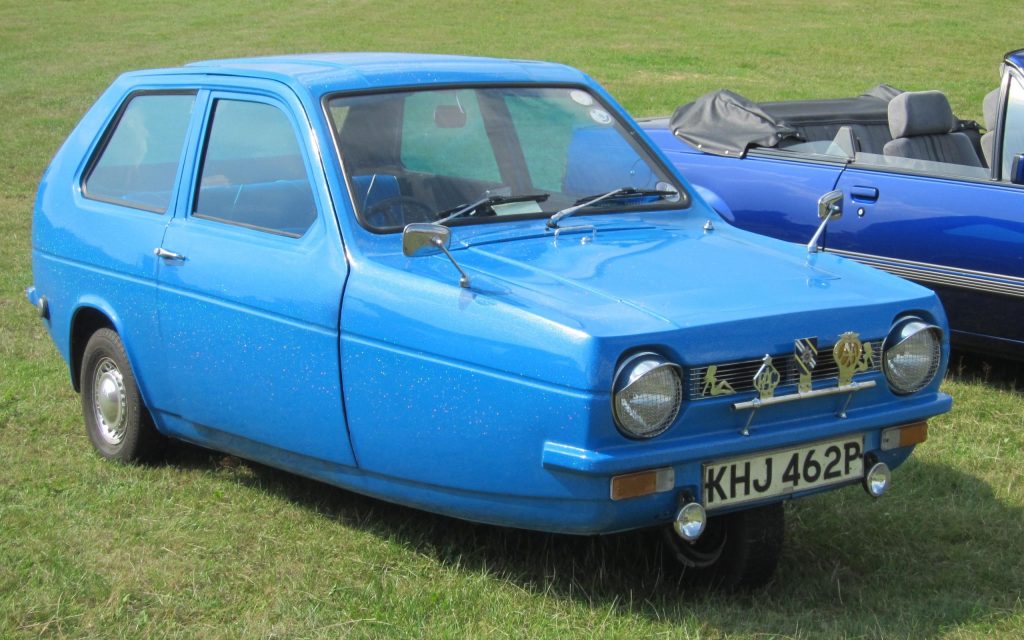
Its longevity is perhaps its strangest achievement. A vehicle that initially appeared to be a regulatory solution became a recognizable part of British automotive culture.
While mainstream manufacturers were moving toward increasingly sophisticated four-wheel cars, Reliant continued developing lightweight three-wheel vehicles for a specific market.
The Robin’s weirdness therefore came from taking a basic automobile and asking whether four wheels were really necessary. For almost 30 years, Reliant’s answer was yes, but only three would do.
6. Fiat Multipla
The original Fiat Multipla was strange for an entirely different reason. It did not try to be tiny, amphibious or three-wheeled. Instead, Fiat created a family vehicle with an unusually tall front section and seating arrangement that made the car look almost like two vehicles had been combined.
The first-generation Multipla arrived in the late 1990s and quickly became famous for its unusual styling. Its most recognizable feature was the abrupt transition between the hood and tall passenger compartment, with headlights positioned unusually high.
Yet the styling had a practical purpose. Fiat wanted to maximize interior space while keeping the vehicle relatively compact externally. The Multipla could accommodate six occupants in two rows of three seats, giving it remarkably efficient use of its footprint.
That seating arrangement was one of its biggest strengths. Instead of using the conventional two front seats and three-person rear bench, Fiat placed three individual seats across the front and three across the rear.
The result was unusual but highly functional. The Multipla demonstrates the difference between a strange car and a badly conceived car. Its appearance was controversial, but its packaging was clever.
The upright cabin gave occupants considerable interior volume, while the relatively short body made the vehicle easier to maneuver in urban environments than a much larger minivan.
Its unusual proportions came from Fiat’s attempt to create a practical family vehicle without simply copying the traditional minivan formula.
The design became one of the most debated automotive shapes of its era. Some observers considered it awkward, while others appreciated Fiat’s decision to prioritize interior functionality over conventional beauty.
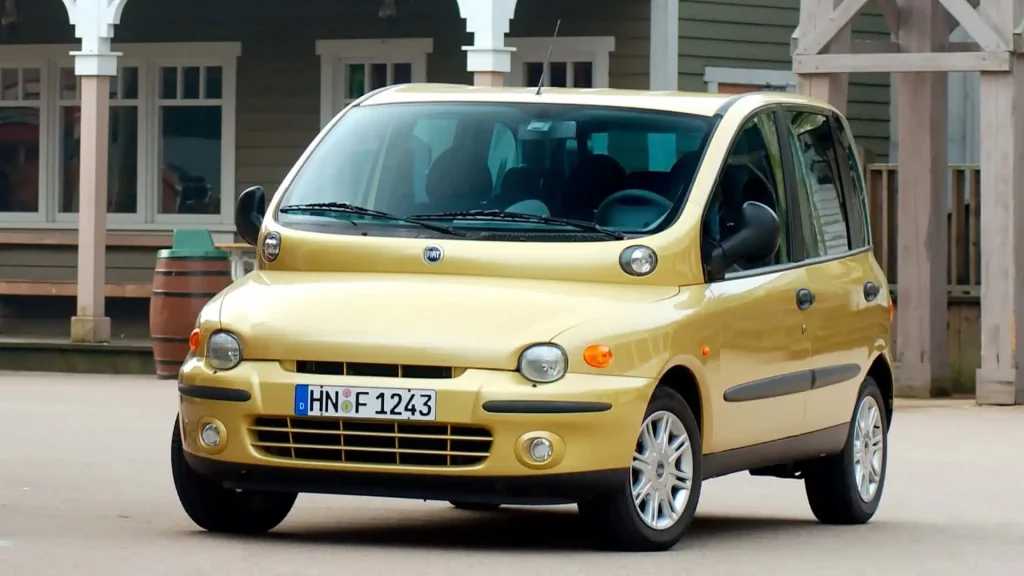
That debate has continued for decades, which is evidence of how effectively the design stood apart from the crowd.
Unlike an ordinary family car that might disappear into traffic, the Multipla was immediately identifiable.
Its first-generation model demonstrates how automotive weirdness can come from packaging rather than mechanical technology. There was nothing inherently exotic about its basic powertrain. What made it strange was how Fiat rearranged the relationship between the occupants, windshield, hood and exterior body.
Few family cars have ever looked so unconventional while remaining focused primarily on carrying people efficiently.
7. Nissan S-Cargo
Nissan’s S-Cargo may have one of the most deliberately playful designs ever applied to a commercial vehicle. Introduced in Japan in 1989, it was a compact delivery van whose rounded body was inspired by a snail.
Even its name contained a joke. “S-Cargo” sounded like “escargot,” the French word for snail, matching the vehicle’s rounded shape and compact commercial purpose.
The S-Cargo was part of Nissan’s Pike series, a group of limited-production vehicles created during a period when Japanese manufacturers were willing to experiment with distinctive designs.
Unlike conventional delivery vans, which generally prioritize box-shaped cargo areas and maximum practicality, the S-Cargo used a rounded body with a tall cabin and smooth surfaces.
The front end was particularly memorable. Its headlights and grille arrangement gave the vehicle a friendly expression, while the tall body provided useful cargo capacity behind the front occupants.
The design was not simply a joke. A delivery vehicle benefits from a compact footprint and usable cargo area, particularly in crowded Japanese cities. The S-Cargo combined those requirements with styling that made it immediately recognizable.
Nissan produced the vehicle in limited numbers from 1989 to 1992, contributing to its cult status.
What makes the S-Cargo especially interesting is that it demonstrated how commercial vehicles could become lifestyle products.
A normal delivery van is generally selected for carrying capacity, durability and operating costs. The S-Cargo added personality to that equation. Its appearance made it memorable even to people with no particular interest in vans.
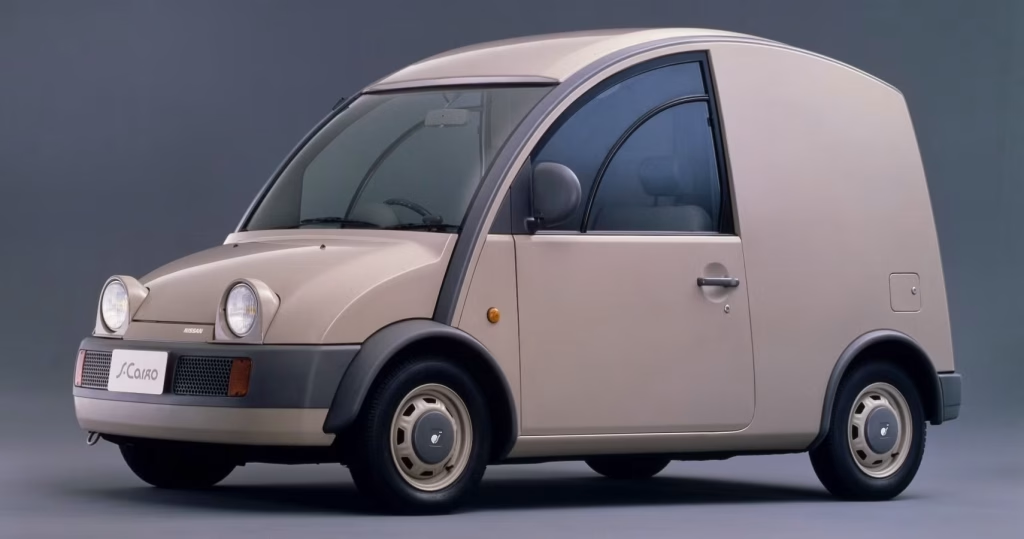
The rounded body has also aged unusually well. Many commercial vehicles from the same period look distinctly utilitarian today, with square bodies and basic proportions. The S-Cargo’s exaggerated design has become almost timeless because it never tried to look conventional.
The S-Cargo is therefore strange not because engineers were forced into an unusual configuration, but because Nissan deliberately decided that a delivery van could have personality.
That was a bold idea at a time when most commercial vehicles were designed primarily as working tools.
8. Subaru 360
The Subaru 360 looks tiny by modern standards, but its importance goes far beyond its dimensions. Introduced in Japan in 1958, it was Subaru’s first mass-produced passenger car and became one of the most recognizable examples of Japan’s postwar kei-car philosophy.
Its unusual appearance came directly from the need to provide affordable transportation within strict size and engine regulations.
The car was small, lightweight and powered by a tiny two-cylinder engine mounted at the rear. Its rounded roof and compact proportions gave it an almost toy-like appearance.
Yet the Subaru 360 was carefully engineered around Japan’s emerging kei-car regulations. Keeping the vehicle within prescribed dimensions and engine capacity helped make it more affordable to own and operate.
That regulatory environment produced vehicles very different from the large American sedans of the same era.
The Subaru 360 was particularly significant because it helped establish Subaru as a passenger-car manufacturer. Instead of simply shrinking a conventional sedan, engineers developed a compact rear-engine layout that allowed useful cabin space within a very small footprint.
The body was also remarkably light. Weight reduction was essential because the tiny engine had limited power, and keeping mass under control allowed the car to perform adequately for its intended urban role.
Its rounded shape was not simply decorative. Designers had to fit passengers and mechanical components into a very limited package while maintaining a practical cabin.
For American observers, the contrast is especially striking. The late 1950s United States was entering an era of enormous cars with large engines, expansive bodywork, and dramatic tailfins. Subaru was developing a tiny machine intended to make efficient transportation accessible to Japanese families.
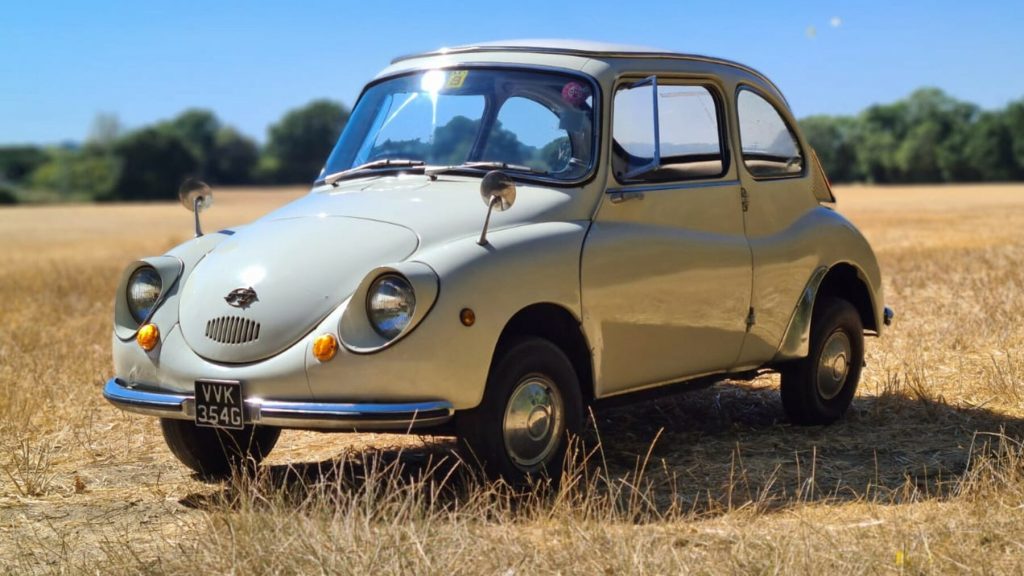
That difference captures why the 360 looks so strange today. It represents a completely different definition of what an automobile needed to accomplish.
Rather than offering excess capacity, the Subaru 360 concentrated on using as little material, space and power as possible while still functioning as a genuine passenger car.
Its importance eventually extended beyond Japan, with Subaru exporting examples to the United States.
The 360 may look like a novelty now, but its engineering philosophy helped establish a foundation for Subaru’s later passenger vehicles. It remains one of the strangest production cars not because it was poorly conceived, but because it was designed around an automotive world with priorities radically different from those familiar to American drivers.