
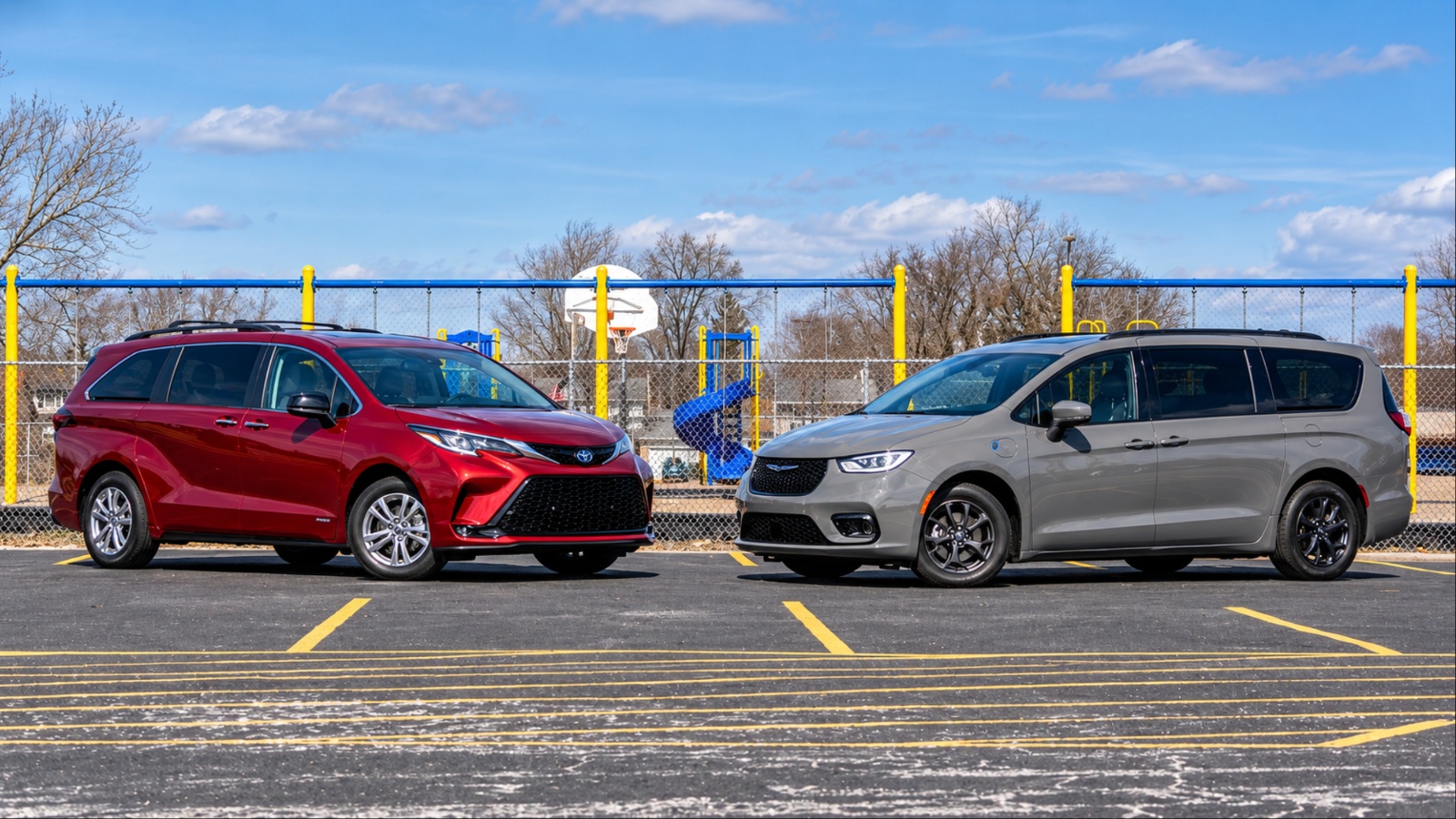
The Honda Odyssey, Toyota Sienna, and Chrysler Pacifica remain three of the most recognizable minivans in the U.S. market, but they take very different approaches to the family-van formula.
All three offer three rows, sliding doors, generous cargo space, and family-focused technology, yet the differences become significant once fuel economy, seating flexibility, performance, towing, comfort, and ownership value enter the picture.
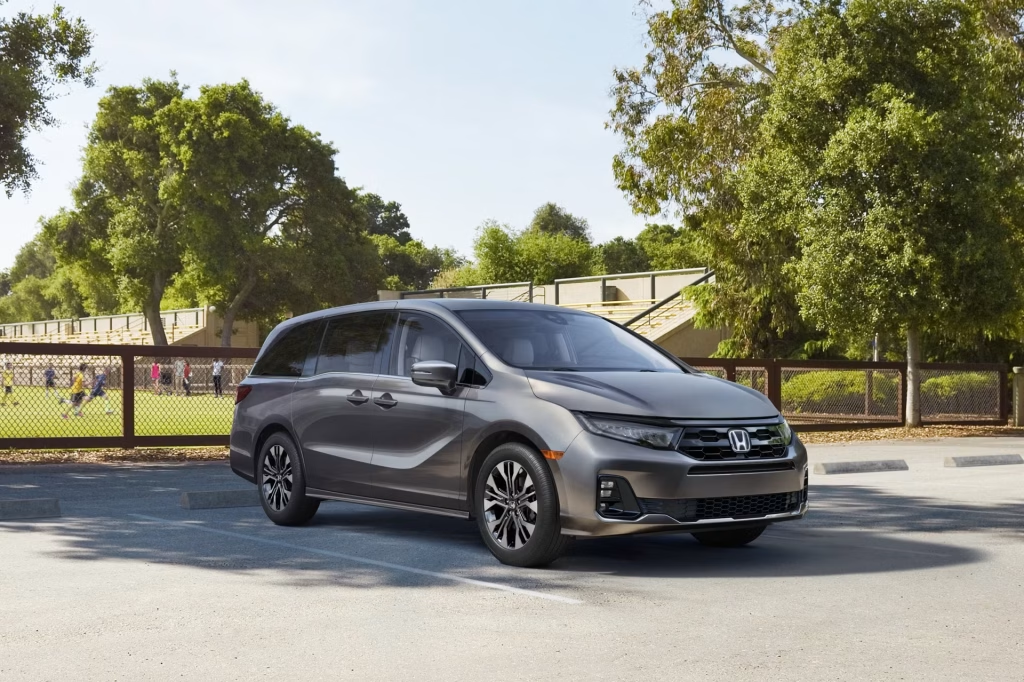
The 2026 Honda Odyssey starts at $42,795 and uses a 280-horsepower 3.5-liter V6 with a 10-speed automatic transmission. It is front-wheel drive only, but Honda gives it removable second-row seats, a folding third row, and up to 158 cubic feet of total cargo space.
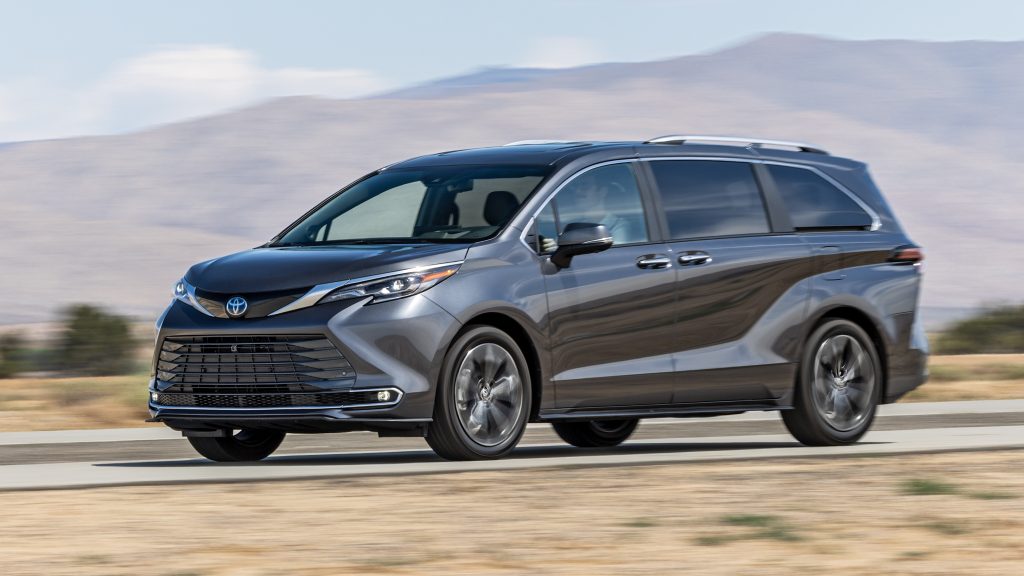
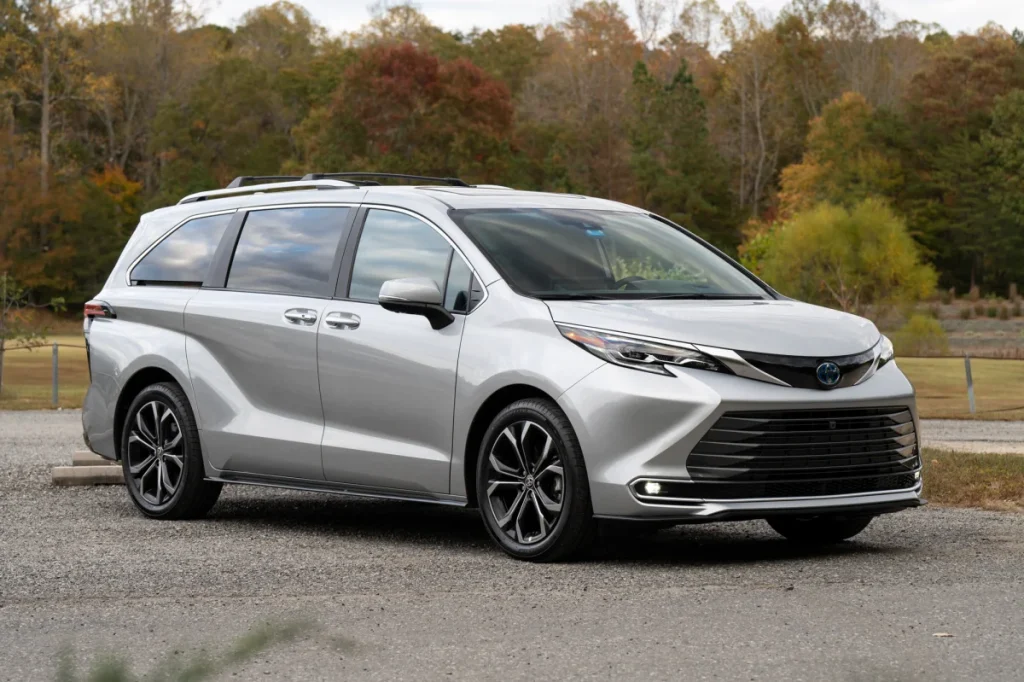
The 2026 Toyota Sienna starts at $41,320 and takes the opposite approach to power. Every Sienna uses a 2.5-liter hybrid system producing 245 horsepower, with front-wheel drive or available all-wheel drive. Its biggest advantage is efficiency, with EPA ratings reaching 36 mpg combined.
The 2026 Chrysler Pacifica starts at $44,445 and uses a 287-horsepower 3.6-liter Pentastar V6. Unlike the Odyssey, it can be equipped with all-wheel drive, and its Stow ‘n Go seating system remains one of its biggest practical advantages. Chrysler also rates the Pacifica for up to 3,600 pounds of towing when properly equipped.
There is no single winner in every category. The Sienna is the efficiency specialist, the Odyssey emphasizes passenger and cargo flexibility, while the Pacifica focuses heavily on interior versatility and available all-weather capability.
Here are the six categories that matter most when comparing these three minivans.
1. Price and Value
The Toyota Sienna starts this comparison with the lowest base MSRP. Its 2026 LE starts at $41,320, compared with $42,795 for the Honda Odyssey EX-L and $44,445 for the Chrysler Pacifica Select.
That difference is not enormous at the dealership, but the Sienna’s value becomes stronger when its standard hybrid powertrain is considered.
Toyota does not ask buyers to move into a more expensive trim to obtain the hybrid system. The 2.5-liter hybrid powertrain is standard across the lineup, producing 245 horsepower while returning up to 36 mpg combined in front-wheel-drive versions. All-wheel drive is also available, giving the Sienna something the Odyssey does not offer.
The Odyssey takes a more traditional approach. Its 280-horsepower V6 provides considerably more power than the Sienna, and its standard equipment list is competitive. The EX-L includes leather-trimmed seating, a power tailgate, wireless phone charging, and a one-touch power moonroof.
However, the Odyssey’s fuel economy is only 22 mpg combined. That creates a substantial running-cost difference for families who drive thousands of miles each year.
The Pacifica starts higher than both rivals, but Chrysler counters with useful standard and available equipment. The Select starts at $44,445, while Limited starts at $49,605 and Pinnacle at $56,095.
Its available all-wheel drive gives the Pacifica a useful advantage in snowy climates, and the Stow ‘n Go system adds practical value that cannot be duplicated by simply comparing sticker prices.
Still, the Sienna’s combination of the lowest starting price, standard hybrid powertrain, and excellent fuel economy makes its ownership proposition difficult to ignore.
The Odyssey may appeal to buyers who prioritize driving performance and cargo flexibility, while the Pacifica offers a compelling equipment package.
But the Sienna requires the fewest compromises for a buyer focused on value. You spend slightly less initially and receive a powertrain capable of returning roughly 36 mpg combined.
That fuel economy advantage can become significant over years of family driving.
Winner: Toyota Sienna
2. Powertrain and Driving Performance
The Honda Odyssey wins this category because it delivers the strongest combination of horsepower, acceleration, and conventional driving feel.
Its 3.5-liter V6 produces 280 horsepower and 262 lb-ft of torque, paired with a 10-speed automatic transmission. Every 2026 Odyssey uses front-wheel drive. Honda’s official specifications confirm a 3,500-pound maximum towing capacity when properly equipped.
The Toyota Sienna takes a completely different route. Its 2.5-liter hybrid system produces 245 horsepower. The emphasis is not outright acceleration but efficiency and smooth low-speed operation.
That does not make the Sienna slow. It is perfectly capable of merging onto highways with a full family onboard, but the Odyssey feels more responsive when the driver asks for stronger acceleration.
Car and Driver recorded the 2026 Odyssey reaching 60 mph in 6.4 seconds, while the Sienna required about 7.5 seconds in testing. The Pacifica sits between them on power.
Its 3.6-liter Pentastar V6 produces 287 horsepower and 262 lb-ft of torque. The engine is paired with a nine-speed automatic transmission, and buyers can select front- or all-wheel drive.
That makes the Pacifica the most powerful of the three on paper, although its advantage over the Odyssey is small.
The Pacifica’s available AWD system is also important. Families living in areas with frequent snow or icy conditions may prefer having power sent to all four wheels rather than relying on front-wheel drive. The Odyssey has no AWD option, which limits its appeal for some buyers.
Yet the Honda’s V6 and 10-speed transmission create a particularly well-matched combination. The engine has enough power to make a fully loaded van feel comfortable during highway acceleration, while the transmission provides a broad range of ratios.
The Sienna’s hybrid powertrain also performs well in stop-and-go traffic, making it particularly well suited to the type of driving many minivans experience during daily family use.
So this category depends heavily on what “performance” means. For efficiency and smooth urban driving, the Sienna is excellent.
For traction in poor weather, the Pacifica has the advantage. For acceleration and driver involvement, the Odyssey is the strongest choice.
Honda’s minivan also avoids the more complex trade-offs associated with a hybrid system while providing more horsepower than the Sienna.
That makes the Odyssey the winner for buyers who want their family minivan to feel energetic rather than merely adequate.
Winner: Honda Odyssey
3. Fuel Economy and Long-Distance Efficiency
This is the category where the Toyota Sienna establishes its clearest advantage. Every 2026 Sienna uses a hybrid powertrain, and front-wheel-drive models are rated at 36 mpg city, 36 mpg highway, and 36 mpg combined. All-wheel-drive versions can still achieve up to 35 mpg combined.
That is a major advantage for a vehicle designed to transport families. The Odyssey is rated at 19 mpg city, 28 mpg highway, and 22 mpg combined.
The difference is not a minor technical statistic. A family that drives 15,000 miles annually could consume significantly less gasoline in the Sienna than in the Odyssey.
The Pacifica is closer to the Odyssey. Chrysler lists up to 19 mpg city and 28 mpg highway for front-wheel-drive versions, while AWD versions are rated lower at up to 17 city and 25 highway mpg.
That makes the Sienna the clear efficiency leader. Its hybrid system is particularly useful in urban driving. Minivans frequently spend time idling in school pickup lines, crawling through traffic and making short trips around town. Hybrid technology can recover energy during braking and use electric assistance during low-speed operation.
The Sienna’s efficiency does not require buyers to sacrifice AWD, either. Toyota offers an electronic all-wheel-drive system on many trims.
That combination is difficult for the rivals to match. The Odyssey’s V6 is stronger, but the trade-off is fuel consumption.
The Pacifica’s V6 and optional AWD provide flexibility, but fuel economy falls further when all-wheel drive is selected. There is also a long-distance advantage to the Sienna.
On a road trip, fewer fuel stops can make a meaningful difference, particularly for families traveling with children. The Sienna’s 18-gallon fuel tank combined with its strong fuel economy gives it a useful cruising range.
The Odyssey and Pacifica remain perfectly acceptable for highway travel, but neither approaches the Sienna’s efficiency.
This is one area where Toyota’s decision to make the hybrid system standard pays off. A buyer does not have to select a premium trim or special package to obtain the efficiency advantage.
For families who drive frequently, commute long distances, or simply want to reduce fuel spending, the Sienna offers the strongest argument.
Winner: Toyota Sienna
4. Interior Space and Cargo Flexibility
The Honda Odyssey takes this category because its seating and cargo systems give families an exceptional range of configurations.
Honda lists up to 158 cubic feet of total cargo space, while its second-row seats can be removed and its third-row Magic Seat folds into the floor. Available Magic Slide second-row seats can also move laterally to make it easier to access the third row or separate passengers.
That matters in real family use. A minivan may transport eight people on Monday, groceries on Tuesday, sports equipment on Wednesday, and large furniture on Saturday. The Odyssey can adapt to those changing requirements without requiring a completely different vehicle.
The Pacifica is its closest rival. Chrysler’s Stow ‘n Go system allows the second- and third-row seating to fold into the floor in applicable configurations. Chrysler says the 2026 Pacifica can provide up to 243 seating configurations, while seating for eight is available on select trims.
That is an impressive level of flexibility. The Pacifica’s ability to create a flat loading area without physically removing seats remains one of its most useful features.
The Sienna is different. Its second-row seats slide forward and backward, but they are not designed to be removed like the Odyssey’s second-row seats. Car and Driver notes that the Sienna’s second-row seats are fixed in place, although they provide substantial fore-and-aft adjustment.
Toyota does offer excellent passenger space, though. The Sienna seats up to eight, and its long body provides plenty of room for families. Higher trims can add features such as reclining second-row seats, ottomans, a refrigerator and a vacuum cleaner.
For normal family transportation, all three provide ample space. But when the question becomes how quickly and easily the cabin can be transformed, the Odyssey has an advantage.
Its removable second-row seating is particularly useful when carrying large objects. The third-row Magic Seat also folds into the floor, creating a large continuous cargo area.
The Pacifica remains extremely competitive because Stow ‘n Go allows owners to fold seats into the floor rather than finding somewhere to store removed seats.
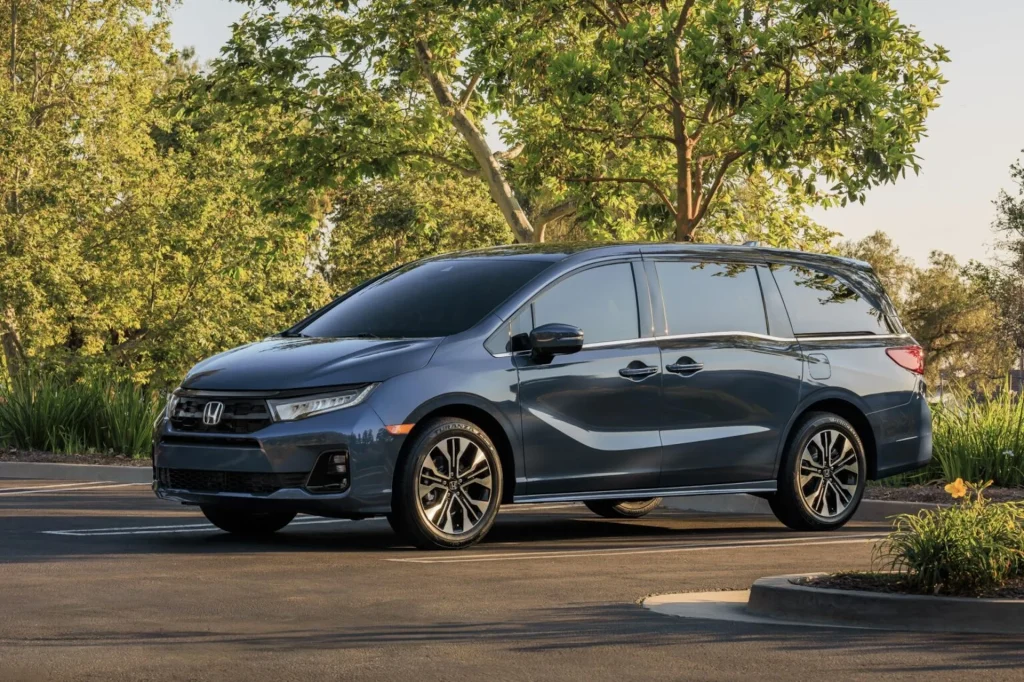
The Sienna’s advantage is passenger comfort and its highly adjustable second row. Still, Honda provides the best combination of passenger room, removable seating and maximum cargo flexibility.
For families who frequently switch between passenger and cargo duty, the Odyssey is the most adaptable.
Winner: Honda Odyssey
5. Comfort, Technology and Family Features
The Pacifica wins this category because Chrysler has consistently emphasized the experience of carrying families rather than simply providing three rows of seats.
The 2026 Pacifica offers a 10.1-inch touchscreen, available premium audio, available rear-seat entertainment and a range of family-focused convenience features. Chrysler also emphasizes its available Stow ‘n Go seating, power doors and available panoramic sunroof.
Its cabin has been designed around the idea that passengers may spend hours inside the vehicle. The Odyssey is extremely strong here as well.
Honda offers an available rear entertainment system, CabinWatch, CabinTalk, second- and third-row sunshades, tri-zone climate control and wireless Apple CarPlay and Android Auto. Higher trims also provide heated and ventilated front seats.
CabinWatch is particularly useful for parents because it allows the driver or front passenger to monitor rear-seat occupants. The Sienna counters with a strong technology package of its own.
Toyota offers a 12.3-inch touchscreen on higher trims, a 12.3-inch digital gauge cluster on Limited and Platinum models, and available JBL audio. Some versions also offer a built-in vacuum and refrigerator.
The Sienna’s interior can therefore become quite upscale. But the Pacifica’s combination of family-oriented technology and interior flexibility gives it the edge.
Its available all-wheel drive also adds another layer of everyday confidence for families living in colder regions.
The Pacifica’s ride quality is another strong point. KBB describes its ride as one of the model’s strengths, making it suitable for school runs and long-distance road trips.
The Odyssey is more engaging to drive, but the Pacifica is particularly good at creating a relaxed family environment.
That distinction matters because minivans are rarely purchased for sporty driving. They are purchased because families spend substantial amounts of time inside them.
A comfortable second row, easy access, entertainment technology and flexible storage can have a bigger impact on daily life than an extra few tenths of a second in acceleration.
The Pacifica also provides available eight-passenger seating on select trims. The Odyssey can seat eight as well, while the Sienna also reaches eight-passenger capacity depending on configuration.
Therefore, the advantage comes from the way Chrysler integrates these functions. The Pacifica’s Stow ‘n Go system, available AWD, family technology, and comfort-oriented cabin give it the strongest package for passengers.
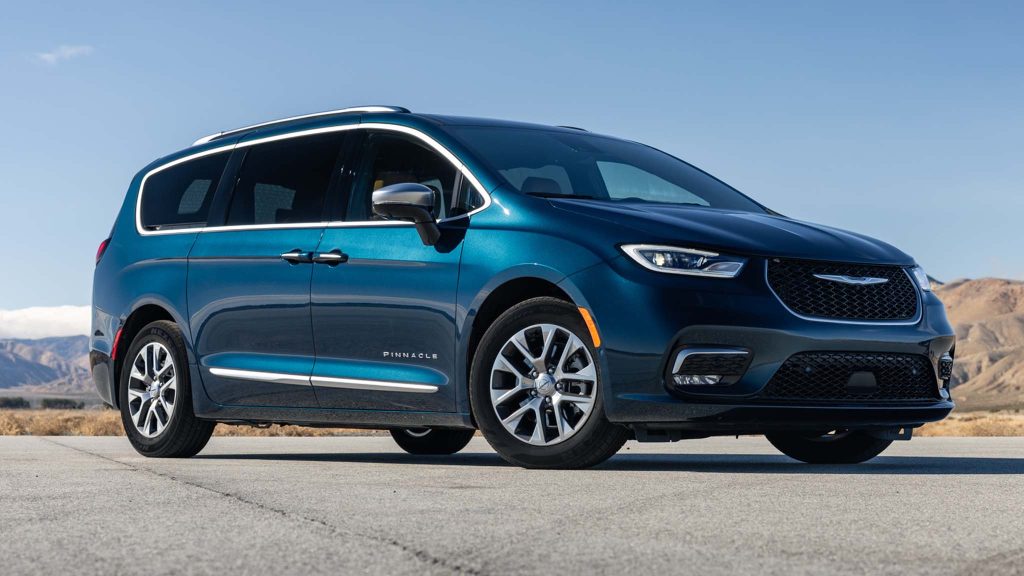
The Odyssey comes very close, particularly for families who value its rear-seat monitoring and entertainment systems. The Sienna offers excellent technology and some clever premium features.
But for the broadest combination of comfort, technology and family-focused equipment, the Pacifica takes the category.
Winner: Chrysler Pacifica
6. Towing, Traction and Everyday Versatility
The final category is closely contested because all three vans can perform more than their traditional family-hauler role suggests.
The Pacifica has the highest maximum towing rating of the three. Properly equipped, Chrysler rates it for up to 3,600 pounds, while the Odyssey is rated for 3,500 pounds and the Sienna’s available tow rating reaches 3,500 pounds on the Woodland Edition.
The difference in the numbers is relatively small, but the Pacifica offers another notable advantage with its available all-wheel-drive system. The Odyssey, by comparison, is offered exclusively with front-wheel drive.
The Sienna offers AWD, giving Toyota a strong counterargument, but the Pacifica combines AWD with its V6 and towing package.
That combination makes the Chrysler particularly attractive to families who live in regions where winter weather is common and still want to tow a small camper, boat, or utility trailer.
The Pacifica’s available Trailer Tow Group raises the maximum rating to 3,600 pounds. Chrysler specifically positions the vehicle for towing small boats, recreational equipment, and trailers.
The Odyssey’s 3,500-pound rating is also useful. Its stronger-than-Sienna V6 gives it confidence when loaded with passengers and cargo, and the 10-speed transmission helps manage highway driving.
The Sienna Woodland Edition has a different character. It adds increased ground clearance, standard AWD, and a tow hitch with 3,500-pound towing capability. Toyota therefore gives the Sienna a more adventure-oriented variant without sacrificing its hybrid powertrain.
That is an unusual combination in the minivan segment. Still, the Pacifica has the broadest capability package.
Its AWD system helps provide additional traction, while the V6 provides enough power for towing and loaded driving.
The Pacifica also benefits from Stow ‘n Go seating, allowing the same vehicle to shift rapidly from passenger transportation to cargo duty. That makes it highly versatile.
The Sienna remains the best choice for someone who values efficiency and AWD together. The Odyssey is the better choice for someone who wants a powerful, responsive minivan and excellent cargo flexibility.
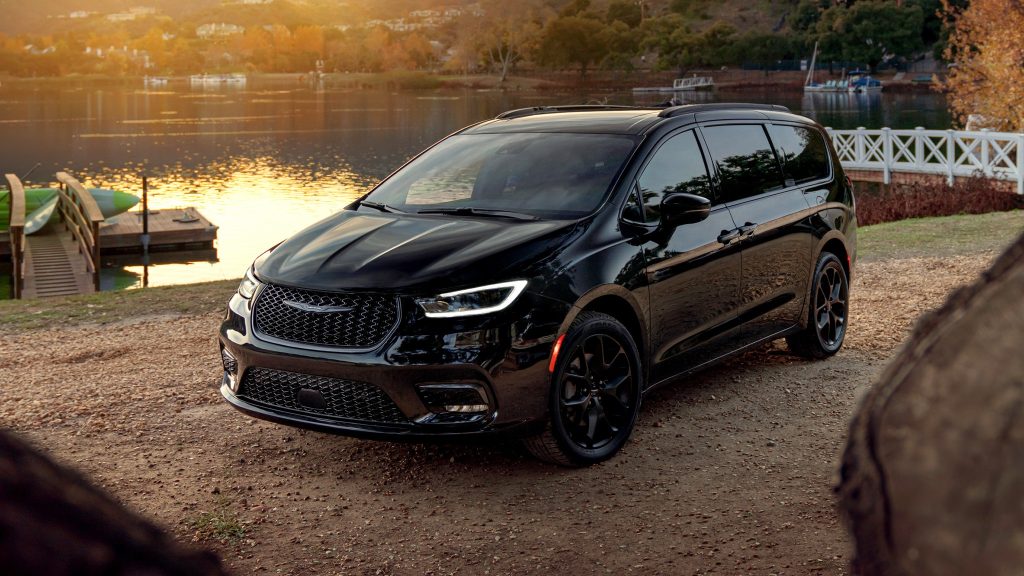
But the Pacifica is the strongest choice for someone who wants one minivan to handle passengers, cargo, winter roads, and light towing.
Its 3,600-pound maximum towing rating is the highest here, and its available AWD expands its usefulness beyond dry pavement. That combination gives Chrysler the final category.
Winner: Chrysler Pacifica
Final Verdict
| Category | Winner | The Edge |
|---|---|---|
| Price and Value | Toyota Sienna | Lowest starting price combines standard hybrid power with exceptional fuel economy. |
| Powertrain and Driving Performance | Honda Odyssey | Strong V6 performance and a 10-speed automatic deliver the quickest driving experience. |
| Fuel Economy and Long-Distance Efficiency | Toyota Sienna | Hybrid powertrain delivers up to 36 mpg combined for major fuel savings. |
| Interior Space and Cargo Flexibility | Honda Odyssey | Removable second-row seats and Magic Seat maximize passenger and cargo versatility. |
| Comfort, Technology and Family Features | Chrysler Pacifica | Stow ‘n Go, family technology and available AWD create a flexible cabin experience. |
| Towing, Traction and Everyday Versatility | Chrysler Pacifica | Highest towing rating combines with available AWD for broader family utility. |
