
Mercedes-Benz is taking another step toward next-generation electric vehicle technology by beginning testing of ProLogium’s latest Gen4 battery cells.
The German automaker has signed a joint testing agreement with the Taiwanese battery developer that gives Mercedes-Benz priority access to the new cells, allowing its engineers to evaluate the technology before any decision is made about potential production applications.
The agreement marks another stage in a partnership that has been developing since 2016. Mercedes-Benz and Prologium have worked together on battery development, validation, and different cell formats, with Mercedes-Benz also becoming a strategic investor in the company and gaining representation on its board.
The latest testing program moves the relationship closer to evaluating whether ProLogium’s newest technology can meet the demanding requirements of future electric vehicles.
Importantly, Mercedes-Benz has not committed to putting the Gen4 cells into a production vehicle. The current agreement is an evaluation program, and the results of the testing will determine whether the technology is suitable for future applications.
Mercedes-Benz Will Put Gen4 Cells Through Extensive Testing
Under the new agreement, ProLogium’s Gen4 battery technology will undergo electrical, thermal, and safety testing. Mercedes-Benz will conduct testing at its own facilities as well as through specialized external testing institutes. The objective is to establish whether the cells can meet the technical, safety, and performance requirements necessary for automotive use.
That distinction is important because laboratory or demonstration performance does not automatically translate into a production-ready vehicle battery.
Automakers must evaluate how battery cells perform across a wide range of temperatures, charging conditions, power demands, and operating cycles. They must also determine how the technology behaves when integrated into a complete battery pack and vehicle.
ProLogium describes the Gen4 platform as a superfluidized inorganic next-generation lithium ceramic battery.
The company says its approach is designed to combine several characteristics that have traditionally been difficult to achieve simultaneously, including high energy density, strong charging performance, high power output, safety, and scalable manufacturing.
The battery’s safety architecture uses a non-flammable inorganic electrolyte and ceramic separator technology, along with what ProLogium calls an active safety mechanism.
The company also says the technology is designed to provide good low-temperature performance, an important consideration for electric vehicles because cold conditions can affect both range and charging performance.
Mercedes-Benz will therefore be looking beyond a single headline specification. The testing program is intended to determine whether the technology can provide a balanced combination of performance, safety, durability, and manufacturability.
A Partnership That Has Been Developing for Nearly a Decade
The latest agreement builds on a relationship that has lasted nearly 10 years. Mercedes-Benz says its cooperation with ProLogium began in 2016 and has progressed from early development and validation work toward potential future vehicle applications.
The two companies have already worked with multiple lithium-ceramic battery formats, including pouch and prismatic cells, as well as ProLogium’s Bi-Polar technology. Mercedes-Benz has also supported ProLogium through strategic investment, giving the automaker a closer position in the company’s technology development.
ProLogium’s technology development is not limited to laboratory prototypes. The company says its Taoke Gigafactory in Taiwan has completed GWh-scale manufacturing validation and supports C-sample production and demonstration vehicle programs. ProLogium also says it has delivered more than 2.4 million battery cells to partners and customers since 2013, including approximately 10,000 automotive battery samples.
For Mercedes-Benz, that manufacturing experience is particularly relevant. A battery technology can offer impressive laboratory results yet remain commercially impractical if it cannot be manufactured consistently at high volumes and competitive cost. ProLogium is attempting to address that challenge as it prepares to expand production into Europe.
The company plans a major battery facility in Dunkirk, France. ProLogium says the planned plant could eventually reach an annual production capacity of up to 44 GWh, providing localized European manufacturing and supply chain capacity. The company expects the facility to support commercial battery production for European customers as development progresses.
That European manufacturing strategy could become significant if Mercedes-Benz eventually determines that Gen4 technology is suitable for one of its future EV platforms.
Solid-State Batteries Are Becoming a Major Development Battleground
Mercedes-Benz’s interest in ProLogium is part of a wider industry effort to move beyond the limitations of today’s conventional lithium-ion batteries. Solid-state technology has attracted significant attention because replacing conventional liquid electrolytes with solid or inorganic materials could potentially improve energy density, safety, and packaging efficiency.
Mercedes-Benz has already demonstrated that it is pursuing more than one solid-state battery development route.
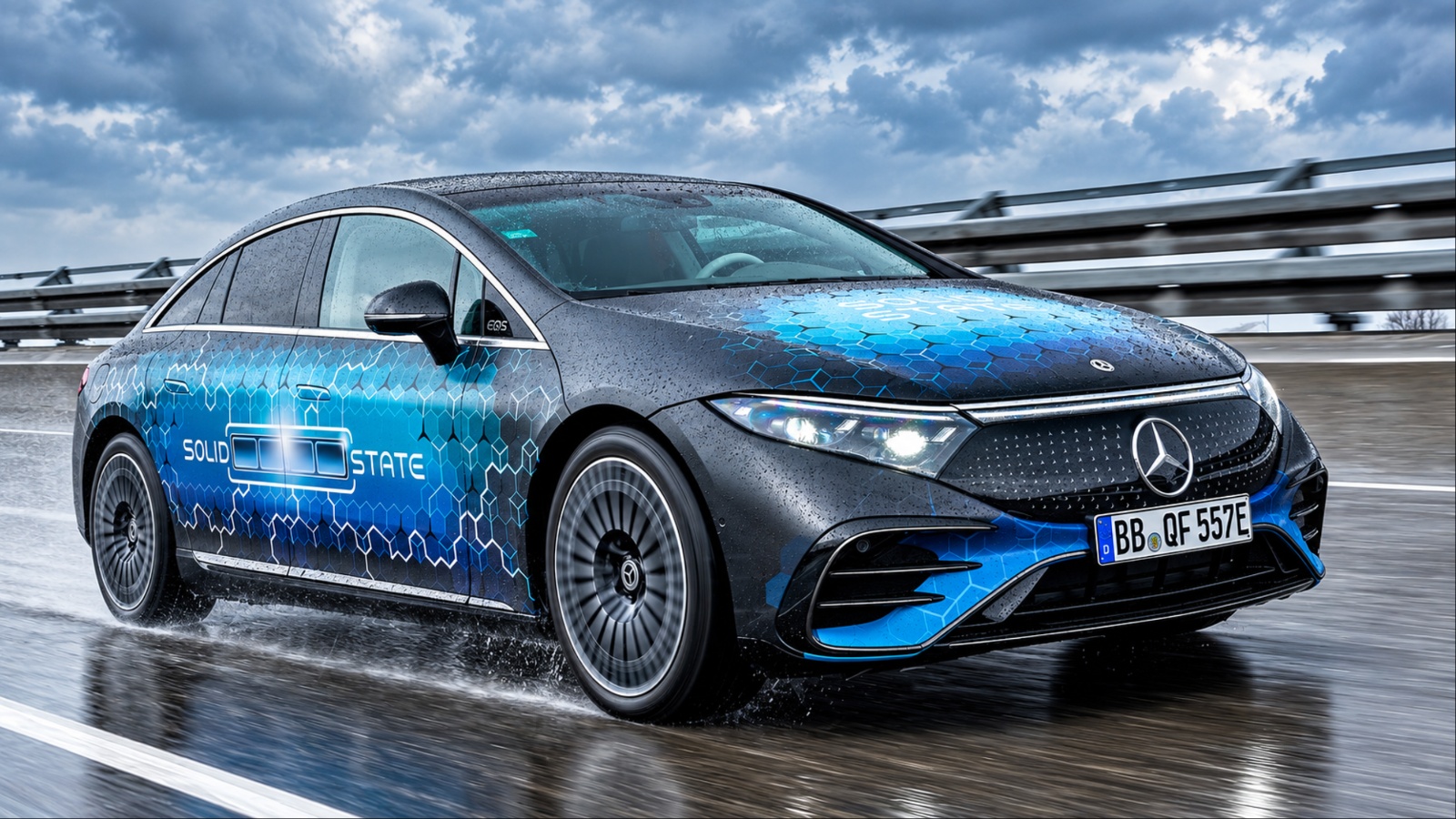
In 2025, the automaker reported that a modified EQS equipped with lithium-metal solid-state battery technology completed a 1,205-kilometer drive from Stuttgart to Malmö without recharging.
The vehicle reached its destination with an indicated 137 kilometers of remaining range. Mercedes-Benz described the test as a demonstration of the technology’s potential under the conditions of that specific journey.
That test involved battery technology supplied by Factorial Energy rather than ProLogium. The distinction illustrates Mercedes-Benz’s broader strategy.
Rather than relying on a single battery chemistry or supplier, the automaker is evaluating multiple approaches as it searches for technologies that can eventually satisfy the demands of future EVs.
The ProLogium Gen4 program adds another option to that development strategy. Its lithium-ceramic approach is particularly interesting because ProLogium is attempting to combine solid-state characteristics with a manufacturing concept that it believes can be scaled for automotive applications.
For consumers, the potential benefits could extend beyond simply increasing driving range. Higher energy density could allow automakers to reduce battery size or weight while maintaining a similar range. Alternatively, manufacturers could use the additional energy capacity to increase range without dramatically increasing pack dimensions.
Fast charging could also become increasingly important. An EV that can store more energy is only part of the equation if drivers still need long periods at charging stations. Battery technology that can accept high charging power while maintaining thermal stability and durability could therefore have a major impact on the ownership experience.
However, those advantages remain potential benefits until Mercedes-Benz completes its testing.

The automaker has made clear that the current agreement does not guarantee a production application. The Gen4 cells first need to demonstrate that they can meet Mercedes-Benz’s requirements across electrical, thermal, and safety testing. Only after that process would the company be in a position to consider how the technology might fit into future vehicles.
For ProLogium, having Mercedes-Benz conduct priority testing represents an important validation opportunity. For Mercedes-Benz, the agreement provides early access to another promising battery technology while the company continues developing its next generation of electric vehicles.
The immediate outcome is not a new Mercedes-Benz EV equipped with a solid-state battery. Instead, the partnership represents a broader engineering evaluation that could help determine whether ProLogium’s Gen4 technology can play a role in Mercedes-Benz’s future electric vehicle plans.
If the cells can deliver the promised combination of safety, performance, energy density, charging capability, and scalable production, the current testing program could become an important step toward bringing a new generation of battery technology into Mercedes-Benz vehicles.
