
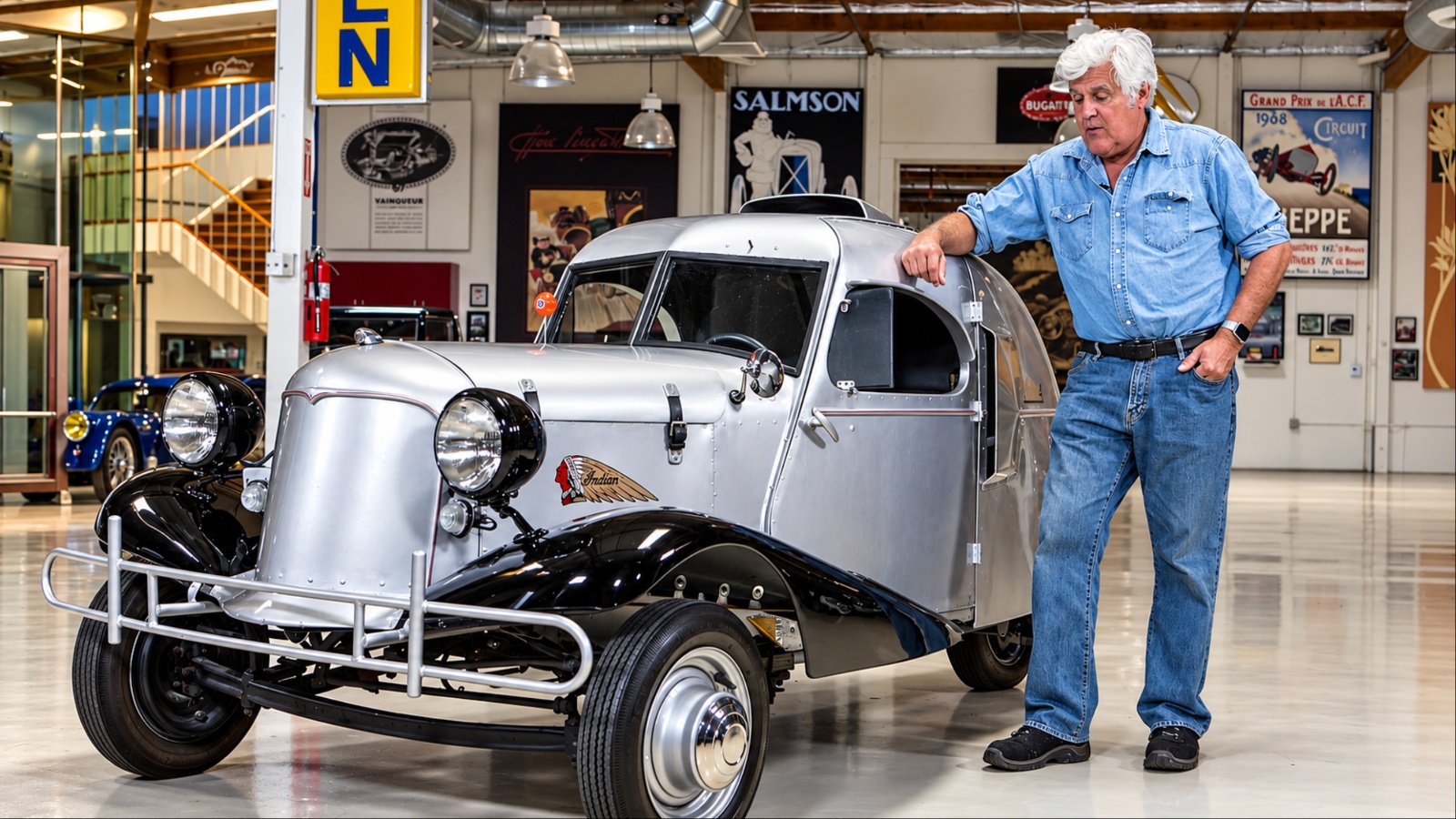
Jay Leno’s garage is unusual because rarity does not always mean astronomical value. His collection contains inexpensive curiosities, historically important machines, European exotics, and cars so scarce that there may be no meaningful public auction comparison at all.
For this ranking, the cars are ordered from lower to higher documented market value, using auction results where available and reliable published valuations or comparable sales where an auction record for Leno’s exact car cannot be established.
That approach also prevents an estimated value from being mistaken for an actual transaction. The result is a fascinating cross-section of Leno’s collection, showing how rarity, provenance, production numbers, and historical importance can dramatically change what a collector car is worth.
1. 1962 Daimler Dart SP250
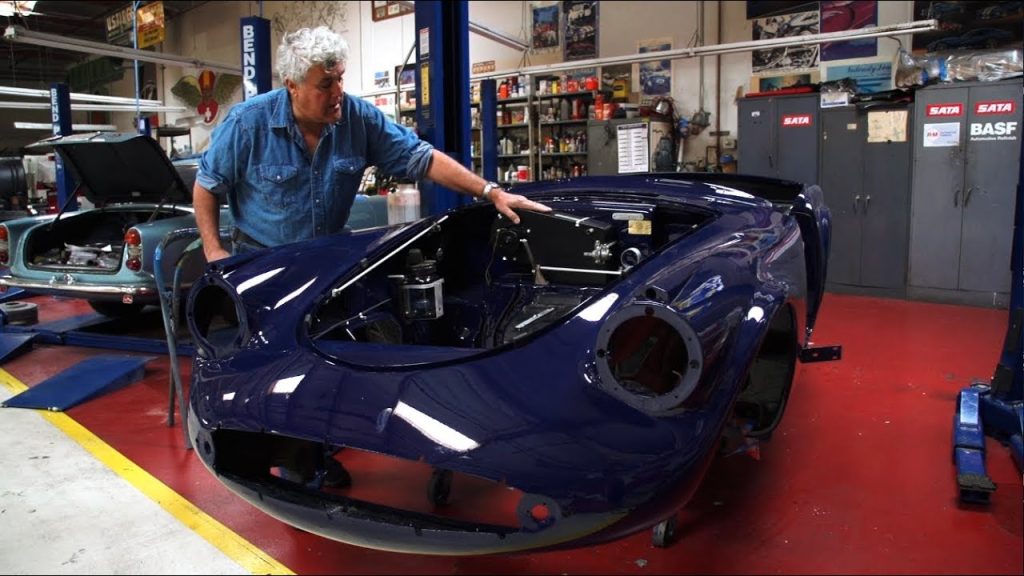
The Daimler Dart SP250 is one of the more affordable rare cars associated with Leno’s collection, but its relatively modest value should not be confused with ordinary production-car status.
The fiberglass-bodied British sports car was produced in limited numbers during the early 1960s, and Leno has owned one as part of his eclectic collection. A documented Jay Leno’s Garage valuation placed his 1962 example at approximately $90,000, making it a useful starting point for this ranking.
The SP250 is particularly interesting because it represents Daimler during a brief period before Jaguar’s ownership completely changed the company’s direction.
Rather than being another mainstream British roadster, the Dart combined a compact sports-car body with Daimler’s distinctive engineering approach. Its unusual identity is part of what makes it collectible today.
The $90,000 figure should be treated as a historical valuation rather than a confirmed auction sale of Leno’s individual car. That distinction matters because collector-car prices can vary substantially with condition, provenance, originality, and restoration quality.
Public auction results for an identical example are not as straightforward as they are for better-known cars such as the BMW M1.
Its place at the bottom of this list therefore reflects documented value, not a judgment about its importance. In fact, the SP250 demonstrates why Leno’s collection is so different from a conventional celebrity garage.
He has repeatedly shown an interest in cars that tell unusual stories, even when they are not among the most expensive vehicles in the world.
2. 1980 BMW M1
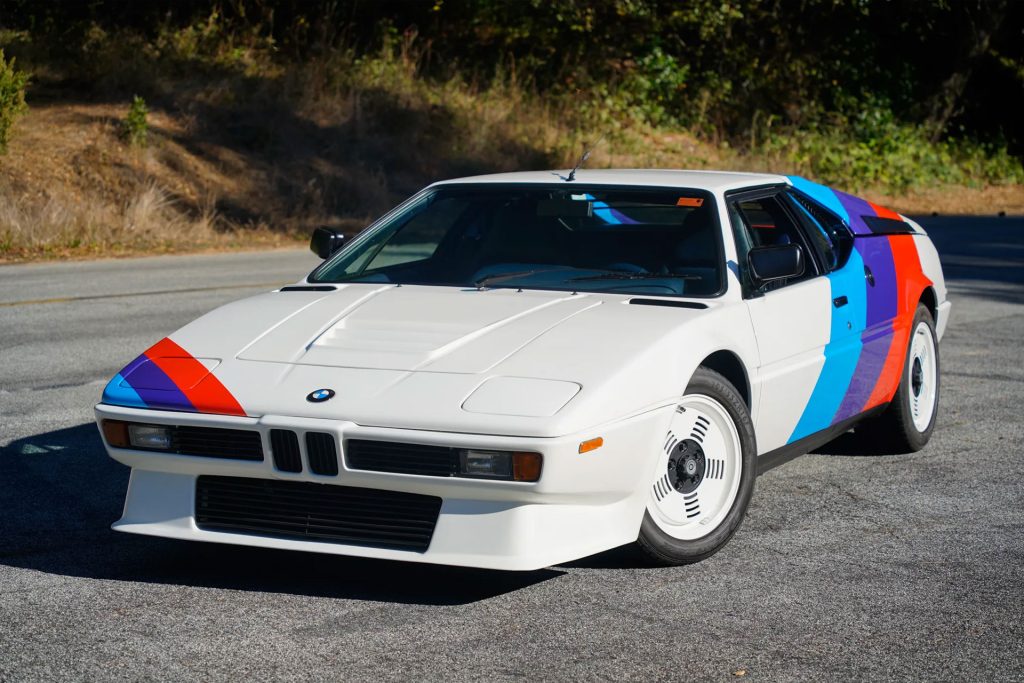
The BMW M1 moves the ranking into a completely different part of the collector market. Only around 400 road-going examples were produced, making it one of the rarest production BMWs ever built. Leno’s collection includes a BMW M1, and a documented Jay Leno’s Garage valuation placed the Johnny Cecotto-associated car at approximately $750,000.
There is also unusually strong auction evidence for the M1, which makes it possible to compare the model against an actual transaction rather than relying entirely on an estimate. A 1980 BMW M1 sold on Bring a Trailer for $605,000 in July 2022, while the same example later sold for $580,000 in September 2024.
That history provides useful context for Leno’s $750,000 valuation. The precise value of his car cannot be assumed to be identical because condition, mileage, provenance, and specification all influence collector prices.
The M1’s rarity is only part of its appeal. BMW developed it as a homologation special connected to the company’s motorsport ambitions, and its mid-engine layout gave it a character unlike almost every other BMW of the period. The car also represents an important moment in BMW Motorsport history.
Its position here is therefore supported by something stronger than celebrity association. There is a real auction market demonstrating that collectors are prepared to pay hundreds of thousands of dollars for the right example. That makes the M1 one of the clearest cases in Leno’s collection where rarity and documented market demand meet.
3. 1967 Lamborghini Miura P400
The Lamborghini Miura is the point where Leno’s garage begins entering genuine seven-figure territory. Leno owns a 1967 P400 that has an unusually entertaining history.
The car was originally purchased by Dean Martin’s son, later became a non-running vehicle, and eventually came into Leno’s possession as part of another transaction. Jay has explained that he effectively received the Miura as part of the deal after its previous owner had stopped using it.
The specific value of Leno’s car should not be confused with an auction result. Contemporary market evidence shows just how valuable the model can become. A 1967 Miura P400 offered at auction carried an estimate of $800,000 to $900,000, while a 1969 Miura S sold at auction for €1.416 million.
The P400 also has an important production history. Only 275 P400S were built, giving the earliest Miura considerable collector appeal. The car’s significance goes beyond its price because its transverse mid-engine V12 layout helped establish the template for the modern high-performance exotic.
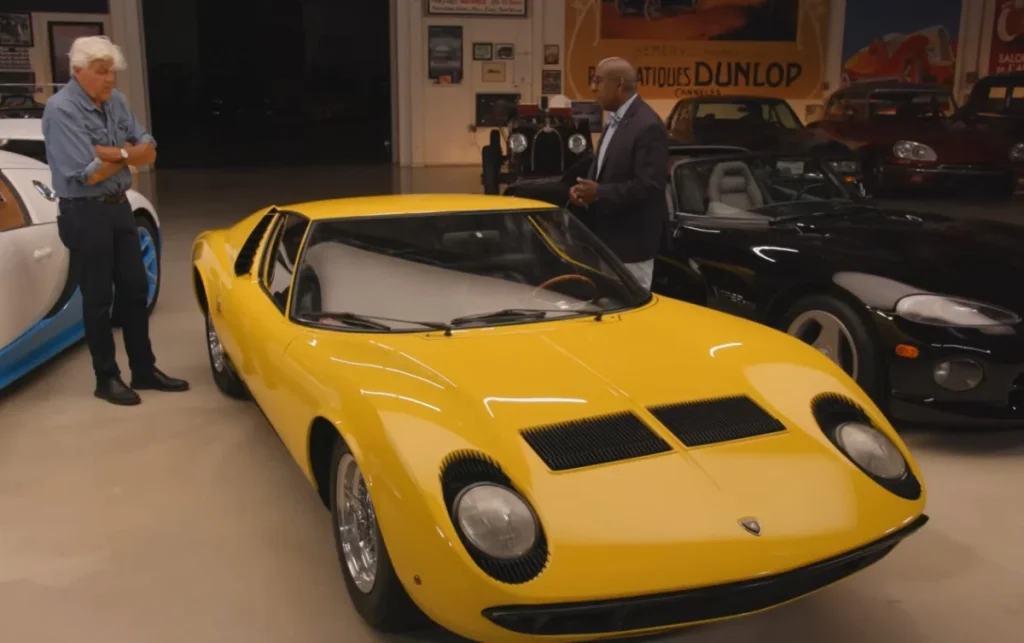
Leno’s Miura is particularly notable because he did not buy it as a pristine, investment-grade collectible. The car had a damaged drivetrain and had been sitting unused for some time. Its history reflects a recurring pattern in his collection, with historically significant cars sometimes gaining renewed attention only after years of neglect.
That combination of limited production, revolutionary engineering, and documented market demand makes the Miura far more valuable than its original role as an exotic sports car might suggest.
4. 1939 Lagonda V12
Leno’s 1939 Lagonda V12 represents a completely different type of rarity. Instead of being a famous Italian supercar, it is a prewar British luxury machine from an era when manufacturers produced cars in extremely small numbers compared with modern standards.
Published descriptions of Leno’s collection have placed the value of his 1939 Lagonda V12 at roughly $2.56 million, while also reporting that the car had previously changed hands for around $1.2 million.
Because a verified auction result for Leno’s specific chassis is not readily available, the $2.56 million figure should be treated as a published valuation rather than an auction sale.
The Lagonda’s appeal comes from its combination of engineering, luxury, and scarcity. The V12 was among the most sophisticated engines available from a British manufacturer before World War II, and surviving examples are far less common than mainstream postwar collector cars.
That makes valuation particularly difficult. With a modern classic, dozens of comparable auction transactions might establish a relatively clear market. With an exceptionally rare prewar car, condition and history can cause enormous differences between two supposedly similar vehicles.
Leno’s example therefore belongs in a category where rarity itself becomes a major part of the value calculation. It is not simply an expensive old car. It represents a period of British automotive engineering that disappeared as the industry changed through the war and postwar decades.
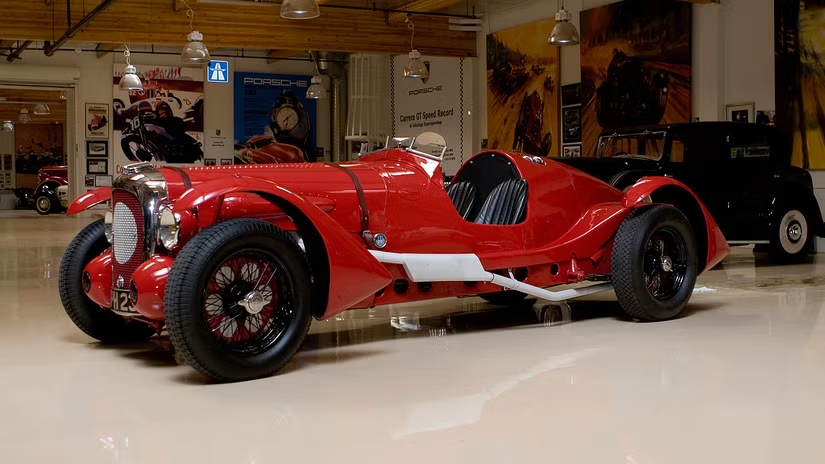
The Lagonda also demonstrates why judging Leno’s garage solely by famous supercars would miss much of what makes the collection unusual. Cars such as this preserve engineering history that would otherwise be represented only by photographs and museum displays.
5. 2022 Czinger 21C
The Czinger 21C is a striking contrast to Leno’s prewar machinery. Rather than representing automotive history from a century ago, it comes from a new generation of low-volume American hypercars.
A documented Jay Leno’s Garage market listing placed the 21C’s price at approximately $2.05 million, corresponding to its published model pricing rather than a used auction transaction.
Its inclusion demonstrates that rarity in Leno’s garage is not limited to old cars. The Czinger was conceived around highly automated manufacturing and extensive use of advanced production technology, making the car as much an engineering statement as a performance machine.
The $2.05 million figure is therefore best described as a purchase-price benchmark rather than an auction result. There is an important difference between a manufacturer’s asking price and what a used example actually achieves under competitive bidding.
Still, the figure places the Czinger comfortably among the expensive machines in Leno’s collection. It also illustrates the range of vehicles that can coexist in his garage. A collector can move from a prewar luxury V12 to an American hypercar designed around digital manufacturing without leaving the same building.
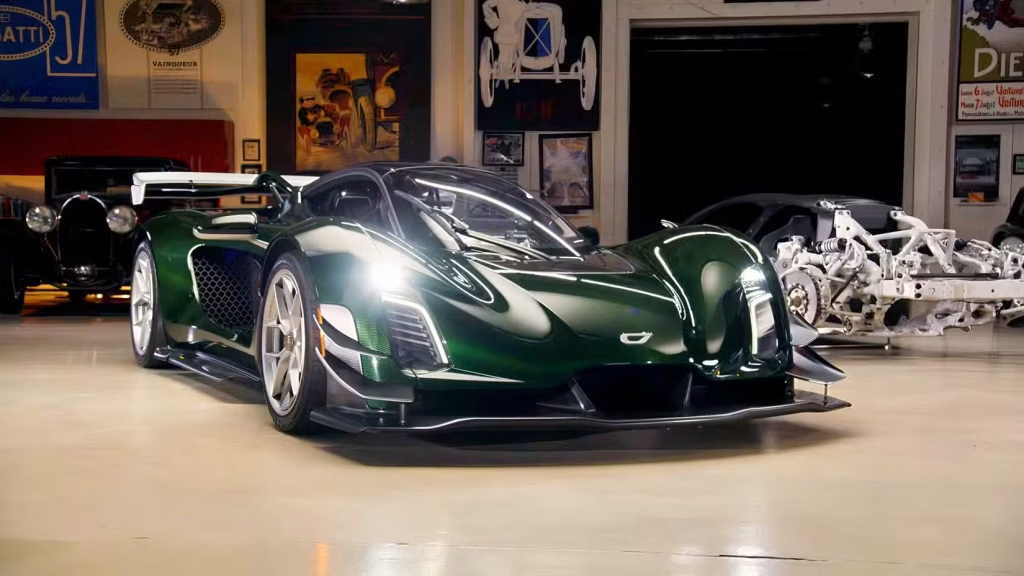
Leno has repeatedly featured unusual technology in his garage, and the 21C fits that pattern perfectly. Its rarity comes partly from the tiny number of cars intended for production and partly from the unusual manufacturing process behind it.
Unlike a mass-produced performance car, there is little chance of seeing another one parked beside it at an ordinary car gathering. That scarcity is a major part of the 21C’s appeal, even before its performance and engineering are considered.
6. 1986 Lamborghini Countach
The Lamborghini Countach occupies an important place in Leno’s collection because it is one of the cars that helped define the visual language of the supercar. Leno has owned his Countach for decades and has said he actually used it extensively, accumulating roughly 50,000 to 60,000 miles rather than treating it as a museum piece.
That usage makes the car especially interesting from a collector’s perspective. Many valuable supercars are preserved with extremely low mileage because owners are reluctant to risk depreciation or mechanical wear. Leno’s approach is different. He has repeatedly argued that cars are meant to be driven.
A useful auction benchmark comes from a 1974 Countach LP400 Periscopo that sold for $1.87 million at Gooding & Company. That is not Leno’s specific car, and the model year and specification differ, so it should not be presented as his car’s value. It does, however, demonstrate the level the most desirable Countach examples can reach.
The Countach also benefits from a level of cultural recognition that some rarer cars do not have. Its distinctive wedge-shaped design became one of the most recognizable symbols of the performance-car era during the 1970s and 1980s.
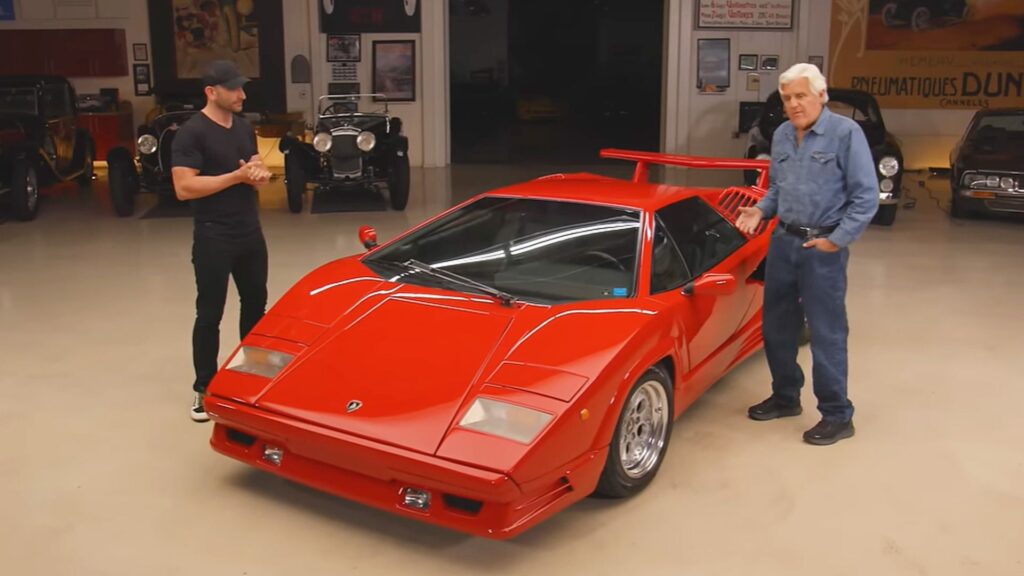
For collectors, that combination matters. Scarcity can create value, but scarcity combined with worldwide recognition can make a car substantially more desirable. Leno’s Countach is therefore valuable not merely because relatively few examples exist, but because generations of enthusiasts grew up seeing it as the ultimate poster car.
Its long driving history also gives it a character that a mileage-free example cannot reproduce.
7. 1957 Mercedes-Benz 300SL Gullwing
Few cars in Leno’s collection have a stronger combination of rarity, engineering significance and collector recognition than the Mercedes-Benz 300SL Gullwing. Leno has featured an exceptionally significant example, including a car described as the last Gullwing built, which he examined with an RM Sotheby’s specialist.
The auction market shows why the model belongs near the top of this ranking. A remarkable 1956 300SL that had spent decades in a junkyard sold for $9.355 million at auction.
That particular car is not Leno’s Gullwing, so the result should not be treated as the value of his exact example. It is instead an unusually strong benchmark for what exceptional provenance can do to a 300SL’s price.
The 300SL’s appeal begins with its racing-derived engineering and continues through its instantly recognizable roof-hinged doors. It was an expensive and technically sophisticated car when new, and surviving examples became highly desirable as the collector market matured.
The final-production example featured by Leno is particularly interesting because production history itself becomes part of the provenance. A car can be valuable because of condition, but being the last example produced can add a separate historical dimension.
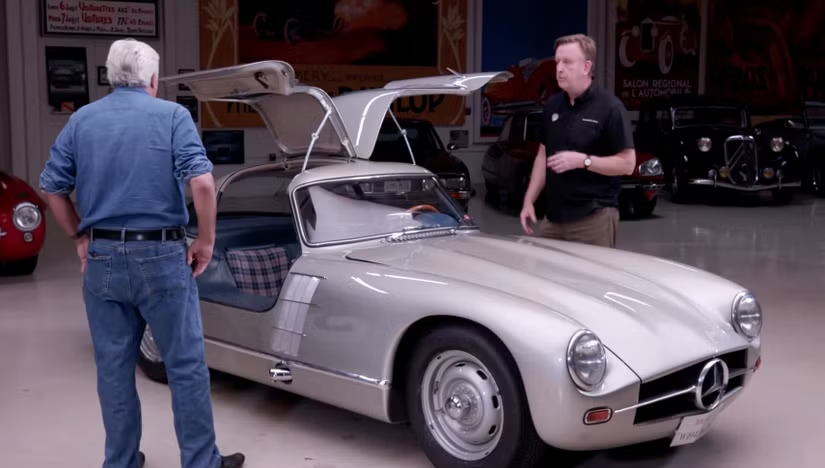
That is precisely why auction comparisons need to be handled carefully. A standard 300SL, a matching-numbers example, a competition-related car and an unusually documented final-production car can occupy very different parts of the market.
For this ranking, the nearly $9.4 million auction provides the clearest evidence of the model’s upper market, while Leno’s specific car deserves its own valuation based on provenance.
8. 1994 McLaren F1
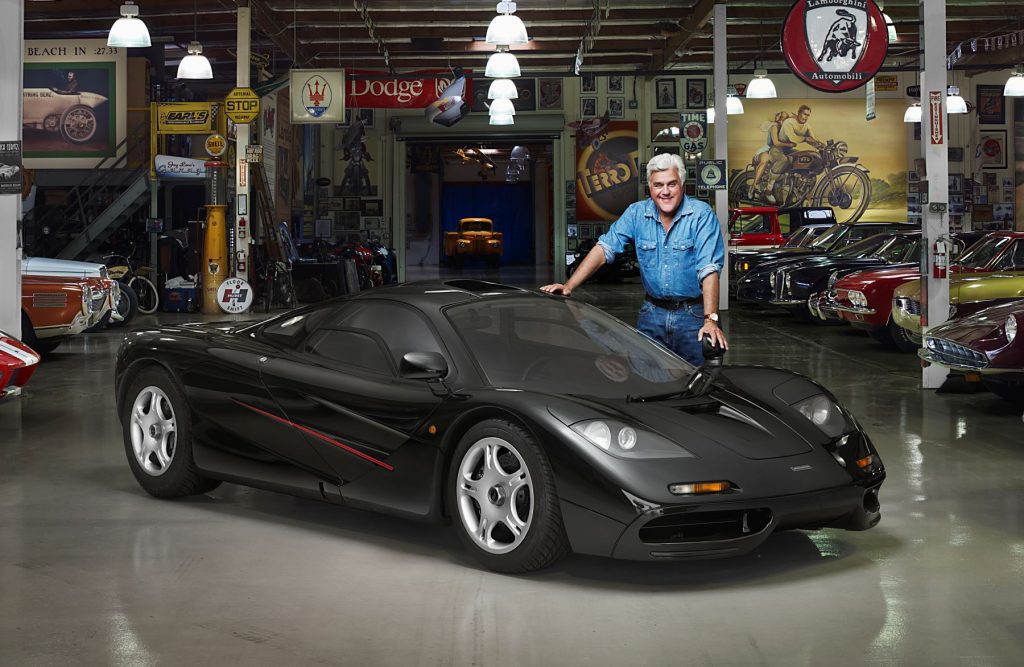
The McLaren F1 is perhaps the clearest example of Leno buying an extraordinary car before the market fully understood its future value.
Leno has said he purchased his F1 for approximately $800,000, and contemporary accounts describe the decision as something he initially considered expensive. Later offers rose dramatically, with published accounts putting the highest offer he received at around $20 million.
The F1’s rarity is beyond dispute. Only 64 road cars were built, and the model combined a carbon-fiber monocoque, central driving position, and BMW-developed V12 powertrain in a package that became one of the defining supercars of the 1990s.
Actual auction evidence supports the extraordinary valuation. A McLaren F1 built to LM specification sold for $19.8 million in 2019, while the broader F1 market has produced several multimillion-dollar results.
There is also a more recent reminder of the model’s scarcity at the top end. In 2026, a 1996 McLaren F1 GTR sold for $34.655 million, setting a record for a McLaren F1 and a British car at auction. The GTR is a competition car, so its value cannot simply be transferred to Leno’s road car, but the sale illustrates the strength of demand for historically significant F1S.
Leno’s F1 is therefore one of the few cars in the collection for which both the original purchase price and extraordinary later market interest are well documented.
9. Koenigsegg CCXR Trevita
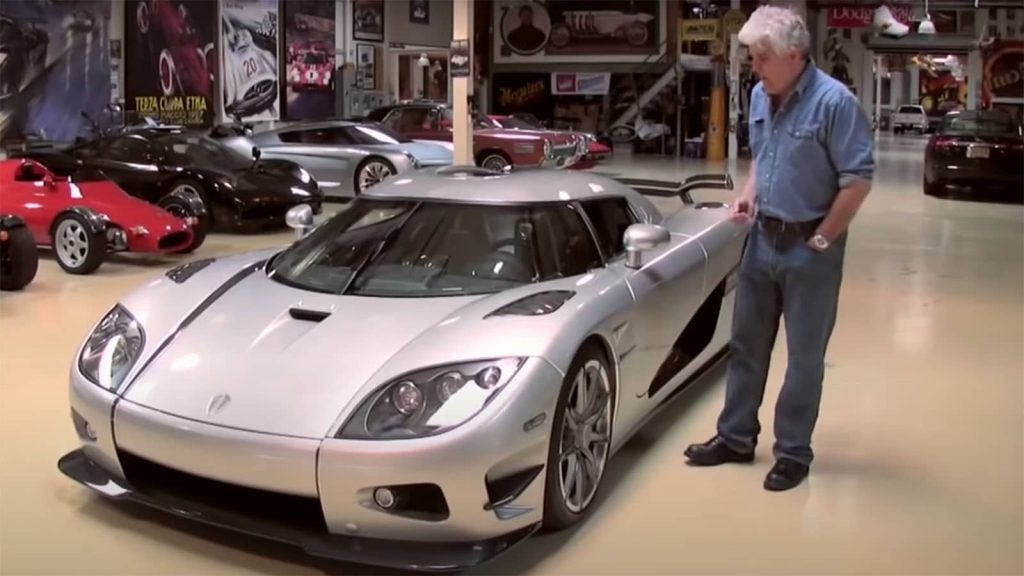
The Koenigsegg CCXR Trevita brings another type of rarity to Leno’s garage. Instead of being a famous prewar survivor or a historically important 1990s supercar, it is an exceptionally limited modern hypercar built around Koenigsegg’s highly specialized engineering.
Published accounts of Leno’s collection have placed the Trevita’s value around $4.8 million. Because a verified public auction result for Leno’s specific example is not established, that figure should not be described as an auction sale.
The Trevita’s scarcity is unusually easy to explain. Koenigsegg originally planned a larger production run, but the complex carbon-fiber finish made the process so difficult that production was limited to only two examples. That makes the model dramatically rarer than even many celebrated low-volume supercars.
This is where the word “rare” takes on a different meaning. A car such as the BMW M1 was produced in hundreds of road-going examples. The McLaren F1 had 64 road cars. The Trevita exists in a tiny handful.
Its valuation is therefore influenced by scarcity as much as by performance. There are simply very few opportunities for collectors to acquire one.
The Trevita also fits Leno’s preference for technically interesting machinery. His collection is full of vehicles built around unusual engines, materials or manufacturing methods, and the Koenigsegg sits comfortably within that philosophy.
While the $4.8 million figure should be treated cautiously because it is a published valuation rather than a confirmed auction result, the underlying rarity is not speculative. Two examples make the Trevita one of the scarcest production cars associated with Leno’s collection.
10. 1958 Porsche 356 Speedster
The 1958 Porsche 356 Speedster provides a much better replacement for the duplicated McLaren F1 section because it adds a completely different chapter to Jerry Seinfeld’s Porsche collection.
The Speedster was one of the most recognizable early Porsche sports cars, created around a simple formula of low weight, open-air driving and a focused road-going character.
Seinfeld has owned examples from the 356 family, and the model has become highly collectible among Porsche enthusiasts. Its appeal comes from its place in the company’s early history rather than from the enormous performance figures associated with later 911-based cars.
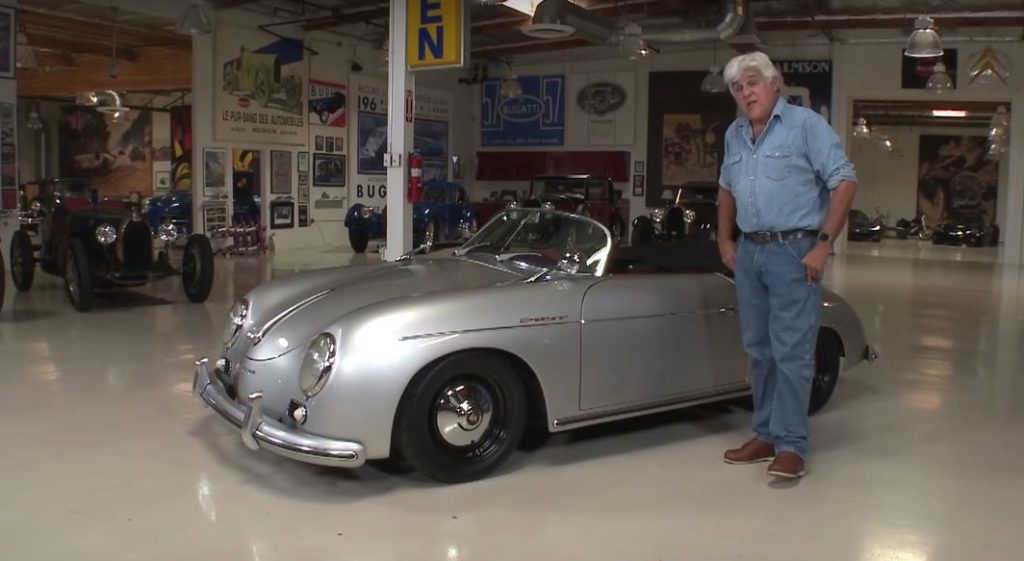
The 356 Speedster also has strong support from the collector market. Exceptional examples have regularly reached six-figure prices at major auctions, while particularly desirable cars with documented histories, rare specifications and high-quality restorations can command substantially more.
For a collection built around Porsche history, the Speedster makes sense because it represents the foundation from which later Porsche sports cars developed. It is considerably older than many of the racing and road-going machines associated with Seinfeld, yet it remains instantly recognizable to collectors.
