
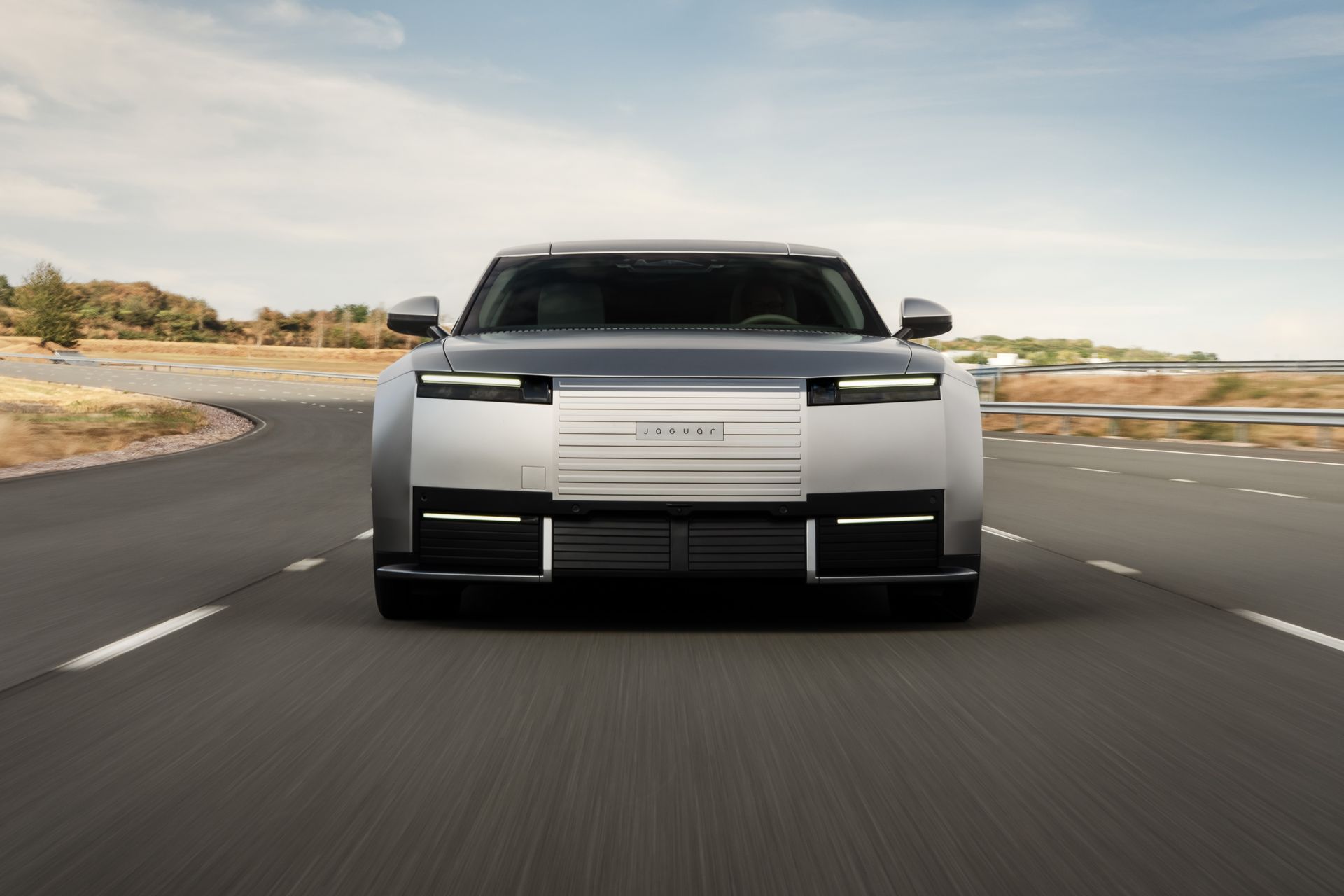
Jaguar has officially introduced the Type 01, a radically styled four-door electric grand tourer that marks the beginning of the British brand’s biggest product transformation in decades.
Revealed in New York, the new flagship combines more than 1,000 horsepower, a claimed 400-mile EPA range, and an unusually low-slung body that eliminates the conventional rear window.
The Type 01 starts at $130,500 in the United States, placing it in a rarefied luxury segment where Jaguar hopes dramatic design and extreme performance will attract wealthy buyers. Orders are expected to open in early 2027, with first customer deliveries scheduled for the second half of the year.
Jaguar describes the Type 01 as the first production model of a completely new generation of vehicles. The company has developed a dedicated Jaguar Electric Architecture, or JEA, specifically for the new lineup rather than adapting an existing platform.
The strategy represents a major departure from Jaguar’s previous product approach. The brand is now positioning itself as an all-electric luxury marque within JLR, with North America identified as an important growth market.
JLR says Jaguar’s transformation is intended to give the brand a distinct position alongside Range Rover, Defender, and Discovery.
A Radical Design Becomes Production Reality
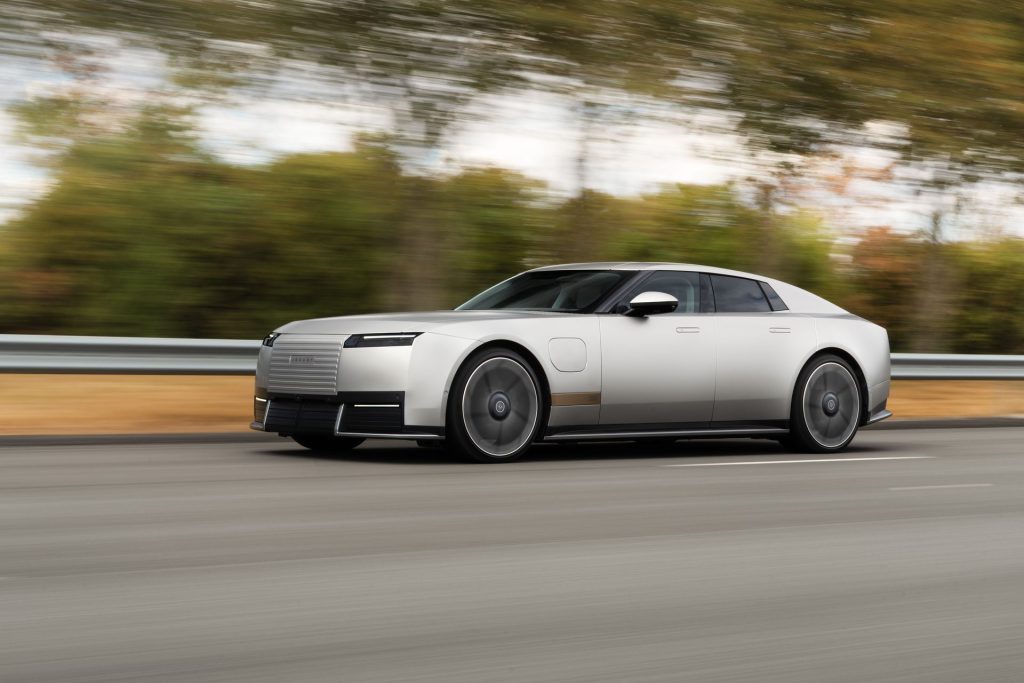
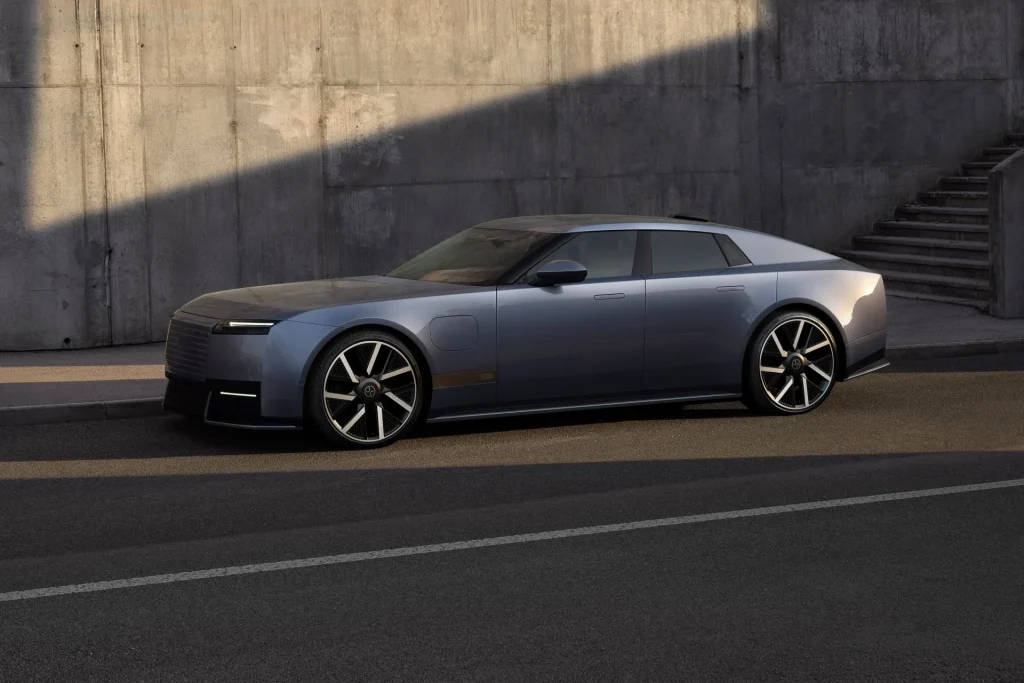
The Type 01 carries much of the visual philosophy first demonstrated by the Jaguar Type 00 concept in 2024, but the production car is considerably more developed. Its proportions include a long bonnet, low roofline, short front overhang, and extended rear section, while enormous 23-inch wheels emphasize its wide stance.
Jaguar says the car measures 208 inches long, or roughly 17.3 feet, yet its four-wheel-steering system gives it a turning circle of just 37.7 feet. The rear axle can turn by up to six degrees, allowing the large GT to maneuver more easily at low speeds while improving stability at higher speeds.
The most unusual element is at the back. Rather than using a conventional rear window, Jaguar has created a glassless tailgate. Rearward visibility comes through a camera-based ClearSight Rear View Display integrated into the cabin.
A panoramic roof and the absence of a traditional rear-view mirror are part of the same effort to give the car a cleaner visual profile.
The design also serves an aerodynamic purpose. Jaguar says the Type 01 uses active aerodynamic vanes and a three-stage deployable spoiler, helping produce a claimed drag coefficient of 0.23, making it the most aerodynamic Jaguar yet.
That combination of long bodywork and controlled airflow is important for an electric GT because reducing aerodynamic resistance directly helps highway efficiency and range.
Jaguar has also developed a new body architecture around the design rather than compromising the shape to fit an existing platform. The company says more than 360 patent applications are associated with the Type 01’s technology and engineering.
Inside, Jaguar has taken an equally unconventional approach. A central spine runs through the cabin, separating individual passenger areas, while a 24-inch OLED display sits in front of the driver. The interior combines traditional luxury materials with a minimalist dashboard and a new infotainment system.
The result is intended to make the Type 01 feel less like a conventional luxury sedan and more like a four-door grand tourer built around Jaguar’s new design identity.
More Than 1,000 Horsepower From Three Motors
The Type 01’s performance credentials are just as dramatic as its exterior. Jaguar is using a tri-motor all-wheel-drive system with intelligent torque vectoring.
Jaguar’s production specification rates it at up to 1,015 horsepower and 1,007 pound-feet of torque, according to its detailed technical information. That is substantially more power than any previous production Jaguar road car.
The three motors can distribute torque between the wheels to improve traction and handling. Jaguar says the system helps the Type 01 deliver its power smoothly rather than simply overwhelming the tires with acceleration.
The company quotes a 0-to-60-mph time of 3.1 seconds for the 1,015-horsepower configuration. Jaguar also highlights rolling acceleration, claiming the car can accelerate from 62 to 112 mph in four seconds.
That emphasis on rolling performance is particularly appropriate for a grand tourer. The Type 01 is intended to deliver effortless acceleration at highway speeds rather than simply produce a spectacular launch figure.
Jaguar says the car can use only a small fraction of its available power while cruising at 60 mph, leaving substantial performance in reserve for acceleration when requested.
The chassis has also been designed to cope with the power. The Type 01 uses four-corner air suspension, active dampers, and all-wheel steering. Jaguar says the battery and body structure provide a low center of gravity and a 50:50 weight distribution.
That is important because the Type 01 is a large vehicle. Managing its mass while maintaining the steering response expected from a Jaguar sports-oriented GT will be one of the key engineering challenges.
The company says its Formula E racing program contributed knowledge to the development of the car’s electric powertrain and torque-vectoring systems, linking the Type 01’s road-going technology with Jaguar’s electric motorsport experience.
400 miles of EPA range and an $130,500 Starting Price
Performance would mean little for a luxury grand tourer if long-distance usability were compromised, so Jaguar has equipped the Type 01 with a 118-kWh usable battery and an 850-volt electrical architecture.
Jaguar estimates up to 400 miles of EPA range for the U.S. market. The company also quotes up to 450 miles under the WLTP testing cycle, although that figure is not directly comparable with the EPA number. The EPA estimate is the more relevant figure for American buyers.
The charging system is another major part of the vehicle’s technology package. Jaguar says the Type 01 can add up to 200 miles of range in 13 minutes when connected to a 350-kW DC fast charger. Actual charging performance will depend on battery temperature, state of charge, charging equipment, and other conditions.
The combination of long range, rapid charging, and high-speed performance is designed to make the Type 01 a genuine long-distance GT rather than an electric performance car intended primarily for short trips.
Jaguar’s U.S. strategy is particularly important because the company has identified North America as a priority growth region. Reuters reported that the Type 01 is being launched with affluent American consumers in mind, particularly technology-focused buyers who may be attracted to its combination of luxury, performance, and unconventional design.
At $130,500 before additional charges, the Type 01 is not intended to compete with mainstream electric sedans. It is Jaguar’s statement product, designed to establish the character of the brand’s new era.
The pricing also places substantial pressure on Jaguar to deliver an ownership experience that matches the car’s positioning. Buyers at this level have numerous alternatives from established luxury manufacturers, including high-performance EVs from Porsche, Mercedes-Benz, and other premium brands.
Jaguar is therefore betting that exclusivity and design differentiation will matter as much as raw performance.
The Type 01 also carries significant importance for the company’s manufacturing strategy. Jaguar says production will begin in 2027 at JLR’s Solihull operations, while electric drive units and battery packs will be produced in Wolverhampton and pressed body panels in Halewood, England.
That means the vehicle is not simply a design exercise. It represents the first production Jaguar built around the company’s dedicated JEA electric architecture and the first major product in the brand’s planned reset.
Jaguar’s transformation comes after a period in which the brand’s product range contracted dramatically. The company is now moving toward an all-electric portfolio, and the Type 01 will replace the previous generation of Jaguar products as the centerpiece of that strategy.
Jaguar says its existing U.S. retailers will continue selling legacy vehicles until Type 01 deliveries begin in 2027. The stakes are therefore unusually high.
Jaguar is attempting to rebuild its identity around a single, highly distinctive electric grand tourer before expanding the new generation with additional models.
The Type 01 has the performance credentials, range, and technology to make a strong first impression, but its unconventional appearance and six-figure price also mean it will appeal to a relatively narrow group of customers.
For Jaguar, that exclusivity is intentional. The company is no longer pursuing the broad-volume strategy associated with its previous lineup. Instead, it is attempting to establish itself as a more focused luxury brand built around distinctive design, advanced technology, and electric performance.
The Type 01 is the first major test of whether that strategy can work. With more than 1,000 horsepower, a claimed 400-mile EPA range, three electric motors, an 850-volt system, and a starting price of $130,500, it certainly makes a dramatic statement.
The bigger question will come when the first customer cars reach American roads in 2027, and Jaguar has to turn that statement into sustained demand.
For a brand attempting its most significant reset in decades, the Type 01 is not simply a new model. It is the product on which Jaguar’s new identity will be judged.
