
BorgWarner has secured three new turbocharger contracts with a global powertrain manufacturer, reinforcing the continued role of advanced combustion technology in the automotive industry’s changing powertrain mix.
Announced on October 29, 2026, the agreements cover one variable turbine geometry (VTG) turbocharger program and two wastegate turbocharger programs for gasoline-powered light vehicles in South America and Europe. Production is scheduled to begin in 2027.
The awards matter not because they signal a reversal of electrification, but because automakers still need combustion engines that deliver better efficiency, responsive performance, and lower emissions as hybrid and electric vehicles expand.
Three Contracts Expand BorgWarner’s Turbocharger Business
The three awards are described by BorgWarner as conquest business wins, meaning the company has secured new business rather than simply extending an existing supply arrangement. The customer is identified only as a global powertrain technology leader.
BorgWarner has not publicly disclosed its name, the vehicle models involved, engine displacements, expected production volumes, or the financial value of the contracts.
The distinction lies in the turbocharging technology used. One award recognizes a variable turbine geometry turbocharger, while the other two are for wastegate turbochargers.
All three are intended for gasoline-powered light-vehicle platforms in South America and Europe. Their production launches are scheduled for 2027, although the company has not provided more specific start dates.
The regional scope is important. Europe has some of the world’s more demanding vehicle emissions and fuel-efficiency requirements, while South America remains a substantial market for conventional gasoline-powered vehicles.
Automakers operating across both regions need engines that can meet local regulations, customer expectations, and different vehicle-price requirements. A single powertrain strategy does not necessarily suit every market, particularly where charging infrastructure, vehicle affordability, and consumer preferences vary.
BorgWarner’s latest business wins demonstrate that suppliers continue to compete for combustion-engine programs even as manufacturers invest heavily in battery-electric platforms.
A turbocharger can help an automaker extract more performance from a smaller engine, potentially reducing fuel consumption and emissions compared with a larger naturally aspirated engine when the complete vehicle and engine are appropriately engineered.
However, these contracts should not be interpreted as evidence that the customer is abandoning electrification or committing to a long-term expansion of gasoline-only vehicles. The manufacturer has not disclosed whether the engines will be used exclusively in conventional vehicles or whether any applications will be incorporated into hybrid powertrains.
The confirmed scope is more specific, with the awards recognizing gasoline-powered light-vehicle platforms across two regions.
For BorgWarner, winning three programs with one global customer strengthens its position in a competitive supplier market. Automakers typically evaluate suppliers on more than component performance.
Cost, reliability, manufacturing capacity, engineering support, and the ability to meet production schedules all influence sourcing decisions. The company says the awards reflect its technical expertise, competitive solutions, and established relationship with the customer.
Variable Turbine Geometry and Wastegate Designs Serve Different Needs
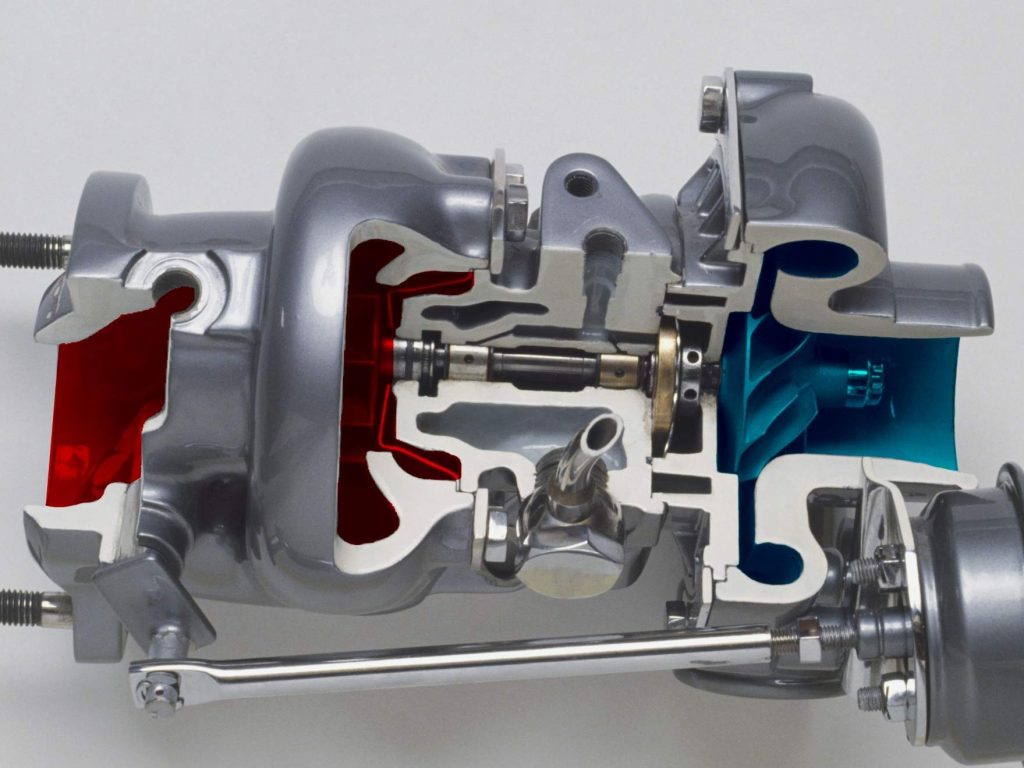
The VTG award is particularly notable because variable turbine geometry technology is more complex than a conventional fixed-geometry turbocharger. A turbocharger uses exhaust gases to spin a turbine connected to a compressor, which forces more air into the engine.
More available air allows the engine to burn fuel more effectively and produce greater power from a given displacement. The challenge is controlling airflow and boost pressure across different engine speeds without creating excessive lag or compromising efficiency.
A VTG turbocharger addresses that challenge through adjustable vanes around the turbine. By changing the geometry of the exhaust passage, the system can influence how quickly exhaust gases drive the turbine.
At lower engine speeds, the vanes can help increase gas velocity and improve response. At higher speeds, they adjust to accommodate greater exhaust flow and manage boost. This gives engineers more control across a wider operating range than a conventional fixed-geometry arrangement.
Gasoline applications present a particular engineering challenge because exhaust temperatures can be extremely high. BorgWarner says its gasoline VTG technology is designed to handle exhaust temperatures of up to 1,050 degrees Celsius while supporting high boost pressures.
The company also highlights compatibility with Miller-cycle gasoline engines, which use modified valve timing to improve thermodynamic efficiency. The turbocharger is engineered to complement that combustion strategy while delivering stronger response at lower engine speeds.
The practical benefit is not simply higher peak horsepower. Better low-speed response can make a smaller engine feel more responsive during everyday acceleration, while improved thermodynamic efficiency can help reduce the amount of fuel needed to produce useful power.
BorgWarner also identifies emissions reduction and transient performance as intended benefits. Actual results will depend on the engine calibration, vehicle weight, transmission, and emissions-control systems used by the automaker.
The other two contracts involve wastegate turbochargers, a more familiar design across modern gasoline engines. A wastegate regulates how much exhaust gas passes through the turbine.
When the system reaches its target boost pressure, the wastegate opens to bypass some exhaust flow around the turbine, helping prevent excessive boost. This provides a relatively straightforward way to control turbocharger output across the engine’s operating range.
BorgWarner says its wastegate products use scalable compressor and turbine stages that can be adapted to customer requirements. The designs are available with single-scroll and twin-scroll configurations, as well as dual-volute turbine arrangements.
They can also use pneumatic or electric wastegate actuation. These options allow engineers to match turbocharger characteristics to different engine layouts, performance targets, and packaging constraints.
Twin-scroll and dual-volute arrangements can help separate exhaust pulses from different cylinders, depending on the engine’s firing order and manifold design. Preserving that separation can improve the energy delivered to the turbine and support response.
Electric actuation also gives the engine control system more precise authority over wastegate operation than a basic pressure-operated arrangement, although the best solution depends on the vehicle program’s cost and performance requirements.
BorgWarner also highlights noise, vibration, and harshness improvements, alongside power density, fuel economy, and emissions benefits. These attributes matter because turbocharging is not judged only by output figures.
Automakers must deliver predictable acceleration, acceptable cabin noise, and durability over years of use. A turbocharger that produces strong power but creates unpleasant noise or inconsistent response can undermine the driving experience.
New Awards Show Why Combustion Technology Still Matters
The contracts arrive as automakers balance investment in battery-electric vehicles with continued demand for gasoline and hybrid powertrains. Electrification is changing the supplier landscape, but the transition is uneven across regions and vehicle categories.
Some markets are adopting electric vehicles quickly, while others continue to rely heavily on combustion engines because of purchase prices, charging availability, infrastructure, and customer preferences.
That creates a continuing market for components that make internal-combustion engines more efficient. Turbochargers are one part of that effort. They allow manufacturers to pursue engine downsizing without necessarily sacrificing the acceleration and performance customers expect.
When combined with direct fuel injection, advanced combustion strategies, improved transmissions, and effective emissions after-treatment, turbocharging can help manufacturers meet increasingly demanding efficiency targets.
Hybrid vehicles also complicate the idea that combustion-engine development is disappearing. Many hybrids still use gasoline engines, and some combine them with turbocharging to deliver performance and efficiency.
However, BorgWarner has not confirmed whether these three specific awards include hybrid applications. The announcement identifies gasoline-powered light-vehicle platforms, so it would be premature to describe the contracts as hybrid programs.
The supplier’s wider business activity provides useful context. In its October 29 third-quarter announcement, BorgWarner listed nine new business awards across its portfolio. Alongside the three turbocharger wins, it disclosed an engine control module award for a future internal-combustion pickup truck platform, with production expected in 2029.
It also announced electric motor awards in China for range-extended, battery-electric, and hybrid applications, plus a high-voltage inverter program for next-generation electric vehicles.
That mix is revealing. BorgWarner is pursuing opportunities in conventional powertrains and electrified propulsion rather than relying on one technology pathway. The company reported third-quarter 2026 net sales of $3.487 billion, down approximately 2.9% from the same period a year earlier.
Its U.S. GAAP operating margin rose to 8.7%, up from 6.9% in the third quarter of 2025. This improvement highlights the importance of winning future programs, which can create a longer-term stream of business beyond existing production cycles. However, the actual revenue impact will depend on vehicle demand and the timing of each program’s launch.
For now, the three turbocharger contracts remain a positive development for BorgWarner’s combustion technology business, but their commercial scale cannot be assessed because the customer, expected volumes and contract value have not been disclosed.
Production is scheduled for 2027, meaning the awards are a future program commitment rather than an immediate increase in vehicle supply.
The larger takeaway is that the automotive industry’s transition is not happening at the same speed everywhere. Battery-electric vehicles are expanding, but gasoline engines remain part of manufacturers’ plans, particularly in markets where affordability and infrastructure shape purchasing decisions.
BorgWarner’s latest wins show that suppliers still see opportunities in improving those engines. The company is betting that more efficient turbocharging will remain valuable while the industry moves toward a broader mix of powertrain technologies.
