
Electric vehicle manufacturers are looking for ways to make charging systems more efficient, compact, and affordable. A new collaboration between Visteon, SHINRY Technologies, and Infineon Technologies aims to address these challenges through a single-stage onboard charger using gallium nitride semiconductor technology.
Announced at the electronica trade fair in Munich on November 11, 2026, the project combines a new power-conversion architecture with integrated bidirectional switches.
The companies say the design could reduce hardware complexity and packaging requirements while supporting high-power AC charging and two-way energy transfer.
A Single-Stage Design Could Simplify EV Charging Hardware
The development is being carried out by Visteon-Shinry Power Electronics LLC (VSPE), a joint venture between Visteon Corporation and SHINRY Technologies, in collaboration with Infineon Technologies.
VSPE is responsible for the converter hardware, control strategy, and system integration, while Infineon contributes its gallium nitride (GaN) monolithic bidirectional switches. The companies announced their partnership during Electronica 2026 in Germany.
The central feature is the charger’s single-stage architecture. An onboard charger, commonly called an OBC, is installed inside an electric vehicle and converts electricity from an AC charging connection into the direct current required by its high-voltage battery.
It also manages the charging process to ensure electricity is supplied within the limits of the vehicle’s electrical system.
Many conventional onboard chargers use two separate power-conversion stages. Each stage performs a different part of the conversion and control process. Although this approach is widely established, it requires multiple electronic components and supporting circuitry.
Traditional two-stage designs also use large bulk capacitors to help manage voltage and maintain stable operation.
VSPE’s new architecture combines functions that would normally be handled by separate stages. According to the companies, it also eliminates the bulk capacitors found in conventional two-stage onboard chargers.
This could reduce the number of components inside the system and make the charger easier to package within an electric vehicle.
Space is an important consideration for automakers. An EV already needs room for its battery pack, electric motors, thermal-management equipment, power electronics, and other electrical systems. Reducing the physical size of the onboard charger could give engineers more flexibility when arranging these components.
A simpler design may also make manufacturing and integration less complicated. Fewer individual components can mean fewer connections and less assembly work. The companies identify improved reliability, reduced system complexity, compact packaging, and lower costs as potential advantages.
However, these benefits have not yet been quantified through publicly released test results. The partners have not disclosed a measured efficiency improvement, a confirmed weight reduction, or a specific manufacturing-cost saving. Their statements describe the intended advantages of the architecture rather than independently verified production results.
The charger is designed to support 22-kilowatt three-phase AC charging and 19.2-kilowatt single-phase AC charging. These figures represent its stated power capabilities. Actual charging performance will depend on the electrical supply, the vehicle’s onboard charging limits, and the equipment being used.
Why Gallium Nitride Technology Is Important to the Development
Infineon’s contribution centers on gallium nitride, a wide-bandgap semiconductor material used in power electronics. GaN devices can operate at high switching frequencies and offer advantages in power density and efficiency in suitable circuit designs.
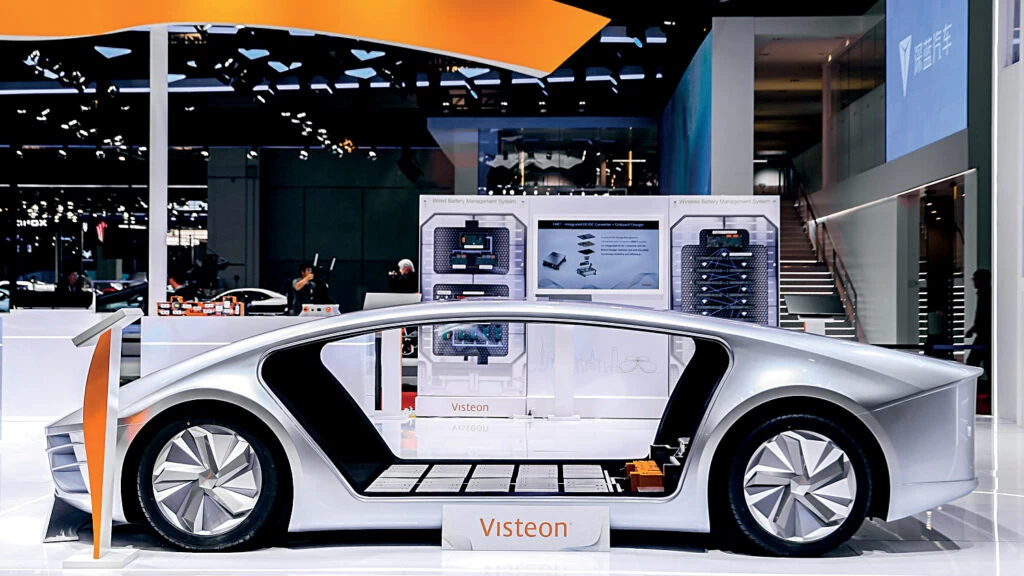
These characteristics make the technology attractive for applications where manufacturers need to manage electrical power without using large amounts of space.
The charger uses Infineon’s monolithic GaN bidirectional switches, known as GaN BDS. Their main feature is the integration of bidirectional voltage blocking and current conduction into a single semiconductor device.
In conventional circuit arrangements, engineers may need multiple semiconductor components to perform comparable bidirectional switching functions. Combining those capabilities in one device can simplify the power stage and reduce the number of components required.
This is particularly relevant to the new charger because its architecture is designed to combine power-conversion functions while supporting electricity flow in both directions. Infineon’s switches are intended to help achieve that arrangement with fewer semiconductor devices.
Another advantage of GaN is its high-frequency switching capability. Power converters use semiconductor switches to control the movement of electrical energy. Faster switching can allow certain magnetic components, including inductors and transformers, to be made smaller.
This can increase power density, meaning the system can handle more electrical power within a given physical space.
For automakers, improved power density could make charging equipment easier to integrate into future vehicle platforms. A smaller power stage may also create opportunities to reduce packaging requirements and simplify the surrounding electrical architecture.
Nevertheless, using GaN does not automatically guarantee that a charger will be cheaper or more efficient. Engineers must account for heat generation, electrical losses, electromagnetic interference, insulation, and long-term durability. Automotive components also have to withstand vibration, temperature changes, and years of regular operation.
These requirements make validation particularly important for the new design. Eliminating bulk capacitors and combining conversion stages may reduce component count, but the complete system still needs to demonstrate stable operation under demanding conditions.
SHINRY chief technology officer Mark Sun said the company’s research and development team is working to validate the architecture against the reliability standards expected by global automotive customers. The statement indicates that the design is still being evaluated rather than already being confirmed for mass production.
Infineon also highlighted that its GaN bidirectional switch received recognition as a “Global New Energy Vehicle Innovative Technology” at the 2026 World New Energy Vehicle Congress. This recognition relates to the semiconductor technology itself.
It does not mean that the complete charger has received production certification or that an automaker has selected it for a specific vehicle.
Bidirectional Charging Could Give Electric Vehicles More Energy Flexibility
Beyond its single-stage design, the charger is notable for supporting bidirectional vehicle-to-everything, or V2X, power transfer. Conventional charging generally moves electricity from the grid into the vehicle’s battery. Bidirectional charging allows a compatible vehicle to send stored electricity back to an external system.
V2X covers several applications. Vehicle-to-grid (V2G) allows an EV to supply electricity back to the power grid. Vehicle-to-home (V2H) can allow a vehicle to provide power to a house, while vehicle-to-load (V2L) enables compatible external equipment to draw electricity from the vehicle.
These capabilities could make EV batteries useful beyond transportation. A compatible vehicle could potentially provide backup power during an outage, support household electricity use, or participate in energy-management programs.
Fleets of connected vehicles could also provide additional flexibility to electricity networks as demand changes.
However, an onboard charger with bidirectional capability does not automatically make every V2X application available. The vehicle’s battery-management system, software, electrical architecture, external charging equipment, and local regulations all influence which functions can operate. The vehicle and external equipment must also be compatible.
It is important to distinguish the new technology from DC fast charging. The VSPE system is an onboard charger designed to convert AC electricity inside the vehicle.
DC fast-charging stations generally perform this conversion outside the vehicle and deliver direct current to the battery. The announcement does not suggest that the new charger replaces public DC fast-charging equipment or increases a vehicle’s maximum DC charging rate.
The two AC power ratings also serve different electrical configurations. The 22-kW rating applies to three-phase power, commonly available in commercial and public charging environments in markets with three-phase electricity.
The 19.2-kW rating applies to single-phase power. Whether a vehicle can reach either maximum depends on the available supply and the vehicle’s electrical system.
The collaboration combines three different areas of expertise. Visteon is an automotive electronics supplier with experience in vehicle systems and electronic architectures.
SHINRY, founded in Shenzhen in 2005, develops power-electronics products for new-energy vehicles, including onboard chargers and DC/DC converters. Infineon contributes semiconductor technology and automotive power-device expertise.

Through their joint venture, Visteon and SHINRY combine converter design, control technology, and vehicle-system integration. Infineon’s GaN switches add a semiconductor technology intended to support a more compact and integrated power-conversion system.
Zilai Zhao, co-general manager of VSPE, described the collaboration as a combination of expertise in vehicle electronics, power conversion, and advanced semiconductors.
For now, the project remains at the development and validation stage. The companies have not announced a production timetable, commercial pricing, expected manufacturing volumes, or a confirmed automaker programme. program.also not published detailed efficiency measurements or independent long-term reliability results.
The next important step will be demonstrating that the charger can meet automotive requirements while delivering its proposed improvements in size and complexity. If validation is successful and vehicle manufacturers adopt the design, it could provide a new approach to integrating AC charging and bidirectional energy functions into future electric vehicles.