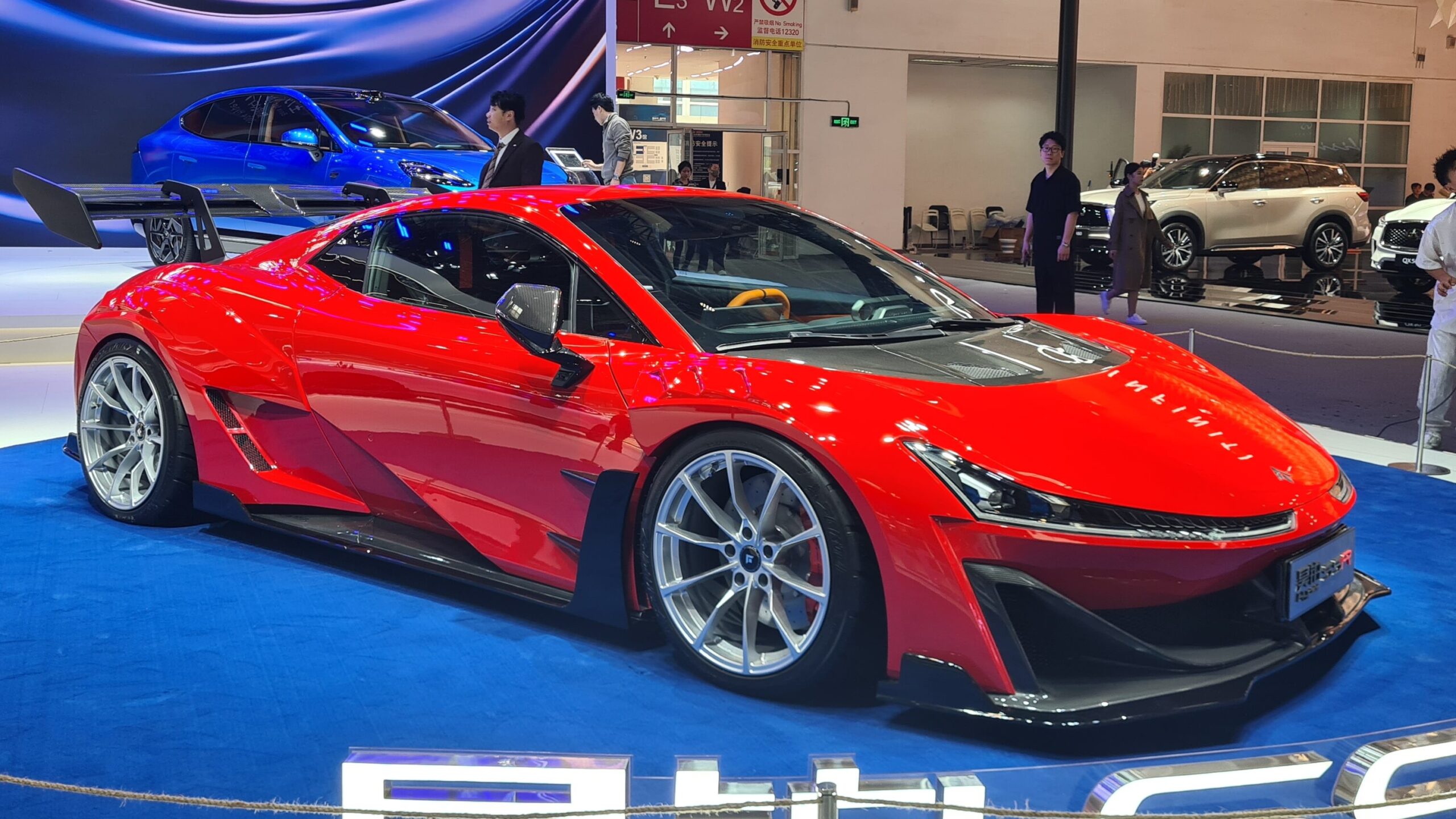
Great Wall Motor (GWM) is preparing to enter the high-performance supercar market with a new mid-engine hybrid model designed to compete with established names such as Ferrari.
The Chinese automaker is developing the vehicle around a 4.0-liter twin-turbocharged V8 engine paired with a plug-in hybrid system, with a previously announced target of more than 1,200 metric horsepower, equivalent to approximately 1,184 mechanical horsepower.
The project has attracted attention after GWM chairman Wei Jianjun tested the prototype against a Ferrari SF90. The company is targeting a 2027 launch, although final specifications, pricing, and international availability remain unconfirmed.
GWM Takes Its First Supercar Prototype to the Track Against Ferrari
GWM’s supercar project represents a major departure from the company’s traditional focus on SUVs, pickups, and mainstream passenger vehicles. The company is developing its first dedicated high-performance road car under its GF performance architecture, with the Ferrari SF90 serving as an important engineering benchmark.
The project received renewed attention on November 12, 2026, when GWM chairman Wei Jianjun shared a video on the Chinese social media platform Weibo. The footage showed him driving a Ferrari SF90 at the company’s proving ground in Baoding, China.
GWM’s own supercar prototype appeared in the video, although its bodywork was deliberately blurred because the vehicle remains confidential.
Wei openly acknowledged that the prototype still falls short of the Ferrari in several areas. He identified handling stability, throttle response, and exhaust sound as areas requiring further development. He also said the team would continue improving the car before its planned launch in 2027.
The comparison is significant because GWM is not simply targeting a high horsepower figure. The Ferrari SF90 is a sophisticated plug-in hybrid supercar that combines a twin-turbocharged V8 with three electric motors.
Its engineering integrates combustion power, electric propulsion, and advanced electronic controls to deliver performance on both road and track.
GWM’s decision to test its prototype against the Ferrari provides an indication of the level of performance it hopes to achieve. However, a comparison session does not establish that the Chinese car can match the SF90. Wei’s own comments confirm that the development team still has work to do.
The project has reportedly been in development for five to six years. GWM has previously discussed its intention to enter the supercar segment and presented parts of its performance-engineering program at major automotive events.
The company has also indicated that the road car will be connected to a broader motorsport program, including a GT3 racing project.
GWM is expected to reveal the production-oriented vehicle before the end of 2026, followed by a market launch in 2027. The company has not yet released an uncamouflaged production model or confirmed its final name.
A 4.0-Liter Twin-Turbo V8 and Plug-In Hybrid System Target More Than 1,200 PS
The most important feature of the upcoming supercar is its powertrain. GWM is developing an in-house 4.0-liter, 90-degree twin-turbocharged V8 engine with a mid-mounted layout. It will be paired with a plug-in hybrid system to provide combined combustion and electric power.
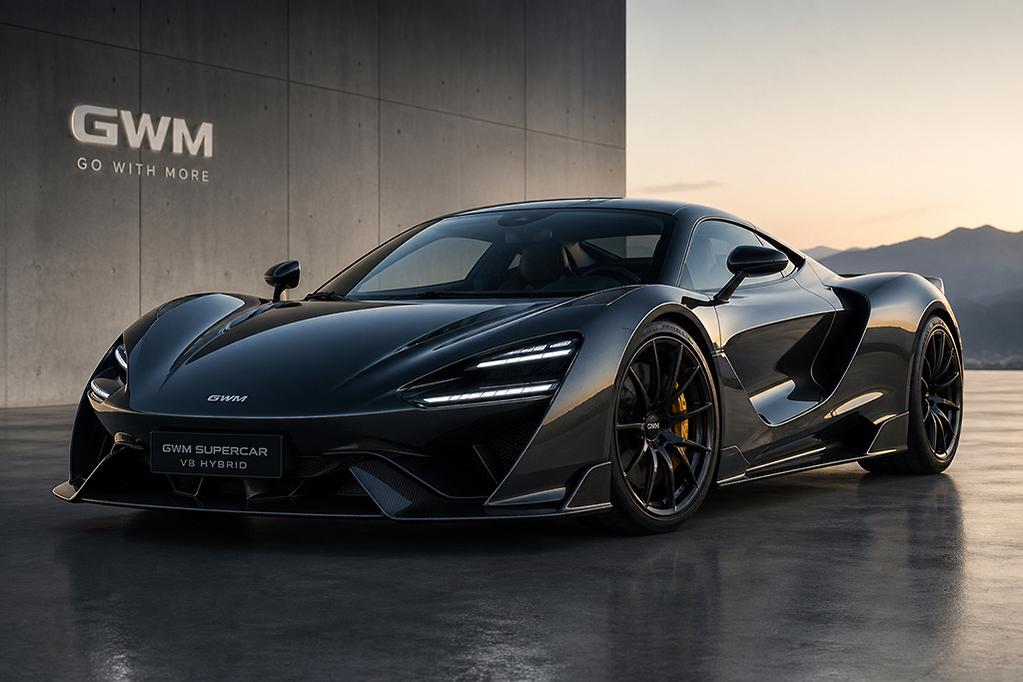
The engine uses a hot-V configuration, which positions the turbochargers within the space between the cylinder banks. This arrangement can help package the turbocharging hardware more compactly, although it also creates demanding thermal-management requirements.
The disclosed engine design includes dry-sump lubrication and dual fuel injection, features suited to a high-performance application.
Dry-sump lubrication is particularly relevant in vehicles intended for sustained high-speed driving. Instead of storing most of the engine oil in a conventional sump beneath the crankshaft, the system uses external oil storage and pumps to circulate lubricant. This can help maintain oil supply during high cornering forces and allow a lower engine installation.
GWM displayed its 4.0-liter V8 at CES 2026 in Las Vegas. At that stage, the company cited a baseline output of approximately 500 horsepower for the standalone engine. The final road-car engine specification has not been confirmed, and the hybrid system is expected to contribute additional power.
GWM has previously announced a target system output exceeding 1,200 metric horsepower. Converted into mechanical horsepower, that figure is approximately 1,184 hp. It is important to distinguish this target from a confirmed production specification.
The company has not published final combined horsepower, torque, battery capacity, electric motor output, or detailed powertrain configuration.
The plug-in hybrid arrangement is expected to combine the V8’s high-speed performance with electric assistance. Electric motors can provide additional torque during acceleration and help manage power delivery at different speeds.
However, GWM has not disclosed how many motors the supercar will use, where they will be positioned, or whether they will drive the front wheels, rear wheels, or both.
The vehicle is being developed around GWM’s GF high-performance architecture. One of the most notable elements is a carbon-fiber monocoque structure that the company has described as weighing less than 130 kilograms.
GWM has also cited a torsional rigidity target of 40,000 Nm per degree. These figures are manufacturer-disclosed engineering claims, not independently verified production measurements.
A carbon-fiber monocoque can offer high structural rigidity while keeping weight low. This is particularly important in a mid-engine supercar, where the chassis must manage substantial forces from acceleration, braking, and cornering. Lower structural weight can also improve the vehicle’s power-to-weight ratio.
The GF architecture is intended to support more than one vehicle. GWM has discussed using the engineering platform for a road-going supercar, an FIA GT3 racing car, and a road model derived from the racing program. This approach could allow the company to share development work across different performance applications.
Former McLaren GT chief engineer Adam Thomson is involved in vehicle integration, while Nürburgring specialists have contributed to chassis development. Their involvement reflects GWM’s effort to develop a car with international performance ambitions rather than relying solely on a powerful engine.
Ferrari SF90 Comparison, Performance Targets, and Expected Launch
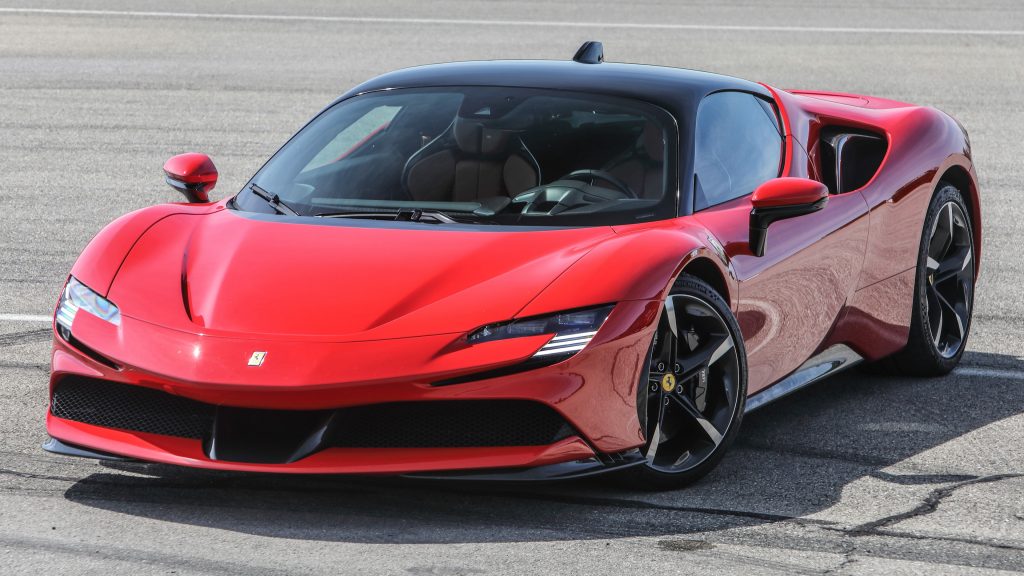
The Ferrari SF90 Stradale provides a useful reference point for understanding GWM’s ambitions. Ferrari’s plug-in hybrid supercar combines a 4.0-liter twin-turbocharged V8 with three electric motors. Its combined output reaches 986 horsepower, while the combustion engine alone produces approximately 769 horsepower.
The SF90 also uses an advanced all-wheel-drive system, with two electric motors driving the front wheels and another electric motor positioned between the V8 and transmission. Ferrari developed this arrangement to combine strong acceleration with precise power delivery and additional traction.
GWM’s target of more than 1,200 metric horsepower would put its proposed system output above the standard SF90 Stradale’s 986 horsepower. However, comparing headline figures alone does not establish which vehicle will perform better.
Weight, transmission response, aerodynamics, cooling, suspension calibration, braking, and electronic control systems all influence a supercar’s capabilities.
The SF90 can accelerate from 0 to 62 mph in approximately 2.5 seconds and reach a top speed of around 211 mph. GWM has not released independently verified acceleration or top-speed figures for its prototype.
Some reports have circulated performance targets of less than 2.5 seconds to 62 mph and a top speed exceeding 217 mph, but these should not be treated as confirmed production specifications.
GWM’s development team still needs to address the areas Wei identified during the comparison test. Throttle response is particularly important in a hybrid supercar because the engine, electric motors, and transmission must deliver power smoothly and predictably.
A vehicle can produce substantial combined output but still require extensive calibration to make that performance usable on a demanding circuit.
Handling stability presents another challenge. A mid-engine layout can provide favorable weight distribution, but suspension geometry, steering response, tire selection, and electronic stability systems determine how effectively the vehicle uses that layout.
GWM’s involvement with Nürburgring specialists suggests that chassis development is receiving considerable attention.
The exhaust note is also part of the challenge. Ferrari’s V8 engines have a distinctive sound that contributes to the brand’s performance identity. GWM will need to establish its own character while meeting the engineering requirements of a turbocharged hybrid powertrain.
The company has not announced a price, production volume, or confirmed sales markets. Chairman Wei has previously indicated that the V8 program has been developed partly with export markets in mind. Nevertheless, there is no confirmed U.S. launch or announcement of American pricing.
If the project reaches production in 2027, it will place GWM in a different competitive category from the SUVs and pickups that form the foundation of its business. Its success will depend not only on achieving the targeted power output but also on delivering the handling, reliability, braking performance, and refinement expected from an expensive supercar.
For now, the 4.0-liter twin-turbo V8, plug-in hybrid configuration, and carbon-fiber structure establish the project’s technical direction. The 1,184-hp figure remains a target rather than a confirmed final output, and the Ferrari comparison has revealed areas where development continues.
GWM’s next major milestone will be the expected public reveal before the end of 2026, followed by its planned 2027 launch.