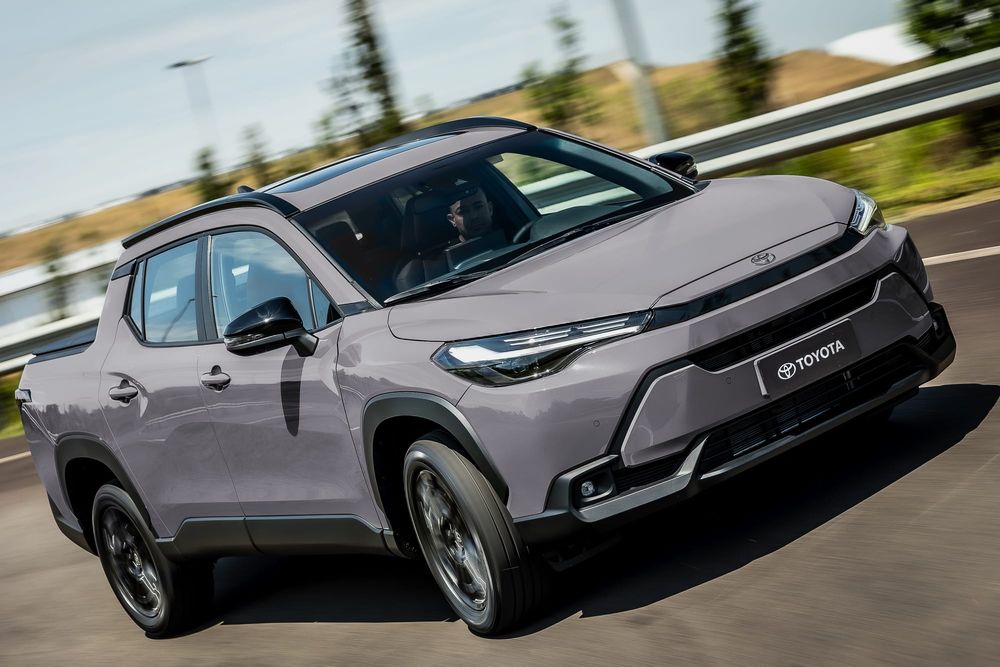
Toyota has introduced the Corolla Deck, a new compact pickup concept developed specifically for Latin American markets, with Brazil set to become its production base.
Revealed on November 18, 2026, during the opening of Toyota’s Sorocaba 2 manufacturing facility in São Paulo state, the vehicle combines the familiar Corolla family identity with a practical double-cab pickup body.
Production is scheduled to begin in the first half of 2027. The new model will sit below the Hilux and target buyers looking for everyday comfort, hybrid efficiency, and additional cargo space without moving into the larger traditional pickup segment.
Corolla Deck Introduces a New Direction for Toyota’s Pickup Lineup
The Corolla Deck gives Toyota an entry into Brazil’s intermediate pickup segment, where vehicles such as the Fiat Toro have established a strong presence. Unlike the Hilux, which uses a traditional body-on-frame construction, the new pickup is derived from the Corolla Cross SUV’s passenger-car architecture.
This approach is intended to deliver a more car-like driving experience while retaining the flexibility of an open cargo bed.
The concept features a double-cab body with seating for passengers behind the front row. Its exterior combines familiar Toyota styling elements with a dedicated pickup design. Although it shares its family identity with the Corolla range, the Deck has its own front-end treatment, body structure, and rear cargo section.
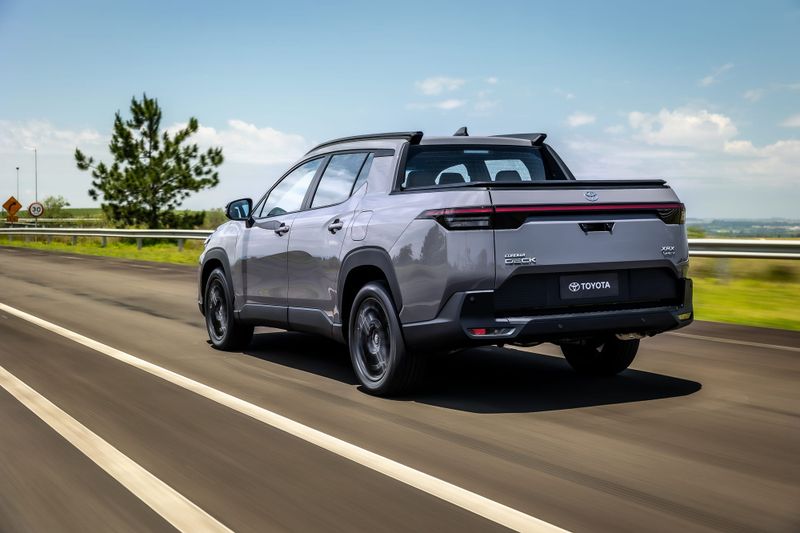
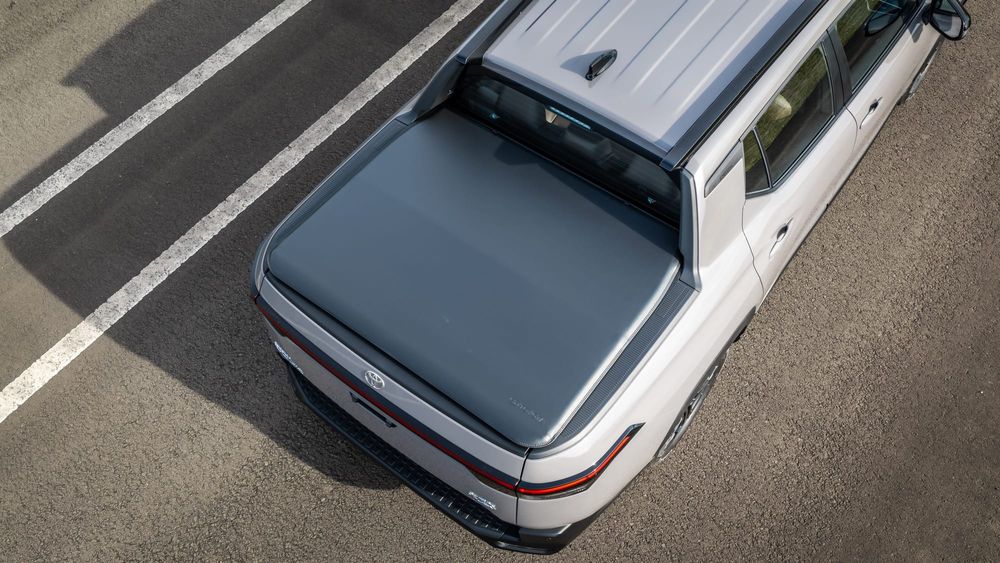
The most important change is behind the passenger cabin. Toyota has added a conventional pickup bed with a tailgate designed to make loading and unloading easier.
The company has highlighted a damped tailgate, which helps control its movement when opening and closing. The cargo area is also designed with a relatively accessible loading height, supporting everyday use.
Toyota has not yet released the final dimensions of the pickup, including its overall length, wheelbase, bed size, or ground clearance. Payload and towing capacities are also unconfirmed.
These figures will be important because they will determine how the Deck compares with established intermediate pickups and whether it can meet the requirements of small businesses and recreational users.
The Corolla Deck is positioned below the Hilux rather than replacing it. The Hilux remains Toyota’s conventional pickup for buyers who need a more rugged vehicle for demanding work, heavier loads, and off-road driving.
The Deck caters to a different type of buyer, particularly those who spend most of their time driving in cities or on highways but still want the added convenience of a cargo bed.
This distinction could help Toyota reach buyers who currently choose a crossover or SUV but occasionally need to carry equipment, luggage, or household materials.
A unibody pickup can offer advantages in ride comfort and maneuverability compared with a traditional ladder-frame truck, although its actual capabilities will depend on the final engineering and suspension setup.
The vehicle is being developed for Latin America, with Brazil playing a central role in its design and manufacturing program. Toyota’s plans also include supplying other markets in Latin America and the Caribbean.
There has been no announcement of a U.S. launch, so the Corolla Deck should not be treated as a confirmed future rival to the Ford Maverick in North America.
Hybrid Flex-Fuel Powertrain Targets Efficiency and Everyday Practicality
One of the most important details confirmed by Toyota is that the Corolla Deck will use a hybrid flex-fuel powertrain. This combination is particularly relevant to Brazil, where ethanol is widely available as an automotive fuel.
A flex-fuel gasoline engine can operate on gasoline, ethanol, or a mixture of the two, giving drivers more flexibility when choosing fuel.
The hybrid system will combine an internal-combustion engine with electric assistance. Unlike a plug-in hybrid, it will not require drivers to connect the vehicle to an external charging station. Its battery will be replenished through the hybrid system and regenerative braking, allowing the electric motor to assist during acceleration and other driving situations.
Toyota has not yet published the final engine displacement, combined horsepower, torque, battery capacity, or transmission specifications for the production Corolla Deck. Although some reports have discussed possible 1.8-liter and 2.0-liter engine options, these should not be presented as confirmed specifications for the pickup.
The hybrid flex-fuel arrangement could be a significant selling point in Brazil. Drivers will be able to choose between gasoline and ethanol depending on fuel prices and availability, while the electric motor can help reduce fuel consumption during suitable driving conditions.
The system may also improve responsiveness in stop-and-go traffic by providing additional electric assistance.
Toyota’s experience with hybrid vehicles in Brazil provides a foundation for the project. The company already sells hybrid models in the country, including the Corolla and Corolla Cross. However, the pickup’s final powertrain calibration may differ because its body structure, weight, and intended uses are different.
The production vehicle will need to balance efficiency with the requirements of a pickup. Carrying passengers and cargo can place different demands on the engine, transmission, and suspension compared with a conventional crossover.
Buyers will therefore be interested in the final payload figures, performance under load, and fuel-consumption ratings once Toyota releases them.
The company has also not confirmed whether the Corolla Deck will initially be offered exclusively with hybrid power or whether additional engine options will follow. Speculation about plug-in hybrid or all-wheel-drive versions should remain separate from the specifications of the concept shown in Brazil.
For now, the confirmed direction is a conventional hybrid flex-fuel pickup designed around the needs of the Brazilian and wider Latin American markets.
This allows Toyota to combine its established hybrid expertise with a body style that has become increasingly popular among buyers who want more versatility than a passenger car can provide.
New Sorocaba Factory Will Build the Corolla Deck From 2027
The Corolla Deck will be manufactured at Toyota’s new Sorocaba 2 facility in São Paulo State. The prototype was revealed during the plant’s inauguration on November 18, 2026, making the pickup the first new model announced for production at the facility.
Toyota plans to begin manufacturing the vehicle in the first half of 2027. The company has not confirmed a precise start date for dealership deliveries or announced the final production volume. Pricing, trim levels, and equipment details are also expected closer to the market launch.
Sorocaba 2 represents a significant expansion of Toyota’s Brazilian manufacturing operations. The new facility has an initial annual production capacity of 100,000 vehicles. It will also take over production of the Corolla sedan, which was previously manufactured at Toyota’s Indaiatuba facility.
The investment forms part of Toyota’s broader Brazilian expansion program, announced at approximately R$11.5 billion through 2030.
The company’s wider plans include developing new products, expanding manufacturing capacity, and strengthening its local supply chain. The new plant is expected to support Toyota’s ability to produce vehicles for both domestic customers and export markets.
Toyota says the Sorocaba 2 facility incorporates highly automated manufacturing processes, including extensive robotic welding operations.
The company also expects the plant to improve resource efficiency compared with its previous production arrangements. These improvements are intended to support more flexible and modern vehicle manufacturing.
The Corolla Deck will join a competitive intermediate pickup category in Brazil. The Fiat Toro is an established participant, while the Renault Niagara is among the upcoming products expected to enter the segment.
Toyota will need to compete on pricing, fuel economy, passenger comfort, and practical cargo capacity rather than relying only on the Corolla name.
Its biggest advantage could be the combination of a familiar brand, hybrid technology, and an existing regional manufacturing network. Toyota already has a strong presence in Brazil, and the Corolla name is widely recognized.
However, the pickup will still need to prove that its cargo area and load-carrying ability meet the expectations of customers who use their vehicles for work as well as personal transport.
The final production specifications will provide a clearer picture of its position. Buyers will want to know how much the pickup can carry, whether different powertrain versions will be available, and how its pricing compares with the Fiat Toro and other competitors. Toyota has not released those details yet.
For now, the Corolla Deck is an important new product for Toyota’s Latin American strategy. Its planned 2027 production allows the company to enter a segment between conventional passenger vehicles and larger utility pickups.
If the production model delivers the promised combination of hybrid efficiency, everyday comfort, and useful cargo capacity, it could become a significant addition to Toyota’s Brazilian lineup.