Automotive supplier Marelli has developed a new Gallium Nitride (GaN) Driver Unit designed to make vehicle lighting electronics lighter, smaller, and more energy-efficient.
Initially developed for automotive headlamps, the technology replaces conventional silicon transistors with gallium nitride semiconductor components to reduce electrical losses and improve power conversion.
Marelli says the new unit can weigh up to 25% less and occupy up to 40% less space than comparable silicon-based driver units.
The development received the 2026 Innovations in Lightweighting Award from the Society of Automotive Analysts, recognizing its potential to improve vehicle efficiency while giving automakers more flexibility when designing advanced lighting systems.
How Marelli’s Gallium Nitride Driver Unit Works
The new technology centers on a DC-DC converter, an electronic component that changes one direct-current voltage level into another to supply the electrical requirements of a vehicle’s headlamps.
Modern lighting systems need carefully controlled power to operate LED modules and other electronic components reliably. The driver unit manages this supply, helping maintain the required lighting performance.
Marelli’s design uses gallium nitride transistors in the converter’s power stages instead of conventional silicon-based components.
Gallium nitride is a wide-bandgap semiconductor, meaning it can switch faster and lose less energy in suitable applications. These characteristics make it useful in compact power electronics where efficiency and thermal management are important.
The difference matters because power conversion is not perfectly efficient. Some electrical energy is lost during the switching process and becomes heat. Reducing these losses can lower the energy required to operate the electronics and may reduce the cooling hardware needed.
According to Marelli, the GaN driver unit can reduce weight by up to 25% and physical size by up to 40% compared with silicon-based driver units currently on the market. These are manufacturer-reported maximum improvements, rather than guaranteed reductions for every vehicle installation.
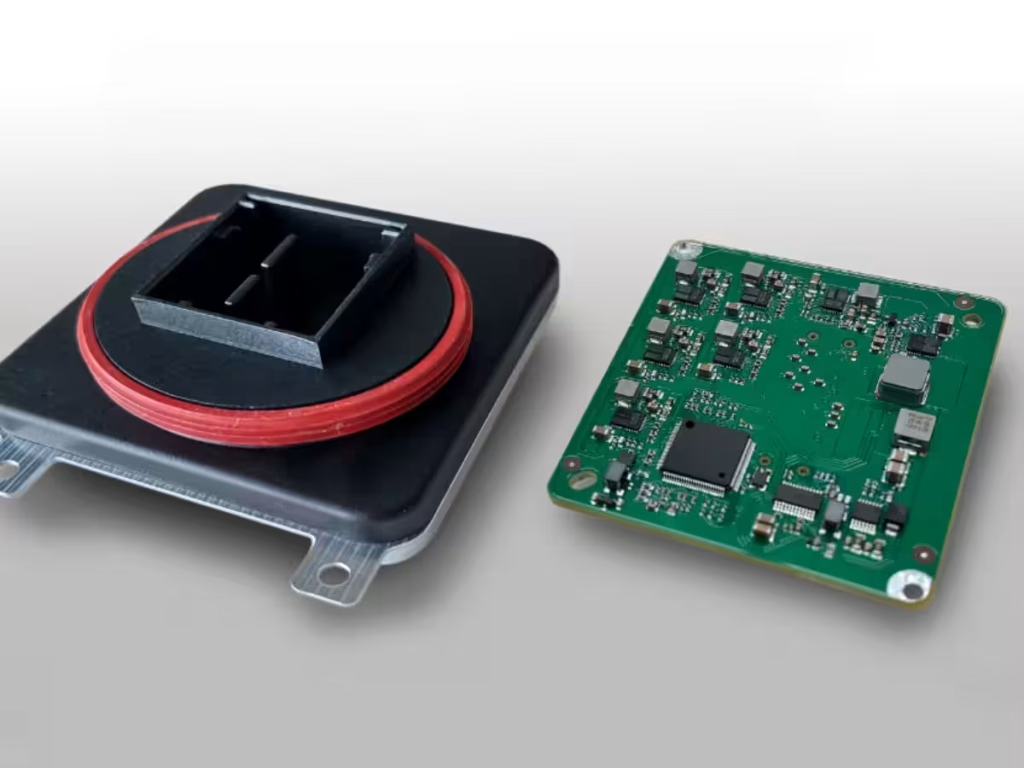
The company attributes the smaller design to several changes. Faster switching allows the use of smaller auxiliary components, including inductors. The circuit board can also be more compact, and the design removes the need for heat sinks used in conventional solutions. Together, these changes reduce the material and space required by the lighting electronics.
This is particularly useful in modern vehicles, where headlamp assemblies have become more sophisticated. LED lighting, adaptive beam functions, and distinctive lighting signatures require electronic systems that can fit within increasingly complex headlamp packaging.
Reducing the size of the driver unit gives vehicle designers more freedom when arranging these components.
The weight reduction also contributes to vehicle lightweighting. Although a headlamp driver is only one small part of a vehicle, reducing mass across multiple electronic systems can support broader efficiency targets.
Marelli says its design also reduces power losses while maintaining the lighting performance expected from conventional silicon-based solutions.
Smaller Electronics Could Improve Manufacturing and Vehicle Design
The benefits of the GaN Driver Unit extend beyond its electrical performance. Marelli has also designed it to simplify manufacturing and reduce the materials required during production.
A smaller printed circuit board allows manufacturers to produce more boards from a single manufacturing panel, improving material utilization and potentially reducing production waste.

The simplified design is intended for high-volume vehicle applications and does not require additional supporting parts or systems. This could make integration easier for automakers and lighting suppliers, particularly when developing headlamp assemblies for vehicles with different designs and equipment levels.
Reducing the need for heat sinks is another important part of the approach. Conventional power electronics often require additional thermal-management components to handle heat generated during operation.
By reducing switching losses, GaN technology can help limit heat generation and potentially eliminate some of this supporting hardware. This creates opportunities to reduce both the size and complexity of the complete lighting electronics package.
For automakers, packaging flexibility is becoming increasingly important. Modern vehicles use lighting not only for illumination but also as a major part of exterior styling and brand identity.
Headlamps can incorporate multiple LED modules, daytime running lights, adaptive functions, and distinctive visual signatures. These features compete for limited space behind the front bodywork.
A more compact driver unit could give designers additional room to integrate lighting functions without significantly increasing the size of the headlamp assembly. It may also help suppliers develop more advanced lighting systems while managing weight and component costs.
The technology could be particularly relevant to electric vehicles, where manufacturers pay close attention to energy consumption and vehicle mass.
Headlamps represent only a small portion of an EV’s total electrical demand, so the new driver unit should not be expected to produce a dramatic increase in driving range by itself. However, reducing unnecessary electrical losses across multiple vehicle systems can contribute to improved energy efficiency.
The potential manufacturing advantages are also relevant beyond electric vehicles. The technology is designed for automotive headlamps generally, meaning it could be integrated into lighting systems used by vehicles with conventional combustion engines, hybrids, and battery-electric powertrains.
Marelli has not announced a specific automaker, vehicle model, or production start date for the GaN Driver Unit. It has also not disclosed its expected unit cost or the precise energy savings under standard driving conditions.
Those details will be important in determining how quickly the technology moves from development into large-scale vehicle production.
Future Applications Could Extend Beyond Conventional Headlamps
Although the initial development focuses on automotive headlamps, Marelli sees opportunities to use the technology in other lighting-related applications. Two potential areas identified by the company are dynamic ground projection and power supplies for displays integrated into front and rear lamps.
Dynamic ground projection uses lighting systems to display visual information on the road surface around a vehicle. Depending on the system, projected graphics can communicate warnings, provide visual guidance, or create distinctive welcome animations.
These functions require additional electronic hardware and precise control, making compact power-management solutions useful.
Integrated lighting displays are another developing area. Some vehicles now use illuminated panels and display elements within their front and rear lighting assemblies. These systems can provide visual communication, styling effects, and additional ways for manufacturers to distinguish their models.
Marelli’s GaN technology could help supply the electrical power needed by such systems while keeping the supporting electronics compact.
However, the company has identified these as potential future applications rather than confirmed production programs. It has not announced specific vehicles that will use the technology for ground projection or integrated lamp displays.
The development also received recognition from the Society of Automotive Analysts. Marelli won the organization’s 2026 Innovations in Lightweighting Award, presented during the Materials Innovation Summit in Auburn Hills, Michigan, on November 11, 2026.
The award recognizes technologies that contribute to direct or indirect vehicle weight reduction and support efficiency improvements.
The recognition highlights how semiconductor technology can influence areas of vehicle engineering that are not usually associated with major powertrain developments.
While GaN is frequently discussed in relation to electric vehicle charging and high-voltage power electronics, Marelli is applying it to a smaller but important component of the vehicle’s lighting system.
The company has not disclosed whether the award-winning unit is already undergoing testing with automakers or when it could enter series production. Its suitability for high-volume applications is part of the stated design objective, but commercial adoption will depend on customer validation, manufacturing costs, and integration requirements.
For Marelli, the development adds another option to its broader automotive lighting portfolio. The supplier already works on advanced LED, microLED, and integrated lighting technologies, where electronic control and compact packaging are becoming increasingly important.
A smaller and more efficient driver unit could complement these systems as automakers demand more complex lighting functions.
The next major step will be demonstrating the technology in production vehicles. Its reported reductions in size, weight, and power losses offer clear engineering advantages, but real-world results will depend on how the unit performs inside complete headlamp assemblies.
If automakers adopt it at scale, the technology could help make advanced vehicle lighting systems more compact and efficient without sacrificing their intended performance.