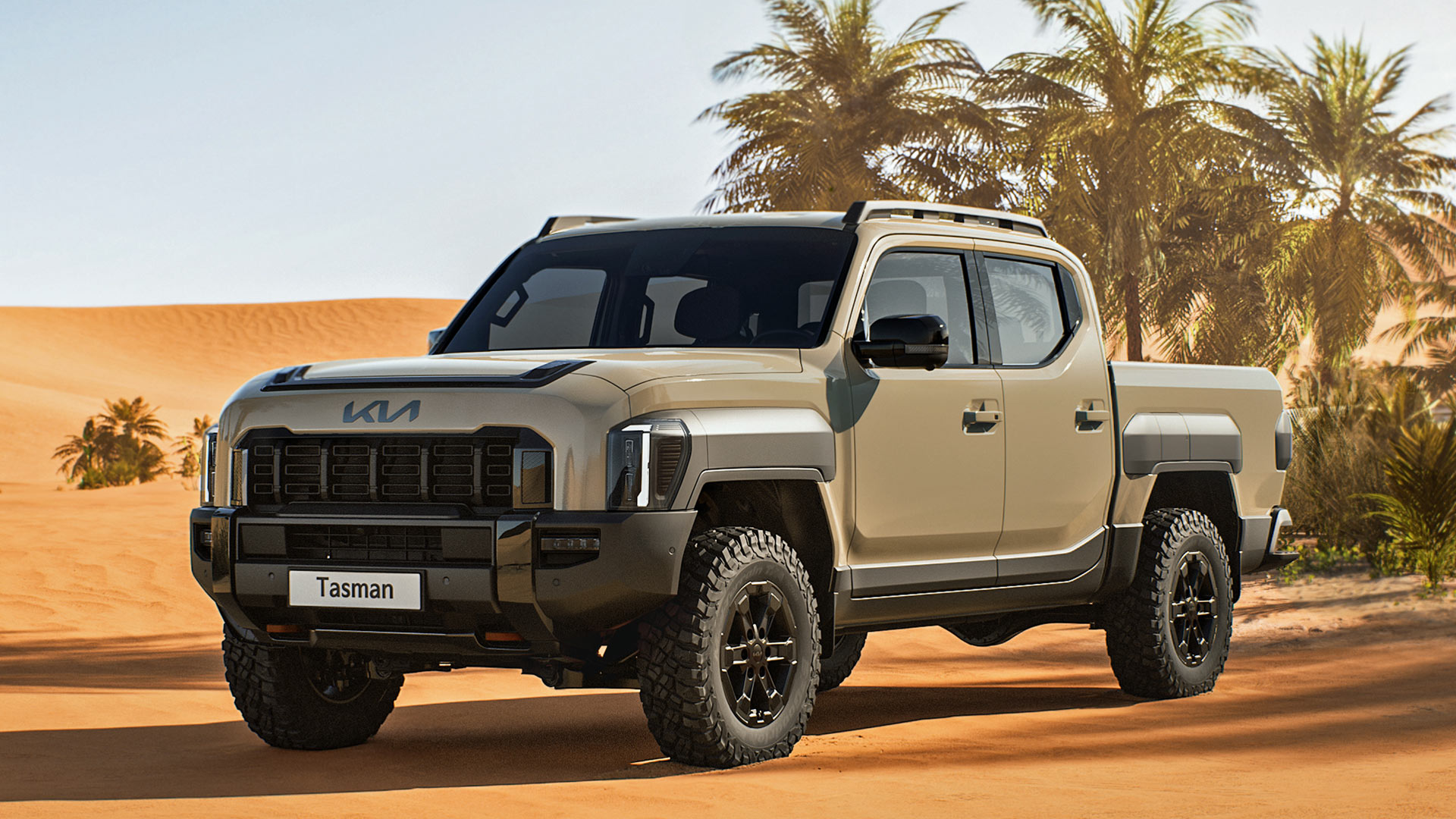
Kia is preparing to enter one of the most competitive parts of the American automotive market with a new midsize pickup planned for North America by 2030. The upcoming truck is expected to use a traditional body-on-frame construction, putting it in a different category from car-based pickups and many electric lifestyle trucks.
Kia has discussed a long-term annual sales target of approximately 90,000 units, showing the importance it places on this new segment.
The company’s plans for its powertrains have also changed over time. Its latest 2026 strategy points to hybrid and extended-range electric models, whereas an earlier announcement outlined plans for a fully electric pickup. This difference will be important as further information about the vehicle becomes available.
Kia Targets the American Midsize Pickup Market
The U.S. pickup market represents a major opportunity for Kia, which has traditionally focused on passenger cars, crossovers, and SUVs in North America.
The company already sells the Tasman in selected international markets, but that truck is not intended to serve as its main entry into the American market. Instead, Kia is developing a separate North American pickup with a body-on-frame platform.
The company’s 2026 CEO Investor Day strategy identifies a new body-on-frame pickup for North America by 2030. Kia’s presentation describes the project as part of its plan to enter the pickup segment and broaden its U.S. customer base.
The company is targeting approximately 90,000 annual sales for the North American pickup program.
That figure is a long-term target, not a production forecast or a confirmed first-year sales commitment. Kia has not announced a specific launch month, final model name, or complete production schedule. The target nevertheless indicates that the company expects the truck to become a meaningful part of its American lineup rather than a low-volume specialty product.
A body-on-frame construction is a significant choice. Unlike unibody SUVs and crossovers, this arrangement uses a separate frame to support the vehicle’s body and major mechanical components. It is commonly used in pickups because it can accommodate demanding workloads, towing requirements, and off-road use.
The platform should also give Kia flexibility to develop different powertrain configurations and equipment packages.
However, the company has not disclosed the truck’s dimensions, wheelbase, payload capacity, towing rating, suspension design, or off-road hardware. Those specifications will determine how closely it competes with established midsize pickups.
Kia’s strategy reflects the size of the American truck market. Pickups remain an important vehicle category for private buyers, contractors, businesses, and outdoor enthusiasts. Entering this segment gives the company access to customers who may not consider a conventional crossover or SUV.
Hybrid and Extended-Range Electric Powertrains Are Now Part of the Plan
The most important development concerns the pickup’s powertrain. Kia’s earlier 2025 business strategy described a new electric pickup for North America, based on a dedicated EV platform.
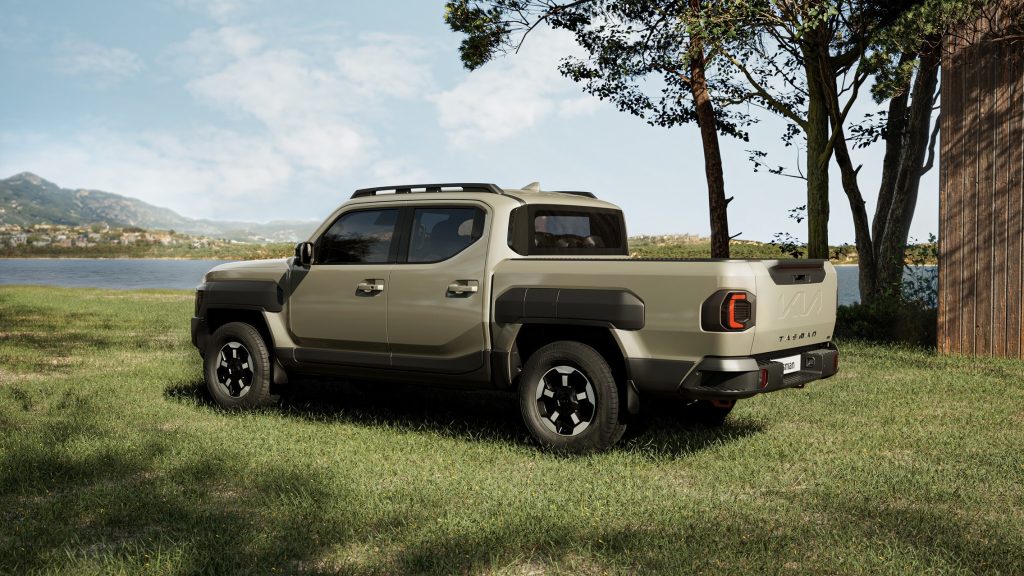
The company set the same long-term target of approximately 90,000 annual sales and highlighted the need for cargo space, towing capability, and off-road performance.
However, Kia’s more recent 2026 CEO Investor Day presentation identifies a body-on-frame pickup with hybrid electric vehicle (HEV) and extended-range electric vehicle (EREV) variants by 2030.
This is the latest official direction available and suggests that the company’s plans have developed beyond the earlier all-electric proposal. Kia has not yet confirmed whether a fully battery-electric version will also reach production. The distinction between these powertrains is important.
A conventional hybrid combines a gasoline engine with an electric motor and a relatively small battery. The system can recover energy during braking and use electric assistance to improve efficiency and responsiveness. Unlike a plug-in hybrid, a conventional HEV does not require external charging.
An extended-range electric vehicle works differently. Its wheels are primarily driven by electric motors, while a gasoline engine operates as a generator to supply electricity when the battery’s charge becomes low.
Depending on the final configuration, an EREV can offer electric driving for shorter journeys while retaining the ability to travel longer distances without depending entirely on public charging infrastructure.
For a midsize pickup, this arrangement could address several practical concerns. Owners who regularly tow trailers or carry heavy loads may be concerned about the effect of battery weight and towing on driving range.
An EREV could provide electric driving characteristics while using a gasoline-powered generator to extend its operating distance. A conventional hybrid could appeal to buyers who want improved fuel efficiency without changing their refueling habits.
Kia has not released the truck’s engine displacement, electric motor output, battery capacity, generator specifications, or estimated driving range.
It has also not confirmed whether the different powertrains will arrive together or follow separate launch schedules. Consequently, claims about horsepower, towing performance, charging speed, or electric-only range would be premature.
The company is also expected to use the project to develop its presence in a segment where established manufacturers already have extensive experience.
The midsize pickup category includes vehicles such as the Toyota Tacoma, Ford Ranger, Chevrolet Colorado, and Nissan Frontier. These models compete on a combination of work capability, passenger comfort, off-road equipment, and everyday usability.
Kia will need to establish the new truck’s identity beyond its powertrain. Buyers in this segment often evaluate practical specifications as closely as styling and technology. Towing ratings, payload capacity, bed dimensions, four-wheel-drive availability, and durability will all influence how competitive the vehicle becomes.
The 90,000-Unit Goal and What Kia Must Deliver
Kia’s annual sales target of 90,000 units gives an indication of the scale it expects from the North American pickup program. Its earlier 2025 strategy presentation associated that target with a potential 7% share of the relevant market over the longer term.
The company has not presented 90,000 units as a guaranteed annual result immediately after launch.
Reaching that volume would require more than introducing an unfamiliar truck. Kia would need a competitive retail network, sufficient production capacity, dependable parts availability, and a clear after-sales support strategy.
Pickup customers may also expect a range of configurations, including different cab and bed combinations, work-focused versions, and more expensive trims with additional comfort and off-road equipment.
Manufacturing location will be another important consideration. Kia has not confirmed where the North American pickup will be assembled.
Local production could help the company respond to U.S. demand and manage logistics, but a final manufacturing decision will depend on investment, supplier arrangements, and the vehicle’s production requirements. The company has not announced a factory, production capacity, or U.S. assembly timeline for this truck.
The new pickup also fits into Kia’s broader American growth plans. At its 2026 CEO Investor Day, the company set a target of 1.02 million annual U.S. vehicle sales by 2030, equivalent to a projected 6.2% market share.
Expanding its hybrid lineup from four to eight models and strengthening its SUV range are among the measures intended to support that ambition. Entering the pickup segment would give Kia another major vehicle category in which to compete.
The company is also expanding its electrified vehicle strategy globally. Its 2030 plans include annual sales of one million fully electric vehicles and 1.15 million electrified vehicles when hybrids, plug-in hybrids, and extended-range electric models are included.
The pickup’s expected HEV and EREV configurations fit into this wider effort to offer different technologies for markets with different customer requirements and charging infrastructure.
There is still considerable uncertainty surrounding the truck. Kia has not revealed a production-ready design, interior, official model name, final powertrain specifications, pricing, or confirmed U.S. launch date beyond its 2030 planning target.
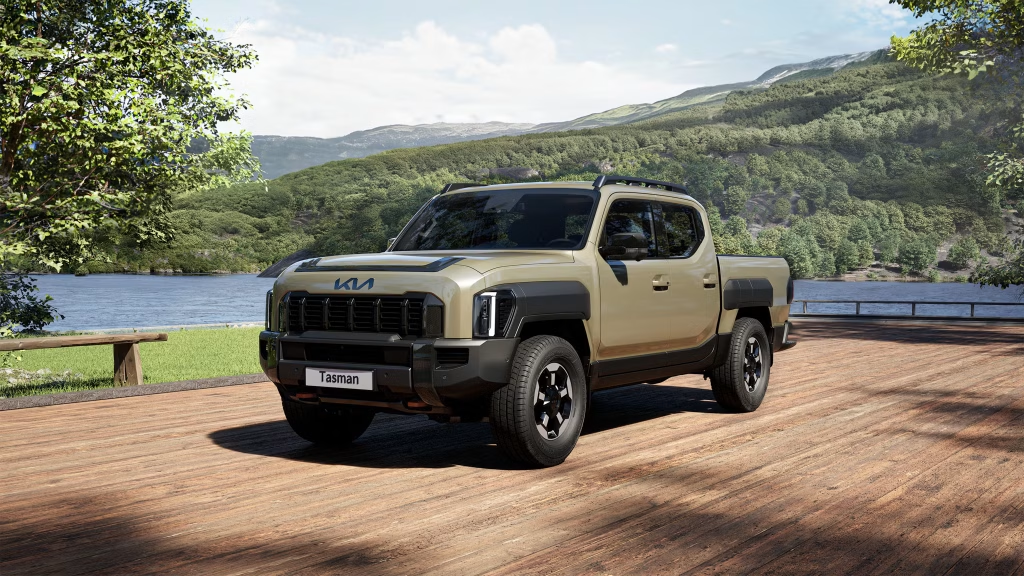
It is also too early to determine whether the company will offer a fully electric version alongside the hybrid and extended-range configurations identified in its latest strategy.
These unanswered questions will become increasingly important as the launch approaches. The American pickup market has established expectations for capability and reliability, and Kia will need to demonstrate that its new platform can meet them.
A competitive price could help attract buyers, but it will not be enough if the truck falls short in towing, payload, durability, or ownership support.
For now, Kia’s announcement signals a significant expansion of its ambitions in the United States. The proposed body-on-frame architecture, hybrid and EREV powertrain options, and 90,000-unit annual sales target show that the company intends to compete in the mainstream pickup market.
The next major milestone will be the release of technical details and a production design that reveals exactly how Kia plans to challenge established American and Japanese truck manufacturers.