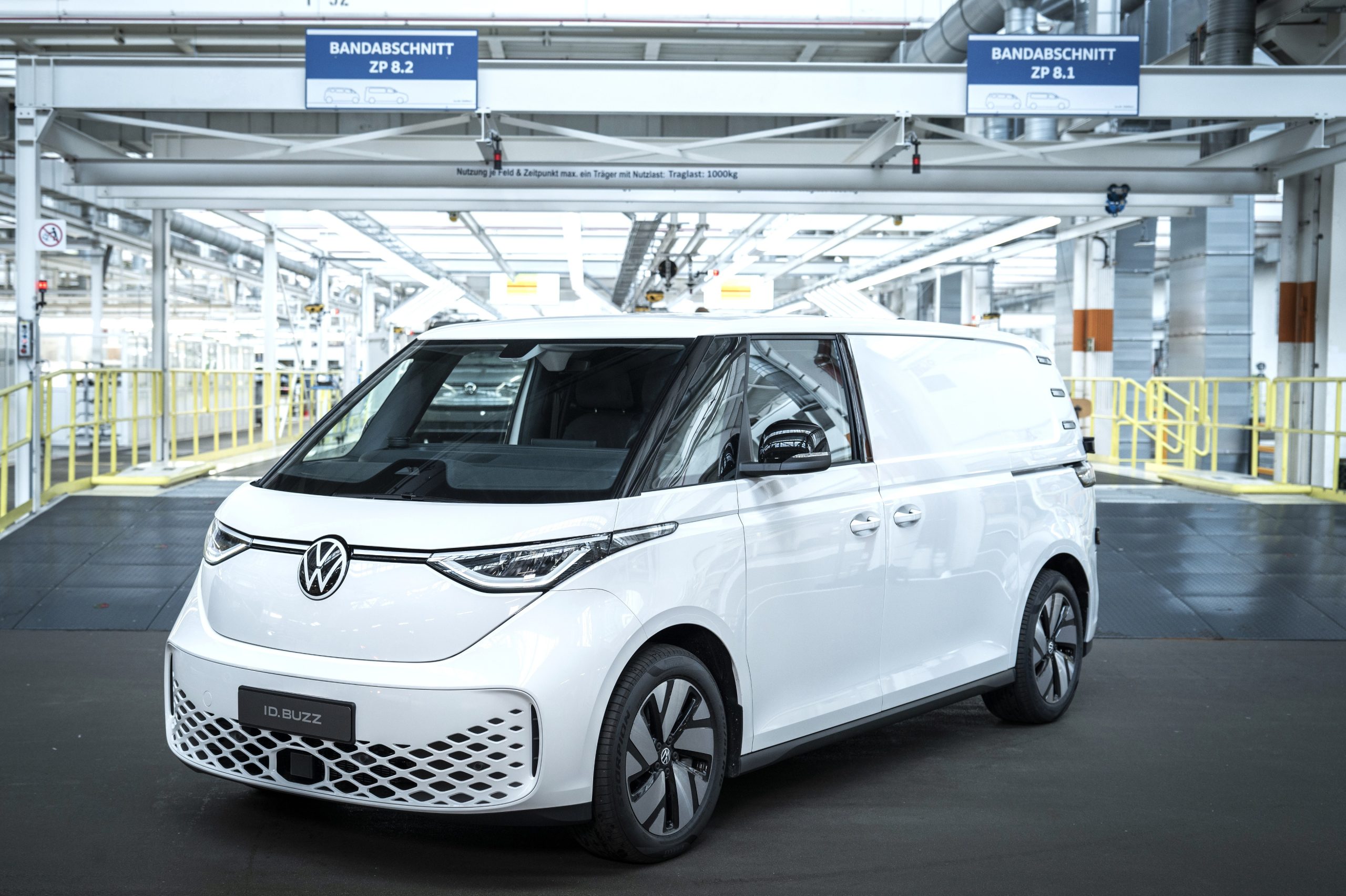
Volkswagen Commercial Vehicles has started production of the long-wheelbase ID. Buzz Cargo at its Hanover facility in Germany, expanding its electric van lineup with a version designed for businesses that need additional carrying capacity.
The extended model increases cargo volume to 155.4 cubic feet and comes with an 86-kWh usable battery. Buyers can choose between rear-wheel drive and 4MOTION all-wheel drive, with power outputs reaching 335 horsepower.
The longer van also gains a second sliding door as standard, making loading and unloading more convenient. Its production marks another step in Volkswagen’s effort to make its electric commercial vehicle range suitable for a wider variety of business operations.
Longer Wheelbase Creates More Room for Commercial Loads
Volkswagen officially began series production of the long-wheelbase ID. Buzz Cargo on November 23, 2026, at its main commercial vehicle facility in Hanover, Germany. The new version joins the standard-wheelbase Cargo and expands the options available to businesses looking for an electric delivery vehicle with additional storage capacity.
The most important change is the extended wheelbase, which grows by 9.8 inches to approximately 128 inches. The overall vehicle length increases from around 185.4 inches to 195.3 inches, while the additional space is directed toward the rear cargo compartment.
Volkswagen has increased the load-floor length to approximately 96.8 inches, giving businesses more room for packages, equipment, and larger commercial items.
Cargo volume increases from approximately 137.7 cubic feet in the standard-wheelbase model to 155.4 cubic feet in the extended version. That represents an additional 17.7 cubic feet, or roughly 0.5 cubic meters.
For delivery companies, contractors, and service businesses, the extra space could reduce the number of trips required when transporting larger loads.
The wider loading arrangement is another practical improvement. Volkswagen has made a second sliding side door standard, allowing access to the cargo compartment from both sides.
The sliding doors are also wider than those on the standard-wheelbase cargo. According to the company, the opening is now large enough to accommodate a Euro pallet, making it easier to load certain types of commercial freight.
The van also receives a standard wooden cargo floor, while buyers can choose between a conventional tailgate and optional rear wing doors. Two- and three-seat cabin configurations are available, allowing businesses to prioritize either additional passenger space or a simpler working layout.
The width between the wheel housings measures approximately 48.4 inches, which is another important consideration when carrying bulky equipment or standardized loads.
These changes are intended to make the ID. Buzz Cargo is more useful in daily commercial operations than simply giving it a larger exterior.
The additional cargo volume, wider side access, and longer load floor are particularly relevant for businesses that frequently transport equipment or packages that are difficult to fit through conventional van openings.
An 86-kWh Battery Offers Rear- and All-Wheel-Drive Options
The long-wheelbase ID. Buzz Cargo comes with an 86-kWh usable battery as standard. This is larger than the 79-kWh battery used in the standard-wheelbase version referenced in Volkswagen’s earlier specifications.
The additional battery capacity supports the extended model’s commercial requirements while providing two drivetrain choices.
The rear-wheel-drive version produces 210 kW, equivalent to approximately 282 horsepower. Customers who need additional traction can choose the 4MOTION all-wheel-drive model, which produces 250 kW, or approximately 335 horsepower.
The all-wheel-drive configuration uses motors at both axles to distribute power between the front and rear wheels.
Range varies depending on the drivetrain. According to figures reported by Electrive, the rear-wheel-drive version is expected to deliver approximately 450 to 490 kilometers of WLTP range, equivalent to around 280 to 304 miles.
The all-wheel-drive model is listed at approximately 430 to 460 kilometers, or about 267 to 286 miles. These are European WLTP estimates, not U.S. EPA ratings, and actual driving distance will depend on load, temperature, speed, and road conditions.
Charging performance is another important consideration for commercial operators. Both versions support DC fast charging at up to 200 kW. Volkswagen’s reported charging figures indicate that the battery can move from 10% to 80% in approximately 28 minutes under suitable conditions.
AC charging is supported at up to 11 kW. These capabilities allow businesses to recharge during planned breaks or between operating shifts, although actual charging times will depend on the available equipment and battery conditions.
The van also offers a braked towing capacity of up to 3,968 pounds. This gives businesses the option of using a trailer for additional equipment or materials.
The vehicle’s payload rating varies depending on the drivetrain. The rear-wheel-drive model can carry up to approximately 1,543 pounds, compared with around 1,336 pounds for the 4MOTION variant. Buyers should weigh the benefits of added traction against the need for greater carrying capacity when choosing the version that best suits their work requirements.
The difference is important because electric commercial vehicles must balance battery weight, passenger capacity, cargo weight, and towing requirements. A van with a larger battery and all-wheel drive may provide additional capability in certain conditions, but it does not necessarily offer the highest payload rating.
Updated Software Adds One-Pedal Driving and Vehicle-to-Load Technology
Volkswagen has also incorporated its latest ID software and infotainment technology into the extended Cargo. One of the notable additions is standard one-pedal driving.
This allows drivers to slow the vehicle using regenerative braking when they release the accelerator, potentially bringing it to a complete stop without frequently using the brake pedal.
For delivery drivers who spend much of their working day in urban traffic, regenerative braking can make repeated acceleration and deceleration more convenient. It can also recover some energy that would otherwise be lost during braking. The actual energy recovered depends on driving conditions and the selected settings.
An optional version of Travel Assist introduces traffic-light recognition. Within the system’s operating limits, the technology can recognize a red traffic signal and bring the vehicle to a stop.
This feature builds on Volkswagen’s existing driver-assistance technology, although it does not replace the driver’s responsibility to monitor traffic and control the vehicle.
Another useful addition is vehicle-to-load capability through Volkswagen’s optional PowerSocket adapter. The system allows the vehicle’s high-voltage battery to supply electricity to external equipment.
This could be useful for contractors and mobile service businesses that need to power tools at a worksite without carrying a separate generator.
Volkswagen specifies continuous output of 3.0 kW and peak output of 3.6 kW through the adapter. Two versions are available, including one with a standard domestic-style socket and another with a 230-volt CEE connection.
The feature effectively gives the electric van an additional role as a mobile power source, although users must manage the available battery charge when operating external equipment.
The infotainment system also receives an expanded app store, allowing owners to access or activate selected digital services. Available applications cover areas such as audio, video streaming, parking, charging, and gaming.
Volkswagen has also revised the multifunction steering wheel with redesigned physical buttons to make important controls easier to operate.
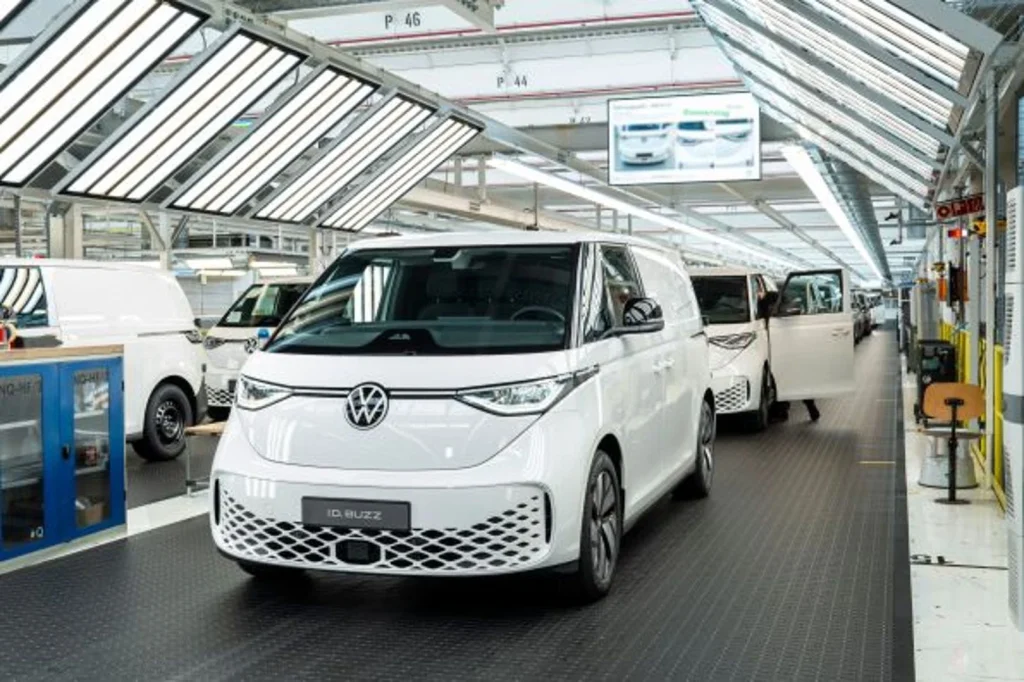
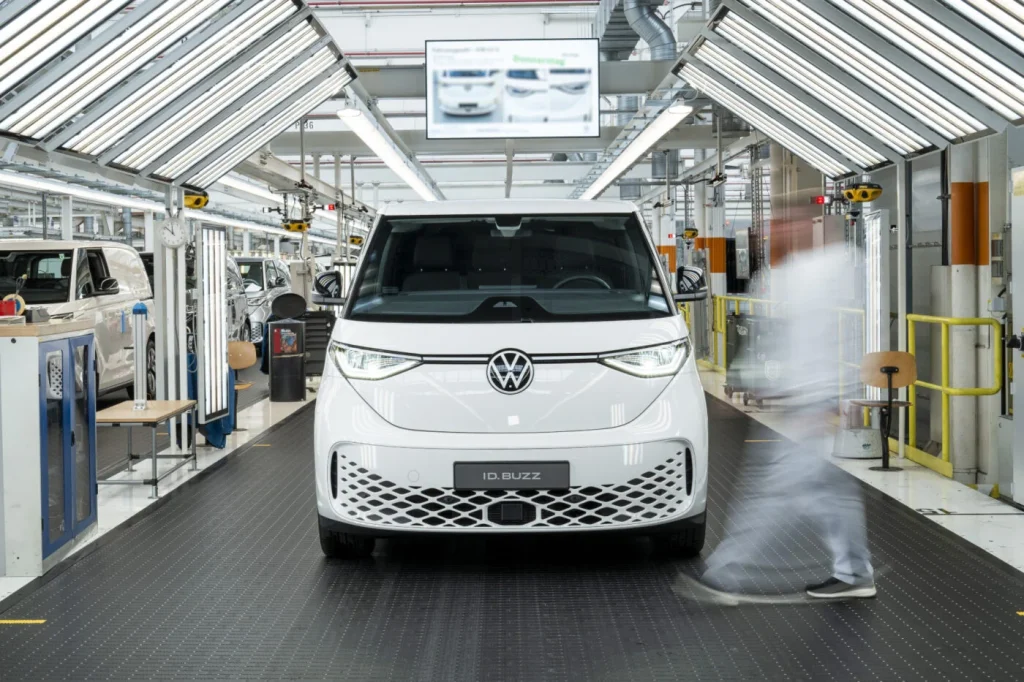
Production of the long-wheelbase cargo has been integrated into the existing Hanover manufacturing operation. The factory already builds the ID. Buzz family, along with the Multivan and California models.
Volkswagen says the main production adjustments involved the side panels and sliding-door installation processes. Many of the changes were completed internally, allowing the new version to join the existing production lines without a completely separate manufacturing facility.
The long-wheelbase ID. Buzz Cargo is initially being offered in Germany, where the rear-wheel-drive version starts at €48,490 before VAT and other charges. The 4MOTION model starts at €50,630.
These are German market prices and should not be treated as U.S. pricing. Volkswagen has not announced a U.S. launch for this commercial van. UK order books are expected to open in early 2027, with market introduction planned for spring.
The extended ID. Buzz Cargo gives Volkswagen a more spacious electric van with stronger drivetrain choices and useful commercial features. Its additional cargo volume, dual sliding doors, 86-kWh battery, and external power capability address practical business requirements.
The next challenge will be demonstrating how effectively the van performs under demanding working conditions, particularly when carrying heavy loads or covering long daily routes.