A zero-down car deal can make buying a vehicle seem easier because you do not need to bring cash for a down payment. However, financing the entire purchase price can create a larger loan balance, higher interest charges, and a greater risk of owing more than the vehicle is worth.
The real cost can become even higher when taxes, dealer fees, optional products, or unpaid debt from a previous car are added to the contract. Before accepting an offer that promises no money upfront, understand how these eight factors can affect your finances long after you drive away.
1. You Borrow the Entire Purchase Price Instead of Reducing the Loan Balance
A zero-down deal may make driving away in a new vehicle feel easier, but it also means you are financing more of the purchase instead of paying part of the cost upfront.
With no cash or trade-in equity reducing the amount borrowed, the loan starts with a larger principal balance. Interest is then calculated on that larger amount, which can make the vehicle more expensive over the repayment period.
Consider a $30,000 vehicle financed at a hypothetical 7% annual percentage rate (APR) for 60 months. With no down payment, the monthly principal-and-interest payment would be approximately $594, and total interest would be about $5,640.
If you put $3,000 down and borrow $27,000 at the same rate and term, the payment falls to approximately $535, with interest of about $5,076. The difference is not a special zero-down penalty. It comes from borrowing $3,000 less.
The Consumer Financial Protection Bureau (CFPB) explains that a larger down payment reduces the amount financed and can lower the interest paid over the life of an auto loan. It may also help reduce the interest rate offered by a lender, depending on the borrower’s circumstances.

That distinction matters when comparing dealership offers. A salesperson may emphasize that no upfront payment is required, but the contract still has to account for the full amount being financed.
Before signing, compare the amount financed, APR, loan term, monthly payment, and total of payments. A zero-down offer is not automatically a bad deal, but it becomes more expensive when the buyer overlooks how much additional principal is being borrowed.
2. You Pay More Interest Because the Loan Starts With a Higher Balance
The cost of borrowing is not determined by the monthly payment alone. The amount financed and the APR work together to determine how much interest accumulates during the loan.
When a buyer puts nothing down, the lender generally has a larger balance on which to charge interest than it would with an otherwise identical loan that includes a down payment.
Here is a straightforward illustration. Suppose a buyer finances $32,000 at 8% APR for 60 months. The estimated principal-and-interest payment is around $649 per month, and the total interest is approximately $6,940.
If the same buyer puts $4,000 down and finances $28,000 at the same rate and term, the estimated payment drops to about $568, while total interest falls to roughly $6,070. These figures are illustrative, assume a fixed APR, and exclude taxes, fees, and optional products.
The CFPB advises consumers to compare the APR, amount borrowed, loan length, and total interest rather than judging an auto loan by its monthly payment. Its published example shows that a $20,000 loan at 4.75% generates about $1,498 in interest over 36 months, compared with about $3,024 over 72 months.
A zero-down contract does not necessarily carry a higher interest rate simply because the down payment is zero. The lender considers several factors, including credit history, income, debt, loan amount, term, and the down payment relative to the vehicle’s value.
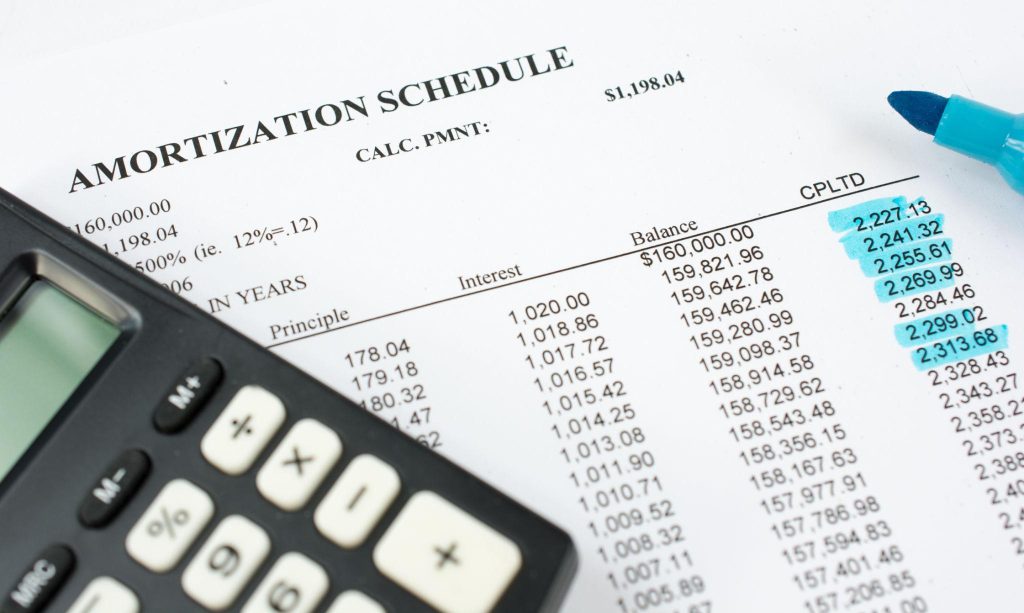
The practical lesson is to compare identical loan terms with different down-payment amounts. That reveals the real cost of financing the full purchase instead of relying on a payment figure that may make the deal appear more affordable than it is.
3. Your Loan Can Become Underwater Soon After Purchase
A vehicle begins losing value as it ages and accumulates mileage, but a zero-down buyer starts with no initial equity cushion from a cash contribution. If the vehicle’s market value falls faster than the loan balance declines, the owner can end up owing more than the car is worth. This is known as negative equity, or being upside down on the loan.
For example, imagine financing $35,000 for a vehicle that is worth $35,000 at purchase. If its market value later falls to $28,000 while the outstanding loan balance is still $31,000, the owner has $3,000 in negative equity. Selling the vehicle for its current value would not be enough to pay off the loan.
The Consumer Financial Protection Bureau (CFPB) defines negative equity as owing more on an auto loan than the vehicle’s value. It also explains that a down payment reduces the loan-to-value ratio, which can lower the risk of starting or remaining underwater.
Depreciation rates vary by vehicle, condition, mileage, and market demand, so there is no fixed date when every zero-down loan becomes upside down. The concern is greatest when a buyer finances a large amount, chooses a long repayment period, or purchases a vehicle whose resale value falls quickly.
This matters if you need to sell the car, trade it in, or replace it after a major accident. You may have to pay the difference out of pocket before the loan can be closed. A down payment cannot prevent depreciation, but it gives the loan a smaller starting balance and can provide more room as the vehicle loses value.
4. Rolling an Existing Loan Into the Deal Makes the Debt Even Larger
A zero-down offer becomes particularly costly when the buyer is also carrying unpaid debt from a previous vehicle. Suppose your current car is worth $15,000 as a trade-in, but you still owe $18,000 on its loan.
That leaves $3,000 in negative equity. If the dealership adds that amount to the financing for your next vehicle, you begin the new loan already owing more than the replacement car’s purchase price before considering other financed charges.
The Federal Trade Commission (FTC) warns consumers that dealers may include negative equity from an existing vehicle in a new financing agreement. This can increase the amount borrowed, the monthly payment, or the length of the new loan.
The FTC recommends checking exactly how the old balance is being handled instead of relying on a salesperson’s verbal explanation.
Consider a $30,000 replacement vehicle with $3,000 of old debt rolled into the deal. The new amount financed could reach $33,000 before taxes, fees, and optional products. With no down payment to offset that balance, the buyer has to repay the old debt alongside the cost of the new vehicle.
This can create a repeating cycle in which the replacement vehicle loses value while the buyer is still paying off the previous loan. A 2024 CFPB analysis found that consumers who financed negative equity had an average loan-to-value ratio of 119.3% in the agency’s auto-finance data pilot, meaning their loan balances exceeded the vehicles’ values by a considerable margin.
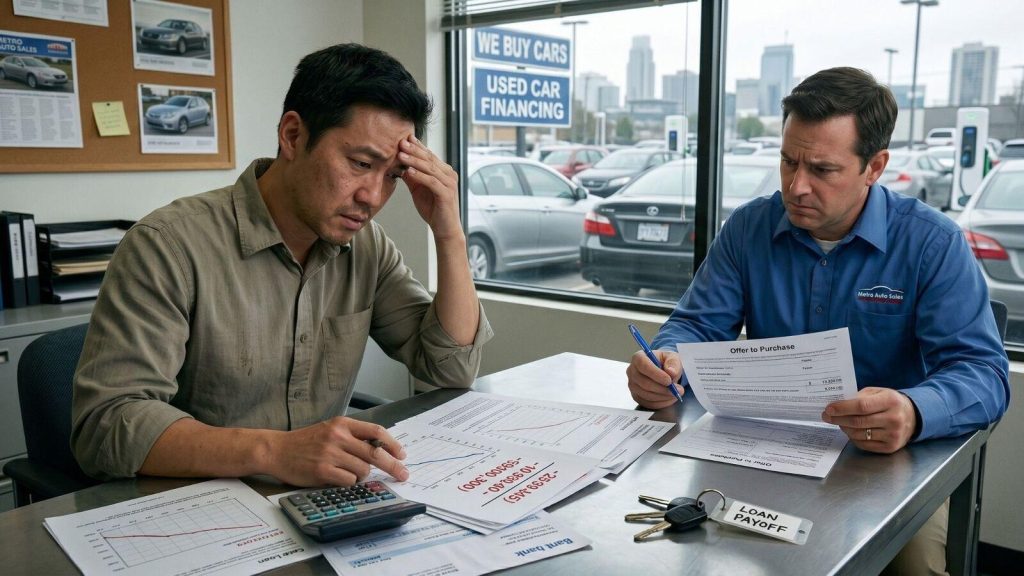
Before trading, obtain your lender’s payoff amount and compare it with realistic trade-in offers. If the car is worth less than you owe, consider waiting or paying down the difference separately rather than carrying the debt into another zero-down contract.
5. A High Loan-to-Value Ratio Can Make Financing More Expensive
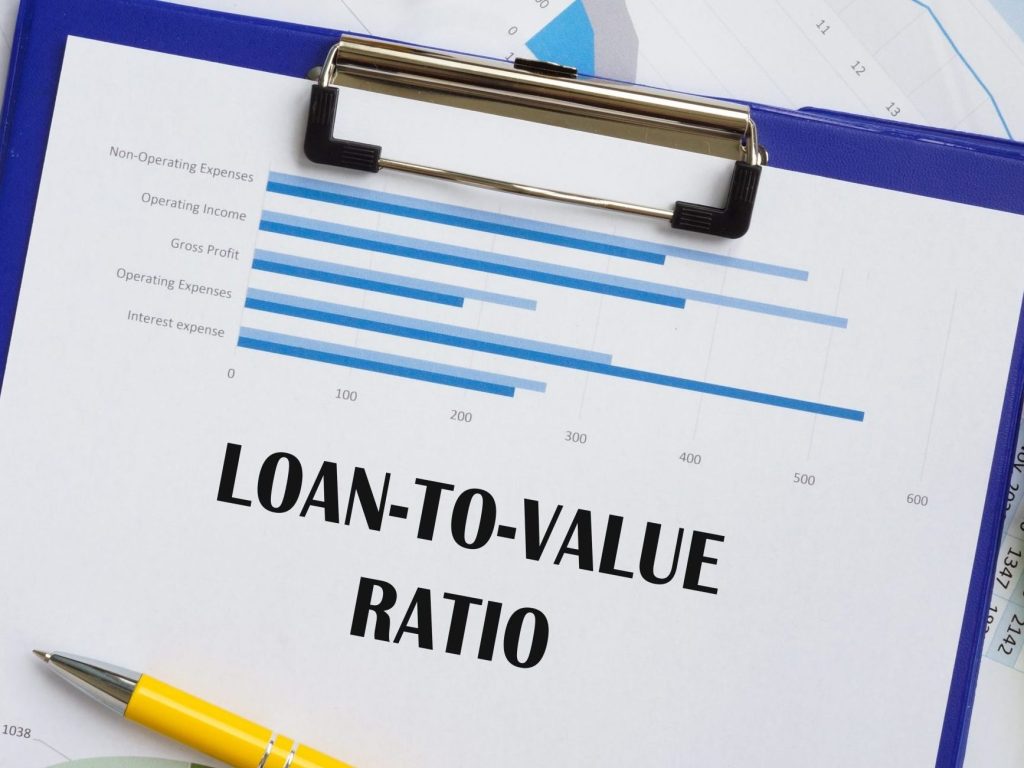
Lenders do not look only at the sticker price when evaluating an auto loan. They also consider the loan-to-value ratio, commonly called LTV. This measures the amount borrowed against the vehicle’s actual cash value.
When a buyer makes no down payment, the loan starts with less protection against depreciation, and the LTV may be higher than it would be with cash or positive trade-in equity.
Lenders also consider the loan-to-value (LTV) ratio when reviewing auto financing applications, according to the CFPB. For example, financing the full $20,000 purchase price results in a 100% LTV ratio. However, making a $5,000 down payment and borrowing the remaining $15,000 brings the ratio down to 75%. When the LTV exceeds 100%, the amount borrowed is greater than the vehicle’s value.
A higher LTV can matter to the lender because the vehicle is collateral for the debt. If the borrower stops paying, the vehicle may not be worth enough to cover the outstanding balance after repossession and sale.
Depending on the lender’s underwriting rules, a high ratio may affect approval, the interest rate, or the loan terms. It does not mean every zero-down application will be rejected or automatically receive a higher APR.
The buyer also carries the risk. A vehicle with a high starting LTV can remain underwater for a longer period, making it harder to sell, trade, or refinance. The problem can become more pronounced if taxes, dealer fees, accessories, or old loan balances are added to the amount financed.
Before signing, ask the dealer or lender to show the vehicle’s value, the total amount financed, and the resulting LTV. If the loan exceeds the vehicle’s value, understand why. A smaller loan through a down payment or a less expensive vehicle can improve the starting position.
6. Taxes, Dealer Fees, and Optional Add-Ons Increase the Amount You Finance
The advertised vehicle price is not always the amount that appears on the loan contract. Sales tax, title and registration charges, dealer fees, accessories, and optional protection products can increase the amount financed.
When a buyer puts nothing down, these costs may be added to the loan rather than paid at signing. That means interest can accrue on more than just the vehicle’s negotiated price.
The CFPB lists the vehicle price, optional add-ons, taxes, title charges, and dealer fees among the factors that determine how much a buyer borrows. It also identifies a down payment and trade-in value as ways to reduce the amount financed.
Optional products deserve particular attention. Dealers may offer extended service contracts, credit insurance, GAP coverage, paint protection, or other aftermarket products. Some can be useful in specific circumstances, but they are not automatically necessary.
The CFPB confirms that optional products included in the purchase contract can become part of the monthly auto loan payment.
For example, adding $2,000 in optional products to a $30,000 vehicle increases the financed balance to $32,000 before other charges. At a fixed APR, that extra $2,000 also generates interest over the repayment period. The buyer may not notice the difference if the dealer focuses attention on a small change in the monthly payment.
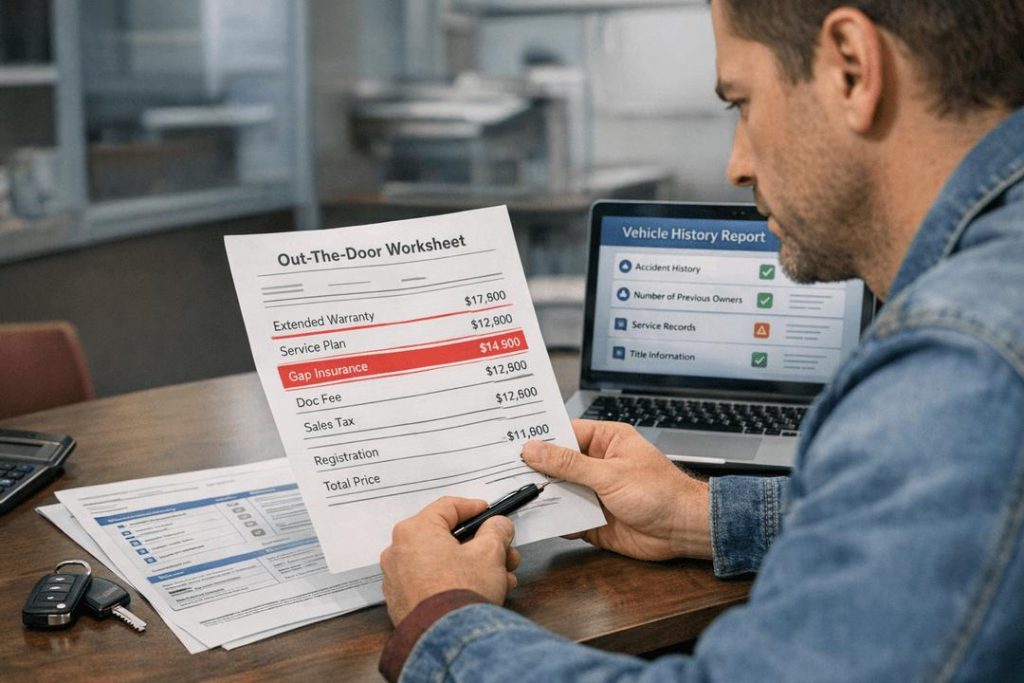
Ask for an itemized breakdown showing the vehicle price, taxes, government fees, dealer charges, and every optional product separately. Decline anything you do not want, and check that the final contract reflects those decisions.
Financing extra products without comparing their price and coverage can make a zero-down deal considerably more expensive than the advertised offer suggests.
7. You May Need GAP Coverage, Adding Another Expense
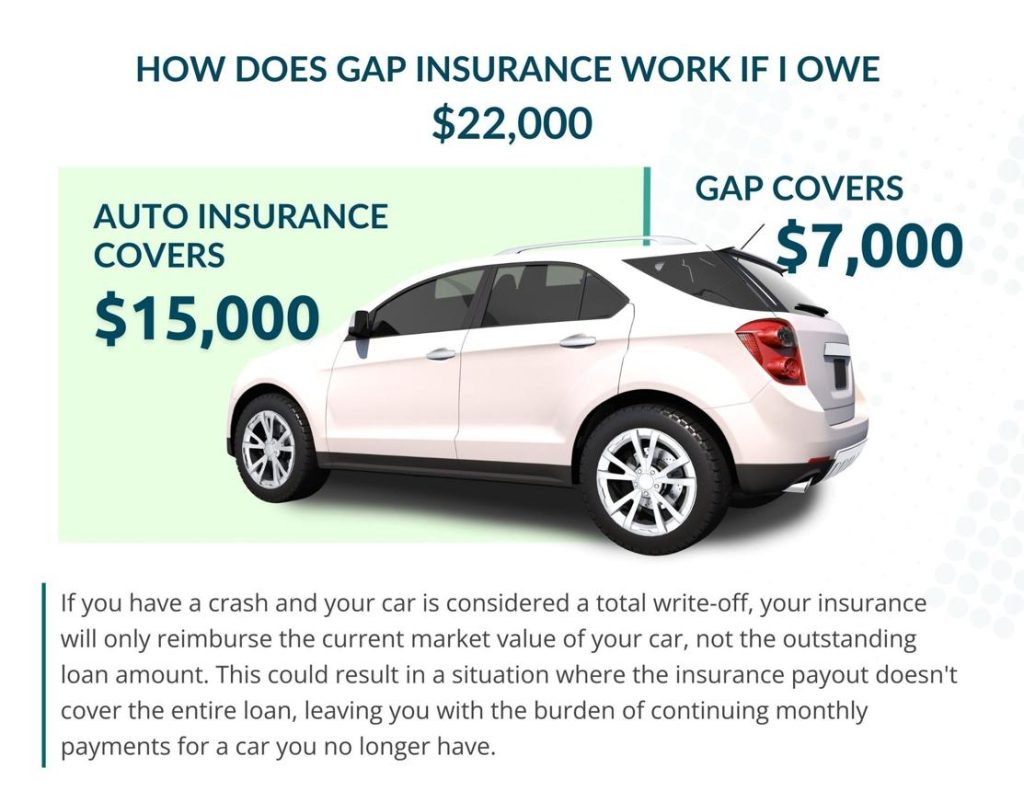
When a vehicle is stolen or declared a total loss after an accident, standard auto insurance generally pays its actual cash value, subject to the policy terms and deductible. That amount may be lower than the outstanding loan balance.
A zero-down buyer can face a greater risk of this shortfall because the loan begins without an initial cash contribution reducing the debt.
This is where Guaranteed Asset Protection, commonly called GAP coverage, may help. The CFPB explains that GAP is designed to cover the difference between the amount owed on an auto loan and the amount paid by the insurer when a vehicle is stolen or totaled. It is an optional product, not a substitute for standard auto insurance.
Consider a vehicle with an outstanding loan balance of $32,000 when it is totaled. If the insurer determines its actual cash value is $27,000, the difference is $5,000 before considering the deductible or any policy-specific adjustments. Without applicable GAP protection, the owner could remain responsible for that unpaid balance even though the vehicle is gone.
However, GAP coverage has limits and exclusions. The CFPB notes that some policies restrict eligibility or the period during which benefits apply. It also warns that financing the cost of GAP increases the loan amount and the interest paid. Buyers should compare the dealer’s price with coverage available through their auto insurer or lender.
Do not purchase GAP simply because a salesperson says zero-down financing requires it. Ask whether it is optional, what it covers, and how claims are calculated. The right coverage can protect against a serious financial loss, but an expensive policy added to an already large loan can make the deal costlier.
8. Selling or Trading the Vehicle Early Becomes More Difficult
Life does not always follow the repayment schedule printed on an auto loan. A job relocation, growing family, unexpected financial pressure, or change in transportation needs may force an owner to sell or trade a vehicle before the loan is paid off.
With zero-down financing, this decision can become difficult if the outstanding balance is higher than the car’s current market value.
Imagine that you financed $34,000 without a down payment. A year later, the vehicle’s market value is $27,000, but your remaining loan balance is $30,000. If you sell it for $27,000, you still need to find another $3,000 to satisfy the lender.
A dealership may offer to include that difference in your next loan, but doing so transfers the unpaid debt rather than eliminating it.
The CFPB specifically warns that negative equity can make selling or trading a vehicle before the loan is paid off more difficult. It also explains that longer loan terms can keep borrowers underwater for longer because the vehicle’s value may fall faster than the balance is repaid.

This lack of flexibility can matter even if you have made every payment on time. Regular payments do not guarantee that you will build positive equity quickly, especially when the initial loan amount is high and the repayment period is long.
Before choosing a zero-down offer, consider how long you realistically expect to keep the vehicle. Compare the amount you would owe after 12, 24, and 36 months with conservative estimates of its resale value.
If the difference is uncomfortable, consider a cheaper vehicle, a down payment, or a shorter loan term. The goal is to avoid becoming financially tied to a car you may need to replace.