

The US truck market may soon welcome a distinctive new competitor with the introduction of REO Trucks’ Runabout lineup. The family includes three models, namely the T4X work pickup, T4C crew-cab pickup, and S4C six-seat SUV, each designed to serve different vehicle needs.
Rather than follow the trend toward larger vehicles packed with touchscreen technology, the Texas-based company is proposing compact, body-on-frame models with mechanical four-wheel drive, simple gasoline powertrains, and an emphasis on owner repairs.
Starting prices are planned below $30,000, although production remains some time away. The announcement revives a historic American automotive name, but the bigger question is whether REO can turn its ambitious promises into production vehicles.
Three Runabout Models Share One Traditional Truck Platform
The new range is built around a common steel ladder-frame chassis, with all three vehicles sharing a 119.6-inch wheelbase, powertrain layout, and front-end design. REO says the platform will use body-on-frame construction, mechanical part-time four-wheel drive, and solid axles at both ends.
The company is positioning the vehicles as practical alternatives to increasingly expensive pickups and SUVs, with a focus on durability and straightforward maintenance.
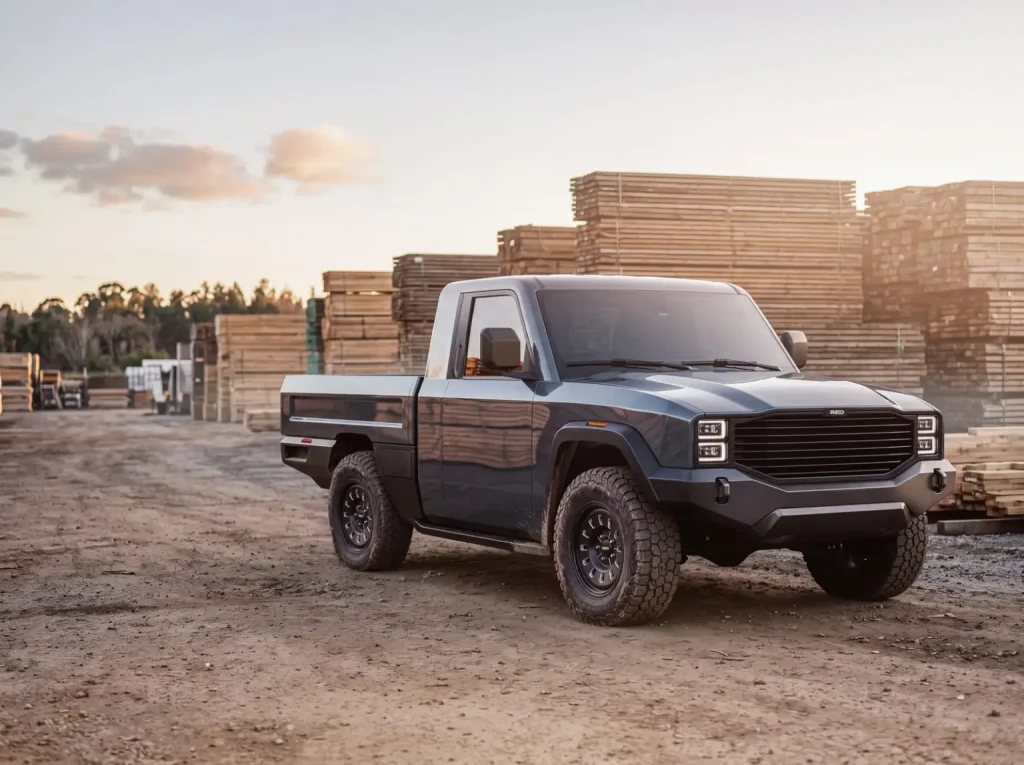
The first model is the Runabout T4X, a two-seat work pickup with a steel drop-side flatbed. Its cargo bed measures 79.1 inches long and 70.6 inches wide between the side walls. The design allows loading from the rear or either side, while integrated steps and footholds are intended to make accessing the bed easier.
A multifunction tailgate includes practical details such as measurement markings, cup holders, and phone recesses. REO lists a planned starting price of $21,500, making it the least expensive member of the family.
The T4C crew cab is designed for buyers who need passenger space without giving up an open cargo bed. It adds four doors and seating for five, with a 54.1-inch bed behind the cabin.
The spare wheel is stored in a dedicated recess in the bed, while the longer roof accommodates two of REO’s modular mount panels for auxiliary equipment. Its announced starting price is $25,000.
The third model, the S4C SUV, takes the same basic architecture in a family-oriented direction. It offers six seats and a side-hinged rear tailgate, with the rear glass designed to drop down into the door. The full-size spare wheel is mounted on a swing-out carrier.
REO says the shorter rear overhang gives the S4C the best departure angle in the lineup, a useful characteristic for drivers who intend to take it onto uneven trails. Its planned starting price is $28,500.
The three-model strategy gives REO a way to address different needs without developing three unrelated vehicles. A shared chassis and powertrain could simplify manufacturing, parts supply, and servicing.
However, the company has not yet published complete production specifications, including final curb weights, payload ratings, towing capacities, or fuel-economy figures. Those details will be important in determining how competitive the Runabout vehicles are against established compact and midsize trucks.
REO Is Betting on Mechanical Simplicity and Easy Repairs
The most distinctive part of the Runabout program is its approach to engineering. REO says every model will use a naturally aspirated four-cylinder gasoline engine mounted longitudinally.
The company has not yet disclosed the engine’s displacement, horsepower, or torque, so buyers cannot make a meaningful performance comparison with existing pickups. It does, however, say the engine will be paired with a six-speed manual transmission as standard, with an automatic transmission available as an option.
Four-wheel drive is planned as standard equipment across the lineup. The system will use a mechanical transfer case with high- and low-range settings, selected through a floor-mounted lever. A locking rear differential will be optional.
REO also plans solid front and rear axles, using coil springs at the front and leaf springs at the rear. This is a conventional arrangement that prioritizes strength and serviceability over the independent suspension systems increasingly found in modern passenger-oriented SUVs.
The company says it is targeting a powertrain life of 500,000 miles. That is an ambitious engineering target, not a demonstrated durability result or a warranty promise. Actual longevity will depend on the final design, maintenance, operating conditions, and how the vehicles perform once they reach customers.
REO is also emphasizing physical controls inside the cabin. The company says essential driving functions will use conventional switches, buttons, and levers rather than being buried in touchscreen menus.
The instrument cluster will be digital, and a separate display will handle navigation and media, but the brand says functions related to steering, braking, and shifting will not depend on over-the-air software updates.
The interior is expected to include manual seat adjustments, power windows, storage areas, and 120-volt power outlets. REO also plans pre-wired switches for accessories such as additional lighting.
These details are aimed at owners who use their vehicles for work, outdoor activities, or modifications and want to avoid complicated electrical installations.
Repairability is another major part of the company’s pitch. REO says its vehicles will not use parts-pairing restrictions that prevent replacement components from working unless they are electronically authorized by the manufacturer.
It plans to publish an open parts catalogue, provide online service information, and make diagnostic access available through an affordable scanner. The company says its parts catalogue will be supported for 20 years.
These are significant promises, particularly for buyers frustrated by the cost and complexity of repairing newer vehicles. However, the real test will be whether independent repair shops can obtain parts quickly and access the technical information needed to complete repairs.
REO’s plans could make ownership more straightforward, but the company must establish a dependable parts distribution and service network before those advantages can be confirmed.
Texas Production and Affordable Pricing Face a Long Road to Launch
REO is presenting the Runabout as an American-built vehicle family, with manufacturing planned at a brownfield assembly facility in Texas. The company says it selected the location partly because of the supplier base in Texas and nearby Mexico.
Its production plans are still developing, and it has not announced the complete factory investment, production capacity, or a confirmed manufacturing start date.
The launch schedule also means customers will have to wait. REO plans pilot builds of the T4X in 2027, with the first customer deliveries targeted for late 2028 or early 2029.
The T4C and S4C are expected to follow, but the company has not provided firm delivery dates for those versions. The T4X is therefore the first model likely to demonstrate whether the proposed design and production strategy can work at scale.
Pricing is one of the strongest elements of the announcement. The T4X is expected to start at $21,500, the T4C at $25,000, and the S4C at $28,500.
If those figures survive the transition from announcement to production, the vehicles could attract buyers who want a relatively simple four-wheel-drive truck without paying the prices associated with many modern pickups.
Still, the advertised figures are planned starting prices, not confirmed final transaction prices. Options, taxes, delivery arrangements, and any changes before production could affect what customers ultimately pay.
REO says it intends to sell directly to consumers rather than through a traditional franchised dealer network. It also says its pricing will avoid hidden dealer add-ons and destination charges, although the final purchasing and delivery process will need to be assessed once sales begin.
The company’s direct-sales approach is closely tied to its repairability strategy. REO wants customers to purchase vehicles, obtain parts, and access technical information through its own channels.
That could give the brand greater control over the ownership experience, but it also places responsibility on a relatively new manufacturer to manage customer support, parts availability, and service arrangements across the country.
There is also a historical connection behind the name. REO was founded by Ransom Eli Olds in 1905, after he had already established Oldsmobile. The company became known for commercial vehicles, particularly the REO Speed Wagon introduced in 1915.
That vehicle helped establish the brand’s reputation for practical transportation and is frequently associated with the development of the American pickup truck. The new company is seeking to revive that heritage for a market in which compact, affordable, body-on-frame vehicles are relatively uncommon.
The design work has been developed with Frank Stephenson Design, the studio founded by automotive designer Frank Stephenson. The styling draws on older REO trucks, with upright proportions, a prominent grille, and separate exterior components intended to be easier to replace after damage.
The design team has described the approach as functional rather than technology-led, matching the company’s emphasis on durability and straightforward ownership.

Despite the attractive pricing and clear product identity, REO faces substantial hurdles. It must complete vehicle development, validate the powertrain and chassis, establish a reliable Texas production operation, and build a customer-support network before deliveries begin.
It will also compete with established automakers that already have extensive parts distribution, dealer coverage, and service facilities.
The company has also not yet released several figures truck buyers will want before placing an order, including engine output, towing capacity, payload, fuel economy, and final safety specifications. Without those numbers, it is too early to determine whether the Runabout can match established competitors in practical capability.
REO’s return is therefore an interesting proposal rather than an established market success. The T4X, T4C and S4C offer a different philosophy from many modern vehicles, emphasizing mechanical hardware, repair access and relatively low entry prices.
If the company can deliver on its production timetable and engineering promises, the Runabout could give American buyers another option in the affordable truck and SUV market. For now, the 2027 pilot builds will be the first major milestone to watch.