

Not all engines are created equal, especially when you look at Ford’s long history of powerplants. Some have proven themselves as near-indestructible workhorses, running strong for hundreds of thousands of miles with minimal fuss.
Others, unfortunately, have earned reputations for leaving owners stranded, draining wallets, and testing patience. Knowing which engines to trust and which to avoid can be the difference between years of dependable service and a constant cycle of costly repairs.
In this article, “5 Ford Engines That Last a Lifetime vs 5 You Should Avoid,” we highlight both ends of the spectrum. On the winning side, we’ll showcase modern standouts like the 3.5L EcoBoost V6, legendary V8s such as the 5.0L Coyote, and enduring classics like the 300 CID “Big Six” inline-six engines praised for their strength, longevity, and adaptability.
On the cautionary side, we’ll examine problem-prone designs that frustrated countless owners, from the troublesome 6.0L Power Stroke diesel to gas engines notorious for mechanical flaws and expensive failures.
Whether you’re searching for a reliable used Ford or simply appreciate automotive engineering, this guide will help you recognize the champions worth owning and the troublemakers best left behind.
5 Ford Engines That Last a Lifetime
1. 2009–2023 Ford 3.5-Liter EcoBoost V6: Power, Efficiency, and Evolution
Introduced in 2009, the Ford 3.5-liter EcoBoost V6 quickly earned a reputation as one of the brand’s most reliable and versatile engines. Delivering between 375–660 horsepower and 470–550 lb-ft of torque, it offered a balanced mix of performance, fuel efficiency, and durability, making it a worthy alternative to Ford’s larger 5.0L Coyote V8.
Known to surpass 150,000 miles with proper maintenance and even reaching over 200,000 miles in real-world cases, the EcoBoost V6-powered key models like the Ford F-150, Ford Focus RS, and Ford Explorer.
Its origins trace back to the 2007 Lincoln MKR concept, where it debuted as the “TwinForce” engine, featuring an all-aluminum build, twin turbochargers, and direct fuel injection. By 2008, it had been rebranded as EcoBoost, entering production in 2009 for various Ford and Lincoln models.
The first-generation EcoBoost (2011–2016) used a Duratec 35 aluminum block with features such as six-bolt main bearing caps, forged crankshaft, and model-specific turbocharger setups. It evolved in 2013 with improvements like larger turbos and a Bosch direct-injection system.
However, early versions faced issues including coolant leaks, exhaust manifold faults, turbo failures, and timing chain elongation. The second-generation, debuting in 2015 with the Ford GT, retained the same bore and stroke but introduced dual fuel injection, stronger internals, larger turbos, and revised cam phasers.
This upgrade significantly improved performance and reliability, though some problems persisted, such as turbocharger failures, coolant leaks, and cam phaser wear.
The third-generation EcoBoost V6, launched in 2021, focused on refining durability and serviceability. Updates included redesigned engine blocks and heads, upgraded cam phasers, metal timing chain guides, improved turbo access, and higher-pressure direct injection.
Turbocharger systems received electronic wastegate upgrades, while knock resistance and fuel adaptability improved. Despite these advancements, the engine was not without setbacks. Ford recalled certain 2024–2025 models for a misaligned cup plug that could cause oil leaks and stalling.
Over its 14-year run, the 3.5L EcoBoost V6 evolved into a high-performing, fuel-efficient, and durable powerplant, cementing its place as one of Ford’s most significant modern engines.

2. 2011–2023 Ford 5.0-Liter Coyote V8: The Heart of Ford’s Muscle
Debuting in 2011, the Ford 5.0-liter Coyote V8 quickly established itself as a high-performance, naturally aspirated powerhouse. Initially producing 412 hp and 360 lb-ft of torque, successive updates boosted output to as much as 480 hp and 420 lb-ft.
While it offers less torque than Ford’s EcoBoost V6, the Coyote’s raw V8 sound and throttle response give it a character that turbocharged engines can’t quite match.
Designed for both the Mustang GT and the F-150, it combines durability and performance, often exceeding 200,000 miles with minimal issues. Tuners have pushed the engine beyond 900 hp using forced induction, proving the strength of its high-quality internals.
The Coyote V8 was Ford’s answer to Chevrolet’s 6.2L LS3 in the Camaro, offering a significant power jump over its predecessor, the 4.6L Modular V8, while fitting in the same space.
Built with an aluminum block and heads, dual overhead cams, and Ford’s Twin Independent Variable Cam Timing (Ti-VCT), it delivered improved efficiency, lower emissions, and better power delivery.
The engine was also offered in a supercharged “Miami V8” variant for the Australian Ford Falcon from 2011 to 2016, producing even greater performance for models like the GT R-Spec and XR8.
Manufactured primarily in Windsor, Ontario previously also at Ford’s Romeo, Michigan plant, the Coyote became a key part of the Modular engine family, used in both sports cars and work trucks.
Across its production run, the Coyote saw four generations of evolution. The first (2011–2014) set the foundation. The second (2015–2017) introduced Charge Motion Control Valves for better low-end torque.
The third (2018–2023) added high-pressure direct injection alongside port injection, increasing both efficiency and output. The latest fourth generation, launched in 2024, brought dual throttle bodies for improved airflow in the new S650 Mustang.
Through each iteration, the Coyote retained its core appeal a robust, high-revving V8 with a distinctive sound and impressive longevity ensuring its place as one of Ford’s most celebrated modern engines.

3. 1986–1995 Ford 5.0-Liter EFI High Output V8: The Revival of Ford Performance
By the mid-1980s, American muscle cars were a shadow of their former selves, with low-compression, underpowered engines dominating the market. That began to change in 1986 when Ford introduced electronic fuel injection (EFI) to its 5.0-liter High Output (HO) V8, revitalizing the Mustang and sparking a new hot-rodding era.
Derived from the Windsor small-block family, the 302 cubic-inch V8 delivered up to 225 horsepower and around 300 lb-ft of torque in its peak HO form, a major leap from the 140 hp versions of the late 1970s.
The EFI HO quickly became known for its bulletproof reliability, strong aftermarket support, and tuning potential qualities that still make it a sought-after choice for restorations, street builds, and entry-level drift cars today.
Compact, lightweight, and versatile, the 5.0 EFI HO V8 featured a 90-degree overhead valve layout, roller camshaft, and improved-flow cylinder heads over earlier versions.
The firing order change in HO models (1-3-7-2-6-5-4-8) improved performance, while electronic fuel injection offered better throttle response, fuel economy, and cold-start reliability compared to carbureted predecessors.
Producing a broad, usable power band, the 302 worked well for both performance cars and trucks without overwhelming handling balance due to its moderate weight of around 450 lbs.
For performance enthusiasts, the engine could be easily upgraded to produce anywhere from 350 to over 500 horsepower with the right modifications, aided by an expansive aftermarket parts network.
While often compared to its larger sibling, the 351 Windsor, the 302’s smaller size and lighter weight made it better suited for tighter engine bays and handling-focused builds.
The 351 offered more displacement and torque potential but added weight and fitment challenges. Ultimately, the 5.0 EFI HO stood out as a balanced performer affordable, easy to work on, and adaptable to a wide range of applications.
From daily drivers to track machines, it became an icon of the late Fox-body Mustang era and a symbol of Ford’s return to form in the performance market. Its blend of durability, modifiability, and classic V8 character keeps it relevant decades after its introduction.

4. 1965–1996 Ford 300 CID “Big Six” Inline-Six: The Workhorse That Wouldn’t Quit
Introduced in 1965 for the Ford F-Series, the 300 cubic-inch (4.9-liter) inline-six quickly earned a legendary reputation for toughness, simplicity, and remarkable longevity. Producing up to 150 horsepower and 283 lb-ft of torque, it offered ample low-end pulling power for trucks, SUVs, and even industrial equipment.
Built with a cast-iron block and head, overhead-valve design, and naturally aspirated setup, the “Big Six” was easy to maintain and virtually indestructible.
Its broad torque curve and reliability made it a favorite for commercial and agricultural use, powering everything from F-150 pickups to tractors, generators, irrigation pumps, and medium-duty utility trucks. Even decades after Ford ended production in 1996, many engines remain in service, including in UPS delivery trucks.
The 300 shared its basic architecture with the smaller 240 cid inline-six but featured a longer stroke for increased displacement and torque. Over its 31-year production run, Ford refined the engine with varying compression ratios 8.9:1 (1965–1972), 8.0:1 (1973–1986), and 8.8:1 (1987–1996) and horsepower outputs ranging from 101 to 150 hp.
Its firing order (1-5-3-6-2-4), rugged internals, and simple distributor ignition made it straightforward to repair and maintain. Known for pulling power rather than speed, the 300 was ideal for heavy loads, off-road work, and harsh conditions where dependability mattered more than high performance.
By the time production ended, the 300 CID inline-six had become more than just a truck engine it was a symbol of Ford’s commitment to durability. Replaced by the smaller 4.2L V6 in 1997, it left behind a legacy as one of the most respected inline-six engines in American automotive history.
Beloved by farmers, fleet operators, and enthusiasts alike, the Ford 300 “Big Six” proved that raw reliability and torque-rich performance could outlast trends, technology shifts, and even the vehicles it powered.

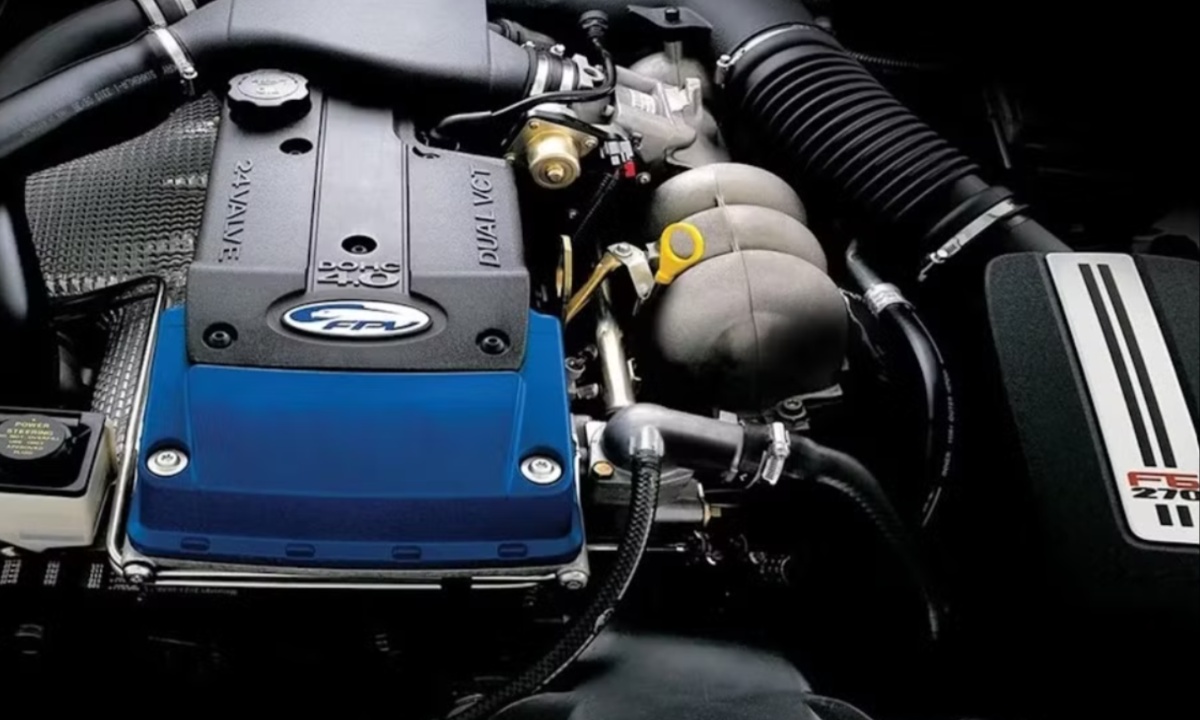
4. 2002–2016 Ford 4.0-Liter Barra Inline-Six: Australia’s Turbocharged Legend
Produced by Ford Australia from 2002 to 2016, the 4.0-liter Barra inline-six became a symbol of reliability, power, and tuning potential. Originally developed with Tickford Vehicle Engineering as a replacement for the Ford Falcon’s SOHC engine, the Barra featured a DOHC setup with Variable Cam Timing while retaining its 4.0L displacement.
Available in naturally aspirated and turbocharged versions, factory outputs ranged from 209 hp to 436 hp, with torque figures between 276 and 425 lb-ft. Renowned for its robust internals, the Barra could reliably handle 800 hp before requiring forged components, and with the right modifications, it could exceed 1,000 hp.
Known to last over 250,000 miles with proper maintenance, it became one of the most durable modern inline-six engines.
The Barra’s appeal among tuners stemmed from its combination of strength and affordability. Even turbocharged models retained stock internals, proving the engine’s resilience under extreme boost. Often called the “Aussie 2JZ-GTE,” the Barra gained a cult following, leading to a thriving aftermarket with conversion kits for engine swaps.
It powered vehicles like the Ford Falcon XR6 Turbo, Fairlane, LTD, and Territory SUV, and was even adapted for LPG-powered fleet cars such as taxis.
Though discontinued in 2016, its reputation continues to grow, and finding low-mileage, unmodified examples has become increasingly difficult as enthusiasts snap them up for high-performance builds.
While never officially sold in the U.S., importers have brought Barra engines stateside, where they’ve found homes in custom builds, including YouTuber Adam LZ’s Mustang Shelby GT350 swap.
Weighing around 525 pounds slightly heavier than Toyota’s 2JZ the Barra remains highly regarded for its balance of street drivability and extreme power capability.
Its legacy is cemented not only in Australian performance culture but also in the global tuning community, standing as one of the finest straight-six engines ever produced. From stock daily drivers to 2,000-hp drag monsters, the Barra embodies the blend of strength, versatility, and raw performance that enthusiasts crave.
5 You Should Avoid
1. 2003–2007 Ford 6.0L Power Stroke V8: Powerful but Problem-Prone
Introduced to meet stricter NOx emissions standards, the 6.0-liter Power Stroke V8 replaced the legendary 7.3L in Ford’s Super Duty lineup from 2003 to 2007.
While offering modern upgrades such as a variable geometry turbocharger, four-valve cylinder heads, and hydraulically actuated electronically controlled unit injectors (HEUI), it delivered 325 horsepower and up to 570 lb-ft of torque.
The engine was more compact than its predecessor, with an integrated oil cooler and high-pressure oil pump, but its rushed development led to a slew of issues that tarnished its reputation.
Early problems included software glitches in the injection system, EGR failures, oil cooler blockages, and high-pressure oil pump leaks issues which even resulted in lawsuits and costly repairs.
Common mechanical problems became notorious among owners and mechanics alike. The EGR cooler, prone to soot buildup and cracking, could leak coolant into the engine, while the factory exhaust manifolds warped and cracked.
Fuel injectors were sensitive to poor fuel and oil quality, and the Fuel Injection Control Module (FICM) often deteriorated unnoticed until major performance issues arose. Head gasket failures were also prevalent due to stretched torque-to-yield bolts.
Turbochargers suffered from carbon buildup in the vanes, causing boost irregularities. Many repairs, such as injector replacement, required removing the cab entirely ,adding significantly to labor costs. Despite this, the 6.0L excelled in towing, with capacities ranging from 12,500 to 19,200 pounds depending on configuration.
Enthusiasts coined the term “bulletproofing” to describe upgrading weak points to make the 6.0L reliable. This typically involved replacing the EGR cooler, oil cooler, head bolts with stronger studs, and the FICM, along with improving the turbo and fuel system.
With proper modifications, the platform could be transformed into a dependable workhorse capable of substantial power gains some builds exceeding 1,700 hp.
While stock engines often proved costly to maintain, a well-bulletproofed 6.0L remains a capable diesel for those willing to invest in preventive upgrades. For buyers, the engine’s history is a cautionary tale: either avoid poorly maintained examples or be ready to invest in making it truly dependable.

2. 2008–2010 Ford 6.4L Power Stroke V8: Power and Innovation Overshadowed by Reliability Woes
Introduced in 2008, the 6.4L Power Stroke V8 was Ford’s final International Navistar-built diesel for the Super Duty lineup, replacing the troubled 6.0L. Based on the Navistar MaxxForce 7, it was cleaner, quieter, and more powerful, boasting 350 horsepower and 650 lb-ft of torque.
It introduced several firsts for Ford diesels, including a high-pressure common-rail fuel system with piezoelectric injectors, a Diesel Particulate Filter (DPF), and an industry-first factory compound turbocharger setup.
This twin-turbo system, combining a variable geometry high-pressure turbo with a fixed geometry low-pressure unit, improved throttle response and high-end power.
Structurally, the engine featured a cast-iron block and bed plate, upgraded powdered-metal connecting rods, and larger 16 mm head bolts aimed at resolving prior head gasket issues. Despite these innovations, the 6.4L shared enough design traits with the 6.0L to inherit many of its weaknesses.
Owners faced a long list of recurring problems. Cracked pistons, often attributed to high boost pressures, plagued many engines. EGR cooler and oil cooler failures remained common, sometimes linked to clogging that led to cascading damage.
Fuel dilution of engine oil a byproduct of the DPF regeneration process caused premature wear to bearings, turbos, and valvetrain components. Rocker arms suffered from poor lubrication, while cracked up-pipes, leaking radiators, and cavitation-induced front cover failures added to maintenance headaches.
The Horizontal Fuel Conditioning Module (HFCM) was prone to clogging if water wasn’t regularly drained, risking costly fuel system damage. While head gasket failures were less frequent than in the 6.0L, they were not eliminated entirely.
The 6.4L Power Stroke remains polarizing among enthusiasts. On one hand, it delivered impressive factory performance, excellent throttle response from its compound turbos, and was easy to tune for substantial power gains.
On the other hand, its poor fuel economy, high repair costs, and difficulty reaching 200,000 miles without major work gave it a reputation as one of Ford’s most maintenance-intensive diesels.
Aftermarket solutions exist to “bulletproof” the engine addressing weak points and improving reliability but they require significant investment. For buyers and owners, the 6.4L represents both a high-performance milestone and a cautionary tale in diesel truck ownership.

3. Essex V4: Origins and Design
Produced between 1965 and 1977, Ford’s V4 Essex engine came in 1.7-liter and 2.0-liter versions, producing between 73–92 horsepower and 100–122 lb-ft of torque. It powered several Ford models, including the Corsair, Capri Mk I, Consul/Granada Mk I, Zephyr Mk IV, and the first-generation Ford Transit van.
The compact 60° V4 layout was chosen to fit the Transit’s short-nose design, with identical bore dimensions for both displacements but different strokes.
Available in both low and high compression ratios, the Essex V4 used a Heron cylinder head design and was initially fitted with a single-barrel carburetor, later upgraded to twin-choke versions in performance trims such as the Corsair 2000E and Capri GT 2000.
Despite its widespread application, the Essex V4 was infamous for underwhelming performance and persistent reliability problems. A 60° V4 is inherently unbalanced compared to a 90° configuration, and while Ford added a balance shaft for smoother operation, the engine still suffered from rough running.
Most notably, faulty head gaskets plagued the design, often failing before 150,000 miles. This flaw, combined with its low output, hurt the popularity of models like the Corsair.
Some improvements were made between 1971 and 1972, including a stronger camshaft drive gear, reshaped inlet ports, and minor compression ratio increases, which marginally boosted power. Nonetheless, even the most powerful 2.0-liter version in the Corsair 2000E Deluxe peaked at only 103 hp.
The Essex V4 was mechanically related to the larger Essex V6, sharing many components and design features, but it never achieved the same success. It found limited use outside Ford, including in a small number of Marcos 2 Litre sports cars.
By 1974, Ford replaced it in the Capri II with the more modern 2.0L Pinto OHC inline-four and the Cologne V6. Today, the Essex V4 is remembered less for its performance and more for its engineering compromises, mechanical fragility, and its role as a transitional powerplant in Ford’s lineup during the late 1960s and early 1970s.

4. 2002–2008 5.4L Triton V8: Power with Persistent Problems
The 5.4-liter Triton V8, part of Ford’s Modular engine family, debuted in 1997 and became a mainstay in trucks, SUVs, and performance vehicles. The 2002–2008 three-valve version offered solid output ranging from 295 to 390 horsepower and up to 500 lb-ft of torque making it well-suited for heavy towing and versatile applications.
Available in both SOHC and DOHC configurations with electronic fuel injection, it provided strong low-end torque and could tow between 7,500 and 11,000 pounds. However, while its specifications suggested durability and power, this version of the Triton gained a reputation for being one of Ford’s most problematic engines.
Reliability concerns were widespread, particularly in the 2004–2008 F-150 models. Common issues included timing chain failures, ignition coil malfunctions, blown spark plugs, cam phaser wear, fuel pump breakdowns, and engine misfires.
The 2007 and 2008 model years were especially troublesome. CarComplaints reported dozens of engine knock and broken spark plug incidents, often requiring complete engine replacements.
The design of the three-valve cylinder heads made spark plug removal risky, as plugs could seize or break, driving up repair costs. Even with proper maintenance, some owners faced expensive overhauls well before the 200,000-mile mark that other Modular V8s could achieve.
Despite its flaws, the Triton 5.4L still found loyal owners who valued its towing capacity and performance when maintained diligently. Regular oil changes, timely timing chain inspections, and preventive repairs could extend its lifespan. Yet, for many, the engine’s mechanical vulnerabilities overshadowed its strengths.
By 2009, Ford moved away from this iteration, introducing improved designs that addressed many of the earlier problems. Today, the 2002–2008 three-valve Triton stands as a cautionary tale: an engine with impressive capabilities on paper, but one whose real-world reliability often fell short of expectations.

5. 1982–2004 3.8-Liter Essex V6: Heavyweight with Heavy Problems
The 3.8-liter Essex V6, essentially an enlarged version of the Essex V4, debuted in 1982 as a 90° overhead valve engine built in Windsor, Ontario. Originally conceived as a diesel, it became a gasoline powerplant, making it heavier than many rivals.
It powered a broad range of Ford vehicles, from mid-size sedans to minivans and trucks. In naturally aspirated form, it produced up to 193 hp and 225 lb-ft of torque, with a supercharged version reaching 230 hp and 330 lb-ft.
Despite these figures, its performance was uninspiring, and its greatest flaw was durability; head gasket failures often occurred around 150,000 miles, leading to costly repairs involving internal engine rework and head bolt replacement.
The Essex V6 went through multiple evolutions, including Ford’s 1996 Split Port Induction (SPI) system, which boosted power, improved torque, and slightly enhanced fuel efficiency.

While this added technical sophistication, it didn’t solve its core reliability woes. Applications spanned from the Ford Granada and Thunderbird to the Mustang, Windstar, and even the F-150 in certain trims. The supercharged variant, used in the
Thunderbird Super Coupe and Cougar XR-7 between 1989 and 1995, added excitement to the lineup, delivering strong low-end torque and respectable performance thanks to an Eaton M90 supercharger.
However, even this high-performance version could not escape Essex’s underlying mechanical weaknesses, particularly with gaskets and cooling system demands.
Over its 22-year run, the Essex V6 built a reputation for being both widespread and problematic. While it was the lightest V6 in North America at launch, early production suffered from block cracking, and later years were marred by the persistent gasket issues that overshadowed any technical gains.
The engine’s heavy design, middling efficiency, and tendency toward expensive failures made it less competitive as newer, more refined V6s entered the market. Production for vehicles ended in 2004, with industrial versions lingering until 2015.
Ultimately, the Essex V6 stands as a workhorse with broad application but one remembered more for its mechanical shortcomings than its successes.
Also Read: 10 Cars That Rarely Sit Unsold In The Lot Due To High Demand in 2025
