

When it comes to cars, most people think of the body, the features, and the comfort first. But for mechanics, the real story is under the hood.
Engines are the beating hearts of our vehicles, and while modern powerplants are often packed with electronics and fragile components, older engines were built with a kind of rugged simplicity that made them nearly bulletproof.
Many of these motors can run for decades, often outlasting the vehicles they were originally bolted into. For American drivers who love dependability, there’s something uniquely satisfying about an engine that just keeps going no matter the miles, weather, or wear.
Below are 12 legendary old engines that mechanics swear will outlast your car. These motors have reputations for toughness, reliability, and staying alive long after the paint fades and the chassis rusts away.
1. Toyota 22R / 22RE
Ask any mechanic about bulletproof engines, and the Toyota 22R/22RE is usually the first name to come up. Found in Toyota pickups and 4Runners throughout the 1980s and early 1990s, this 2.4-liter four-cylinder is famous for shrugging off abuse.

Its simple design, chain-driven timing, and overbuilt internals meant it could easily see 300,000 miles with just basic oil changes.
In fact, many mechanics will tell you the body of the truck often gave out before the engine did, especially in northern states where rust was relentless.
Toyota’s 22-R and 22-RE four-cylinder engines may seem outdated compared to modern options like Honda’s K24, but they remain highly respected for their toughness and dependability.
As part of Toyota’s R-series lineup, these 2.4-liter fuel-injected motors earned a reputation for strength and long-term reliability.
Straight from the factory, they weren’t the most powerful engines available, but that shortcoming could easily be addressed with a few modifications.
For powerplants designed in the mid-1980s, the aftermarket support available for them is still surprisingly strong.
One of the standout qualities of the 22R and 22-RE is their durability. Owners often report that these engines can last well beyond 400,000 miles with nothing more than routine maintenance, which speaks volumes about Toyota’s engineering at the time.
Because of this, they have become beloved among enthusiasts and remain a popular choice even decades after their introduction.
The 22R first entered production in 1981, and it remained in use until 1997. A year later, Toyota introduced the 22-RE as an improved, fuel-injected version, which stayed in production until 1995.
Both engines underwent a significant redesign in 1985 that involved extensive changes to the cylinder head, block, pistons, and timing belt system. Related parts such as the timing chain, water pump, and oil pump were also revised.
This overhaul was so comprehensive that post-1985 engines had far fewer interchangeable parts with the earlier versions. From that point on, the 22R and 22-RE were nearly identical, with the RE distinguished mainly by its fuel injection system.
Both motors offered the same basic specifications: a 2,366 cc displacement, two valves per cylinder, a bore of 92 mm, and a stroke of 89 mm. The compression ratio was set at 9.4:1 for fuel-injected versions.
Early 22-RE engines produced around 105 horsepower and 136 lb-ft of torque, while later post-1985 examples delivered 113 horsepower and 140 lb-ft. The carbureted 22R, on the other hand, generated between 97 and 109 horsepower and 128 to 138 lb-ft of torque, depending on the year.
As the last members of Toyota’s R engine family, the 22R and 22-RE became widely used across a variety of Toyota cars and trucks, solidifying their status as reliable and versatile workhorses.
Their combination of simplicity, aftermarket support, and proven longevity ensures that these engines continue to be appreciated by enthusiasts and everyday drivers alike.
Also Read: 5 Cars With Dependable Start-Stop Systems and 5 That Annoy Owners
2. Chevrolet Small-Block 350
The Chevy 350 is one of the most produced engines in history, and for good reason it’s practically indestructible. This V8 powered everything from Camaros to trucks to boats.
Mechanics love it because parts are cheap, repairs are straightforward, and it’ll run even when neglected.

Countless shade-tree mechanics have stories of a 350 running with a cylinder misfiring or low oil pressure, yet refusing to quit. It’s not just reliable it’s a legend of American motoring.
3. Ford 300 Inline-Six
Few engines are as beloved by truck mechanics as Ford’s 300 cubic-inch inline-six. Built from the mid-1960s through the mid-1990s, it was used in F-Series pickups, vans, and even industrial equipment.
This motor was designed for torque and durability rather than speed, and it became known for lasting half a million miles in farm trucks and work vans.
Mechanics often joke that the truck bed would rust away, but the 300 inline-six would still fire up on the coldest mornings.
The Ford 300 cubic inch straight-six has long been considered a cornerstone of American truck culture, playing a vital role in shaping the nation’s working backbone.
Introduced in the 1960s and remaining in production until 1996, this massive 560-pound iron-block engine proved itself as a powerhouse for farmers, construction crews, and lumberjacks alike. Its rugged durability made it nearly indestructible, which is exactly why it continues to command respect decades later.

In this installment of the “Engines You Should Know” series, we once again turn to the inline-six layout. Unlike the highly tunable 2JZ-GTE found in the Toyota Supra or General Motors’ modern all-aluminum 4200 Vortec Atlas, the Ford 300 was engineered for one purpose, enduring unimaginable levels of abuse.
During its 31-year production run, the 300 inline-six powered far more than just farm pickups. It found homes in airline tugs, tractors, irrigation pumps, snowplows, wood chippers, and even the large, boxy UPS trucks that reliably delivered parts across the country.
To suit different needs, the engine was offered to run on multiple fuel types, including gasoline, LPG, and natural gas. The 300 made its debut in 1965 alongside its sibling, the 240 CID, a de-stroked variant of the same engine.
Both shared the same robust iron block and were produced at Ford’s Cleveland Engine Plant, and both earned a reputation for serving in a wide range of agricultural applications. The 240 even saw use in cars, while the 300 was developed specifically as a truck motor.
Although the 240 CID was discontinued by the mid-1970s, the 300 carried on for another 22 years, cementing its legacy as one of the most enduring and versatile engines Ford ever produced. Its unmatched resilience and ability to thrive in the toughest conditions earned it a permanent place in the history of American workhorses.
4. Mercedes-Benz OM617 Diesel
For those who prefer European engineering, the Mercedes OM617 five-cylinder diesel is a legend. Found in cars like the 240D and 300D, this engine was built to survive harsh climates and rough fuels. It’s slow by modern standards, but incredibly durable.
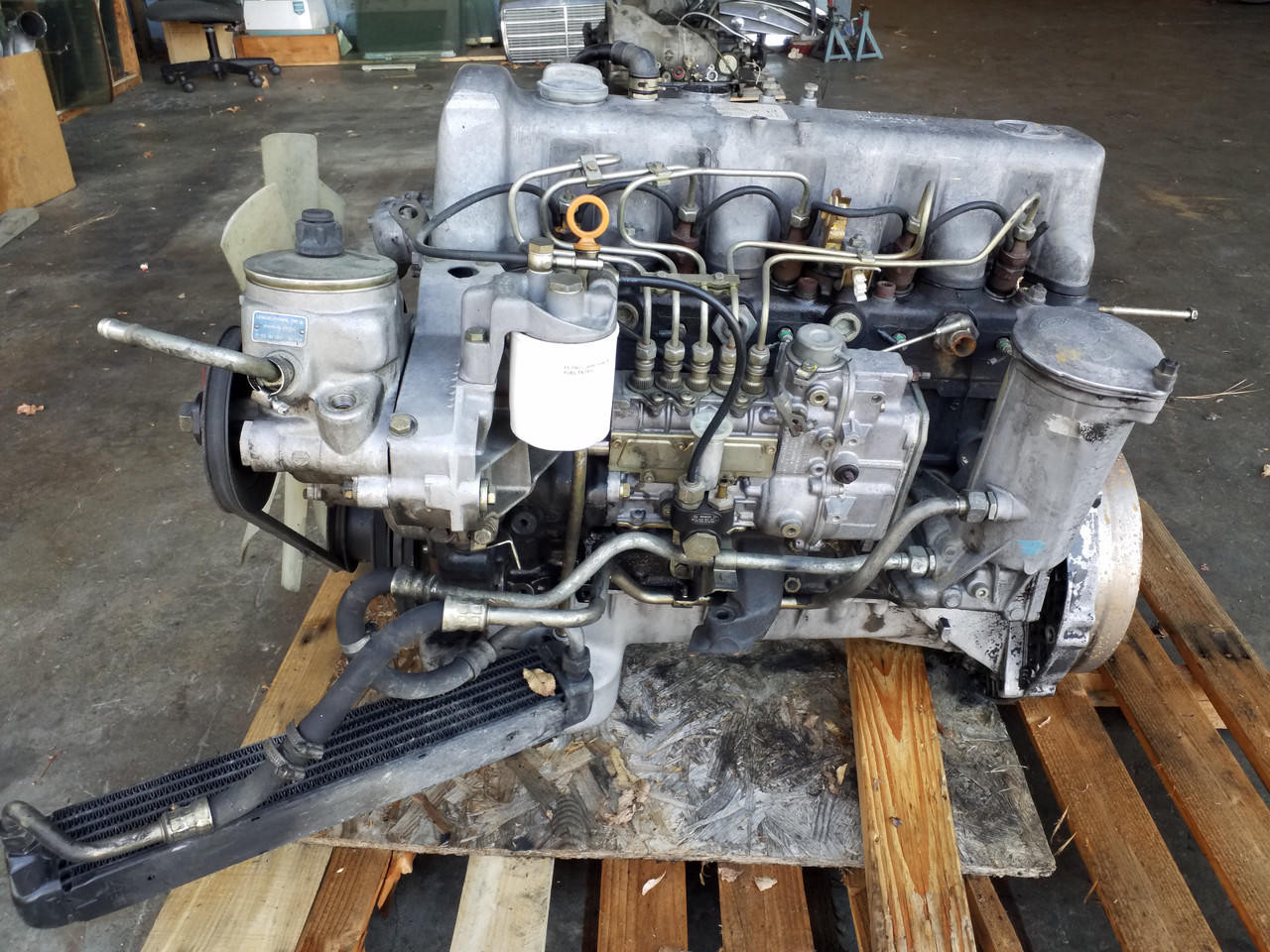
Mechanics often point to examples still running strong after 500,000 miles, with some going past a million. In many cases, the car around the OM617 is long gone, but the engine itself finds a second life in off-road builds, boats, or stationary machines.
5. Jeep/AMC 4.0L Inline-Six
Jeep fans know the 4.0-liter inline-six as the soul of the Cherokee XJ and Wrangler YJ/TJ. This engine, first developed by AMC in the 1980s, became famous for its reliability and torque delivery.
Mechanics swear by its ability to run even when abused off-road, overheated, or neglected. Many examples pass 300,000 miles with little more than basic maintenance. In fact, when a Jeep finally dies, the engine is usually the last component left working.
The Jeep 4.0 engine, often referred to as the AMC 4.0, is one of the most iconic inline-six engines in automotive history.
Renowned for its rugged construction and dependable performance, it became a staple across multiple Jeep models and earned a loyal following among off-road enthusiasts and daily drivers alike. Its combination of strength, simplicity, and smooth operation ensured its place as a trusted workhorse for decades.
With a displacement of 4.0 liters, or 242 cubic inches, the engine produces around 190 horsepower at 4,600 rpm and 235 lb-ft of torque at 3,200 rpm. It carries a compression ratio of 8.8:1 and uses a multi-port fuel injection system paired with regular unleaded 87-octane fuel.

A distributor-less ignition system contributes to its ease of maintenance and reliability, while its water-cooled design helps regulate temperature under demanding conditions. Weighing roughly 450 pounds, the Jeep 4.0’s robust build makes it both durable and capable of withstanding years of hard use.
One of the defining characteristics of the Jeep 4.0 is its inline-six layout, a configuration celebrated for smoothness and balance. This setup provides exceptional torque delivery, especially at low speeds, which makes it particularly well-suited for off-road applications.
The engine’s long-stroke design further enhances low-end torque, ensuring dependable pulling power when navigating rugged terrain. Its cast-iron block, combined with an aluminum head, provides a strong foundation for durability, while the multi-port fuel injection system enhances efficiency and performance.
The distributor-less ignition system adds another layer of reliability, making it easier to maintain compared to older ignition designs.
Like any engine, proper lubrication is essential to keeping the Jeep 4.0 performing at its best.
The recommended oil types include both conventional and synthetic options, with viscosity ratings of 5W-30 or 10W-30 depending on climate conditions. In colder regions, 5W-30 oil is the preferred choice, while 10W-30 is ideal for warmer environments.
Also Read: 5 Engines That Handle Stop-and-Go Traffic vs 5 That Break Early
6. Honda B-Series (B18/B20)
Honda’s B-series engines from the late 1980s and 1990s earned a cult following among enthusiasts and mechanics alike. Found in Civics, Integras, and CR-Vs, these motors combined efficiency with surprising toughness.

The B18 and B20 in particular are known to rack up huge mileage with little more than regular oil changes. Mechanics often mention that even after decades, these engines still run smooth and rev happy, often outlasting the lightweight Hondas they were bolted into.
7. Dodge 225 Slant-Six
Chrysler’s Slant-Six, particularly the 225 cubic-inch version, has a reputation for being nearly unkillable. Built from the 1960s into the 1980s, it was used in everything from Darts and Valiants to Dodge pickups.
Its angled cylinder design gave it a unique look under the hood, but what mechanics remember most is how indestructible it was. Stories abound of Slant-Sixes running with little or no oil, surviving neglect, and still firing up decades later.
First introduced in 1960, the Chrysler 225 Slant Six was designed to replace Mopar’s aging Flathead-style engine. This inline-six quickly earned recognition not only for its durability but also for its unusual engineering.
Its “Slant Six” nickname came from the distinctive 30-degree tilt of the block toward the passenger side, a design choice that set it apart from other engines of the era.

Chrysler explained in its original 1960 press release that the slanted orientation lowered the center of gravity compared to upright engines, allowed for increased clearance under the low-profile hood of the Plymouth Valiant, and made engine accessories easier to access.
The angled layout also brought performance advantages. It permitted the use of equal-length intake runners and header primaries, which improved airflow distribution and reduced restriction.
Along with a unique internal cylinder configuration that featured a smaller bore relative to its stroke, the result was an engine that produced impressive amounts of torque.
Many enthusiasts found even greater performance by swapping out the factory one-barrel carburetor for a two-barrel setup, a common modification that unlocked more potential from the motor.
Chrysler also offered a special Hyper-Pak package between 1960 and 1962, which elevated the Slant Six’s performance to an entirely new level.
This upgrade included a four-barrel carburetor and several additional performance components, boosting output to nearly 200 horsepower, an impressive figure that brought the six-cylinder engine into territory usually reserved for V8s.
With its clever design, strong torque delivery, and surprising tuning potential, the Chrysler 225 Slant Six carved out a legacy as one of Mopar’s most innovative and enduring engines.
8. Cummins 6BT 5.9 Diesel
When Dodge teamed up with Cummins in 1989 to put the 6BT 5.9-liter straight-six diesel in its Ram trucks, it created one of the most legendary engines in American truck history.
The 6BT was built for industrial equipment, so when dropped into a pickup, it proved to be practically unstoppable.
Mechanics love its mechanical injection system, simple design, and ability to run forever with proper maintenance. It’s not uncommon to see these engines with 500,000 miles still pulling heavy loads.
The legendary 6BT Cummins made its debut in 1984, initially developed for use in agricultural equipment by Case. Just a few years later, in 1989, Chrysler struck a partnership with Cummins to bring the 5.9-liter turbodiesel into its ¾-ton and 1-ton Dodge pickups.
This move proved transformative, as the 12-valve Cummins quickly emerged as a favored alternative to Dodge’s V8 gasoline engines.
With nearly twice the torque available at low engine speeds and a dramatic improvement in fuel economy, particularly when towing, the 6BT immediately set itself apart.

By 1991, an intercooler had been added to the engine, and in 1994, the Bosch P1700 injection pump replaced the older VE system. Simplicity, ruggedness, and impressive performance made the 12-valve Cummins one of the most sought-after diesel platforms ever built.
It was also groundbreaking in another way, the 6BT was the first inline-six diesel to be offered in a pickup truck, and Dodge remains the only manufacturer to adopt that layout in the segment.
Cummins produced the 5.9L 12-valve engine for Dodge Ram applications until the end of the 1998 model year, when it was phased out in favor of the more emissions-friendly 24-valve version.
But the 6BT’s reach extended far beyond Dodge pickups. It powered everything from light- and medium-duty trucks to agricultural machinery and construction equipment. Its long-stroke, undersquare bore-to-stroke ratio was specifically designed to deliver excellent low-end performance, with peak torque arriving at just 1,600 rpm.
At 1,100 pounds, the engine was undeniably heavy, yet its massive cast-iron block and cylinder head gave it unmatched durability and an outstanding reputation for longevity.
Adding to its appeal was the inline-six configuration, which made servicing easier by leaving ample space on either side of the block, something that V8 layouts simply couldn’t offer.
Thanks to its combination of brute strength, simplicity, and reliability, the 6BT Cummins has become one of the most celebrated diesel engines in truck history, setting a benchmark that many consider the gold standard.
9. Volvo Redblock (B230)
Volvo’s B230 “Redblock” engines from the 1980s and 1990s are a favorite among mechanics who value longevity. These four-cylinder motors were built with heavy cast-iron blocks and simple fuel injection systems.

They powered boxy 240s and 740s that became famous for their ability to rack up mileage like a taxi cab. Mechanics often say that while the car’s body might rust or electronics may fail, the Redblock keeps chugging along with minimal care.
10. Nissan L-Series (L28)
The Nissan/Datsun L28 inline-six, found in the 280Z and early 280ZX, is an engine mechanics respect for its durability. While it was often overshadowed by sportier engines, the L-series became known for its bulletproof reliability.

Even when owners neglected them, these engines refused to give up. Mechanics often swap them into project cars, knowing they can handle years of running without needing a rebuild.
11. Buick 3800 V6
The Buick 3800, also known as the GM 3.8 V6, was one of General Motors’ greatest engines. Produced for decades, it was used in everything from Regals to Bonnevilles to minivans.

Mechanics prize it for being easy to work on, cheap to repair, and capable of lasting hundreds of thousands of miles. Even today, many older GM cars on the road owe their continued existence to the 3800 under the hood.
When people think of American engineering icons, V8 engines like Chevrolet’s small-block or Chrysler’s HEMI usually come to mind.
Yet, Buick’s V6 deserves its own recognition. While it lacked the excitement and raw performance of its eight-cylinder counterparts, this engine was produced in huge numbers and earned its place in history by excelling in areas like reliability, fuel economy, and ease of maintenance.
These qualities ultimately made it one of the most successful and influential powerplants ever built.
The story began in 1961, when General Motors introduced two new engines for its Buick, Oldsmobile, and Pontiac compact cars: an all-aluminum 215 cubic-inch (3.5-liter) V8, and an iron-block V6 that borrowed much of its architecture from that same aluminum V8.
Buick branded the V6 the “Fireball,” though in reality, it was somewhat of an oddball in the automotive world. As the first V6 used in a mass-produced passenger car, the Buick Special, it stood out with its 90-degree cylinder bank angle, an irregular firing order, and the absence of a balance shaft.
The vibrations it produced were significant, and GM attempted to mask them with soft engine mounts, which many considered an uninspired solution. Enthusiasts defended the design for its distinctive low rumble, while critics simply dismissed it as an example of a rough and uneven idle.
Despite its quirks, the original 198 cubic-inch (3.2-liter) V6 was both reliable and reasonably fuel-efficient, which encouraged Buick to continue refining the engine even as its V8 sibling was discontinued after only two years.
In 1964, the V6 was enlarged to 225 cubic inches (3.6 liters), offering better performance and broader appeal. But just three years later, GM decided to sell the rights and tooling to Kaiser-Jeep.
Under its new name, the Dauntless 225, the compact and capable engine proved a perfect fit for the CJ Jeep, where it served faithfully until 1971.
The early 1970s oil crisis created a renewed focus on fuel economy, forcing automakers to rethink their strategies.
Recognizing the potential of its old design, GM reacquired the rights to the V6 in 1974 from American Motors, which had by then taken over Kaiser-Jeep.
This move brought the Buick V6 back into the GM lineup at exactly the right moment, setting the stage for decades of continued use and development.
12. Toyota 2UZ-FE V8
Finally, the Toyota 2UZ-FE, a 4.7-liter V8 used in the Land Cruiser, Tundra, and Lexus LX470, rounds out the list. Introduced in the late 1990s, it quickly earned a reputation for being one of the toughest modern-ish engines.
Mechanics admire it for its smooth operation and longevity, with many examples reaching 400,000 miles or more without issue. In true Toyota fashion, the 2UZ often outlasts the SUV or truck it’s in, making it a favorite among off-roaders and long-haul drivers alike.

Engines like these remind us of an era when durability mattered more than squeezing out every bit of horsepower or efficiency. Mechanics love them because they don’t just survive they thrive under tough conditions.
While modern engines are often built with complicated electronics and thinner materials, these old-school motors were designed to run forever.
If you’re looking for a car or truck that will keep moving long after the odometer stops counting, finding one with any of these engines is a safe bet. In many cases, the only reason they stop running is because the vehicle around them falls apart.
