
Rear-wheel drive (RWD) has long been the holy grail for driving enthusiasts: better balance, predictable handling, and a connection to the road that front-drive platforms rarely replicate.
In an age where all-wheel drive and electric torque-vectoring systems dominate the headlines, some of the best RWD cars remain hidden gems undervalued, under-appreciated, and ready for savvy buyers to scoop up in 2025.
Whether you want a spirited weekend cruiser, a comfortable daily driver with rear-drive dynamics, or a future collectible with classic proportions, these ten overlooked RWD cars deserve a second look. Let’s dive into what makes each one special, and why they’re worth snagging this year.
1. Nissan 370Z (2009–2020)
Long before the Z-car nameplate returned with the new 2023/2024 Nissan Z, its predecessor the 370Z quietly delivered pure rear-wheel-drive thrills for over a decade.
Affordable on the used market, the 370Z pairs a robust 3.7-liter V6 with sharp steering and a relatively light curb weight.
Enthusiasts often overlook it because it’s not as flashy as more recent sports cars, but that’s exactly why it’s compelling: you can find clean examples well under $25,000 with manual transmissions and limited-slip differentials.
For drivers who crave an analog sports car experience wind up the revs, shift yourself, feel the rear wheels push the 370Z is arguably one of the best value propositions.
Aftermarket support remains strong, too, meaning you can tailor a 370Z for canyon carving, track days, or just aggressive highway fun without spending a fortune.
The 2009 Nissan 370Z is a standout in the lineage of Nissan’s iconic Z cars, continuing a legacy that has defined accessible sports-car performance for decades.
Known for its combination of sharp handling, strong power, and relatively affordable pricing, the 370Z represents a refined evolution of the 350Z, offering drivers both a familiar sporting feel and several modern upgrades.
While the 370Z retains clear visual cues from its predecessor, virtually every element has been re-engineered for performance and refinement. The wheelbase is slightly shorter, the rear track wider, and 95 pounds have been shaved off the car’s weight, contributing to a more agile and responsive driving experience.
Structural rigidity has been improved, including the relocation of the old crossmember that previously intruded into cargo space, which enhances both handling precision and cabin functionality. The result is a sport coupe that feels more premium, planted, and dynamically capable than the previous generation.
Powering the 370Z is a 3.7-liter V6, a larger iteration of the outgoing engine and shared with Infiniti’s G37. It features variable valve timing and lift, a redline of 7,500 rpm, and produces 332 horsepower, 17 more than the heavier 2010 Mustang GT V8.

Coupled with refined suspension tuning and improved chassis dynamics, this engine allows the 370Z to accelerate briskly, handle corners with confidence, and maintain a composed ride, striking a balance between performance and usability.
The interior has been upgraded with higher-quality materials, less hard plastic, and a more ergonomic layout. Instrumentation remains clearly visible even with steering-wheel tilt, and there’s now a proper glovebox for additional convenience.
The Touring trim elevates comfort with leather seating, Bluetooth connectivity, and a hard-drive-based navigation system capable of storing music. These enhancements make the cabin feel mature, comfortable, and in keeping with the car’s sporty yet refined character.
Like most two-seat sports cars, the 370Z is limited in cargo space, and practicality is inherently compromised. The newly inverted rear brace provides some improvement, but those needing more room might consider alternatives like the BMW 1 Series, Infiniti G37, or Mazda RX-8.
For those looking for more daily usability or American muscle flair, the Hyundai Genesis Coupe, Chevrolet Camaro, Dodge Challenger, or Ford Mustang are worth considering.
Despite its compromises in space, the 2009 Nissan 370Z excels in all the areas that matter most to enthusiasts: power, handling, braking, ride quality, and driver engagement.
With a well-appointed interior and a robust feature set, it stands as a modern Japanese sports car icon that balances performance and refinement while remaining relatively accessible. For those who can live with its size limitations, the 370Z remains a compelling, fun-to-drive choice in the world of affordable performance coupes.
2. Lexus IS 250/350 (2006–2013)
When you think of Lexus, comfort and reliability might come to mind before driving engagement, but the early-generation IS proved that luxury brands could also deliver fun rear-drive dynamics.
The IS 250 and IS 350 especially V6-powered IS350s combine balanced chassis tuning with smooth power delivery and excellent build quality.

They’re typically priced well below European rivals like BMW 3 Series or Audi A4, yet offer similar performance in many respects. Inside, these sedans are comfortable and well-appointed, and maintenance costs tend to be friendlier than that of German competitors.
For buyers who want a refined everyday driver that still rewards enthusiastic driving on twisty backroads, these lightly overlooked Lexus RWD sedans are a smart pick in 2025.
3. BMW 5 Series (E39/E60)
BMW’s 5 Series has long been a benchmark for balanced performance and daily usability, but older generations particularly the beloved E39 (1996–2003) and the slightly newer E60 (2003–2010) sit in a sweet spot for enthusiasts who know what to look for.
The E39, with its crisp chassis and inline-six engines, is often hailed as one of the last truly analog executive sedans. Meanwhile, the E60 introduced more modern tech and styling while still retaining rear-wheel drive at its core.
Prices on well-maintained examples can be shockingly reasonable, especially compared to their reputation.
Buyers in the U.S. should be mindful of service history and rust common concerns in colder northern states but with proper care, a 5 Series from these eras can be a sublime daily driver or a weekend joy machine that turns heads at meets without breaking the bank.
The BMW 5-Series strikes a fine balance between performance, refinement, and everyday usability, offering engines that deliver smooth, confident power across the lineup.
The 530i and 540i provide compelling choices for those seeking efficiency without sacrificing authority. The 530i’s four-cylinder engine delivers a refined, responsive drive, while the 540i’s inline-six combines silky smoothness with impressive potency.
Both engines are paired with BMW’s eight-speed automatic transmission, which shifts quickly and intuitively, maximizing both performance and fuel economy.

For enthusiasts craving more excitement, the M550i takes the 5-Series to a higher level. Its twin-turbocharged 4.4-liter V8 is a powerhouse, producing brisk acceleration and an exhilarating exhaust note that clearly distinguishes it from the standard models.
In comparative tests, the M550i outpaced rivals such as the Audi S6 and Mercedes-AMG E43, underscoring its athletic credentials without reaching the extreme focus of the M5.
All 5-Series models handle competently, with a suspension setup that strikes a comfortable balance for daily driving. However, the steering is lighter than some driving purists might prefer, and even the M550i leans toward comfort rather than razor-sharp, track-focused responsiveness.
While it’s a capable performer, the 5-Series prioritizes composure and refinement over raw driving verve, making it more suited to long journeys and spirited but relaxed driving.
Overall, the BMW 5-Series offers a versatile blend of power, comfort, and technology. The 530i and 540i deliver smooth, efficient performance for everyday use, while the M550i adds an engaging burst of V8 excitement.
For drivers seeking a luxurious, well-rounded sedan that can handle both the commute and weekend drives, the 5-Series remains a strong choice, even if it sacrifices a touch of the visceral thrill BMW purists might expect.
4. Cadillac CTS (2003–2013)
Before Cadillac shifted toward front-drive crossovers and SUVs, the CTS was a cornerstone of its performance aspirations, especially in rear-wheel-drive trim.
The first-generation CTS (2003–2007) and second-generation models (2008–2013) deliver sharp handling and bold styling that still looks fresh today.
The platform’s 3.6-liter V6 offers adequate power, and later models even come with magnetic ride control a standout feature for ride quality and composure.
These cars are often overlooked in favor of European sport sedans, yet they offer comparable driving dynamics with a distinctly American flair.
For buyers craving sharp steering, comfortable interiors, and a unique alternative to the usual German suspects, the CTS remains an appealing choice in the used RWD market.
The third-generation Cadillac CTS sedan is a midsize luxury sedan that is defined by performance, elevated luxury, and sophisticated technology. On its own merits, the CTS sedan still has plenty of appeal. Despite the newcomers ATS and XTS, the 2013 CTS remains the heart of Cadillac’s sales and reputation.
The CTS’s distinctive shield-shaped front grille is updated again for 2013 with a bright appearance on the vertical and horizontal bars that compose the grille’s frame.
The grille is wider, while the headlights flow up with the hood line, incorporating a strip of LED lights that runs down until it meets the lower spoiler lip. Models equipped with the CTS Touring Package feature a grille with dark vertical and horizontal bars.

The third-generation Cadillac CTS sedan is a midsize luxury sedan that is defined by performance, elevated luxury, and sophisticated technology. It is based on the high-performance rear-drive ATS sport sedan architecture that will enable it to be the class’s most agile and dynamic car.
The engine range includes the all-new Cadillac Twin-Turbo engine bolted to an eight-speed automatic transmission. It also includes multi-link MacPherson strut suspension for the front, five-link independent rear suspension, available all-wheel-drive, and Magnetic Ride Control to enhance performance.
The interior is roomy and driver-oriented, with eight environment trimmings, each fitted with wood, carbon fiber,, aluminum, and leather.
Among Cadillac’s technologies, the CTS includes heated and cooled 20-way adjustable front seats, an electronically locking glove box, an adaptive remote start feature, panic brake assist, lane departure warning, and others. Worth mentioning is that the new CTS will be the first car from Cadillac to have Automatic Parking Assist, which enables it to park itself in a parallel space.
In terms of performance might not be as sporty as its rivals, BMW or Audi. While the 2013 Cadillac CTS remains an enjoyable luxury sedan, we think there are better choices to check, such as the the 2013 BMW 3 Series or the similarly sized 2013 Lexus GS 350. CTS might be an option if you truly need that extra room and you are more on comfort and space.
Every 2013 Cadillac CTS comes standard with rear-wheel drive, but there is also an all-wheel drive for those who need it. The 3.0 Luxury comes standard with a 3.0-liter V6 that produces 265 horsepower and 220 pound-feet of torque.
The included dual exhaust bumps output up to 270 hp and 223 lb-ft of torque when equipped with the Touring package. The Gearbox is not the most performant, and for lovers of automatics, there is only one available, A six-speed automatic.
If Caddilac has some lacks on the performance side, it didn’t neglect the safety of its passengers. Standard safety features for the 2013 Cadillac CTS include antilock disc brakes, traction control, stability control, active front head restraints, front-seat side airbags, and full-length side curtain airbags.
Also standard is OnStar, which includes automatic crash notification, on-demand roadside assistance, an emergency button, stolen vehicle locator and active intervention, and remote door unlock. In the crash test, they received 5 stars out of five, making the CTS one of the safest cars in its class.
We must conclude with some pros and cons. It has a roomier cabin than its similarly priced rivals, an elegant interior, and good safety scores.
The cons we want to mention are that the sport suspension may be too firm, it has a bit of poor reward visibility, and, most important could be more agile. The 2013 Cadillac CTS Sedan remains one of America’s best luxury sedans but is still outclassed by European competitors.
5. Ford Mustang (S197/2010–2014)
Among American muscle cars, the Ford Mustang is ubiquitous yet certain model years and trims still fly under the radar in 2025. The 2010–2014 S197 generation blends classic Mustang character with modern RWD engineering, serving up solid V6 and V8 options.
The 3.7-liter V6 delivers satisfying grunt with good fuel economy for the class, while the 5.0-liter Coyote V8 found in GT variants is a modern legend in its own right.

Enthusiasts often chase the latest S550 models, but clean S197 cars can be had for a fraction of the price and still provide intoxicating RWD dynamics, strong aftermarket support, and easy access to upgrades.
Whether you’re looking for a project car, a weekend cruiser, or a daily that doesn’t feel tame, the S197 Mustang deserves more attention in the used-car spotlight.
6. Infiniti G37/Q60 (2007–2015)
Nissan’s luxury arm delivered an intoxicating mix of RWD balance and straight-six smoothness in the Infiniti G37 sedan and coupe, later rebranded as the Q60. These cars balance comfort, style, and dynamic polish in a package that remains attractively priced.
The naturally aspirated 3.7-liter VQ engine delivers responsive power and a soundtrack that’s still satisfying by today’s standards.

Their handling is poised without being intimidating, making them excellent choices for drivers who want livelier performance than a basic commuter car but without the complexity or cost of high-end sports cars.
RWD examples, especially with manual transmissions, command a bit of enthusiast respect but are still often overlooked by mainstream buyers making them a hidden gem for anyone ready to drive something truly engaging.
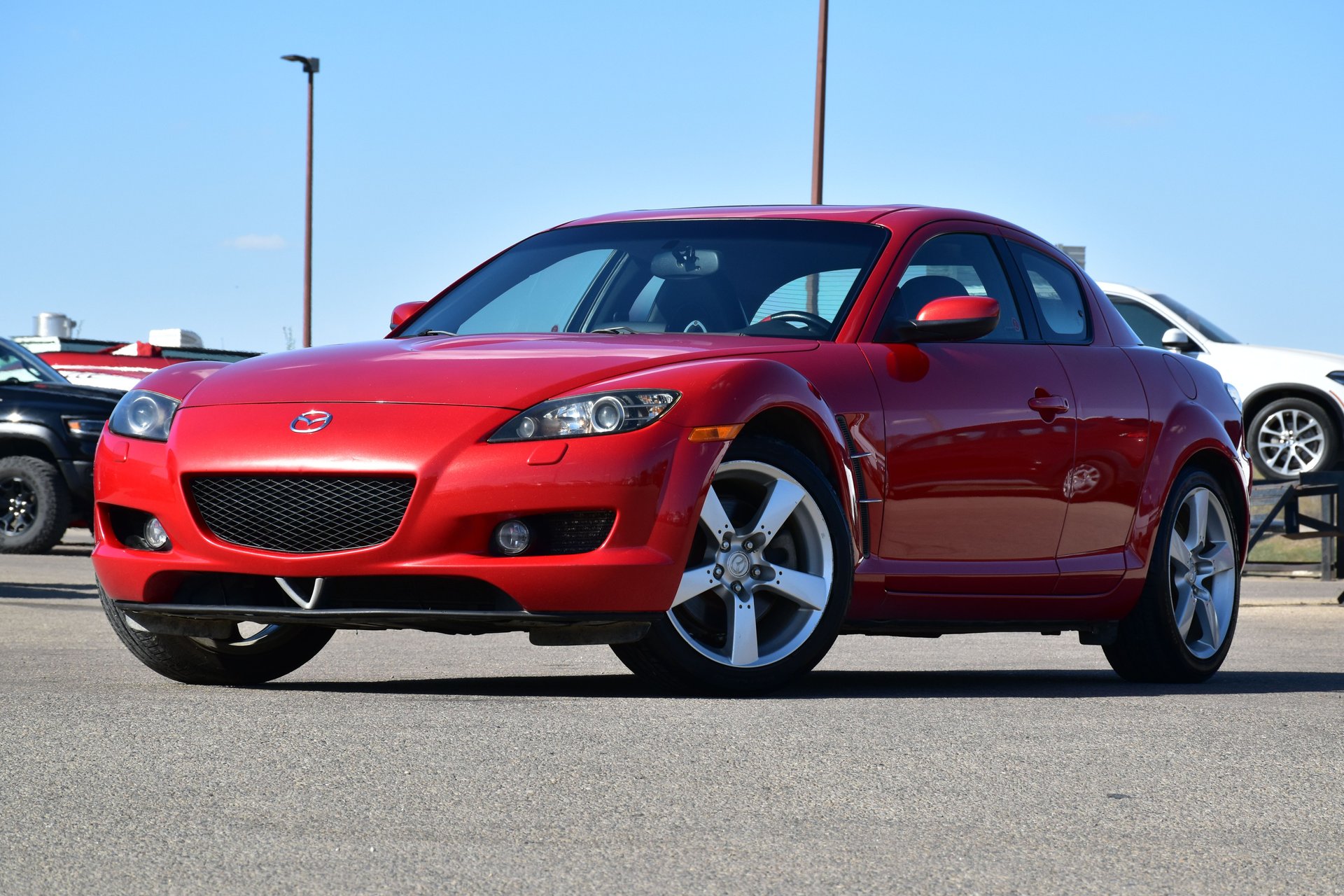
7. Mazda RX-8 (2004–2011)
You won’t find many cars with a unique personality like the Mazda RX-8. Its Wankel rotary engine makes it one of the most distinctive RWD cars ever made, offering rev-happy power and an incredibly light front end that rewards precise handling.
Practicality isn’t the RX-8’s strongest suit fuel economy is modest, and the engine requires careful maintenance but for drivers who prioritize feel and character, nothing else on this list matches its uniqueness.

On the used market, RX-8s tend to be priced low due to misconceptions about the rotary engine, but those willing to educate themselves on proper upkeep can enjoy one of the purest rear-drive experiences available.
In a world of turbocharged four-cylinder cars chasing efficiency, the RX-8’s analog charm remains a breath of fresh air.
8. Chrysler 300C (2011–2014)
The Chrysler 300C especially in RWD trim with the 5.7-liter Hemi V8 is often overshadowed by flashier European sedans, yet it offers old-school big-body luxury with robust power and American swagger.
The combination of rear-wheel drive, potent Hemi muscle, and a plush interior makes the 300C feel like a grand tourer that doesn’t apologize for its size.
On U.S. roads, they’re comfortable highway cruisers with enough torque to make merging effortless. They’re also relatively affordable on the used market compared to European rivals while offering comparable features like heated leather seats, infotainment, and premium sound systems.
For buyers who want a commanding presence with classic RWD feel, the 300C stands out as a compelling if underappreciated choice.
The 2012 Chrysler 300 builds on its already bold presence with refinements that make it more appealing than ever, blending traditional American muscle car flair with modern efficiency and luxury.
The biggest update for 2012 focuses on the Pentastar V6 models, which now benefit from an eight-speed automatic transmission, either optional or standard depending on the trim. This upgrade improves both performance and fuel economy.
Rear-wheel-drive 300s equipped with the eight-speed achieve an impressive 19/31 mpg city/highway, while all-wheel-drive variants deliver 18/27 mpg, making the 300 surprisingly efficient for a full-size sedan.
Chrysler also reintroduces the 470-hp 300 SRT8, which brings a sport-tuned suspension, more aggressive exterior styling, and a refreshed interior. This high-performance trim elevates the 300’s muscle-car credentials, offering serious power while maintaining everyday usability.

Inside, the 2012 300 feels markedly more refined than previous generations. Soft-touch plastics, quality materials, and a well-organized layout give the cabin a premium feel. Drivers and passengers alike benefit from a combination of comfort, ergonomics, and upscale touches that make long drives enjoyable.
As the last full-size rear-wheel-drive family sedan still on sale, the Chrysler 300 carries forward a proud American automotive tradition.
Its distinctive styling, strong performance across trim levels, and refined interior make it a head-turner while still offering practicality for daily driving. The 2012 model, in particular, strikes a balance between classic muscle-car attitude and modern sophistication, making it a standout in its segment.
9. Dodge Challenger (2008–2014)
More than just a pony car, the Dodge Challenger occupies a niche all its own in the RWD landscape. The early 2008–2014 models tap into retro muscle nostalgia with wide-body proportions and bold styling that turns heads.
Underneath, RWD layouts and a range of engines from V6 to Hemi V8 provide a spectrum of performance levels to match different budgets.

While it’s heavier than some competitors, that mass translates into a stable, planted feel at speed, making it a comfortable highway cruiser and powerful drag strip contender.
Challengers are often overshadowed by Mustangs and Camaros in enthusiast circles, but they offer unique character and presence that buyers in 2025 might find irresistible if they’re looking for something different from the mainstream muscle-car picks.
10. Toyota Crown (S210, 2023–2025 Used/Certified)
The newest entry on this list comes from a storied nameplate that’s only just returning to the U.S. market. The Toyota Crown blends luxury sedan comfort with rear-wheel-drive poise in a package that’s been hugely popular in Japan for decades.
While not every Crown will be strictly RWD many are AWD there are RWD trims and certified pre-owned options becoming available stateside by 2025 that offer a quiet cabin, refined ride, and understated design.
Toyota’s reputation for reliability and resale value makes the Crown a smart alternative to pricier German rivals, and its combination of comfort and dynamics is likely to age well as a future collectible.
For early adopters who want something new but still classic in driving philosophy, the Crown represents a forward-looking yet analog-friendly choice.

In an era where electrification and all-wheel drive are reshaping automotive design, rear-wheel drive holds a special place for enthusiasts and everyday drivers alike.
It’s not simply about straight-line performance; it’s about balance, predictability, and a connection to the road that front-drive cars can’t match.
Whether you’re exploring twisty backroads, heading out for spirited canyon runs, or simply enjoy smooth highway cruising with a responsive chassis beneath you, RWD continues to reward thoughtful drivers.
The ten cars above span decades and vehicle types, but they share a common thread: dynamic engagement that still feels relevant in 2025.
From affordable sports cars and sporty sedans to big-bodied cruisers with character, these overlooked rear-wheel-drive options offer real value for buyers who know what they want and know how to enjoy the journey.
