
There’s something deeply visceral about a truly characterful engine. It’s not just about horsepower figures or torque curves on a dyno sheet it’s about the soul-stirring symphony that erupts when you press the accelerator, the mechanical heartbeat you can feel through the steering wheel, and the raw emotion that transforms driving from mere transportation into an experience.
These are the engines that make enthusiasts weak at the knees, that inspire passionate debate in forums and garages worldwide, and that have earned legendary status not through marketing campaigns but through the unforgettable impressions they’ve left on everyone fortunate enough to experience them.
The greatest engines in automotive history possess a unique personality that transcends their technical specifications. They communicate with their drivers through vibrations, sounds, and sensations that create an almost telepathic connection between human and machine.
From the banshee wail of naturally aspirated high-revving masterpieces to the thunderous rumble of American V8s, from the mechanical precision of inline-sixes to the exotic shriek of Italian supercars, these powerplants have defined generations of automotive passion.
In an era where electrification is rapidly reshaping the automotive world, celebrating these characterful combustion engines feels more important than ever.
These twelve engines represent the pinnacle of internal combustion artistry, each one a testament to the fact that engineering excellence and emotional engagement aren’t mutually exclusive. They remind us why we fell in love with cars in the first place.
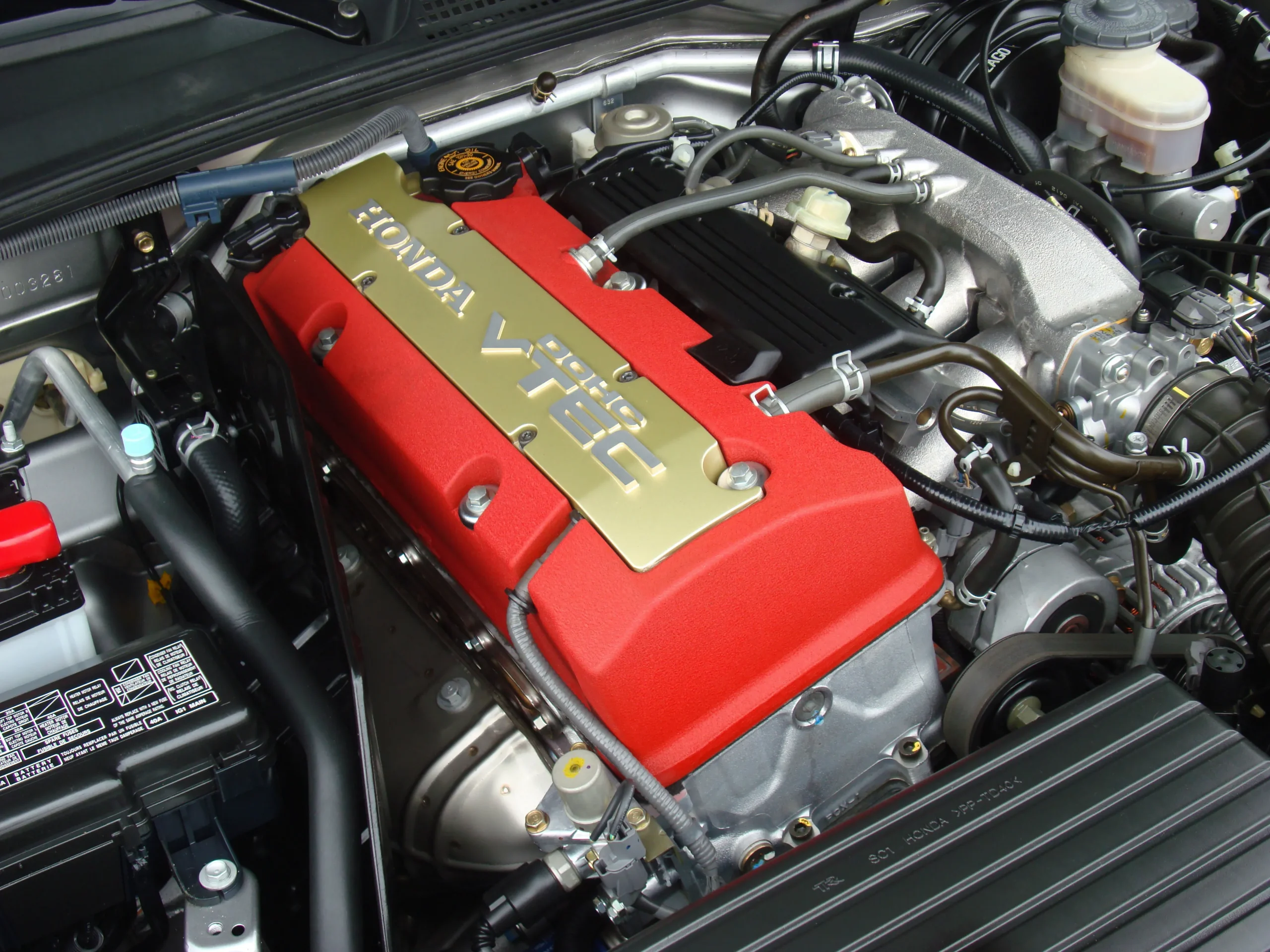
1. Honda S2000 F20C/F22C 2.0L/2.2L Inline-Four
The Honda S2000’s engine is nothing short of miraculous a naturally aspirated four-cylinder that redefined what small-displacement engines could achieve.
The F20C, in particular, produced an astounding 120 horsepower per liter, revving to an eye-watering 9,000 RPM with the smoothness of a Swiss watch and the urgency of a racing motorcycle.
This wasn’t just impressive on paper; it was an experience that rewrote the rulebook for four-cylinder engines. What makes this engine truly special is the way it rewards commitment. Unlike turbocharged engines that deliver their power in surging waves, the F20C demands that you work for its performance, keeping it singing in the upper reaches of its rev range where VTEC unleashes its full fury.
The moment VTEC engagement occurs around 6,000 RPM, the engine’s character transforms completely. The intake note changes from a mechanical hum to an aggressive howl, and the power delivery shifts from adequate to absolutely ferocious. It’s an addictive experience that encourages spirited driving and rewards precision.
The mechanical symphony this engine produces is unforgettable. There’s a purity to its sound no turbocharger whoosh, no supercharger whine, just the honest mechanical music of precisely engineered components working in perfect harmony.
The throttle response is instantaneous, creating an intimate connection between your right foot and the rear wheels. You can feel every combustion event through the cabin, sense the engine’s eagerness through the vibrations in the aluminum shift knob, and hear the intake sucking air as you approach the redline.
Honda’s obsessive attention to detail is evident throughout. Individual throttle bodies, titanium connecting rods, and a forged steel crankshaft were just some of the motorsport-derived technologies that allowed this compact four-cylinder to achieve such remarkable specific output.
The engine’s reliability, despite its high-strung nature, became legendary, with many examples exceeding 200,000 miles while still capable of hitting the 9,000 RPM redline. It proved that high performance and durability weren’t mutually exclusive, cementing Honda’s reputation for building engines that could withstand enthusiastic use day after day.
2. BMW S54 3.2L Inline-Six
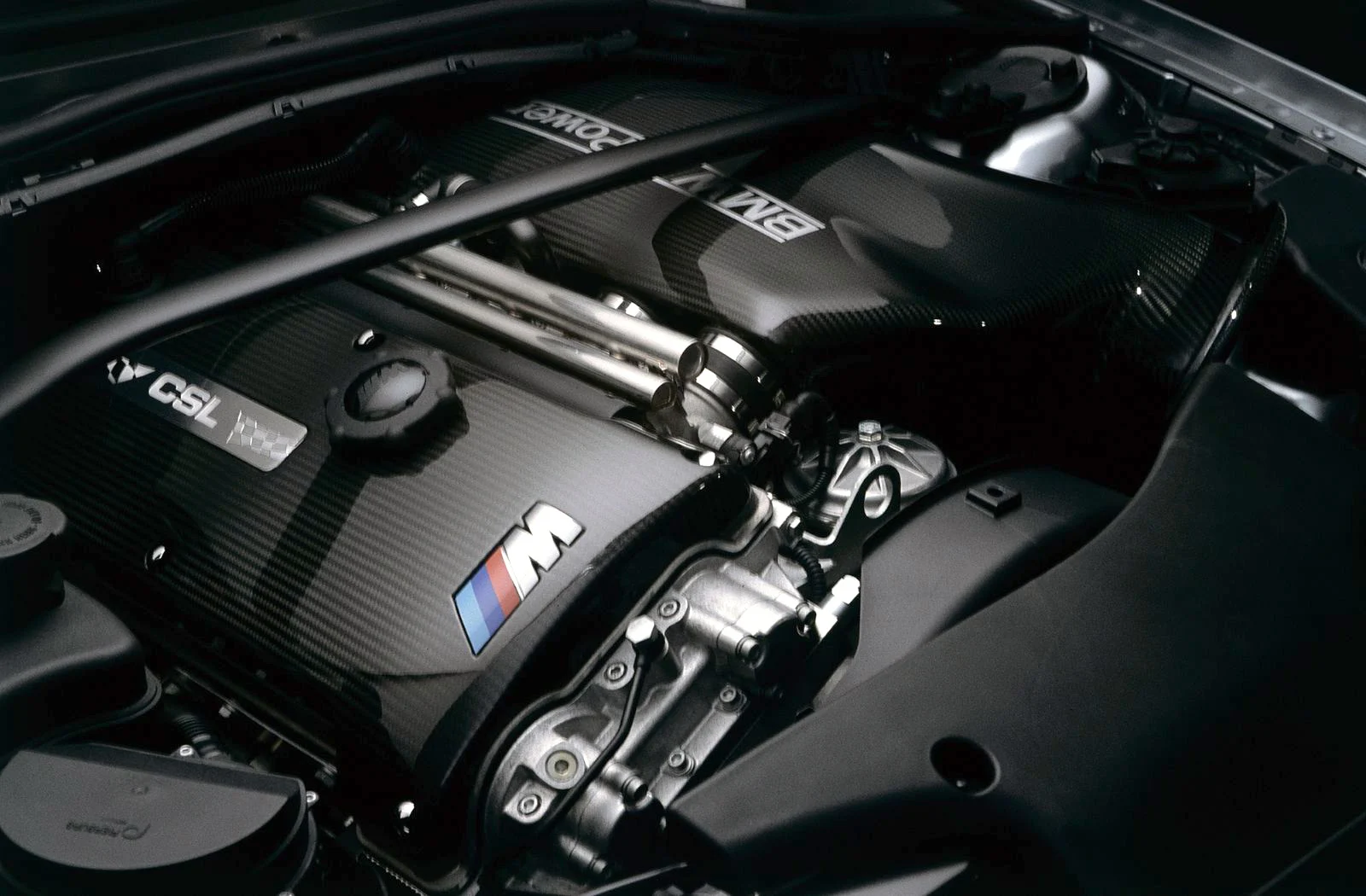
BMW’s S54 inline-six, found in the E46 M3 and Z4 M Coupe/Roadster, represents the pinnacle of naturally aspirated six-cylinder engineering.
With individual throttle bodies for each cylinder, this 3.2-liter masterpiece delivered 333 horsepower while maintaining the smoothness and refinement expected from a premium German manufacturer. But specifications only tell part of the story the S54’s real magic lies in how it makes you feel.
The S54’s character reveals itself gradually as you explore its rev range. Below 3,000 RPM, it’s a docile, refined powerplant suitable for daily commuting.
Push past 4,000 RPM, and the engine begins to awaken, its voice growing more insistent. But it’s beyond 6,000 RPM where the S54 truly comes alive, screaming toward its 8,000 RPM redline with an intensity that feels more like a racing engine than something you’d find in a street car.
The induction roar from those six individual throttle bodies is intoxicating, a mechanical crescendo that builds with every hundred RPM.
The tactile feedback from this engine is extraordinary. Through the steering wheel, shift knob, and even the seats, you can sense the mechanical precision of its operation.
There’s a particular smoothness to its power delivery that’s characteristic of inline-six architecture, eliminating the vibrations common in V-configuration engines.
Yet it’s not clinical or sterile there’s genuine emotion in every rev, a sense that you’re controlling something special, something engineered without compromise.
BMW invested heavily in motorsport-derived technology for the S54. Variable valve timing, aggressive camshaft profiles, and weight-saving measures throughout resulted in an engine that could genuinely compete with larger-displacement rivals.
The cooling system was over-engineered, using a dedicated oil cooler and robust water cooling to ensure consistent performance even under track conditions.
This attention to detail meant owners could push the engine hard repeatedly without fear of mechanical failure, making it a favorite among track day enthusiasts who valued reliability as much as performance.
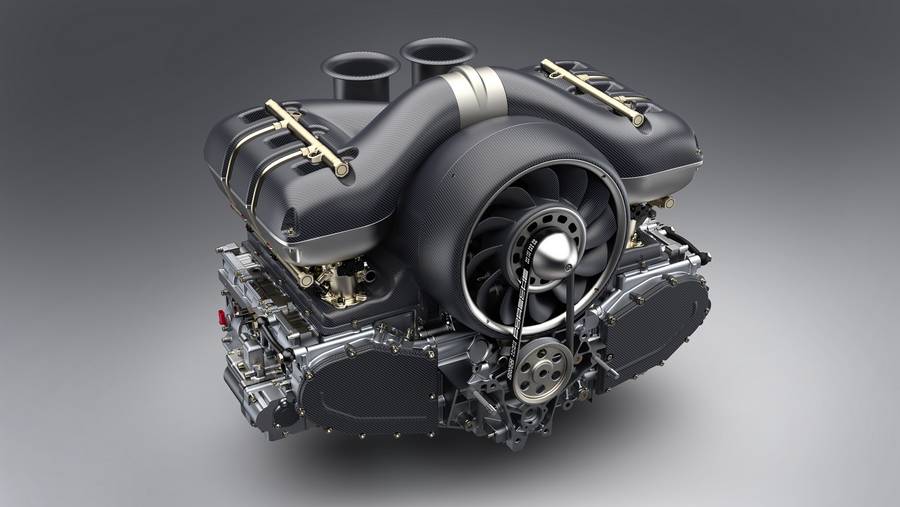
3. Porsche 911 GT3 4.0L Flat-Six
Porsche’s naturally aspirated flat-six engines have achieved legendary status, but the 4.0-liter unit from the 991.2 GT3 represents the absolute zenith of this configuration.
Producing 500 horsepower and revving to 9,000 RPM, this engine is essentially a detuned racing powerplant that Porsche somehow made street-legal, emissions-compliant, and reliable enough for daily use. The engineering achievement alone is staggering, but the emotional experience is what raises it to automotive sainthood.
The flat-six configuration creates a unique auditory signature that’s instantly recognizable. Unlike the smoothness of an inline-six or the rumble of a V8, the Porsche flat-six has a distinctive mechanical rasp, a sound that’s equal parts precision engineering and raw aggression.
As the revs climb, this rasp transforms into a full-throated scream that reverberates off tunnel walls and echoes through mountain passes. It’s a sound that makes pedestrians stop and stare, that gives passengers goosebumps, and that reminds drivers why they’re passionate about automobiles.
The throttle response is telepathic, translating inputs into action with virtually zero lag. This immediacy creates an incredible sense of connection, making the car feel like an extension of your own body. You can place the engine’s power exactly where you want it, making minute adjustments mid-corner with confidence.
The engine’s placement behind the rear axle creates distinctive handling characteristics, but it also means you feel every vibration, every resonance, every mechanical event with remarkable clarity.
Porsche’s racing heritage permeates every aspect of this engine’s design. The individual throttle bodies, dry-sump lubrication, and titanium connecting rods are components you’d expect to find in endurance racing prototypes, not street cars.
Yet Porsche’s engineers managed to package this technology in a form that could pass emissions regulations, achieve reasonable fuel economy when driven conservatively, and require only standard maintenance intervals. This duality genuine racing technology in a streetable package is what makes the GT3’s engine so special.
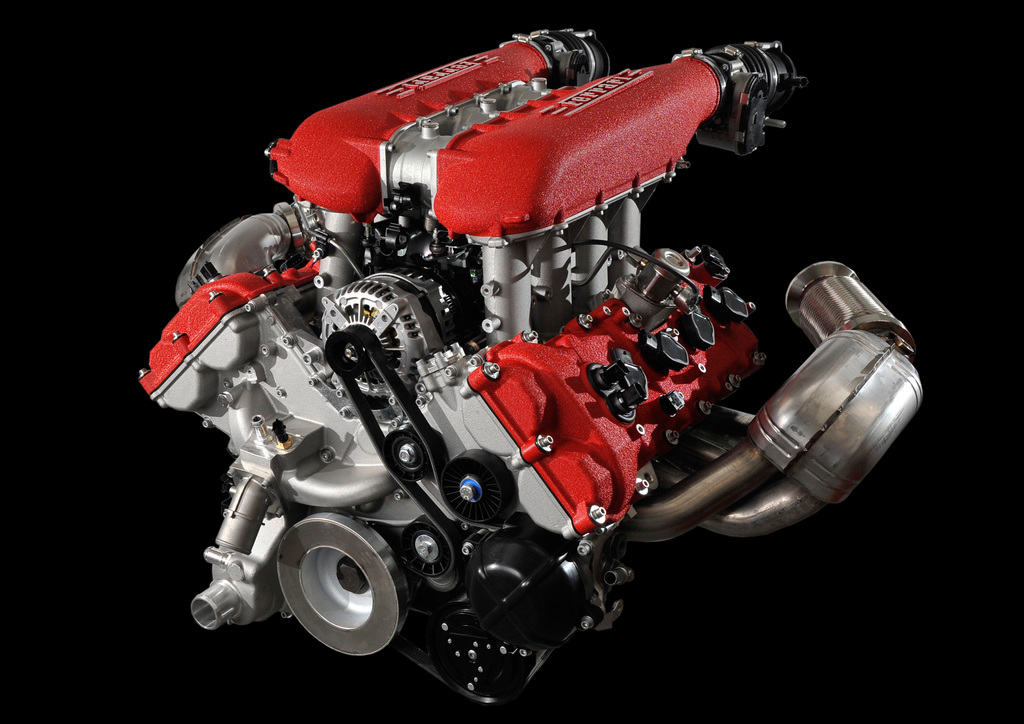
4. Ferrari 458 Italia 4.5L V8
The Ferrari 458 Italia’s flat-plane crank V8 represents perhaps the greatest naturally aspirated V8 ever created. At 9,000 RPM, producing 562 horsepower from 4.5 liters, this engine achieved a specific output of 125 horsepower per liter figures that seemed almost impossible when it debuted.
But more than the numbers, it’s the way this engine communicates with its driver, the operatic quality of its exhaust note, and the relentless urgency of its power delivery that secured its place in automotive history.
The flat-plane crankshaft configuration gives this V8 a character distinct from typical American V8s. Instead of a deep, burbling rumble, the 458’s engine produces a high-pitched, exotic wail reminiscent of Formula 1 cars from the early 2000s.
As the tachometer needle sweeps toward redline, the sound intensifies, becoming almost painful in its intensity yet utterly addictive. The exhaust note has multiple harmonics layered on top of each other, creating a complex symphony that changes character depending on load, RPM, and throttle position.
The power delivery is linear and relentless. There are no flat spots, no hesitation, just smooth, continuous acceleration that builds with almost violent intensity in the upper rev range.
The throttle response is immediate, almost too sharp for clumsy inputs, demanding precision from its driver. Through the steering wheel and chassis, you can feel the engine’s mechanical violence this is a highly-strung, racing-derived powerplant that happens to be streetable, not a street engine pretending to be sporty.
Ferrari’s obsessive pursuit of perfection is evident in every detail. The intake system was tuned to produce the most evocative sound possible, the exhaust manifolds were designed as works of art, and the variable geometry intake system ensures optimal breathing across the entire rev range.
The result is an engine that feels alive, that seems to have its own personality, and that creates an emotional connection few modern cars can match.
Also Read: 5 Hybrids That Hold Up Under Urban Use vs 5 That Don’t
5. Chevrolet LS7 7.0L V8
The LS7, fitted to the Corvette Z06, represents American V8 engineering at its finest a 7.0-liter naturally aspirated monster producing 505 horsepower and 470 lb-ft of torque.
While European manufacturers chased high specific output through complex technology, Chevrolet proved that displacement and careful engineering could achieve similar results with greater reliability and a character all its own. This engine is unapologetically American: big, powerful, and dramatic.
The LS7’s character is defined by its sheer torque. Unlike high-revving engines that require patience and precise shifting, the LS7 delivers massive thrust from just above idle, providing effortless acceleration in any gear at any speed.
The cross-plane crankshaft creates the classic American V8 rumble a deep, thunderous sound that resonates in your chest cavity. At wide-open throttle, the exhaust note becomes a roar of barely-contained aggression that announces the car’s presence from blocks away.
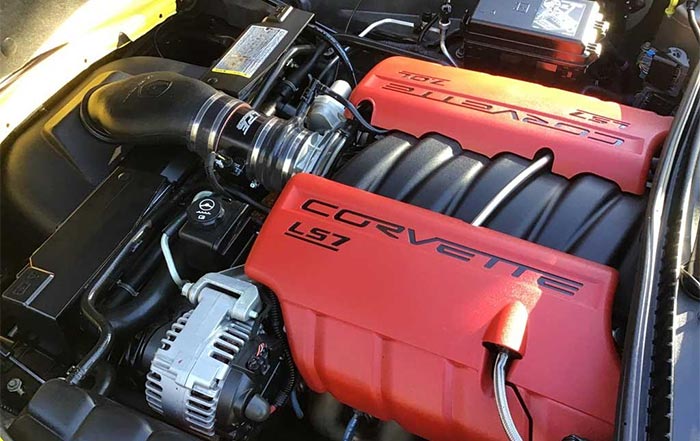
What makes the LS7 special is its combination of brutality and sophistication. This isn’t a crude pushrod relic; it features titanium connecting rods, titanium intake valves, a dry-sump lubrication system, and CNC-ported aluminum heads.
Each engine was hand-assembled, with the builder’s signature on a plaque attached to the intake manifold. The attention to detail ensured remarkable reliability despite the engine’s performance capabilities LS7-powered Corvettes routinely exceeded 100,000 miles without major issues.
The tactile experience of the LS7 is distinctly different from high-revving engines. There’s a mechanical heft to everything the throttle inputs, the vibrations through the chassis, even the sound has physical weight.
It’s an engine that reminds you of the raw physics involved in combustion, the conversion of chemical energy into mechanical force. This visceral quality, combined with effortless power delivery, creates an addictive driving experience that converts skeptics into believers.
6. Mazda RX-7/RX-8 Rotary Engine
The rotary engine found in Mazda’s RX-7 and RX-8 is unlike anything else in automotive history. With no pistons, connecting rods, or conventional valves, the Wankel rotary engine achieves power through the orbital rotation of triangular rotors within an epitrochoidal chamber.
This unique design creates an engine that’s impossibly smooth, remarkably compact, and capable of revving to stratospheric heights the RX-8’s Renesis engine redlined at 9,000 RPM.
The smoothness of rotary power delivery is almost unsettling at first. With far fewer moving parts than conventional piston engines, there’s virtually no vibration at any speed. The engine spins with a turbine-like quality, building revs with barely any mechanical sensation.
This smoothness, combined with its high-revving nature, creates a unique driving experience you watch the tachometer climb rather than feel it through seat-of-the-pants sensation. The exhaust note is equally distinctive, a high-pitched buzzing that sounds more like a racing motorcycle than a car.
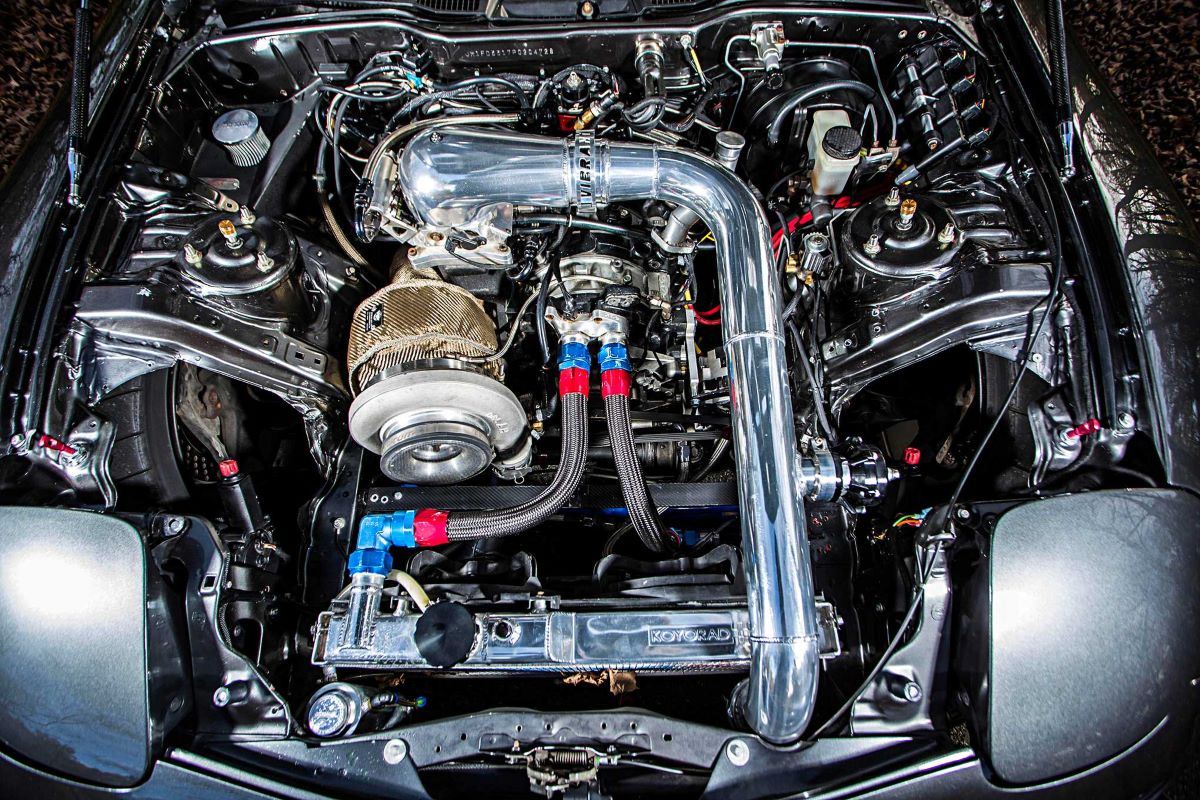
What truly defines the rotary experience is its character, its willingness to rev, and the way it encourages spirited driving. The power delivery is peaky, with maximum output arriving near redline, so extracting performance requires keeping the engine singing in the upper reaches of its rev range.
This characteristic rewards skilled driving and creates an engaging experience that’s fundamentally different from torque-rich piston engines. You don’t muscle a rotary-powered car forward; you finesse it, using precise shifts and momentum management.
The rotary’s drawbacks, including significant oil consumption, poor fuel economy, and questionable reliability, are well-documented, yet enthusiasts remain devoted to these engines precisely because of their unique character.
The mechanical simplicity, compact dimensions, and racing heritage create an emotional connection that transcends practical considerations.
For those who appreciate unconventional engineering and genuinely distinctive experiences, the rotary engine represents something irreplaceable in automotive history.
7. Dodge Viper V10 8.4L
The Viper’s V10 is an engine of almost comical excess 8.4 liters, ten cylinders, and in its final iteration, 645 horsepower. This wasn’t a refined, sophisticated powerplant designed for balance and harmony; this was a fire-breathing monster that existed to deliver maximum drama and performance.
Everything about this engine was extreme, from its physical size to its brutal power delivery to the soundtrack it produced. The Viper V10’s character is defined by its raw, unfiltered aggression.
The throttle response is immediate and almost violent, translating inputs into savage acceleration with no electronic nannies softening the experience.
The exhaust note is a deep, menacing rumble at idle that transforms into an apocalyptic roar under acceleration. It’s loud, it’s crude, and it’s absolutely glorious in its complete lack of subtlety. This engine doesn’t whisper; it shouts.
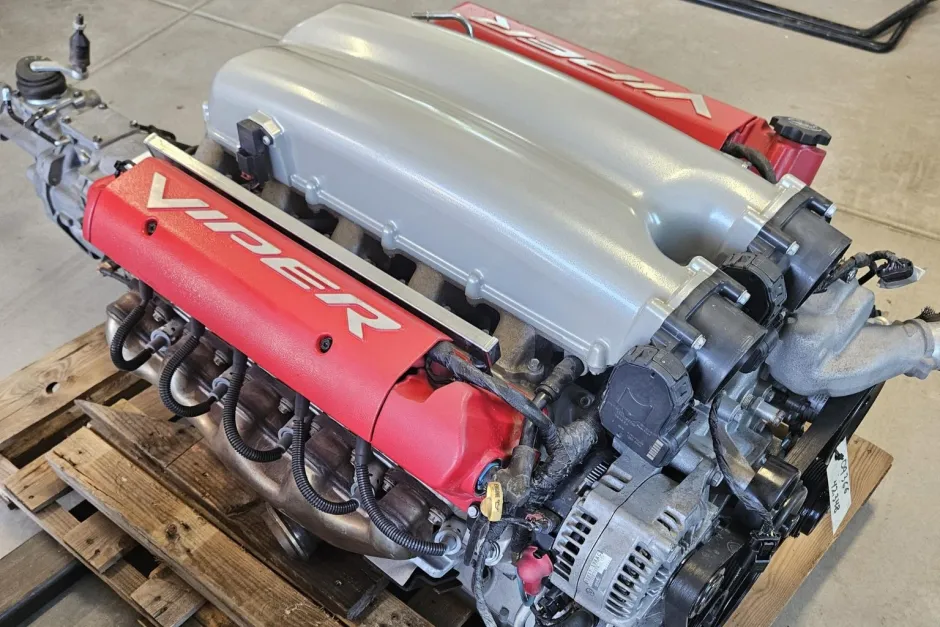
What makes the Viper V10 special is its honest brutality. In an era where even performance cars featured multiple electronic systems to manage power delivery and prevent driver error, the Viper remained defiantly old-school.
The engine’s massive torque could overwhelm the rear tires at virtually any speed, demanding respect and skill from its driver. There was no launch control, no sophisticated traction management just raw power and the driver’s right foot. This made the Viper genuinely intimidating but also incredibly rewarding for those who learned to harness its power.
The physical presence of this engine is impossible to ignore. The massive hood bulge required to clear the engine’s height, the heat radiating through the transmission tunnel, even the way the entire car vibrates at idle everything reinforces that you’re sitting ahead of something genuinely monstrous.
It’s an engine that makes every journey an event, that transforms mundane drives into memorable experiences through sheer force of character.
8. Audi/Lamborghini 5.2L V10
Shared between Audi’s R8 and Lamborghini’s Huracán, this naturally aspirated V10 represents the sweet spot between Ferrari’s high-strung exotica and American V8 torque.
Displacing 5.2 liters and producing up to 602 horsepower in Huracán Performante specification, this engine delivers accessible supercar performance with an unforgettable soundtrack and character that makes every drive special.
The V10 configuration creates a unique sound signature more cylinders than a V8 for a higher-pitched note, but without the frenetic quality of smaller-displacement engines.
The result is a howl that’s simultaneously muscular and exotic, building from a purposeful growl at low RPMs to a full-throated scream approaching the 8,700 RPM redline.
Lamborghini’s exhaust tuning, in particular, produces an operatic quality with multiple harmonics that change character based on throttle position and engine load.
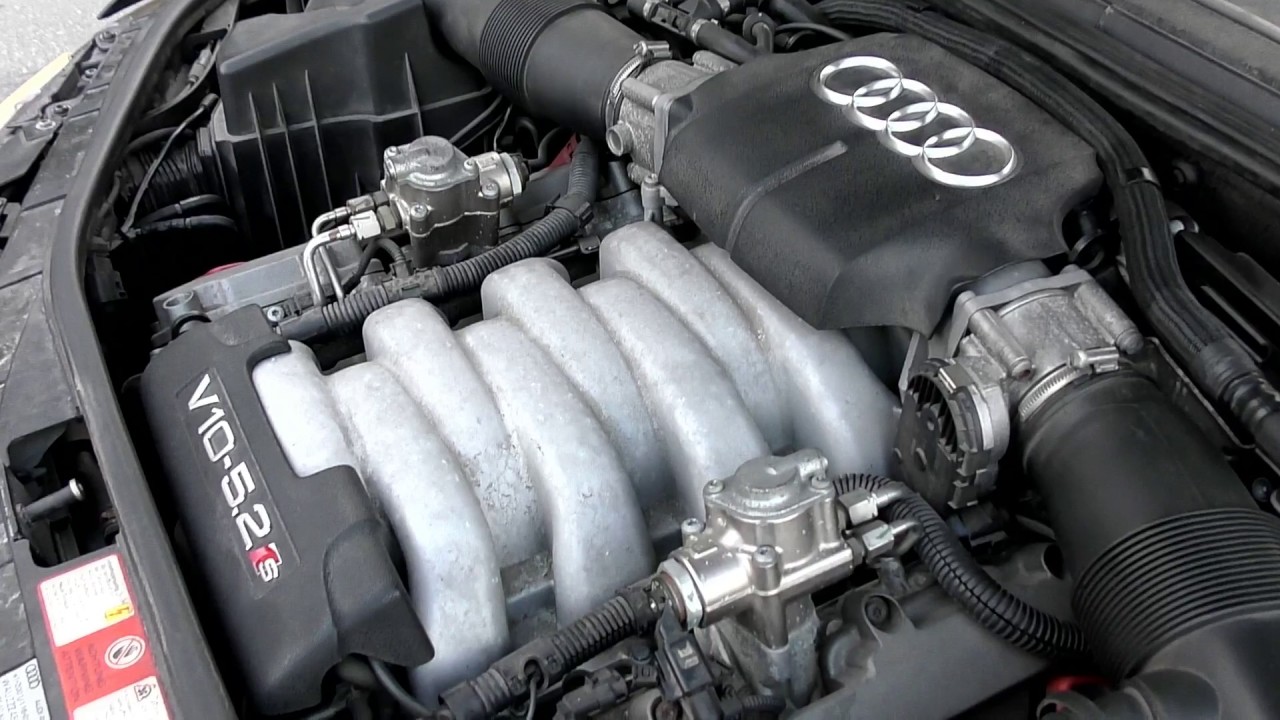
The power delivery strikes an ideal balance between tractability and excitement. Unlike peakier engines that require high RPMs to deliver performance, the V10 provides substantial torque throughout its rev range, making it easy to drive in traffic while still offering explosive acceleration when you open the throttle.
The progressive nature of the power delivery builds confidence, allowing drivers to explore the engine’s full potential without the intimidation factor of more extreme powerplants.
The placement of this engine behind the occupants, combined with minimal sound deadening in both applications, means you experience its mechanical symphony in surround sound.
The intake growl behind your head, the exhaust note reverberating off surrounding surfaces, and the mechanical whir of ten pistons pumping create an immersive automotive experience.
It’s an engine that justifies tunnel detours and encourages using the manual mode just to hold gears longer, maximizing exposure to its addictive soundtrack.
9. Mercedes-AMG M156 6.2L V8
AMG’s M156 engine, found in cars like the C63 AMG and E63 AMG, represented a watershed moment for the tuning division. Unlike previous AMG engines that were modified versions of standard Mercedes powerplants, the M156 was designed from scratch by AMG’s engineers.
The result was a naturally aspirated 6.2-liter V8 that produced 451 horsepower, revved freely to 7,200 RPM, and possessed a character that was uniquely AMG.
This engine’s defining characteristic is its versatility. At low RPMs and light throttle, it’s a refined, smooth powerplant suitable for luxury sedan duty, delivering effortless cruising with barely a whisper. But demand performance, and the M156 transforms completely.
The throttle response sharpens, the exhaust note changes from a muted burble to an aggressive snarl, and the power delivery becomes genuinely violent.
This Jekyll and Hyde personality made AMG cars equipped with this engine remarkably usable as daily drivers while still providing explosive performance when desired.
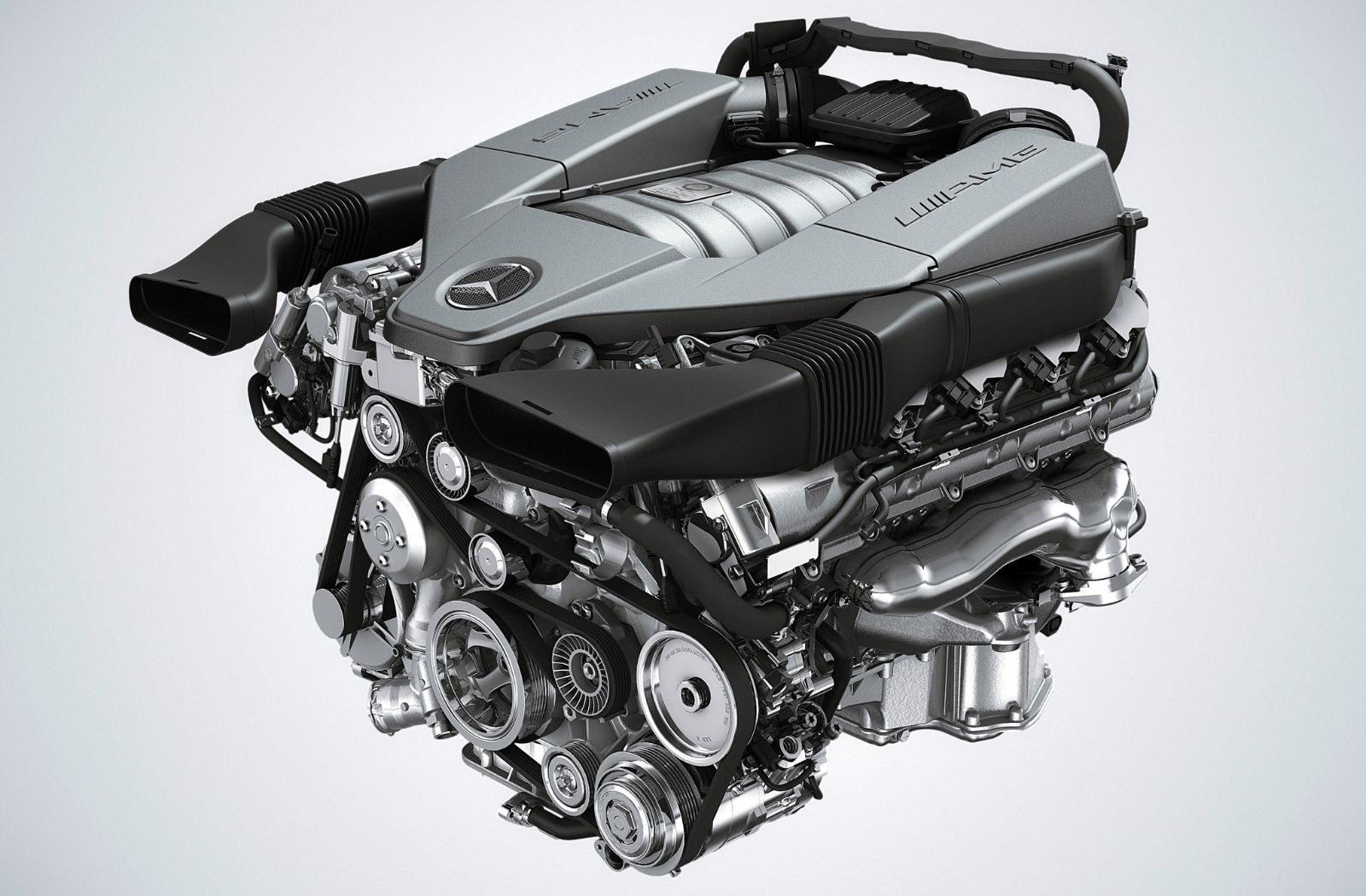
The sound this engine produces is among the best in the business. The cross-plane crankshaft creates the classic V8 rumble, but AMG’s tuning gives it a particularly aggressive, muscular quality.
There’s a distinct bark on throttle tip-in, a continuous growl under acceleration, and dramatic overrun pops when lifting off the throttle. The mechanical symphony is enhanced by the intake noise, a purposeful roar as the engine gulps air approaching redline.
The M156’s legacy extends beyond its specifications. It proved that AMG could develop world-class engines independently, establishing the division’s credibility as a manufacturer rather than just a tuner.
The engine’s reputation for reliability, despite its performance capabilities, created devoted enthusiasts who mourned its replacement with turbocharged engines. While the newer forced-induction units are faster and more efficient, many argue they lack the M156’s soul and character.
10. Nissan GT-R VR38DETT 3.8L Twin-Turbo V6
While turbocharged engines often lack the character of naturally aspirated powerplants, Nissan’s VR38DETT is a remarkable exception.
This hand-built, twin-turbocharged 3.8-liter V6 produces 565 horsepower in standard form, but its character extends far beyond the specification sheet.
The engine’s personality is defined by its explosive power delivery, distinctive sound, and the way it communicates its immense capability to the driver.
The VR38’s character is dominated by its twin turbochargers. Unlike modern engines with small turbos designed to eliminate lag, Nissan embraced old-school turbo drama.
There’s a noticeable pause after you mat the throttle, a brief moment where the engine builds boost, and then WHAM the turbos spool fully and thrust you forward with shocking violence.
This isn’t the linear, progressive acceleration of a naturally aspirated engine; it’s a surging, explosive delivery that never gets old. The sensation is enhanced by the six-piston rev-matching, allowing you to carry boost between gears.
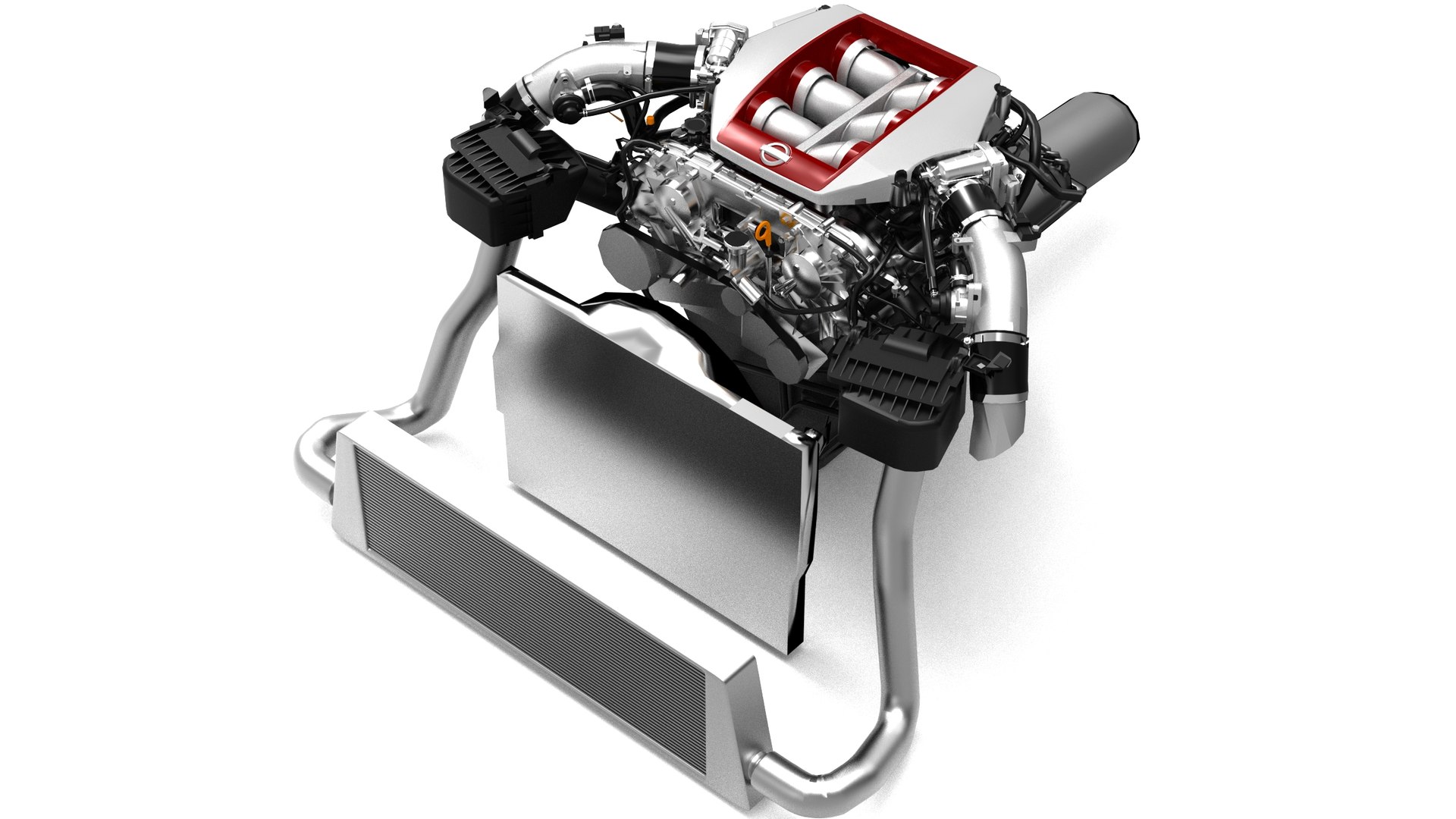
The sound signature is distinctly industrial and mechanical. The turbochargers produce a characteristic whistle and whoosh, the exhaust has a sharp, staccato bark, and at full throttle, the combination creates an aggressive, purposeful symphony.
It’s not as melodious as a Ferrari V8 or as thunderous as an American V8, but it has its own character purposeful, efficient, and aggressive. The intake and wastegate noises add layers of complexity, creating an ever-changing soundtrack that responds to throttle inputs.
Each VR38 engine is hand-assembled by a single technician whose name appears on a plaque affixed to the engine. This attention to detail ensures consistency and quality, contributing to the engine’s legendary reliability despite its immense performance capability.
Tuners have extracted well over 1,000 horsepower from this platform with relative ease, demonstrating the robust nature of Nissan’s engineering. The VR38 proves that turbocharged engines can possess genuine character when designed with passion rather than just efficiency.
11. Ford Mustang Shelby GT350 Voodoo 5.2L V8
Ford’s Voodoo engine, developed specifically for the Shelby GT350, represents Detroit’s answer to European high-revving exotica. This 5.2-liter V8 features a flat-plane crankshaft a rarity in American V8s, allowing it to rev to 8,250 RPM while producing 526 horsepower.
The result is an engine that combines American displacement and torque with European revving characteristics and sound, creating something genuinely unique in the automotive world.
The flat-plane crank configuration gives the Voodoo a completely different character from traditional American V8s. Instead of the deep, rumbling bass note of a cross-plane V8, the Voodoo produces a higher-pitched, more aggressive wail reminiscent of Ferrari V8s.
The exhaust note is complex and exotic, with a mechanical edge that sounds distinctly unlike anything else from Detroit. At full throttle, approaching redline, it produces an almost painful shriek that feels utterly inappropriate coming from a Mustang yet absolutely intoxicating.
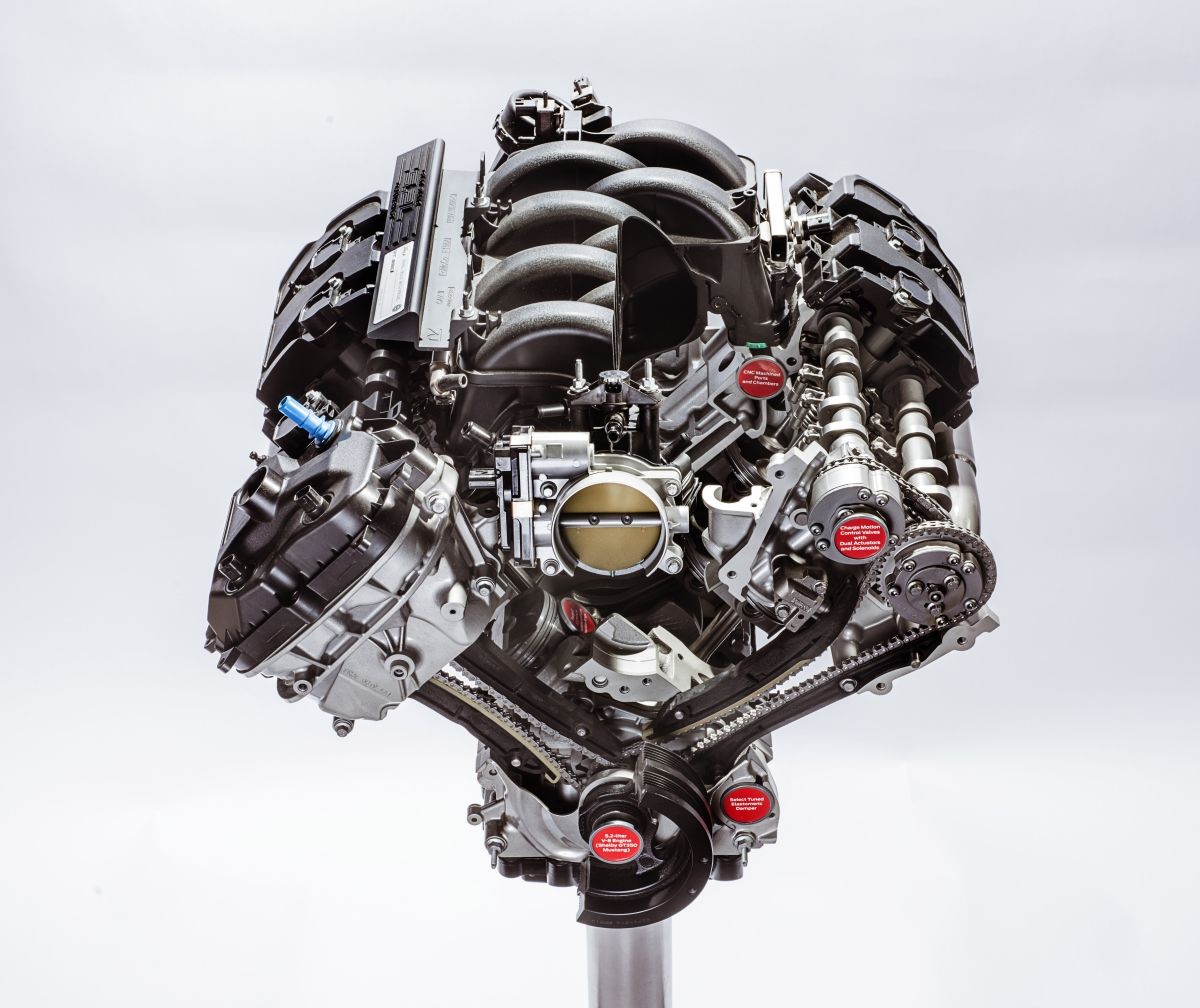
The engine’s personality rewards aggressive driving. While it produces decent torque at low RPMs, the Voodoo truly comes alive above 5,000 RPM, delivering ferocious acceleration right to its 8,250 RPM redline.
The throttle response is sharp and immediate, the power delivery is linear and predictable, and the engine’s eagerness to rev encourages constantly using its full rev range. This high-strung character makes it more demanding than a typical muscle car engine but vastly more rewarding for enthusiast drivers.
Ford’s engineering team went to extraordinary lengths to ensure the Voodoo could survive sustained high-RPM operation. The engine features an innovative oil pan design with baffles and sumps to maintain lubrication during high lateral acceleration, upgraded cooling systems, and robust internal components.
This reliability meant GT350 owners could regularly take their cars to track days without fear of mechanical failurerealizing Ford’s vision of a Mustang that could legitimately compete with European sports cars on road courses.
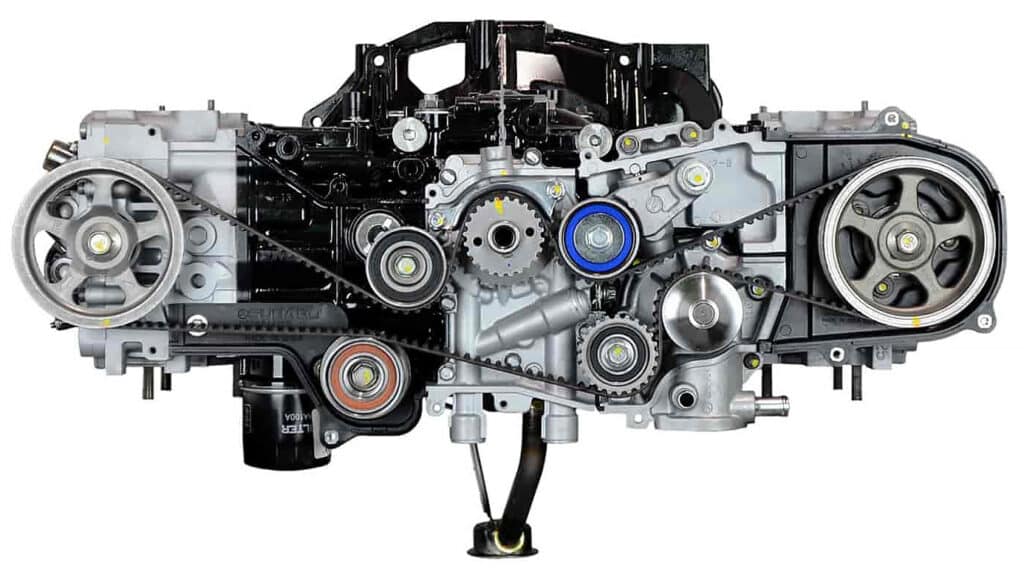
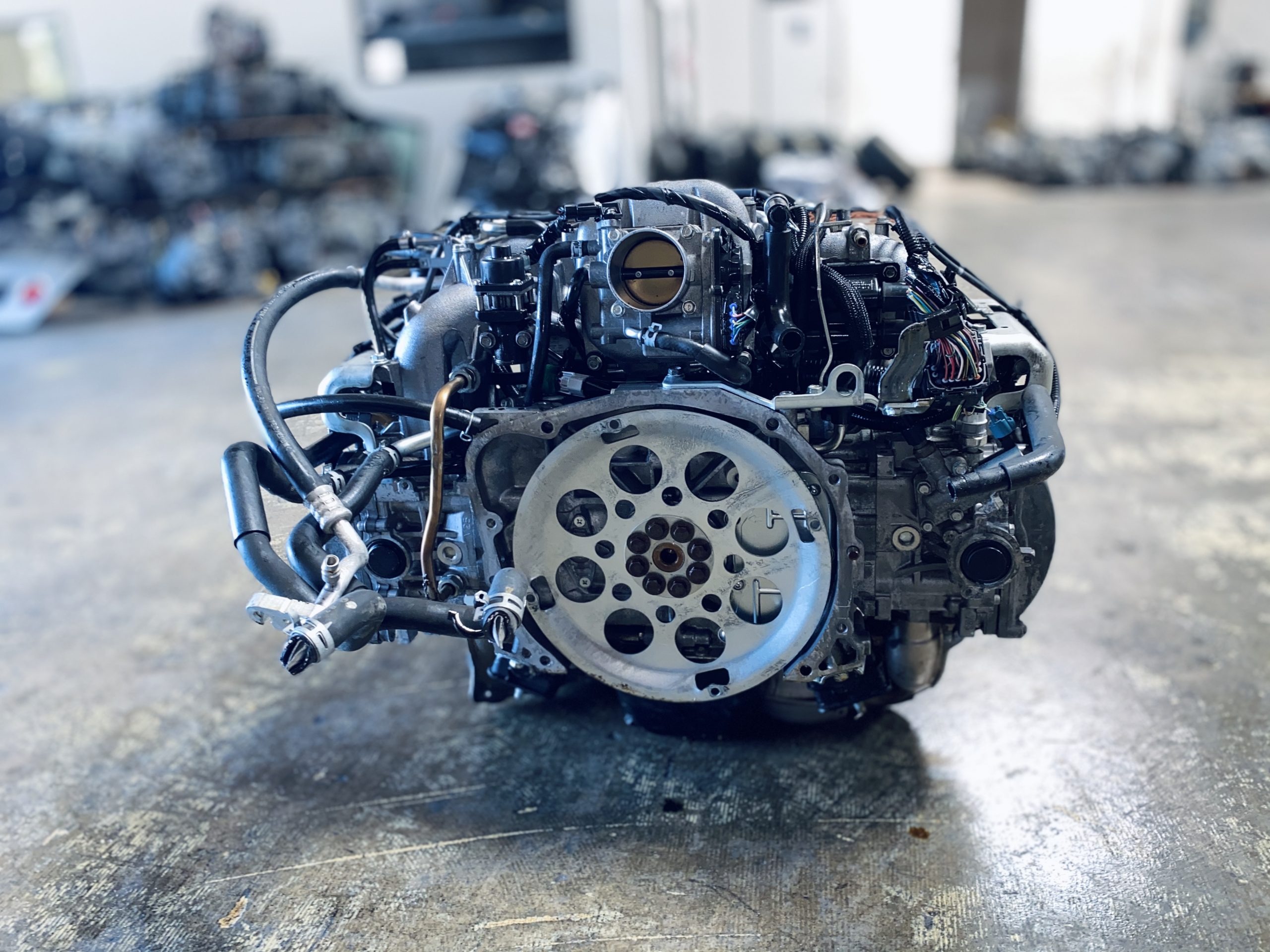
12. Subaru EJ25 2.5L Boxer Engine
The Subaru EJ25 boxer engine, particularly in turbocharged WRX STI form, has achieved cult status among enthusiasts despite—or perhaps because of its quirks and imperfections.
This horizontally-opposed four-cylinder produces a distinctive sound, unique character, and driving experience that’s immediately recognizable and deeply beloved by those who appreciate unconventional engineering.
The boxer configuration creates Subaru’s signature exhaust note, an uneven, burbling rumble that’s instantly identifiable. This distinctive sound comes from the unequal-length exhaust headers used in many versions, creating a syncopated rhythm that sounds almost like a malfunction to the uninitiated but is music to Subaru enthusiasts’ ears.
The turbocharger adds whooshes and flutters to the symphony, particularly when equipped with aftermarket blow-off valves, creating a complex auditory experience.
The engine’s character is defined by its raw, mechanical feel. There’s substantial turbo lag in stock form, creating a deliberate power delivery that requires anticipation and planning.
When boost arrives, it hits hard, providing a surge of acceleration that feels more dramatic than the actual power figures suggest. The engine vibrates noticeably through the cabin a reminder of the horizontally-opposed pistons punching against each other giving every drive a visceral, mechanical quality that’s increasingly rare in modern cars.
What makes the EJ25 truly special to enthusiasts is its tunability and potential. The aftermarket support is enormous, with countless companies offering everything from simple bolt-on modifications to complete engine builds. The engine responds enthusiastically to modifications, with significant power gains achievable relatively easily.
This modification potential, combined with the engine’s distinctive character and Subaru’s rallying heritage, has created a devoted community of enthusiasts who wouldn’t trade their rumbling, vibrating, turbo-whooshing Subarus for anything smoother or more refined.
Also Read: 5 Vehicles That Suit Multi-Driver Homes vs 5 That Don’t
